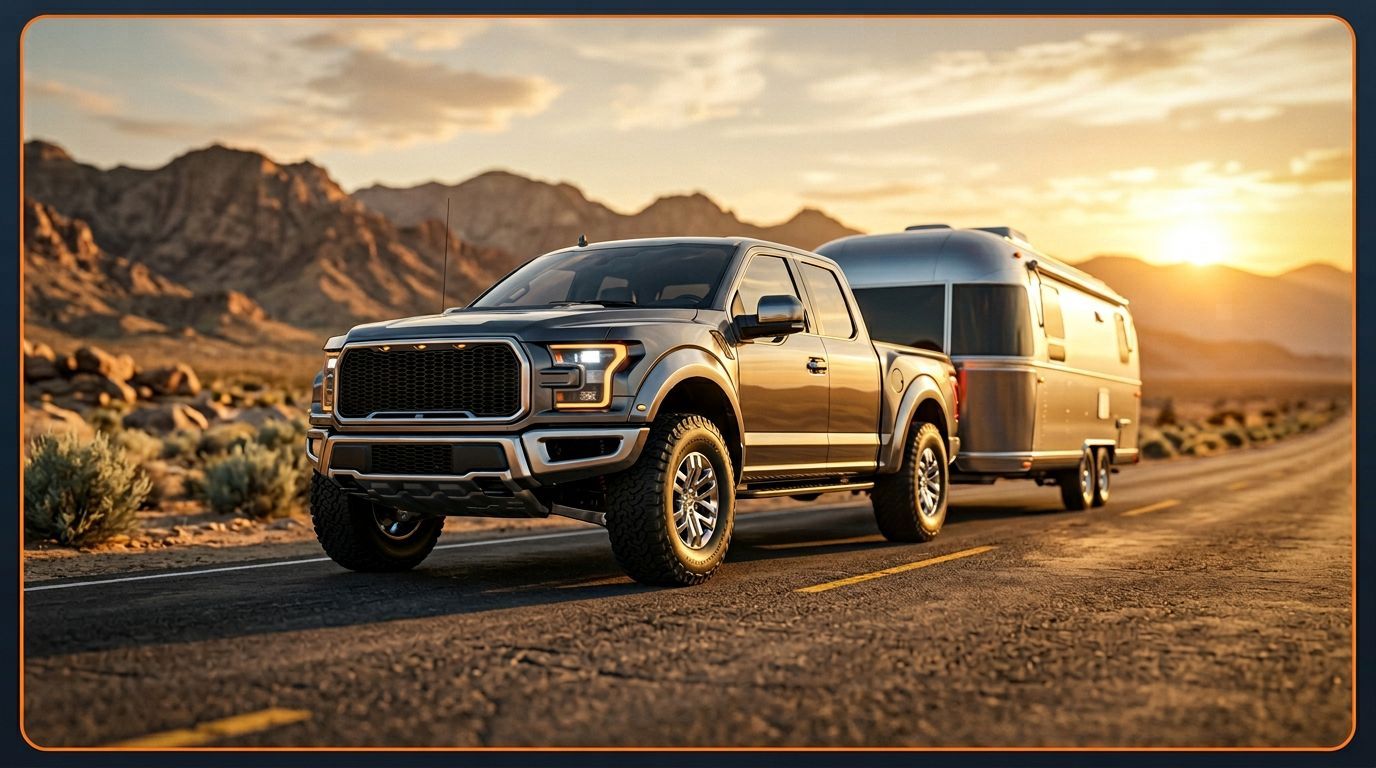
The 2017 Ford F-150 Raptor features an official maximum towing capacity of 6,000 pounds for the SuperCab model and 8,000 pounds for the SuperCrew model. Powered by a high-output 3.5-liter twin-turbo EcoBoost V6 generating 450 horsepower and 510 lb-ft of torque, the second-generation Raptor trades raw towing capability for long-travel off-road performance.
Official 2017 Ford F-150 Raptor Towing and Payload Specifications
When Ford released the second-generation F-150 Raptor for the 2017 model year, truck enthusiasts immediately noted the distinct towing ratings compared to standard F-150 trim levels. While a non-Raptor 2017 F-150 equipped with the 3.5L EcoBoost engine and Max Trailer Tow Package could pull up to 12,200 pounds, the Raptor was intentionally calibrated for extreme off-road terrain rather than heavy commercial hauling.
The 2017 Raptor came in two primary cab configurations: the two-door SuperCab (with small rear half-doors) and the full four-door SuperCrew. Both configurations shared a 5.5-foot aluminum-alloy cargo bed, but differed significantly in wheelbase, curb weight, gross vehicle weight rating (GVWR), and maximum allowable trailer weights.
Towing and Weight Capacities by Body Style
| Specification | 2017 Raptor SuperCab | 2017 Raptor SuperCrew |
|---|---|---|
| Cab Configuration | 4-Door (Rear Half-Doors) | 4-Door (Full Crew Cab) |
| Wheelbase | 133.0 inches | 145.0 inches |
| Maximum Towing Capacity | 6,000 lbs (2,721 kg) | 8,000 lbs (3,629 kg) |
| Maximum Payload Capacity | 1,000 lbs (454 kg) | 1,200 lbs (544 kg) |
| Gross Vehicle Weight Rating (GVWR) | 6,600 lbs | 7,050 lbs |
| Gross Combined Weight Rating (GCWR) | 12,050 lbs | 14,250 lbs |
| Base Curb Weight | ~5,525 lbs | ~5,697 lbs |
| Axle Ratio | 4.10:1 Electronic Locking | 4.10:1 Electronic Locking |
Understanding these maximum capacities requires evaluating how payload and trailer weight interact. Gross Vehicle Weight Rating (GVWR) represents the maximum total weight of the truck itself, including fuel, passengers, cargo, and trailer tongue weight. Gross Combined Weight Rating (GCWR) is the combined maximum limit for the fully loaded truck and attached trailer.
Engine, Drivetrain, and Powertrain Dynamics
The performance foundation of the 2017 F-150 Raptor is its second-generation High-Output 3.5-liter EcoBoost twin-turbocharged V6 engine. Replacing the naturally aspirated 6.2-liter V8 used in the first-generation (2010–2014) Raptor, the High-Output EcoBoost delivers higher peak horsepower and significantly greater low-end torque.
Engine Output and Torque Delivery
- Horsepower: 450 hp @ 5,000 rpm
- Torque: 510 lb-ft @ 3,500 rpm
- Compression Ratio: 10.0:1
- Fuel Delivery: Port-fuel and direct-injection (PFDI) system with dual injectors per cylinder
- Turbochargers: Higher-boost twin turbochargers mated with cast-iron exhaust manifolds
From a powertrain perspective, the 450-horsepower V6 has more than enough engine output to move heavy loads. The 510 lb-ft of torque reaches its peak early in the rev range at 3,500 rpm, producing robust pulling power off the line and strong hill-climbing acceleration.
10-Speed Automatic Transmission and Axle Gearing
Mated to the high-output engine is Ford’s 10-speed SelectShift automatic transmission, developed jointly with General Motors. The wide gear ratio spread allows the transmission to keep the engine in its optimal powerband during towing:
- Short Lower Gears: Gears 1 through 3 feature aggressive step-down ratios, allowing smooth startup under load without straining the torque converter.
- Direct Drive & Overdrive Ratios: Gear 7 acts as a direct drive, while gears 8, 9, and 10 provide progressive overdrive ratios to reduce engine rpm and highway fuel consumption when towing lighter loads.
- 4.10:1 Rear Axle Ratio: Both SuperCab and SuperCrew 2017 Raptors come standard with a 4.10:1 final drive gear ratio featuring an electronic locking rear differential. An optional Torsen front differential (4.10:1 ratio) was available to optimize front-wheel traction off-road and on slippery surfaces.
Despite these heavy-duty powertrain credentials, the mechanical limiting factors for towing are not found in the engine or transmission, but in the vehicle's specialized chassis and suspension architecture.
Why the Raptor Towing Capacity Is Lower Than Standard F-150s
Prospective buyers often ask why a premium, high-performance truck with 450 horsepower and 510 lb-ft of torque is limited to an 8,000-lb tow rating when a base F-150 with a standard 3.5L EcoBoost can pull over 12,000 lbs. The lower towing threshold is the direct result of intentional off-road engineering trade-offs.
- RAPTOR TOWING CAPABILITY
- Powertrain Capability: 450 HP / 510 lb-ft Torque (High Pulling Power)
- Off-Road Suspension: FOX 3.0 Bypass Shocks, Soft Springs & High Travel (Limits Tongue Weight)
- RESULT: Lower Max Tow Rating (6,000 - 8,000 lbs) to maintain safety, prevent severe rear sag, and preserve dynamic stability.
1. Long-Travel Off-Road Suspension
The 2017 Raptor is fitted with Fox Racing Shox 3.0-inch internal bypass dampers featuring anodized aluminum bodies and internal fluid reservoir channels. Combined with custom front coil springs and soft rear leaf springs, the setup delivers 13.0 inches of front wheel travel and 13.9 inches of rear wheel travel.
While these soft, high-travel springs excel at absorbing severe high-speed off-road impacts, they compress rapidly under heavy static downforce. Exceeding recommended trailer tongue weights causes pronounced rear-end suspension sag, lifting weight off the front axle and severely degrading steering control and braking efficiency.
2. Absence of a Rear Sway Bar
To maximize rear axle articulation over uneven boulders, ruts, and desert terrain, Ford engineered the second-generation Raptor without a rear anti-roll (sway) bar. In normal off-road driving, this allows each rear wheel to move independently through its full stroke. However, during high-speed highway towing, the absence of a rear sway bar reduces roll stiffness. Heavy trailers exert lateral sway forces on the tow vehicle; without stiff rear springs or a rear stabilizer bar, a heavy trailer could cause severe vehicle instability.
3. Off-Road Tire Construction and Sidewall Flex
The 2017 Raptor is fitted from the factory with LT315/70R17 BFGoodrich All-Terrain T/A KO2 tires (35-inch outer diameter). These tires feature flexible tread blocks and softer carcass construction designed to conform to terrain off-road. Under high payload or heavy tongue weight, soft tire sidewalls flex laterally under side loads, contributing to trailer sway and squishy steering feel compared to low-profile, high-load-rated highway truck tires.
4. Vehicle Curb Weight and Frame Architecture
The 2017 Raptor uses a high-strength, boxed steel frame that is uniquely reinforced compared to the standard F-150 frame to handle off-road jump impacts. Combined with skid plates, wider track dimensions (+6.0 inches wider than a standard F-150), and specialized bodywork, the Raptor’s base curb weight is higher than comparable standard F-150 models. Higher curb weight reduces the remaining margin under Gross Combined Weight Ratings (GCWR).
Essential Factory Towing Technologies and Features
To maximize driver safety within its designated towing envelope, Ford equipped the 2017 F-150 Raptor with advanced electronic driver assistance systems and factory towing hardware.
Factory Towing Equipment Overview
- Class IV Trailer Hitch Receiver: Integrated directly into the rear frame structure, featuring a standard 2-inch receiver tube.
- Smart Trailer Tow Connector: Includes 4-pin and 7-pin trailer wiring harnesses with automatic lamp check functionality and trailer connection status alerts integrated into the instrument cluster gauge screen.
- Integrated Trailer Brake Controller (TBC): Allows the driver to automatically or manually adjust the electric trailer brakes directly from the dashboard, synchronizing trailer braking force with the vehicle’s hydraulic brake pressure.
- Pro Trailer Backup Assist: Enables drivers to steer the trailer while reversing using a control knob on the instrument panel, while the system automatically controls vehicle steering wheel inputs.
- Dynamic Hitch Assist: Integrates a target overlay onto the center stack rear-view camera screen to align the hitch ball with the trailer coupler without assistance.
Terrain Management System Integration
The 2017 Raptor includes Ford's Terrain Management System (TMS) with six selectable drive modes: Normal, Sport, Weather, Mud/Sand, Baja, and Rock Crawl.
When towing on paved roads, drivers should select Tow/Haul Mode (accessible via the drive mode controller or stalk switch). Tow/Haul mode alters transmission shift schedules by holding lower gears longer during acceleration to prevent unnecessary gear hunting, engaging aggressive engine braking during downhill descents, and adjusting throttle mapping for smoother power delivery under heavy loads.
Real-World Towing Setup, Payload Math, and Payload Constraints
Calculating your actual available towing capacity requires measuring trailer tongue weight against the truck’s overall payload capacity. Beginners often focus solely on the maximum trailer weight (e.g., 8,000 lbs for SuperCrew) while neglecting payload limits, leading to dangerous overloaded conditions.
Understanding the Tongue Weight and Payload Balance
Trailer tongue weight is the static downward force that the trailer tongue exerts on the hitch ball. Safe trailer towing requires a tongue weight between 10% and 15% of the total loaded trailer weight.
- For an 8,000 lb trailer, expected tongue weight ranges from 800 lbs to 1,200 lbs.
- For a 6,000 lb trailer, expected tongue weight ranges from 600 lbs to 900 lbs.
Now consider the payload capacities:
- 2017 Raptor SuperCab Max Payload: 1,000 lbs
- 2017 Raptor SuperCrew Max Payload: 1,200 lbs
Payload includes everything added to the empty vehicle: driver, passengers, aftermarket accessories, cargo in the bed, and trailer tongue weight.
Sample Real-World Scenario (2017 Raptor SuperCrew):
- Available Payload: 1,200 lbs
- Driver and 3 Passengers: -650 lbs
- Bed Cargo / Coolers / Gear: -150 lbs
- Remaining Available Payload for Tongue Weight: 400 lbs
In this typical scenario, despite the truck having an 8,000 lb towing rating, the remaining available tongue weight limit is only 400 lbs. Based on a standard 10% tongue weight ratio, the maximum safe trailer weight under these loading conditions is limited to 4,000 lbs. To pull an 8,000 lb trailer, passenger and cargo weight inside the truck must be strictly limited.
Weight Distribution Hitch (WDH) Requirements
Ford explicitly mandates in the 2017 F-150 Owner’s Manual that a Weight Distribution Hitch (WDH) with load-leveling spring bars must be used for any trailer weight exceeding 5,000 pounds or tongue weight exceeding 500 pounds.
A weight distribution hitch uses spring bars attached to the trailer frame to transfer a portion of the tongue weight forward onto the tow vehicle’s front axle and backward onto the trailer axles. This levels the stance of the vehicle, restores front tire grip for responsive steering, maintains headlight aiming, and reduces structural stress on the rear Fox shocks.
Suitable Trailer Types for the 2017 Raptor
Given the maximum boundaries of 6,000 lbs (SuperCab) and 8,000 lbs (SuperCrew), the 2017 Raptor can comfortably pull a wide variety of recreational and light-duty commercial trailers when configured properly with a weight distribution hitch.
Recommended Trailer Categories
- Single-Axle and Lightweight Dual-Axle Travel Trailers: Compact travel trailers ranging from 18 to 26 feet typically feature dry weights between 3,500 and 5,500 lbs. Fully loaded with water, propane, and camping gear, they remain well within the Raptor’s GCWR and towing limits.
- Ski Boats, Center Console Boats, and PWC Trailers: Marine trailers carrying single or dual personal watercraft, ski boats, or center-console fishing boats up to 24 feet typically fall into the 3,000 to 6,500 lb range.
- Open Car Haulers and Utility Trailers: An open aluminum or steel car hauler carrying a lightweight track car or side-by-side off-road vehicles usually weighs between 4,500 and 7,000 lbs, making it an excellent match for the SuperCrew Raptor.
- Enclosed Cargo Trailers: Enclosed trailers up to 20 feet long (loaded under 7,000 lbs) can be towed effectively, though drivers should be mindful of the large front frontal area, which increases aerodynamic drag at highway speeds.
Trailers to Avoid
- Heavy Fifth-Wheel or Gooseneck Trailers: The Raptor is strictly incompatible with fifth-wheel or gooseneck hitches due to bed sidewall clearances, soft rear suspension dynamics, and payload constraints.
- Large Dual/Triple-Axle Enclosed Toy Haulers: Heavy travel trailers with toy hauler garages frequently exceed 9,000 to 12,000 lbs gross weight ratings, which far exceed the Raptor's structural boundaries.
Frequently Asked Questions
Can aftermarket air bags or helper springs increase the 2017 Raptor's towing capacity?
No. Installing aftermarket air helper springs or bump-stop spring upgrades will reduce rear-end suspension sag, but it does not legally or mechanically increase the manufacturer's certified towing capacity or GVWR. The certified tow rating is determined by frame strength, axle limits, braking performance, tire sidewalls, and dynamic stability tests. Furthermore, stiff air bags restrict high-speed off-road suspension travel, negating the primary purpose of the Raptor's Fox internal bypass shocks.
What is the maximum hitch tongue weight for the 2017 Raptor?
The factory Class IV receiver on the 2017 Raptor is rated for a maximum tongue weight of 500 pounds using a standard weight-carrying ball mount. When equipped with a properly adjusted Weight Distribution Hitch, the maximum tongue weight rating increases to 600 pounds for the SuperCab and 800 pounds for the SuperCrew.
How does the 2017 Raptor's towing capacity compare to the 1st-Gen (6.2L V8) Raptor?
The first-generation Raptor (2010–2014) equipped with the 6.2-liter V8 engine had maximum tow ratings of 6,000 pounds for the SuperCab and 8,000 pounds for the SuperCrew. The second-generation 2017 Raptor retained those exact same overall towing thresholds. However, the 2017 model delivers significantly better low-end acceleration and hill-climbing performance due to its higher torque (510 lb-ft vs. 434 lb-ft) and 10-speed transmission compared to the older 6-speed automatic.
Is a Weight Distribution Hitch required to pull an 8,000-lb trailer with a 2017 Raptor?
Yes. Ford guidelines require a Weight Distribution Hitch for any trailer weighing over 5,000 pounds or with a tongue weight exceeding 500 pounds. Attempting to tow an 8,000-lb trailer with a standard ball mount will overload the rear suspension, cause dangerous vehicle pitch, and severely degrade front-wheel steering control.
Why does the SuperCab tow less than the SuperCrew?
The 2017 Raptor SuperCab has a lower towing rating (6,000 lbs vs. 8,000 lbs) primarily due to its shorter 133-inch wheelbase, lower vehicle curb weight, lower Gross Combined Weight Rating (12,050 lbs vs. 14,250 lbs), and lower Gross Vehicle Weight Rating (6,600 lbs vs. 7,050 lbs). Shorter wheelbase tow vehicles exhibit less directional stability when managing the sway forces created by long, heavy trailers.
Practical Recommendations for Towing with a 2017 Raptor
If you intend to use a 2017 Ford F-150 Raptor for towing tasks, follow these operational best practices to ensure vehicle reliability and passenger safety:
- Verify Your Model Configuration: Confirm whether your truck is a SuperCab (6,000-lb limit) or SuperCrew (8,000-lb limit) before selecting or renting a trailer.
- Weigh Your Setup at a CAT Scale: Drive your fully loaded truck and trailer over a commercial vehicle scale to confirm that individual axle weights, total vehicle weight, and trailer weight stay below the GVWR, GCWR, and GAWR limits listed on your driver-side door jamb sticker.
- Invest in a Quality Weight Distribution Hitch: Select a dual-cam or sway-control weight distribution hitch system tailored to your trailer’s actual tongue weight. Proper setup levels the truck, prevents suspension bottoming, and enhances highway tracking.
- Monitor Tire Pressures and Thermal Loads: Ensure tires are inflated to the manufacturer’s recommended cold pressure before towing. Monitor transmission fluid temperatures using the productivity screen in the instrument cluster when ascending long mountain grades in high ambient temperatures.