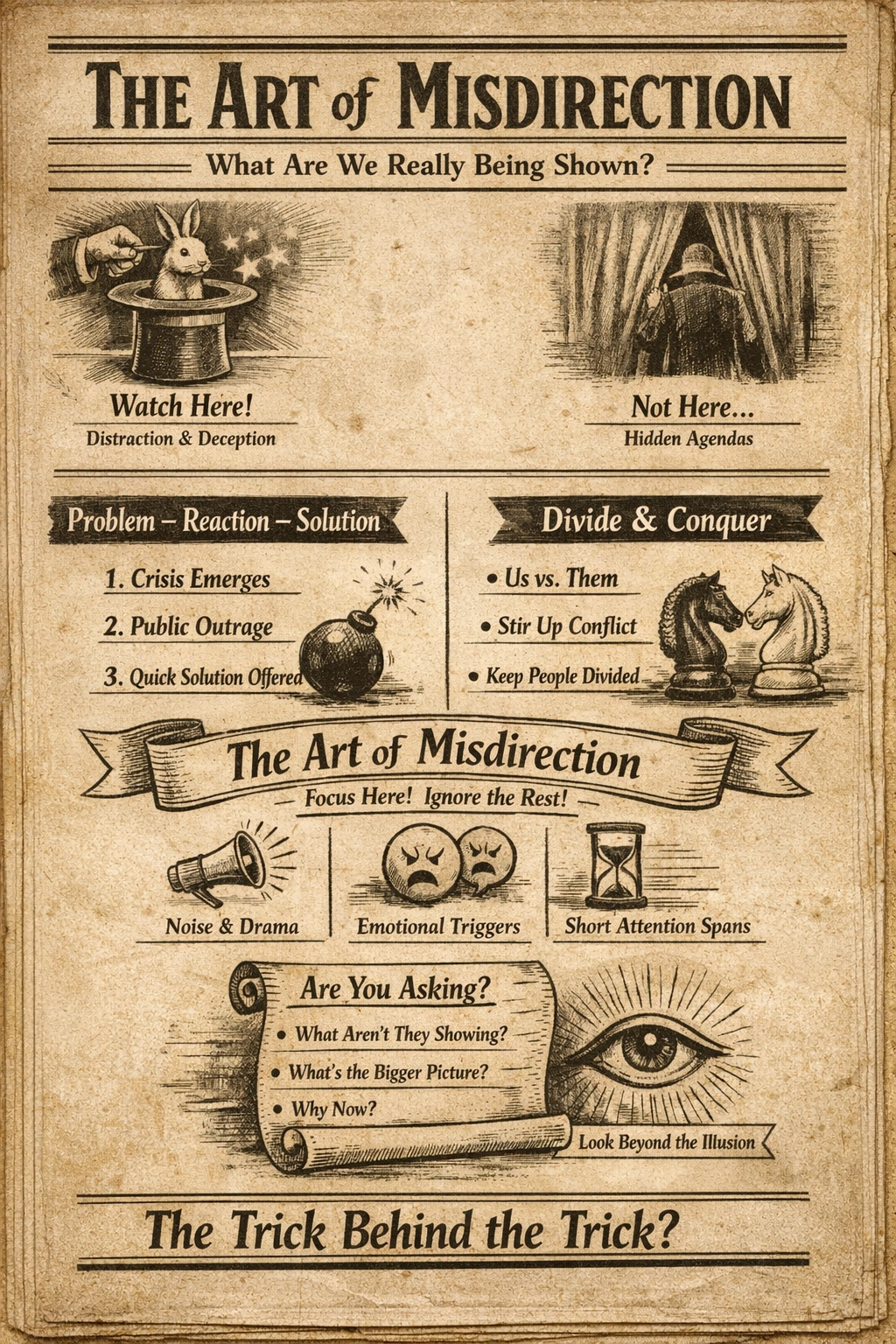
Apollo Robbins is a world-renowned performer, security consultant, and deception expert widely recognized as the world’s foremost master of misdirection. Known professionally as "The Gentleman Thief," Robbins uses sleight-of-hand pickpocketing not for theft, but to demonstrate how easily human attention, spatial awareness, and sensory perception can be hijacked by a skilled manipulator.
Who Is Apollo Robbins?
Apollo Robbins rose to international prominence by transforming the ancient art of street pickpocketing into a sophisticated study of human cognitive limits. Born in Texas in 1974, Robbins spent years studying human movement, body language, and behavioral psychology to perfect his craft. Rather than relying on standard magic props, he works entirely within the personal space of his audience, manipulating where people look, what they remember, and how they perceive reality in real time.
His title, "The Gentleman Thief," reflects his signature performance ethics: every item lifted—watches, wallets, cell phones, passports, and neckties—is returned immediately to its owner, accompanied by a clear explanation of how the lapse in perception occurred.
Over his career, Robbins has expanded his work far beyond the stage. He functions as an executive consultant, security researcher, and speaker for law enforcement agencies, defense contractors, and corporate boards. By treating attention as a limited, hackable resource, Robbins provides vital insights into physical security, fraud prevention, and human factors engineering.
The Mechanics of Misdirection: How Human Perception Is Hacked
Misdirection is frequently misunderstood as simply looking left while something happens on the right. Robbins’s methodology is far more nuanced. He relies on specific quirks in the human central nervous system to guide focus, blind spots, and subconscious decisions.
- External Stimulus (Movement, Eye Contact, Verbal Cue)
- Brain Prioritizes High-Value Target (Attentional Spotlight)
- Saccadic Suppression Occurs (Micro-blindness during motion)
- Memory Fills Gaps (Brain invents continuity / misses theft)
Attentional Spotlight and Internal Focus
The human brain processes vast amounts of visual and auditory data every second, but conscious awareness can only process a fraction of it at any single moment. Scientists refer to this limited focus as the attentional spotlight.
Robbins manipulators this spotlight through two distinct types of attention:
- Exogenous Attention (External): Triggered automatically by unexpected movements, loud sounds, or sudden changes in light.
- Endogenous Attention (Internal): Driven by internal thought processes, such as trying to remember a PIN code or focusing on a specific task.
Robbins frequently forces targets into internal attention. By asking an unexpected or slightly confusing question—such as "Do you know what time it was when you lost your keys?"—the target’s brain shifts inward to search memory banks. While the subject is engaged in internal processing, their external situational awareness drops dramatically, allowing physical contact to go entirely unnoticed.
Motion Trajectories: Curved vs. Straight Lines
One of Robbins’s most famous contributions to both magic and neuroscience is his observation regarding hand movement trajectories.
- Straight Movements: When a hand moves in a straight line, the observer’s eyes naturally track the entire path of movement. Straight lines create anticipation and keep the observer's gaze locked onto the moving object.
- Curved Movements: When a hand moves in a smooth, semicircular, or curved arc, the observer’s eyes jump directly from the starting point to the destination point.
This visual jump is driven by saccadic eye movement. During a saccade, the brain temporarily suppresses visual processing to prevent motion blur—a phenomenon known as saccadic suppression. By utilizing curved hand gestures, Robbins triggers mini-blinds during which the target is momentarily incapable of processing fine visual detail, masking covert physical movements.
Frame of Focus and Social Cues
Human beings are hardwired to prioritize social cues over mechanical actions. When someone looks directly into your eyes, your natural response is to return eye contact. Robbins exploits this biological instinct through gaze direction.
By controlling his own focal point, Robbins dictates the focal point of his target:
- Direct Eye Contact: Locks the target’s eyes to his face, pulling visual focus away from their torso and pockets.
- Anchored Gestures: Holding an object high in his right hand forces the target’s eyes upward, leaving his left hand free to operate undetected below their line of vision.
- Physical Framing: Standing at specific angles relative to the target allows Robbins to control their peripheral field of view, creating visual blind spots across their body.
The Infamous Secret Service Incident: Turning Illusion into Expertise
The event that propelled Apollo Robbins into the national spotlight occurred in Las Vegas in 2001. While performing at a venue, Robbins was introduced to members of the United States Secret Service detail assigned to former President Jimmy Carter.
In a brief interaction, Robbins successfully pickpocketed several Secret Service agents without their knowledge. He systematically removed:
- Former President Carter’s confidential itinerary documents.
- The personal keys to the presidential motorcade vehicles.
- Agent credentials, badges, and communication equipment.
- Personal items including cell phones and wallets.
When Robbins returned the items to the agents, the incident caused a shockwave within the security organization. Rather than treating the event as a stunt, law enforcement leaders realized that Robbins had identified critical vulnerabilities in human situational awareness that traditional tactical training failed to address.
The event shifted Robbins’s career trajectory. He was subsequently invited to consult with federal agencies, police forces, and high-security organizations to analyze how physical deception occurs in real-world environments.
Bridging Magic and Neuroscience
Robbins’s unique abilities drew the attention of the scientific community, leading to groundbreaking interdisciplinary research into cognitive neuroscience.
Collaborations with Neuroscientists
Robbins partnered closely with neuroscientists Dr. Stephen Macknik and Dr. Susana Martinez-Conde from the Barrow Neurological Institute. Together, they authored scientific papers exploring how sleight-of-hand artists exploit the neural mechanisms of vision and spatial attention.
Their joint findings were highlighted in the book Sleights of Mind: What the Neuroscience of Magic Reveals About Our Everyday Deceptions, which illustrates how magic tricks expose fundamental design limitations in the human brain. The research proved that misdirection is not a trick played on the eyes, but an exploitation of how the brain constructs visual reality.
- Real World Physics
- Perceptual Processing
- Cognitive Vulnerability
- Neural Interpretation
- Misdirection Tactics Applied
- Manipulated Reality
The TED Talk: "The Art of Misdirection"
In June 2013, Robbins delivered a presentation at TEDGlobal titled "The Art of Misdirection." The talk quickly became one of the most viewed TED presentations of all time, accumulating tens of millions of views globally.
During the presentation, Robbins demonstrated live pickpocketing on an audience member while simultaneously explaining the cognitive principles at play. He demonstrated how easily an individual's attention can be directed to a specific object (such as a poker chip or a watch) while major physical changes occur in plain sight.
The core message of the talk emphasized that human beings cannot multi-task visual attention; we simply switch focus rapidly from one item to another, leaving massive gaps in situational awareness.
Real-World Applications: Security, Technology, and Human Behavior
While misdirection originated in performance art, the principles refined by Apollo Robbins have major practical applications across multiple industries.
| Domain | Key Application Mechanism |
|---|---|
| Cyber & Physical Security | Identifying social engineering and physical penetration vulnerabilities before attackers exploit them. |
| User Experience (UI/UX) Design | Designing visual hierarchy to guide user focus cleanly through complex digital interfaces. |
| Law Enforcement & Military | Training officers to resist spatial distraction during high-stress tactical operations. |
| Medical Safety & Operations | Minimizing cognitive interruptions and sensory overload for surgical teams during complex medical procedures. |
Physical and Cyber Security (Social Engineering)
In the cybersecurity sector, human error remains the primary vector for system breaches. Social engineering attacks rely on the exact same psychological principles that Robbins uses on stage:
- Urgency and Distraction: Creating panic forces a target into internal cognitive processing, causing them to miss warning signs like suspicious email addresses or unauthorized physical tailgating.
- Authority Exploitation: Impersonating trusted figures causes targets to drop their defensive awareness.
Robbins works alongside corporate security teams to conduct physical penetration testing. By showing how easily access badges, security tokens, and sensitive hardware can be retrieved right off an employee's person, he helps organizations build defensive protocols that account for human cognitive weaknesses.
Interface Design and Ergonomics (UI/UX)
Digital product designers use principles of misdirection and directed focus to build intuitive user experiences. By manipulating visual hierarchy—such as contrast, motion, spatial padding, and scale—designers guide a user's attention seamlessly to primary action buttons while minimizing secondary clutter. Conversely, understanding these mechanics helps regulators identify "dark patterns," which intentionally trick users into clicking unwanted offers or agreeing to intrusive privacy terms.
Key Misdirection Techniques Applied by Apollo Robbins
To understand how Robbins operates, it is helpful to contrast traditional misdirection myths against verified behavioral mechanics.
| Category | Common Misconception | Apollo Robbins's Applied Mechanism | Cognitive Mechanism Involved |
|---|---|---|---|
| Gaze Control | "Look away so they don't see your hands." | Establish direct eye contact or look intently at a neutral object. | Gaze Following & Mirror Neurons: Humans automatically look where others are looking. |
| Gesture Path | "Move quickly to beat the eye." | Use smooth, curved arc movements rather than fast, straight lines. | Saccadic Suppression: Eyes skip detail during curved tracking, blinding the viewer briefly. |
| Cognitive Load | "Keep the mark quiet and isolated." | Ask complex or unexpected questions during physical contact. | Attentional Bottleneck: The brain prioritizes internal retrieval over tactile awareness. |
| Touch Masking | "Touch them as lightly as possible." | Apply firm, natural touch on non-sensitive areas (e.g., shoulders). | Tactile Adaptation & Anchoring: Strong, static pressure hides light, dynamic contact nearby. |
| Spatial Framing | "Work out of open sight." | Step inside the personal space angle at a 45-degree offset. | Peripheral Blindness: Exploits outer bounds of human visual field coverage. |
Practical Defenses: Protecting Yourself Against Misdirection
Understanding misdirection allows individuals to develop heightened situational awareness in daily life, especially when navigating crowded environments like transit hubs, tourist sites, or public gatherings.
1. Recognize Physical Anchoring
Pickpockets and scam artists rarely operate without physical contact. They often use subtle bumps, friendly pats on the shoulder, or accidental spills to mask physical theft.
- Defense: If an unexpected physical contact occurs in public, do not reach directly for your wallet or phone to check if it is there. Doing so signals the exact location of your valuables to onlookers. Instead, hold your arm firmly over your pocket area neutrally.
2. Manage Cognitive Overload
Manipulators create chaos to overwhelm your working memory. Common tactics include asking for directions while shoving a large map into your face, dropping coins at your feet, or causing a sudden verbal argument.
- Defense: When an unexpected distraction occurs, freeze your physical stance and step backward out of the immediate physical circle. Restoring your spatial boundary breaks the manipulator's control over your attention frame.
3. Secure Personal Items Structurally
Relying on situational awareness alone is insufficient, as human attention naturally fluctuates.
- Defense: Use structural security measures rather than behavioral vigilance. Store cash, cards, and phones in zipped inner coat pockets or front pockets with high-density fabric. Avoid storing high-value items in easily accessible backpack outer pockets.
Frequently Asked Questions
Has Apollo Robbins ever been arrested for pickpocketing?
No. Apollo Robbins has spent his career operating strictly as an entertainer, researcher, and security consultant. He performs pickpocketing exclusively within controlled settings, theatrical shows, or official training demonstrations, returning all property to its owners immediately.
What is the difference between physical misdirection and psychological misdirection?
Physical misdirection involves manipulating where a person physically looks using sightlines, movement trajectories, bright colors, or sounds. Psychological misdirection manipulators what a person thinks about, using confusing questions, emotional triggers, or social expectations to divert internal processing away from external events.
How does Apollo Robbins steal watches so quickly?
Robbins utilizes a technique that combines physical pressure masking with wristband manipulation. By applying firm, steady pressure to a target's upper arm or shoulder, he numbs the localized skin sensitivity on that arm. He then unbuckles or unclasps the watch band using precise, single-handed micro-movements while keeping the target engaged in direct eye contact.
Can someone be trained to be completely immune to misdirection?
No one is entirely immune to misdirection because the visual and cognitive mechanisms it targets are hardwired biological functions. Even trained security personnel, elite soldiers, and scientists can have their attention manipulated. However, individuals can lower their vulnerability by adopting strict operational security habits and remaining aware of personal space boundaries.
What scientific publications cover Apollo Robbins’s work?
Robbins’s techniques have been analyzed in peer-reviewed scientific journals focusing on perception and neuroscience, including Nature Reviews Neuroscience. His work is also covered extensively in the book Sleights of Mind by Dr. Stephen Macknik and Dr. Susana Martinez-Conde, as well as the 2011 profile article "A Pickpocket's Tale" published by The New Yorker.
Recommended Next Steps
To deepen your understanding of attention, perception, and security dynamics, consider exploring these foundational resources:
- Watch "The Art of Misdirection": Review Apollo Robbins's official TED Talk to see live demonstrations of frame control, gaze manipulation, and attention shifting.
- Study Cognitive Science Principles: Read Sleights of Mind to understand the neurological framework underlying visual illusions and attentional blind spots.
- Audit Personal Physical Security: Evaluate your everyday carry habits. Move critical items (wallets, phones, keys) to secure inner pockets or anti-theft bags to reduce reliance on situational awareness in high-density areas.
EDITORIAL CATEGORY METADATA: