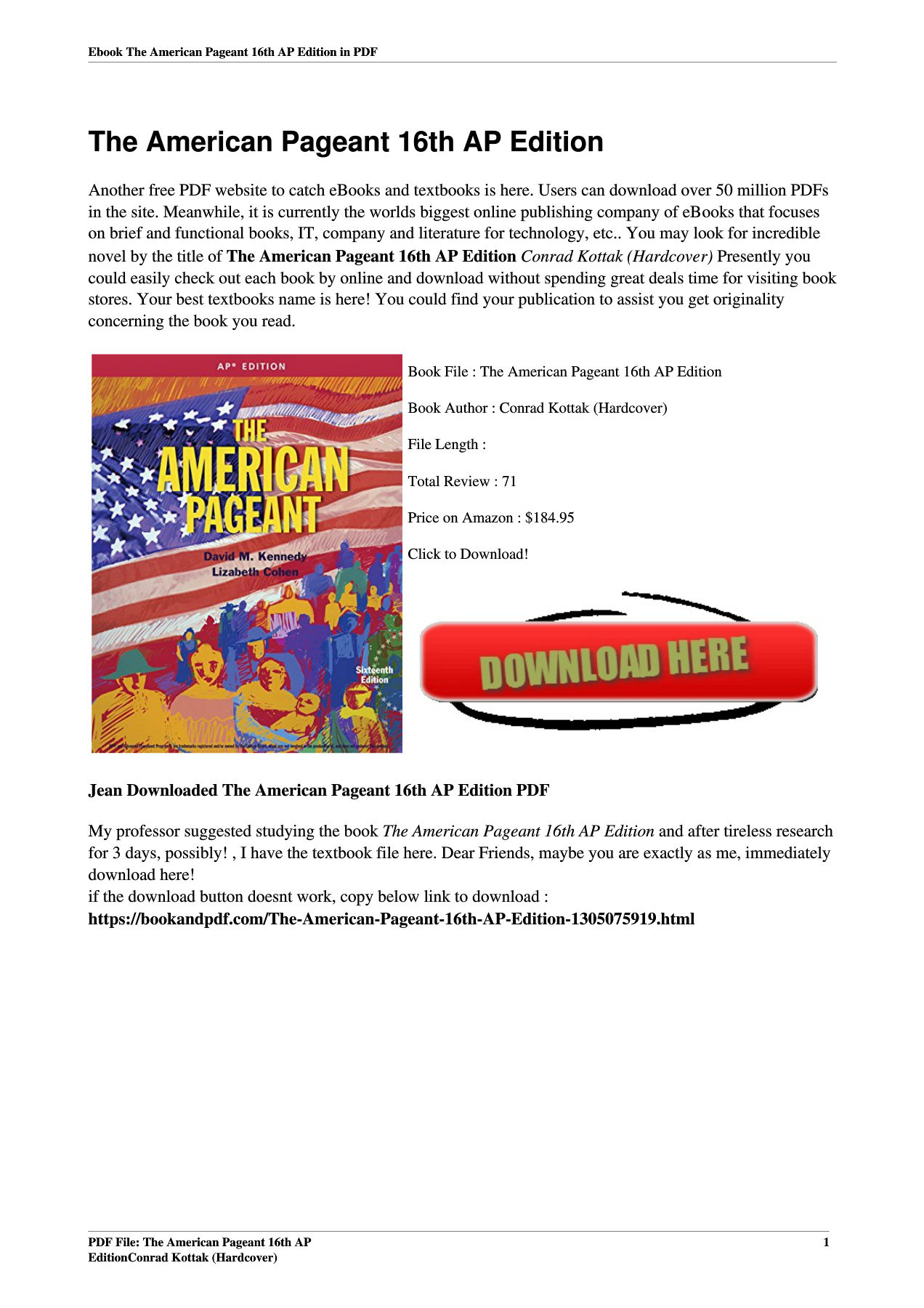
The American Pageant, 16th Edition, is a premier historical textbook frequently used in Advanced Placement (AP) United States History courses. Students and educators typically access the 16th edition PDF through licensed digital platforms such as Cengage, VitalSource, or school-issued Learning Management Systems (LMS) to facilitate digital note-taking and keyword searching.
The American Pageant remains one of the most widely used and influential textbooks in the history of American secondary and higher education. As of 2026, while newer editions have been released to account for more recent political shifts and historiographical trends, the 16th edition continues to be a cornerstone for many high school social studies departments. Its popularity stems from its narrative-driven prose, which transforms the dry recitation of facts into a cohesive story of the American experience. For students seeking the 16th edition in PDF format, understanding the content, technical requirements for digital study, and the legal avenues for access is essential for academic success.
Understanding the 16th Edition’s Place in 2026
In the current educational landscape of 2026, the 16th edition of The American Pageant (originally published in 2015) occupies a unique middle ground. While the 17th and 18th editions are available, many school districts retain the 16th edition due to its alignment with specific state standards and the significant investment required to refresh physical and digital inventories.
The 16th edition was a pivotal update in the series, authored by David M. Kennedy and Lizabeth Cohen. It was designed to align specifically with the College Board’s redesigned AP United States History (APUSH) curriculum, which shifted focus toward historical thinking skills like periodization, comparison, and contextualization. This makes the 16th edition PDF a highly relevant tool even a decade after its initial release, as the fundamental structure of the AP exam has maintained the thematic approach introduced during this era.
Core Pedagogical Features
The 16th edition is noted for several key features that assist students in mastering complex historical narratives:
- Makers of America: These segments provide a deep dive into the diverse groups that have shaped the nation, focusing on the immigrant experience and social history.
- Varying Viewpoints: This section exposes students to historiography—the study of how historical interpretations change over time—by presenting different scholarly perspectives on controversial events.
- Chronological Clarity: Unlike textbooks that are strictly thematic, The American Pageant maintains a strong chronological backbone, which is vital for students trying to understand cause-and-effect relationships.
How to Access the American Pageant 16th Edition PDF Legally
In 2026, the demand for digital textbooks has surpassed physical copies in many regions. However, accessing a PDF version of a copyrighted textbook involves navigating licensing and intellectual property rights. Unauthorized downloads of the 16th edition PDF often contain malware or incomplete chapters, making legitimate channels the only reliable option.
Institutional Access via School Portals
The most common way for a student to obtain the 16th edition PDF is through their school’s digital library or Learning Management System (LMS), such as Canvas, Google Classroom, or Schoology. Many districts purchase "e-packs" or digital site licenses from the publisher, Cengage Learning. These licenses often allow students to download the book for offline use or access it through a dedicated e-reader app that supports PDF-like functionality, such as highlighting and bookmarking.
Digital Textbook Retailers
For independent learners or college students, several platforms provide legal digital access to the 16th edition:
- Cengage Unlimited: This is a subscription service provided by the publisher. It allows students to access a massive library of textbooks, including the 16th edition of The American Pageant, in a digital format that functions similarly to a high-quality PDF.
- VitalSource: As one of the leading providers of digital textbooks, VitalSource offers the 16th edition for rent or purchase. Their "Bookshelf" app allows for offline reading, which is essentially a DRM-protected PDF experience.
- Chegg and Amazon: These platforms often offer e-textbook rentals. While they may use their own proprietary viewers, the content is identical to the 16th edition print and PDF versions.
Technical Specifications and Digital Navigation
When using the American Pageant 16th edition in a digital format, the technical quality of the file significantly impacts study efficiency. A high-quality PDF or e-book version should possess several technical features that support the rigors of an AP-level course.
OCR and Searchability
Optical Character Recognition (OCR) is a critical feature for any historical PDF. Because The American Pageant is dense—often exceeding 1,000 pages—the ability to use the "Ctrl+F" (Find) function to locate specific terms like "Mercantilism," "Saratoga," or "Great Society" is a massive time-saver. Students should ensure their digital version is text-searchable rather than just a series of scanned images.
File Size and Organization
A full-resolution PDF of the 16th edition can be quite large, often ranging from 150MB to 300MB due to the high-quality maps and photographs. In 2026, most student devices handle this easily, but organization is key. Professional digital versions include a hyperlinked Table of Contents. This allows a student to click on "Chapter 24: Industry Comes of Age" and be taken directly to that page, rather than scrolling through hundreds of pages of colonial history.
Accessibility Standards
For students with visual impairments, the 16th edition digital files are often designed to be compatible with screen readers. Legitimate PDFs provided by Cengage or VitalSource include alt-text for images and a logical reading order, which are often missing from "free" or pirated PDF versions found online.
Content Breakdown: The 16th Edition Structure
The 16th edition is divided into six major parts, covering the timeline from approximately 33,000 B.C. to the mid-2010s. Understanding this structure helps students navigate the PDF effectively when studying for unit exams.
| Part | Title | Chapter Range | Major Themes |
|---|---|---|---|
| Part 1 | Founding the New World | Chapters 1–5 | Pre-Columbian life, Colonization, Colonial Society |
| Part 2 | Building the New Nation | Chapters 6–12 | Revolution, Constitution, Jeffersonian Democracy |
| Part 3 | Testing the New Nation | Chapters 13–18 | Jacksonian Democracy, Manifest Destiny, Sectionalism |
| Part 4 | Forging an Industrial Republic | Chapters 19–26 | Civil War, Reconstruction, Gilded Age, Urbanization |
| Part 5 | Struggling for Justice at Home | Chapters 27–35 | Progressivism, World Wars, Great Depression |
| Part 6 | Making Modern America | Chapters 36–42 | Cold War, Civil Rights, Modern Presidency |
Part 1: The Pre-Colonial and Colonial Era
The 16th edition begins with a robust look at Native American cultures before European contact. This is a critical area of focus for the 2026 AP exam, which emphasizes that American history did not begin in 1492. The PDF version allows students to zoom in on detailed maps of trade routes and tribal territories.
Part 4: The Gilded Age and Industrialization
Chapters 23 through 26 are often considered the "meat" of the late 19th-century curriculum. The 16th edition provides extensive coverage of the rise of corporations and the labor movement. In a PDF format, the charts detailing the growth of the railroad industry and the influx of "New Immigrants" are particularly useful for evidence-based writing in DBQs (Document-Based Questions).
Effective Study Strategies for Digital Textbooks
Simply owning the American Pageant 16th edition PDF is not enough; students must interact with the text to retain information. In 2026, several digital-first study methods have become standard for high-achieving students.
The "Search and Synthesize" Method
Instead of reading 40 pages linearly, students can use the PDF search function to track a single theme across multiple chapters. For example, searching for "suffrage" allows a student to see the evolution of voting rights from the property requirements of the 1700s to the 19th Amendment in 1920, and finally to the Voting Rights Act of 1965. This thematic synthesis is exactly what AP graders look for in long-essay responses.
Digital Annotation and Split-Screen Learning
Most PDF readers (like Adobe Acrobat, Kami, or Preview) allow for highlighting and commenting. A successful strategy involves:
- Color-coding: Using yellow for key dates, green for significant figures, and blue for "Varying Viewpoints."
- Margin Notes: Summarizing each subsection in two sentences to ensure comprehension before moving on.
- Split-Screen: Keeping the textbook PDF on one half of the screen and a digital notebook (like OneNote or Notion) on the other. This facilitates the "Cornell Note-taking System," which is highly effective for history.
Utilizing the Index and Appendix
The 16th edition PDF includes a comprehensive index and several valuable appendices, including the Declaration of Independence, the Constitution, and various data tables on presidential elections. When writing a research paper or preparing for a debate, these primary sources are just a quick search away within the document.
Comparing the 16th Edition to Other Versions
As of 2026, students might wonder if they are at a disadvantage using the 16th edition compared to the 17th or 18th. While the core historical facts of the 1700s and 1800s do not change, the interpretation and the coverage of recent history do.
- 16th vs. 15th Edition: The 16th edition introduced more significant changes in how it addresses social history and the "Atlantic World" concept. It is much better aligned with the current APUSH exam format than the 15th.
- 16th vs. 17th/18th Edition: Newer editions provide more coverage of the late Obama, Trump, and Biden administrations. If your course focuses heavily on 21st-century politics, the 16th edition (which ends its narrative around 2015-2016) will require supplemental readings for the final unit of the year.
Frequently Asked Questions
Is there a free version of the American Pageant 16th edition PDF?
While some websites claim to offer the 16th edition PDF for free, these are typically unauthorized copies that violate copyright laws. Legitimate "free" access is usually provided only through school-funded licenses or library programs like Open Library (for temporary borrowing).
How many chapters are in the 16th edition?
The 16th edition contains 42 chapters. It is structured to be covered over two semesters, with the first half of the book (up to Chapter 22) typically handled in the fall and the second half in the spring.
Does the PDF version include the same images and maps as the print version?
Yes, a legitimate PDF or e-book version of the 16th edition contains all the visual aids found in the hardback. This includes the "Makers of America" photographic essays and the detailed tactical maps for major battles like Gettysburg and Midway.
Can I print pages from the American Pageant 16th edition PDF?
This depends on the platform through which you accessed the file. Most school-issued PDFs allow for limited printing for personal study use. However, digital versions purchased via services like VitalSource may have "print limits" to prevent unauthorized mass reproduction.
Is the 16th edition still valid for the AP Exam in 2026?
Yes. The vast majority of the AP US History exam covers periods 1 through 8 (1491–1980). The 16th edition covers these periods extensively and accurately. Students may only need supplemental materials for Period 9 (1980–Present) to cover events that occurred after the book’s publication.
Final Recommendation for Students
For students preparing for the AP US History exam in 2026, the American Pageant 16th edition PDF remains an excellent and reliable resource. To maximize its value, prioritize obtaining a version with OCR search capabilities and a hyperlinked table of contents. Always access the file through your school’s authorized portal or a reputable e-textbook retailer to ensure you have a complete, safe, and legal copy. By combining the book's rich narrative with modern digital study tools like split-screen annotation and thematic searching, you can build the deep historical understanding necessary to excel in the classroom and on the national exam.