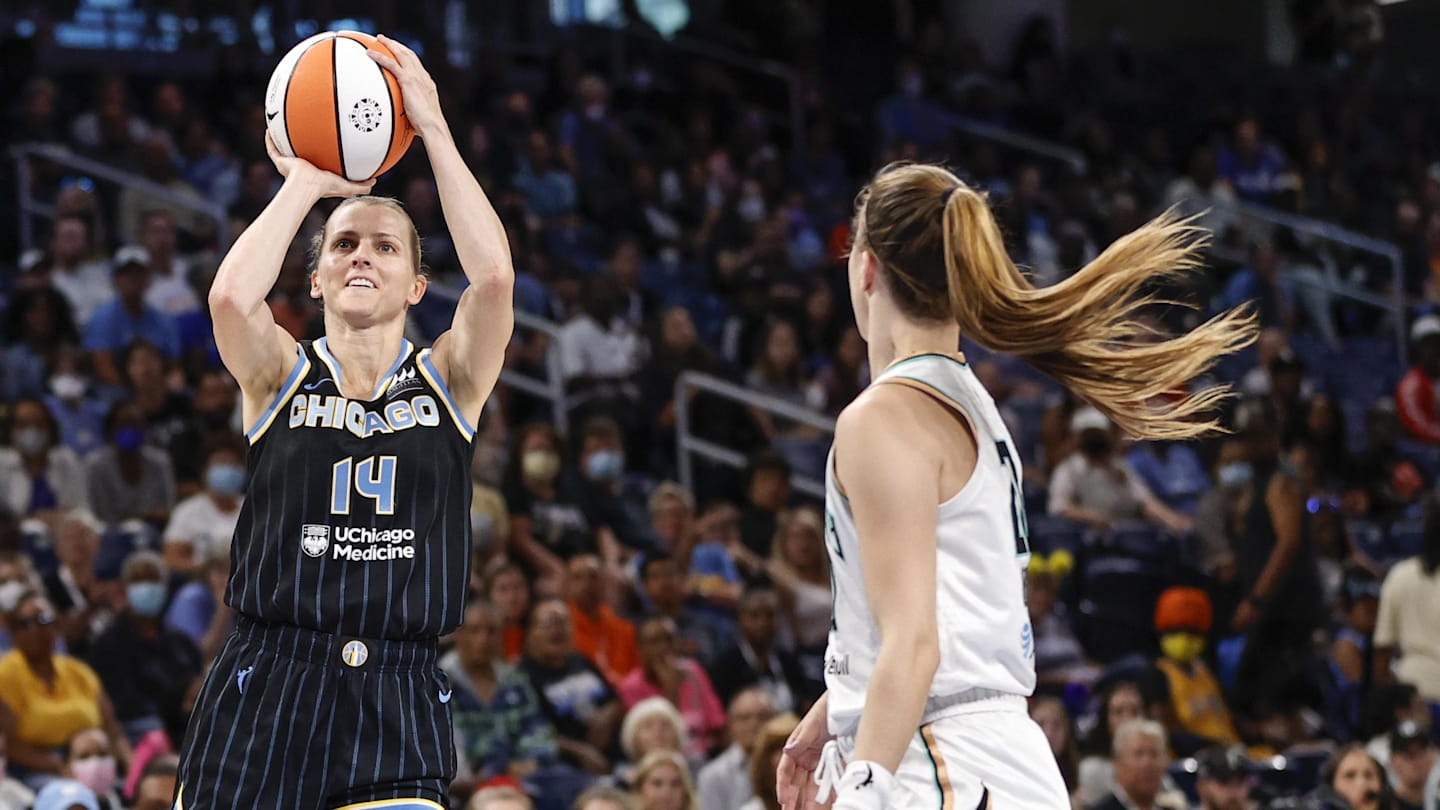
Allie Quigley’s retirement fundamentally reshaped the WNBA by forcing a league-wide evolution in offensive spacing, defensive scouting, and roster construction. As the premier sharpshooter of her generation, her departure from the Chicago Sky signaled the end of the "specialist" era and accelerated the transition toward high-volume, multi-positional perimeter threats.
Allie Quigley, often referred to as "The Queen of the 3-Point Shot," officially moved into the post-playing chapter of her career following a hiatus that began after the 2022 season. While her absence was felt immediately in Chicago, the ripple effects across the league have been profound. By 2026, the WNBA has fully transitioned into a new tactical reality—one that Quigley helped architect through two decades of elite floor spacing and perimeter dominance. Her retirement did more than just leave a void in the Chicago Sky’s starting lineup; it forced coaches to rethink how gravity is used on a basketball court and how the next generation of guards must be developed to maintain the league's offensive efficiency.
The Strategic Shift: From Specialist to Systematic Necessity
Before Quigley’s ascent, the 3-point shot was often viewed as a secondary weapon in the WNBA, a league historically dominated by elite post play and mid-range maestros. Quigley changed that narrative by proving that a singular, elite skill could dictate the entire flow of a game. Her retirement removed the most reliable "gravity" threat in the league—a player who required defensive attention the moment she crossed half-court.
In the years following her departure, teams have struggled to find a direct replacement for her specific brand of efficiency. Quigley wasn't just a "3-and-D" player; she was a movement shooter who could navigate complex screen actions (such as "stagger" or "elevator" screens) to generate high-value looks. Without her as a blueprint, the league has pivoted toward a more democratized shooting model where every player on the floor is expected to shoot, but few can match the 40%+ accuracy on high volume that Quigley maintained for years.
The loss of this archetype has led to a surge in creative offensive sets. Coaches in 2026 now focus more on "drive-and-kick" distributions rather than the "screen-the-screener" actions that defined the Chicago Sky’s championship run in 2021. Quigley’s retirement effectively closed the book on a specific type of offensive philosophy that relied on a dedicated shooting specialist to bend the defense.
The Chicago Sky’s Reconstruction and the End of an Era
The most direct impact of Quigley’s retirement was the dissolution of the "Skytown" core that brought Chicago its first WNBA championship. Alongside Courtney Vandersloot, Candace Parker, and Kahleah Copper, Quigley was the tactical glue that made the Sky’s offense unpredictable. Her ability to shoot from deep allowed Vandersloot the space to operate in the pick-and-roll, a partnership that remains one of the most statistically efficient duos in league history.
When Quigley stepped away, the Sky faced a catastrophic loss of institutional knowledge and floor spacing. This led to a multi-year rebuilding process that saw the franchise move away from the veteran-heavy roster of 2021 toward a younger, more athletic core. The "post-Quigley" Sky had to reinvent their identity, moving from a finesse-based, high-IQ passing team to one that prioritizes transition points and defensive versatility. This shift mirrors a broader trend in the WNBA where franchises are opting for "positionless" basketball over the traditional roles that Quigley embodied so perfectly.
Comparative Evolution of WNBA Shooting Standards
To understand how Quigley reshaped the league, one must look at the statistical shift in perimeter play. The following table illustrates the benchmark she set and how the league has attempted to fill that void.
| Metric | The Quigley Era (2017–2022) | The Modern Era (2024–2026) | Impact of Transition |
|---|---|---|---|
| League Average 3P% | ~34.1% | ~36.8% | Increased focus on shooting development across all positions. |
| Top-Tier Specialist Volume | 5-7 attempts per game | 8-11 attempts per game | Higher volume, but often lower individual efficiency than Quigley. |
| Offensive Spacing Focus | Corner and Wing emphasis | "Logo" and deep-range emphasis | The "Caitlin Clark Effect" expanding the floor further. |
| Primary Scoring Option | Inside-Out | Perimeter-First | Complete reversal of traditional WNBA strategy. |
Impact on the WNBA’s Tactical Identity
Quigley’s retirement occurred just as the league was entering a period of unprecedented growth and talent influx. Her legacy is visible in the playstyles of the current 2026 stars. Players like Caitlin Clark and Sabrina Ionescu have taken the "shooting gravity" concept Quigley pioneered and extended it even further from the basket. However, Quigley’s influence is most felt in the technical details of the game.
Defensive Scouting and the "No-Help" Rule
During her prime, Quigley was one of the few players who triggered a "no-help" defensive rule. This meant that the defender assigned to her was forbidden from leaving her side to help on a drive to the basket. By retiring, Quigley essentially "unlocked" defensive schemes, allowing teams to play more sagging defenses—until a new generation of shooters forced them back out. The tactical chess match of how to guard an elite shooter changed because Quigley's release was so quick that even a split-second of "help" resulted in three points.
The Rise of Movement Shooting
Quigley was a master of the "C-cut" and the "flare screen." She didn't just stand in the corner; she was constantly in motion. In 2026, we see this "movement shooting" taught at every level of the women's game. Her retirement forced the WNBA to realize that "stand-still" shooters were no longer enough to win championships. The modern WNBA guard must be able to shoot off the dribble, off the move, and from unconventional angles—all traits Quigley perfected during her tenure with the Sky and her legendary overseas career in the EuroLeague.
The Ripple Effect on Free Agency and Team Building
The retirement of a player of Quigley's caliber also fundamentally changed the economics of the WNBA. Teams realized that elite shooting is the most expensive and hardest-to-find commodity in the league. This has led to a significant increase in the market value for perimeter specialists.
In the 2025 and 2026 free agency periods, we saw teams willing to pay "supermax" salaries not just for all-around superstars, but for players who could provide the 40% 3-point accuracy that Quigley once guaranteed. Her retirement highlighted a scarcity in the market. Before she left, the Sky had the luxury of a "homegrown" star (via trade development) who took a team-friendly approach to keep the core together. Now, in the current landscape, finding a "Quigley-lite" often requires aggressive trades or high-lottery draft picks.
Comparative Analysis: Quigley vs. The New Wave
By 2026, the conversation has shifted from "who is the next Allie Quigley" to "how does the new generation compare to her technical precision." While newer players may shoot from deeper range (the "logo" shots), Quigley remains the gold standard for shooting mechanics.
- Mechanics and Release: Quigley’s high release point and identical footwork on every shot made her nearly impossible to block. Current shooting coaches often use her game film as the primary instructional tool for collegiate and professional prospects.
- Consistency: While the new wave of shooters might have higher scoring outbursts, Quigley’s ability to remain efficient over a 40-game season is a feat few have replicated. Her retirement serves as a reminder that "streaky" shooting is the enemy of championship contention.
- The 3-Point Contest Legacy: Her four WNBA 3-Point Contest titles (including a record-breaking 30-point round in 2022) established a standard of excellence that has turned the All-Star Saturday event into one of the most-watched segments of the WNBA season.
Challenges for the League in Replacing Specialized Production
Replacing Quigley has proven difficult because she occupied a unique niche: a veteran leader who did not require the ball in her hands to be effective. Most modern stars are "ball-dominant," meaning they need high usage rates to produce. Quigley’s "low-usage, high-impact" profile is a rare commodity.
The WNBA has responded by scouting more aggressively in Europe and at the mid-major college level for shooters who can thrive in a supporting role. The "Quigley Mold"—a player who can provide 15 points a game while barely dribbling the ball—is now the most sought-after archetype in the 2026 draft cycles.
Frequently Asked Questions
When did Allie Quigley officially retire from the WNBA?
While Allie Quigley did not play in the 2023 or 2024 seasons, her transition into retirement became a settled part of league history by the 2025 season. She chose to prioritize her personal life and post-career opportunities after a legendary run that culminated in the 2021 championship and her record-breaking 2022 3-point contest performance.
How many 3-point contests did Allie Quigley win?
Allie Quigley won a record four WNBA 3-Point Contests (2017, 2018, 2021, and 2022). She is the only player in WNBA or NBA history to win four such titles, a testament to her standing as one of the greatest shooters to ever play the game of basketball.
Who replaced Allie Quigley on the Chicago Sky?
There was no single replacement for Quigley; instead, the Chicago Sky underwent a complete roster overhaul. By 2026, the team moved toward a collective approach to perimeter shooting, utilizing various young guards and wing players to try and replicate her floor spacing, though her specific efficiency remains unmatched in franchise history.
What is Allie Quigley’s career 3-point percentage?
Allie Quigley finished her WNBA career with a 3-point percentage of approximately 39.4%. In her most dominant seasons, she frequently shot over 43% from beyond the arc, making her one of the most efficient high-volume shooters in the history of women's professional basketball.
Did Allie Quigley play for any teams other than the Chicago Sky?
Although she is most famous for her time with the Chicago Sky (where she played from 2013 to 2022), Quigley actually had a "journeyman" start to her career. She played brief stints for the Phoenix Mercury, San Antonio Silver Stars, Seattle Storm, and Indiana Fever before finding her home in Chicago and blossoming into an All-Star.
Moving Forward: The Future of Perimeter Play
As we look at the WNBA in 2026, the shadow of Allie Quigley looms large over every perimeter-oriented offense. Her retirement was not an end, but a catalyst. It forced the league to acknowledge that elite shooting is not a luxury—it is a fundamental requirement for success.
For players looking to follow in her footsteps, the path is clear: master the mechanics, embrace the role of a floor spacer, and develop the mental toughness to shoot under pressure. For the league, the challenge remains finding the next player who can command the same "no-help" respect that Quigley earned over two decades of excellence. Whether through the draft or international scouting, the hunt for the next "Queen of the 3" continues to define the strategic landscape of the WNBA.