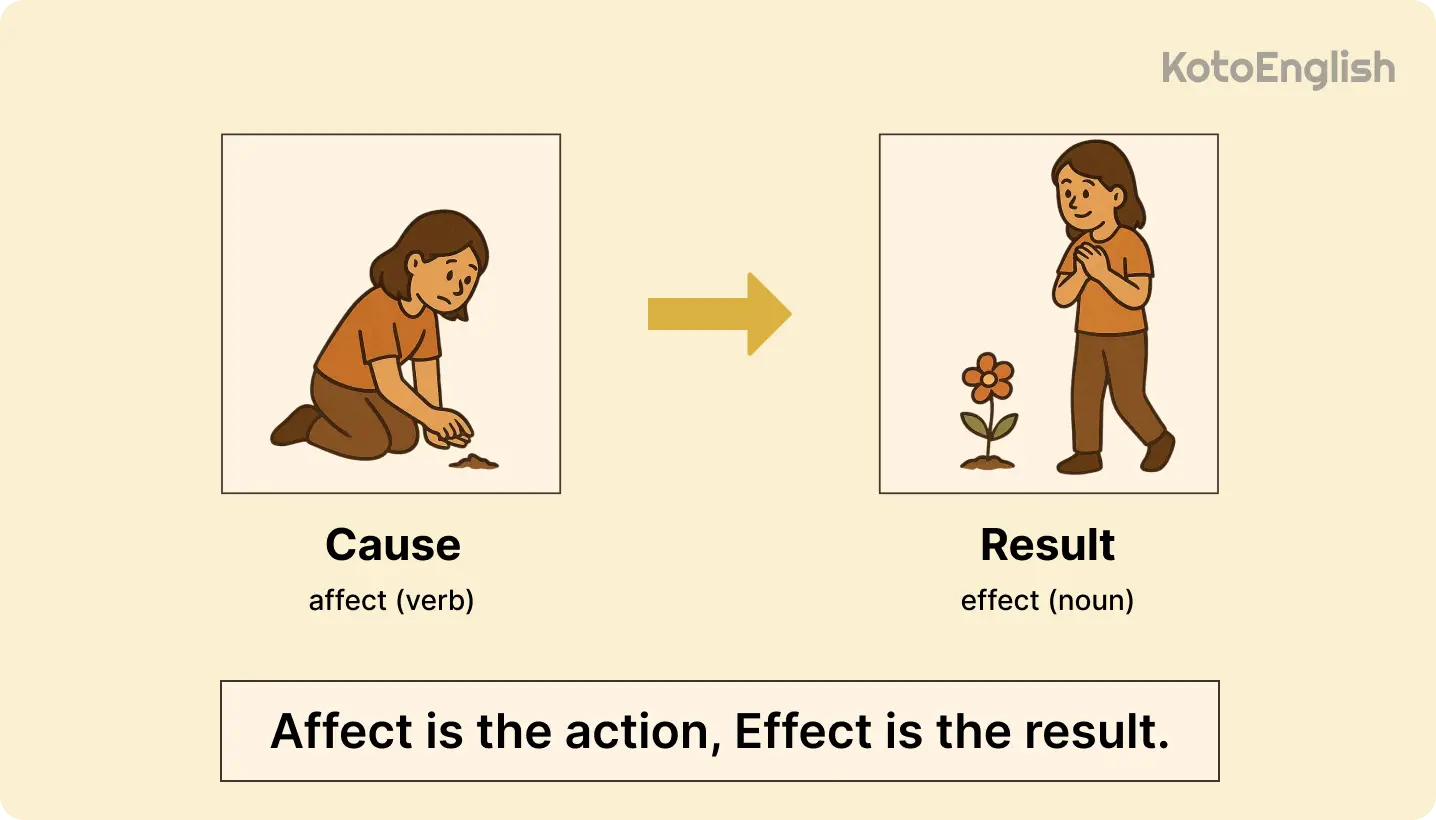
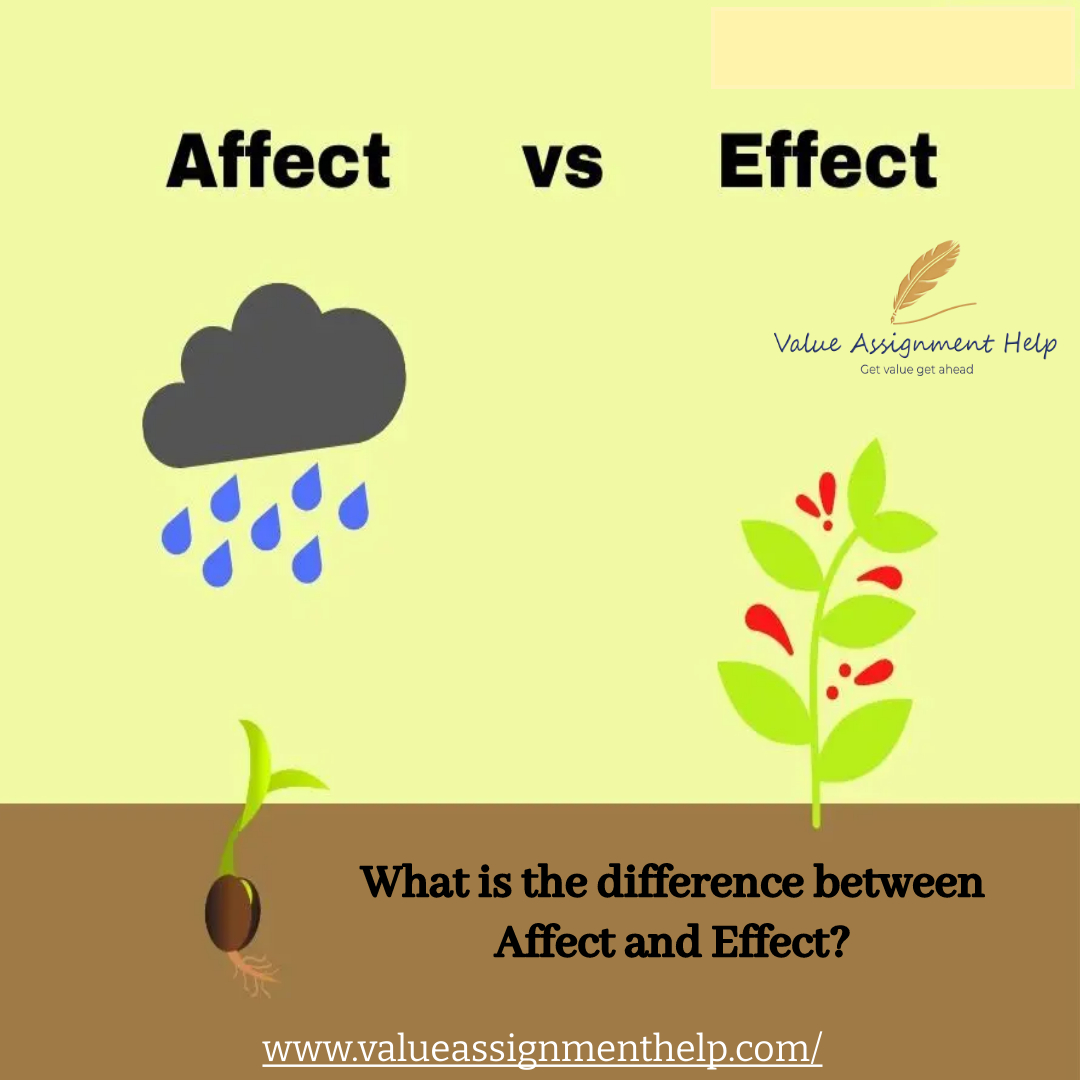
The word affect is primarily used as a verb meaning to influence or produce a change in something, whereas effect is typically used as a noun referring to the result, consequence, or outcome of an action. Understanding the grammatical role of each word in a sentence is the fastest way to choose the correct spelling in professional and academic writing.
Understanding the Core Grammar Rules
The confusion between affect and effect is one of the most widespread grammatical errors in the English language. Because both words sound almost identical in casual speech—functioning as near-homophones—writers frequently rely on sound rather than syntax. However, their primary grammatical functions in formal written English are distinct.
- THE RAVEN MNEMONIC
- R — Remember
- A — Affect — V — Verb (To Influence)
- E — Effect — N — Noun (The Result)
The Primary Rule: Action vs. Result
At its core, the distinction relies on whether you are describing an action taking place or the outcome produced by that action:
- Affect (Verb): An action word. It means to act upon, influence, alter, or transform something. If you can substitute the word influence or modify without destroying the grammar of the sentence, affect is almost certainly the correct choice.
- Effect (Noun): A naming word. It refers to a tangible or intangible result, impact, or consequence produced by a cause. If the word follows an article (a, an, the) or a descriptive adjective (positive, negative, profound), effect is almost certainly the correct choice.
Etymological Origins
Both words derive from Latin roots through Old French, which explains their overlapping phonetic structures:
- Affect stems from the Latin afficere, meaning "to do something to" or "to act upon."
- Effect originates from the Latin efficere, meaning "to bring about," "to accomplish," or "to complete."
Understanding these Latin foundations clarifies why affect centers on the process of acting upon something, while effect focuses on the completed realization or outcome.
5 Clear Examples of Affect and Effect in Everyday Contexts
To master these terms, it is helpful to examine them side by side across real-world scenarios. Each example pair demonstrates how shifting the grammatical structure of a sentence dictates whether you must use affect as a verb or effect as a noun.
| AFFECT (VERB = INFLUENCE) | EFFECT (NOUN = RESULT) |
|---|---|
| Weather affects daily mood. | Weather has a direct effect on mood. |
| Inflation affects buying power. | Inflation creates a ripple effect. |
| Medication affects blood pressure. | The medication had no side effects. |
| Screen time affects sleep quality. | Screen time has a negative effect. |
| Algorithms affect search traffic. | The update produced a positive effect |
Example 1: Healthcare and Medicine
Medical contexts frequently contrast actions taking place within the body against the measurable outcomes of treatments.
- Sentence A (Affect - Verb): * "Irregular sleep schedules directly affect your body’s circadian rhythm and immune system."*
- Sentence B (Effect - Noun): * "A major side effect of chronic sleep deprivation is a weakened immune system."*
Grammatical Breakdown
In Sentence A, affect functions as a transitive verb driven by the subject (irregular sleep schedules) and acting directly on the object (your body’s circadian rhythm). You can replace affect with the verb disrupt or influence, and the sentence remains grammatically sound.
In Sentence B, effect functions as a compound noun phrase (side effect). It is preceded by the indefinite article a and the modifier major. It describes the resulting state rather than the action causing it.
Example 2: Economics and Business
Financial reporting requires absolute clarity when discussing market forces, policy decisions, and economic shifts.
- Sentence A (Affect - Verb): * "Rising interest rates will significantly affect consumer borrowing habits in the fourth quarter."*
- Sentence B (Effect - Noun): * "The Federal Reserve’s interest rate hike had an immediate effect on average mortgage costs."*
Grammatical Breakdown
In Sentence A, affect works alongside the modal auxiliary verb will (will affect). This establishes a future action where rising rates act upon consumer habits.
In Sentence B, effect acts as the direct object of the verb had. Notice the structural marker an immediate: the article an combined with the adjective immediate signals that a noun must follow.
Example 3: Environmental Science and Agriculture
Scientific writing regularly details cause-and-effect relationships, making precise word choice essential for peer-reviewed clarity.
- Sentence A (Affect - Verb): * "Extended drought conditions severely affect crop yields in temperate agricultural regions."*
- Sentence B (Effect - Noun): * "Scientists are evaluating the long-term effects of deforestation on regional precipitation levels."*
Grammatical Breakdown
In Sentence A, affect is modified by the adverb severely. Because adverbs modify verbs, adjectives, or other adverbs—but never nouns directly—the presence of severely indicates that affect is operating as a verb.
In Sentence B, effects appears in its plural noun form. Verbs do not take plural -s endings to represent multiple concepts; pluralization is a defining characteristic of count nouns. The word is also preceded by the definite article the and the modifier long-term.
Example 4: Education and Productivity
Academic discussions often center on how study habits and learning environments influence student performance.
- Sentence A (Affect - Verb): * "Ambient noise levels in open-plan offices negatively affect complex problem-solving abilities."*
- Sentence B (Effect - Noun): * "Installing soundproofing panels had a noticeable effect on employee concentration."*
Grammatical Breakdown
In Sentence A, affect conveys the active impact of ambient noise on cognitive performance. The sentence follows a standard Subject-Adverb-Verb-Direct Object structure: Noise levels (Subject) + negatively (Adverb) + affect (Verb) + abilities (Object).
In Sentence B, effect serves as the noun complement following the verb had. The noun phrase a noticeable effect quantifies the outcome achieved by the soundproofing panels.
Example 5: Technology and Search Algorithms
In digital media, technical changes constantly drive shifts in visibility and online traffic.
- Sentence A (Affect - Verb): * "Core algorithm updates frequently affect how search engines evaluate content quality."*
- Sentence B (Effect - Noun): * "The structural website optimization produced a positive effect on organic search visibility."*
Grammatical Breakdown
In Sentence A, affect describes the ongoing action performed by core updates on evaluation methods.
In Sentence B, effect acts as the target noun of the verb produced. It is introduced by the article a and qualified by the descriptive adjective positive.
The Advanced Exceptions: When Affect is a Noun and Effect is a Verb
While the "Affect = Verb, Effect = Noun" rule holds true roughly 95% of the time, advanced English syntax includes two important exceptions. Recognizing these specialized uses prevents critical errors in professional legal, academic, and psychological writing.
| EFFECT AS A VERB | AFFECT AS A NOUN |
|---|---|
| Meaning: To bring about; to cause to happen; to execute fully.Example: The board voted to effect sweeping policy changes. | Meaning: An observable emotional expression or psychological display.Example: The patient exhibited a flat affect during the evaluation. |
Exception 1: Effect as a Verb (To Bring About or Execute)
When used as a verb, effect does not mean to influence something that already exists; it means to bring about, to accomplish, to create, or to cause to happen.
It is most frequently used alongside nouns like change, transformation, solutions, repairs, or policies.
- Correct Usage: * "The new management team was hired to effect sweeping organizational reforms across all departments."*
- Meaning: The team was hired to bring about or accomplish new reforms, not merely to influence existing ones.
"Affecting Change" vs. "Effecting Change"
This precise distinction is critical in policy and executive communications:
- To affect change: To influence, modify, or alter a change that is already occurring.
- To effect change: To initiate, produce, and accomplish a new change from scratch.
For authoritative guidelines on formal grammar rules and advanced usage exceptions, refer to the Merriam-Webster Dictionary Usage Guide.
Exception 2: Affect as a Noun (Psychological Emotional Display)
In psychology, psychiatry, and neurology, affect is used as a noun to describe an individual's observable emotional response, facial expression, or demeanor.
- Correct Usage: * "Despite receiving distressing news, the patient displayed a remarkably flat affect during the clinical interview."*
- Meaning: The patient showed an absence of visible emotional expression.
Key Characteristics of Noun "Affect":
- Pronunciation Shift: Unlike the verb affect (pronounced /əˈfɛkt/ with emphasis on the second syllable), the noun affect is pronounced with emphasis on the first syllable: /ˈæf.ɛkt/.
- Clinical Terminology: It is commonly paired with adjectives in clinical evaluations, such as flat affect, blunted affect, inappropriate affect, or labile affect.
For official definitions of psychological terms and diagnostic terminology, consult the APA Dictionary of Psychology.
Quick-Reference Comparison Table
The following matrix synthesizes the structural rules, grammatical markers, and usage contexts for both standard forms and advanced exceptions:
| Feature / Dimension | Affect (Standard Verb) | Effect (Standard Noun) | Effect (Advanced Verb) | Affect (Advanced Noun) |
|---|---|---|---|---|
| Primary Meaning | To influence, modify, or act upon | A result, outcome, or consequence | To bring about, execute, or accomplish | An observable physical display of emotion |
| Grammatical Role | Transitive Verb | Countable or Uncountable Noun | Transitive Verb | Uncountable Noun |
| Phonetic Emphasis | Second syllable (/əˈfɛkt/) | Second syllable (/ɪˈfɛkt/) | Second syllable (/ɪˈfɛkt/) | First syllable (/ˈæf.ɛkt/) |
| Common Structural Signals | Preceded by subjects, modal verbs (can, will), or adverbs | Preceded by articles (a, an, the), possessives, or adjectives | Followed directly by target nouns (change, reforms) | Preceded by clinical descriptors (flat, blunted) |
| Simple Test | Replace with influence | Replace with result or outcome | Replace with bring about | Replace with emotional display |
| Example Sentence | * "Tax changes affect net income."* | * "The tax had a major effect."* | * "We must effect real policy changes."* | * "She spoke with a muted affect."* |
Common Phrases, Idioms, and Derived Forms
English contains numerous fixed expressions that always require one specific spelling. Committing these idioms to memory ensures consistent accuracy.
Fixed Expressions Requiring "Effect"
- In effect: Operating in practice or legally binding. (* "The new security protocol is now in effect."*)
- Take effect: To become operational or enforceable. (* "The law takes effect at midnight."*)
- Side effect: A secondary, typically undesirable outcome of a treatment or action. (* "Dizziness is a possible side effect."*)
- Cause and effect: The principle of causality linking actions to outcomes. (* "The essay analyzes the cause and effect of the economic crisis."*)
- Personal effects: Belongings or items owned by an individual. (* "Passengers must collect all personal effects before disembarking."*)
- Domino effect: A cumulative chain reaction where one event sets off a series of similar events. (* "The supply shortage created a domino effect across the industry."*)
Derivative Forms: Effective vs. Affective
Understanding the adjective forms further reinforces proper usage:
- Effective (Adjective): Successful in producing a desired or intended result.
- "She developed an effective strategy for managing complex projects."*
- Affective (Adjective): Relating to moods, feelings, attitudes, or emotional states.
- "Seasonal affective disorder is triggered by changes in natural sunlight exposure during winter months."*
Diagnostic Checklist: How to Test Which Word You Need
When editing your work, run your sentence through these three diagnostic tests to verify your choice:
- DIAGNOSTIC DECISION TREE
- Is there an article (a/an/the) or adjective right before it?
- YES: Use EFFECT (Noun)
- Example: "a positive EFFECT"
- NO: Can you swap it with "influence" or "alter"?
- YES: Use AFFECT (Verb)
- Example: "will AFFECT us"
- NO: Check Advanced Exceptions
- YES: Use AFFECT (Verb)
- YES: Use EFFECT (Noun)
- Is there an article (a/an/the) or adjective right before it?
Test 1: The Substitution Method
- Replace the word with influence or alter. If the sentence remains grammatically correct and coherent, use affect.
- Replace the word with result, outcome, or consequence. If the sentence makes sense, use effect.
Example: * "The power outage will [affect / effect] business operations."*
- Test A: * "The power outage will influence business operations."* (Makes sense $\rightarrow$ affect)
- Test B: * "The power outage will outcome business operations."* (Ungrammatical)
Test 2: The Article and Modifier Signal Test
Look at the word immediately preceding your choice. If you see any of the following grammatical markers, you almost certainly need the noun effect:
- Articles: a, an, the
- Determiners/Possessives: this, that, these, its, their, your
- Adjectives: profound, negative, positive, lasting, immediate, side
Example: * "The policy had an immediate [affect / effect] on compliance."*
- The presence of an immediate signals that a noun must follow $\rightarrow$ effect.
Test 3: The Pluralization Marker
Ask whether the word can be rendered plural in your sentence. In general writing, only effect forms a standard plural (effects).
Example: * "What were the environmental [affects / effects] of the spill?"*
- The word is pluralized with an -s ending $\rightarrow$ effects.
Frequently Asked Questions
Is it "side affect" or "side effect"?
The correct spelling is always side effect. Because a side effect refers to a secondary outcome or result produced by a drug or action, it requires the noun form effect. Writing "side affect" is a grammatical error.
Can you ever write "affect change"?
Yes, but it carries a different meaning than "effect change." To affect change means to act upon or modify a change that is already underway. To effect change means to initiate, cause, or bring about a brand-new change. In executive summaries and mission statements, "effect change" is usually the intended phrasing.
What is the difference between "effective" and "affective"?
Effective describes something that successfully produces an intended result (e.g., * "an effective marketing campaign"). Affective is a specialized term used in psychology and neurology to describe things related to emotions, feelings, and mood (e.g., * "affective computing" or * "affective disorders"*).
Why do digital grammar checkers sometimes miss affect/effect errors?
Because both affect and effect are valid English words with overlapping secondary definitions (as shown in the advanced exceptions section), automated software tools often fail to detect contextual context errors. A sentence like * "The news had a bad affect on him"* may bypass basic spellcheckers because affect is a recognized English word, even though it violates standard grammar rules in that context.
What is the fastest memory trick for timed tests or writing under pressure?
Use the RAVEN acronym: Remember Affect = Verb, Effect = Noun. If you are describing an action taking place, choose affect. If you are describing an outcome or result, choose effect.
Practical Summary and Next Steps
Correctly navigating affect and effect comes down to identifying the grammatical role the word plays within your sentence structure.
- Identify whether you are describing an action (affect) or a result (effect).
- Scan the preceding words for articles (a, an, the) or descriptive adjectives that signal a noun must follow.
- Apply the substitution test: use influence for affect and outcome for effect.
- Keep the RAVEN rule (Remember Affect = Verb, Effect = Noun) in mind during quick editing passes.
Before submitting high-stakes professional documents, academic papers, or publications, perform a targeted search for every instance of affect and effect. Running these diagnostic tests guarantees polished, accurate, and professional writing.