The 1948 War of Independence, known in Israel as the Milhemet HaAtzmaut, was a pivotal conflict fought between the newly declared State of Israel and a coalition of Arab states. Beginning in May 1948 following the British Mandate’s termination, the war secured Israel's sovereignty, established its initial borders, and resulted in significant humanitarian, demographic, and political shifts that continue to define the Middle East today.
Historical Context and the Lead-Up to 1948
To understand the 1948 conflict, one must look at the geopolitical landscape of Mandatory Palestine following World War II. After decades of escalating tension between Jewish and Arab populations, the United Kingdom—the mandatory power—decided to relinquish its administration. In November 1947, the United Nations General Assembly passed Resolution 181, proposing the partition of the land into independent Arab and Jewish states, with Jerusalem under international administration (a corpus separatum).
While the Jewish leadership accepted the partition plan, the Arab Higher Committee and neighboring Arab states rejected it, viewing the proposal as an infringement on the rights of the Arab majority in Palestine. Violence escalated almost immediately following the UN vote, evolving from localized civil unrest into a full-scale regional conflict upon the expiration of the British Mandate on May 14, 1948.
The Declaration of Independence and Invasion
On May 14, 1948, David Ben-Gurion proclaimed the establishment of the State of Israel in Tel Aviv. The reaction from neighboring countries was immediate. Within 24 hours, armies from Egypt, Syria, Transjordan (now Jordan), Lebanon, and Iraq crossed the borders of the former Mandatory Palestine. The stated objective of these forces was to prevent the consolidation of the Jewish state and to occupy territory for the formation of an Arab state.
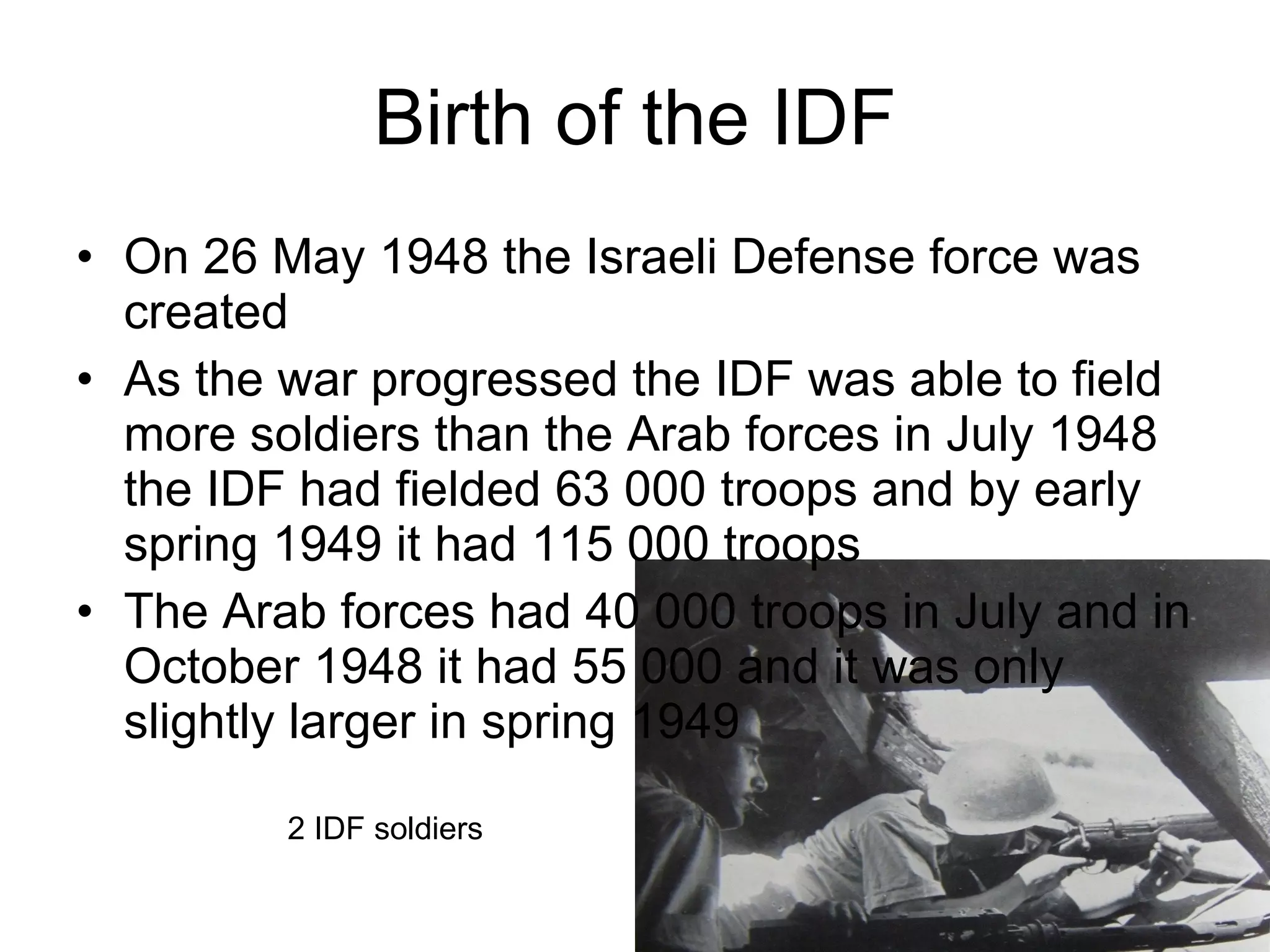
For the nascent Israeli Defense Forces (IDF), the situation was dire. The newly unified military force lacked heavy weaponry, armored vehicles, and an air force equivalent to the invading nations. The war was characterized by brutal defensive battles, most notably in the defense of Jewish settlements in the Negev, the outskirts of Jerusalem, and the Galilee.
Key Phases of the Conflict
The war is generally divided into several operational phases, influenced by diplomatic intervention and shifting momentum on the battlefield.
Initial Offensive and Defensive Struggles (May–June 1948)
During the first weeks, the IDF struggled to contain the invasion. The Iraqi and Jordanian Arab Legion forces exerted significant pressure on the Jerusalem corridor, eventually cutting off access to the city. The Egyptians pushed from the south, reaching the outskirts of what is now Ashdod, while Syrian forces engaged in the north.
The First Truce and Arms Procurement (June–July 1948)
A UN-brokered truce allowed both sides to regroup. During this lull, the Israeli government prioritized the importation of aircraft and artillery, significantly bolstering its military capabilities. When fighting resumed in July—the "Ten Days' Campaign"—the IDF successfully pushed back on several fronts, securing control of Lod, Ramle, and parts of the Galilee.
Operations and Territorial Consolidation (Late 1948–Early 1949)
As the war progressed, the IDF transitioned from a defensive posture to an offensive one. Operation Yoav and Operation Horev pushed Egyptian forces out of the Negev desert, effectively establishing Israeli control over the southern portion of the country. By the winter of 1949, the front lines had solidified, and the combatants began engaging in armistice negotiations.
Key Military and Strategic Components
| Aspect | Description |
|---|---|
| Primary Actors | Israel (IDF) vs. Egypt, Jordan, Syria, Lebanon, Iraq, and local Arab militia. |
| Duration | May 1948 – March 1949 (with formal armistice agreements concluding in July 1949). |
| Key Objectives (Israel) | Survival of the state, maintenance of sovereignty, breaking the siege of Jerusalem. |
| Key Objectives (Arab States) | Prevention of Israeli statehood, control of the former Mandatory territory. |
| Outcome | Israeli victory; control of approximately 78% of Mandatory Palestine. |
Humanitarian and Demographic Consequences
The 1948 war resulted in a monumental demographic shift. The conflict led to the displacement of hundreds of thousands of Palestinian Arabs, an event referred to in Arabic as the Nakba ("Catastrophe"). Estimates regarding the number of refugees vary widely due to the lack of census data at the time, but most historical records place the figure between 600,000 and 750,000.
Simultaneously, the war triggered an exodus of Jewish populations from various Arab and Muslim countries. Following the war, approximately 600,000 to 800,000 Jews fled or were expelled from their homes in North Africa and the Middle East, with the vast majority settling in the newly formed State of Israel. This two-way displacement fundamentally altered the demographic composition of the region and created a legacy of unresolved status and displacement issues that remain central to the Israeli-Palestinian conflict in 2026.
Diplomatic Resolution: The 1949 Armistice Agreements
The war did not end with a final peace treaty, but rather with a series of bilateral Armistice Agreements negotiated under UN mediation (led by Ralph Bunche). These agreements established the "Green Line," which served as the de facto border of Israel until the 1967 Six-Day War.
The agreements did not resolve core political disputes, such as the right of return for refugees or the final status of Jerusalem. Instead, they served as a military cessation of hostilities. Because no formal peace treaties were signed with neighboring states—with the exception of Egypt and Jordan decades later—the 1949 agreements left the region in a state of "neither war nor peace" for many years.
Legacy and Impact on Modern Israel
The 1948 War of Independence serves as the foundational narrative for the State of Israel. It cemented the concept of Ein Breira ("no choice"), a national ethos reflecting the belief that the state's survival necessitated a strong, self-reliant defense force.
For the state, the war provided the physical space required to absorb millions of immigrants in the following decades. However, the costs were immense. Thousands of Israeli soldiers and civilians perished, and the war left a legacy of regional hostility that shaped Israeli domestic and foreign policy for the next 78 years. In 2026, the historical analysis of the war remains a vibrant field, with scholars continuing to examine the military archives and political correspondence of the era to understand the complexities of the decisions made by leaders on all sides.
Frequently Asked Questions
What was the primary cause of the 1948 war? The war was primarily caused by the rejection of the UN Partition Plan (Resolution 181) by the Arab Higher Committee and neighboring Arab states, leading to an armed confrontation upon the end of the British Mandate.
What was the "Green Line"? The Green Line refers to the demarcation lines set by the 1949 Armistice Agreements. It defined the borders of Israel until 1967 and represents the boundary between Israel and the territories that came under control of Jordan (the West Bank) and Egypt (the Gaza Strip) post-1949.
Did the 1948 war include the whole of Mandatory Palestine? The war took place throughout much of the territory, though the areas that remained under Arab control (the West Bank and Gaza) were administered by Jordan and Egypt, respectively, following the conclusion of hostilities.
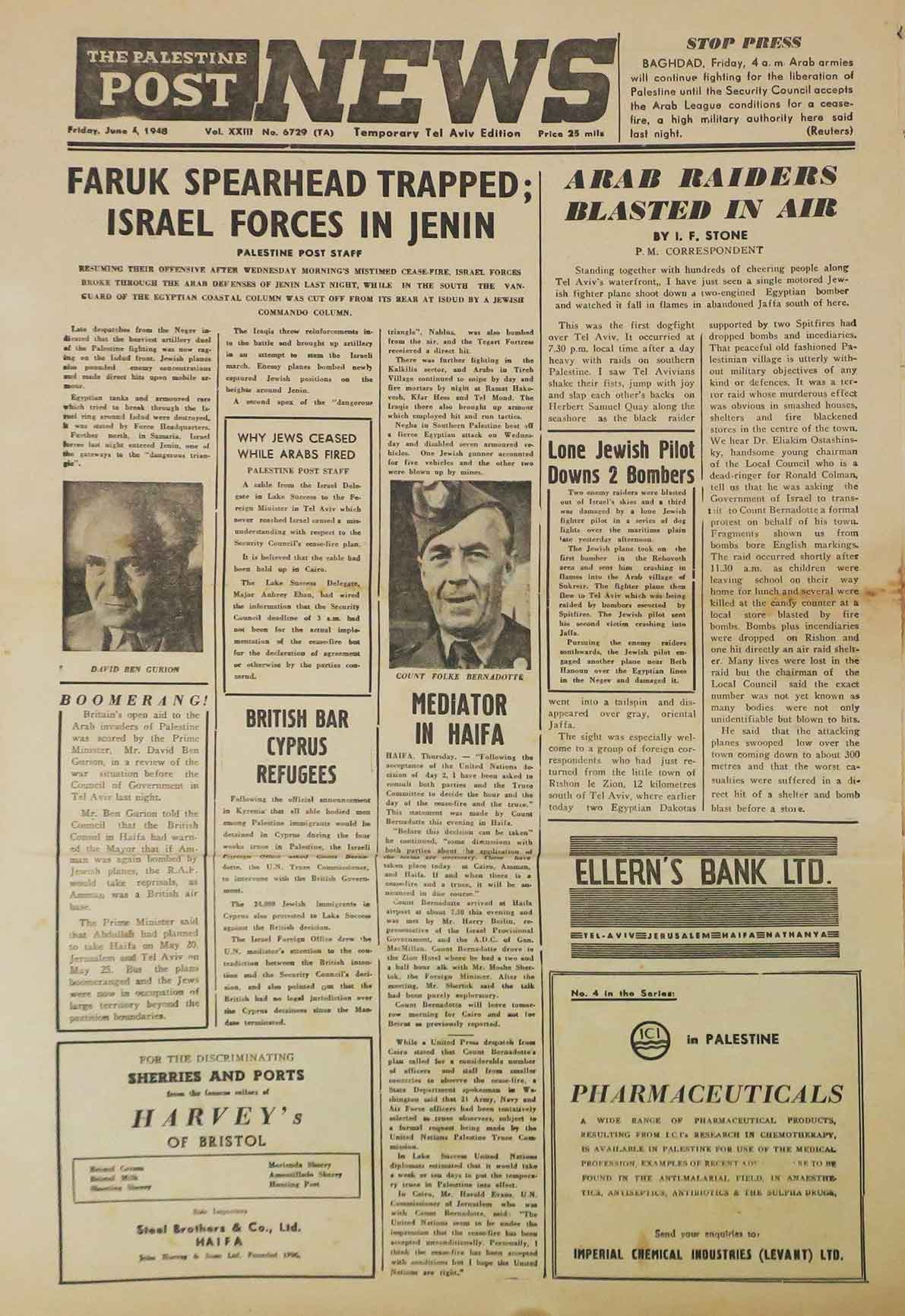
What was the role of the international community? The international community was primarily involved through the United Nations, which oversaw the initial partition proposal and later facilitated the armistice negotiations through the work of mediators like Count Folke Bernadotte and Ralph Bunche.
Why is it called the "War of Independence"? It is called the War of Independence because, for the Jewish population of Israel, the conflict was an existential struggle for the survival of their newly declared sovereign state and the realization of Zionist aspirations for national self-determination.
Next Steps for Historical Research
For those interested in exploring this period further, official records are preserved in the Israel State Archives and the Central Zionist Archives in Jerusalem. Researchers should prioritize primary sources such as cabinet minutes from 1948, operational military logs, and the text of the original armistice agreements, which remain the baseline for understanding the legal and territorial framework of the region.