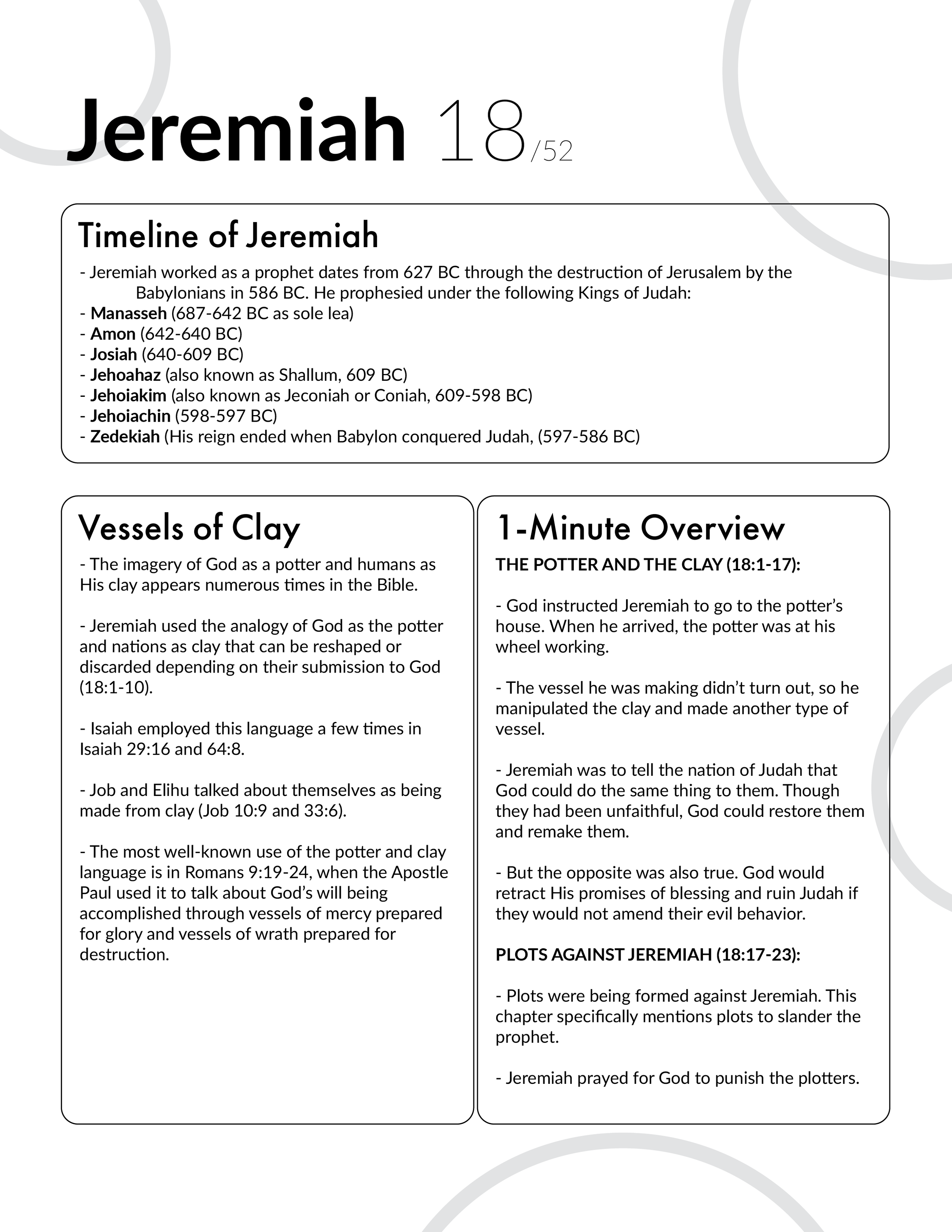
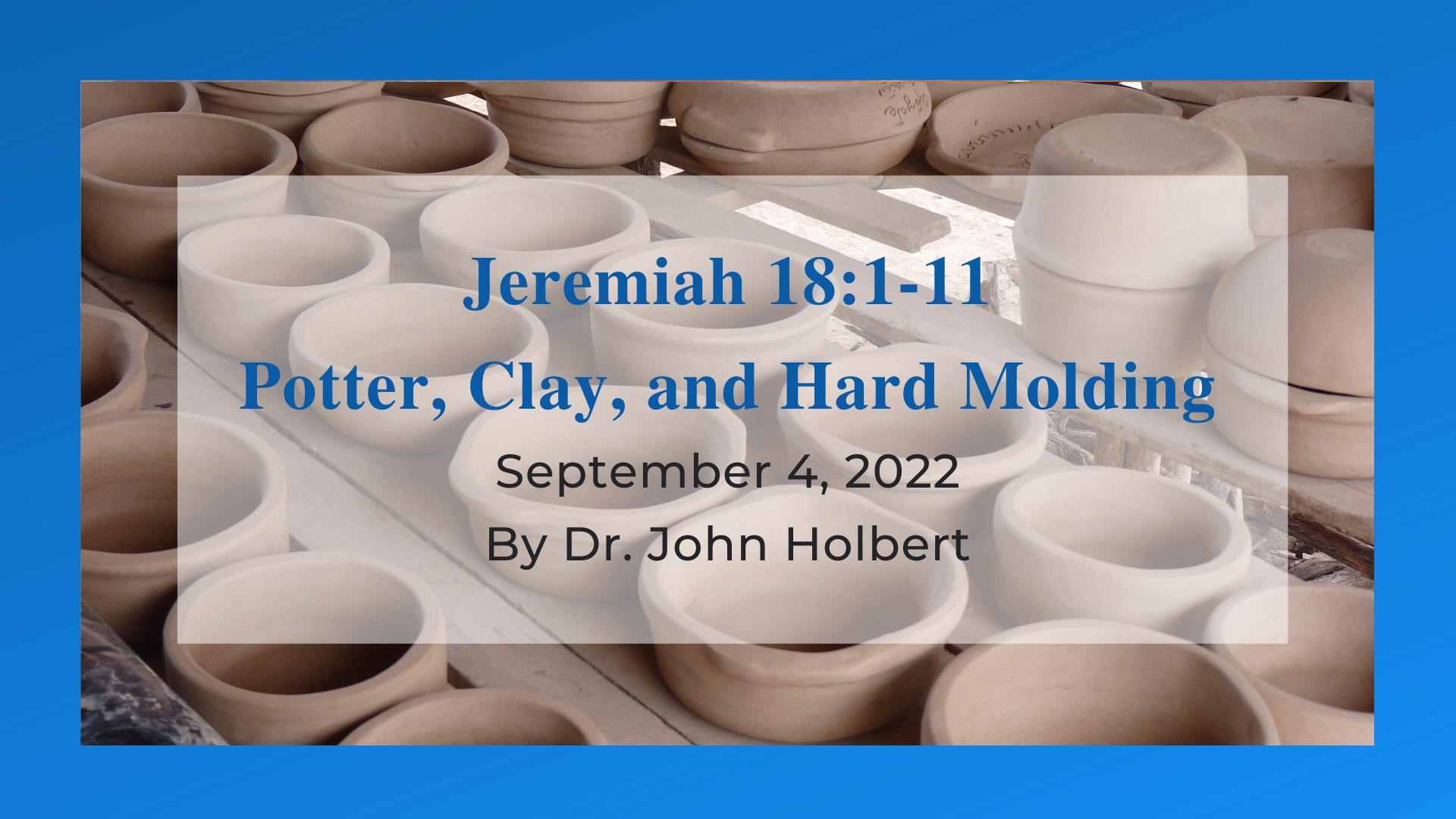
Jeremiah 18 presents a pivotal theological object lesson in which the prophet visits a potter’s house to observe clay being reshaped on the wheel, illustrating God's sovereign authority over nations, His responsiveness to human repentance, and the persistent stubbornness of the kingdom of Judah.
Introduction to Jeremiah 18: Context and Historical Setting
The biblical book of Jeremiah records the prophetic ministry of Jeremiah ben Hilkiah, who prophesied during the turbulent final decades of the Kingdom of Judah—from the thirteenth year of King Josiah’s reign (c. 627 BCE) through the fall of Jerusalem and the Babylonian exile in 586 BCE. Chapter 18 belongs to a collection of prophetic discourses, symbolic actions, and biographical narratives that highlight Judah's impending judgment due to covenant unfaithfulness, idolatry, and social injustice.
To understand the core message of Jeremiah 18, one must recognize the literary and historical framework of prophetic symbolism in the Ancient Near East. Prophets frequently used enacted parables—physical actions that dramatized divine messages—to jolt audiences out of spiritual complacency. By instructing Jeremiah to go down to the potter's house, God provides a vivid, tactile metaphor that bridges the gap between divine sovereignty and human moral accountability. Rather than presenting an abstract philosophical debate about predestination versus free will, the text offers a pastoral and prophetic appeal: divine judgment is not an unalterable fate, but a warning designed to provoke repentance and restoration.
The Metaphor of the Potter and the Clay (Jeremiah 18:1–6)
The chapter opens with a divine command directing Jeremiah's physical movement: "Arise, and go down to the potter's house, and there I will cause thee to hear my words" (Jeremiah 18:2, KJV). Upon arriving, Jeremiah observes a potter working at the wheel. The scene captures an ordinary, daily occupation of the ancient world and elevates it to a profound theological paradigm.
The Mechanics of Ancient Pottery and Theological Application
In ancient Judean culture, pottery production involved sourcing local clay, tempering it with water and organic material, kneading out air pockets, centering the lump on a stone wheel, and shaping it manually while spinning the wheel. Jeremiah watches as a vessel the potter is shaping becomes "marred in the hand of the potter" (Jeremiah 18:4). Crucially, the potter does not discard the ruined clay or abandon the project; instead, he remakes it into another vessel, "as seemed good to the potter to make."
| Potter's Action | Divine Principle |
|---|---|
| Sourcing the clay | God creating and establishing nations |
| Shaping on wheel | God governing, directing, and disciplining |
| Vessel is marred | Human rebellion, sin, and covenant breaking |
| Remaking the lump | Divine mercy, restructuring, and restoration |
God applies this observation directly to His relationship with the house of Israel in verse 6: "O house of Israel, cannot I do with you as this potter? saith the Lord. Behold, as the clay is in the potter's hand, so are ye in mine hand, O house of Israel." This declaration establishes two foundational theological truths:
- Absolute Sovereignty: As the Creator and Sustainer of the cosmos, God possesses absolute prerogative over the nations. He holds the sovereign right to raise up, establish, judge, or dismantle kingdoms according to His holy character and divine standard.
- Dynamic Relationship: Unlike lifeless clay molded by an indifferent craftsman, human beings possess moral agency. The metaphor does not imply rigid, unfeeling determinism; rather, it sets the stage for a conditional framework of divine interaction governed by human response.
The Conditional Principles of Divine Judgment and Blessing (Jeremiah 18:7–10)
Immediately following the potter illustration, God articulates the universal principles governing His interactions with nations and kingdoms. Verses 7 through 10 outline a symmetrical theological rule of engagement that balances divine sovereignty with human accountability.
The Rule of Re-evaluation
God explains that whenever He pronounces a sentence against a nation or kingdom—declaring that He will pluck it up, pull it down, or destroy it—that specific decree is fundamentally conditional. If that nation turns away from its evil, God relents regarding the disaster He planned to inflict. Conversely, when God promises to build and plant a nation, but that nation does evil in His sight and refuses to obey His voice, God reconsiders the good benefit He promised to bestow.
This passage demonstrates that biblical prophecy concerning judgment is rarely an unconditional, fatalistic decree. Instead, it functions as a moral warning. The primary purpose of announcing impending disaster is to avert it through repentance. The theological mechanism relies on divine justice intersecting with human moral responsibility, showing that God's character remains consistently responsive to the moral posture of His creation.
Judah's Stubborn Resistance and Alternative Plans (Jeremiah 18:11–17)
Moving from general theological principles to specific historical application, God commands Jeremiah to speak directly to the men of Judah and the inhabitants of Jerusalem. The message is stark: God is framing a disaster against them and devising a plan. He urges every individual to return from their evil way and amend their doings.
The Hardened Response of the People
The tragedy of Jeremiah 18 is captured in the unapologetic response of the populace in verse 12: "And they said, There is no hope: but we will walk after our own devices, and we will every one do the imagination of his evil heart." The phrase "There is no hope" (Hebrew: yi'ush) in this context does not express despair over sin; rather, it represents a cynical, defiant resignation. The people refuse to alter their behavior, effectively declaring that reform is useless, and stubbornly commit to following their own desires.
God uses a vivid agricultural and geographical comparison in verse 14 to highlight the irrationality of Judah's behavior:
- Does the snow of Lebanon fail to leave the rocks of the field?
- Do cold flowing waters from foreign sources dry up?
Yet, God's people have forgotten Him. They have burned incense to worthless idols, causing them to stumble in their ways and stray from the ancient paths to walk on unmarked roads. Consequently, their land becomes an object of horror and perpetual derision. As they flee from their enemies, God vows to scatter them "as with an east wind before the enemy," showing them His back rather than His face in the day of their calamity.
Jeremiah's Lament and Cry for Vengeance (Jeremiah 18:18–23)
The final section of Jeremiah 18 reveals the intense personal cost borne by the prophet. Faced with relentless opposition, the leaders of Judah plot against Jeremiah, demonstrating that the nation's spiritual corruption has reached the highest levels of society.
The Conspiracy Against the Prophet
In verse 18, the opponents of Jeremiah conspire: "Come, and let us devise devices against Jeremiah; for the law shall not perish from the priest, nor counsel from the wise, nor the word from the prophet. Come, and let us smite him with the tongue, and let us not give heed to any of his words."
The adversaries rest their false security on institutional status. They possess the temple priesthood, the royal advisors, and traditional prophecy, assuming God would never abandon His formal institutions, regardless of the moral corruption of the individuals operating them. They target Jeremiah's words, seeking to discredit his prophetic office through verbal slander and public opposition.
Jeremiah's Appeal to Divine Justice
Overwhelmed by betrayal, Jeremiah responds with an impassioned prayer that modern readers categorize among the "Jeremiah Laments" or imprecatory prayers. He asks God to pay attention to him and listen to what his adversaries are saying. He points out the injustice of their actions: after he stood before God to speak good on their behalf and turn away His wrath, they repaid his intercession by digging a pit for his life.
Jeremiah calls for divine judgment upon his persecutors, asking that their children be delivered over to famine, their husbands slain by the sword, and their homes left desolate. While these fierce appeals can trouble modern readers, they reflect the ancient prophetic identification with divine justice, where opposing God's true messenger was understood as rebellion against God Himself.
Comparative Analysis of Major Themes in Jeremiah 18
To grasp the full theological weight of Jeremiah 18, it is helpful to examine its core motifs alongside parallel biblical passages and historical frameworks.
| Theme | Biblical Expression in Jeremiah 18 | Theological Implication & Parallel Texts |
|---|---|---|
| Divine Sovereignty | God as the Potter shaping clay (vv. 4–6). | Absolute authority balanced with moral responsiveness (cf. Romans 9:20–21). |
| Conditional Prophecy | Warnings of judgment averted by repentance (vv. 7–10). | God's relenting in response to human turnabout (cf. Jonah 3:10; Ezekiel 18:30–32). |
| Covenant Stubbornness | Refusal to repent; walking in evil imagination (vv. 11–12). | Hardness of heart and rejection of divine instruction (cf. Zechariah 7:11–12). |
| Persecution of Truth | Plotting against Jeremiah's message (vv. 18–23). | Institutional corruption and rejection of prophetic witness (cf. Matthew 23:29–37). |
Common Misinterpretations and Theological Clarifications
When studying a summary of Jeremiah 18, readers frequently encounter several interpretive pitfalls regarding predestination, divine wrath, and prophetic prayers.
1. Deterministic Misreading of the Potter Metaphor
A common error is reading the potter and clay metaphor through a strictly Calvinist or deterministic lens that strips humanity of free will. While the Apostle Paul later uses the potter analogy in Romans 9 to emphasize absolute divine freedom in salvation history, Jeremiah 18 explicitly emphasizes conditional contingency. Verses 7 through 10 demonstrate that the clay's shape changes dynamically based on its response to the potter's hands. The passage teaches that God retains the sovereign right to judge or bless, but He exercises that right in dialogue with human repentance or rebellion.
2. Misunderstanding Imprecatory Laments
Another frequent challenge involves Jeremiah’s harsh petitions against his enemies in verses 21–23. Critics view these verses as contradictory to New Testament teachings on loving enemies. However, biblical scholars note that Jeremiah is not acting out of petty personal vengeance. As God’s covenant spokesperson, Jeremiah views the plot against his life as a direct assault on God's truth. His prayer delegates vengeance entirely to the divine courtroom, reflecting an urgent plea for ultimate justice in a society where earthly justice has entirely collapsed.
Practical Applications and Contemporary Relevance
Though rooted in ancient Near Eastern history, the principles of Jeremiah 18 offer enduring insights for contemporary readers across various ethical, spiritual, and communal contexts:
- Openness to Correction: Just as pliable clay yields to the pressure of the potter's hands, spiritual maturity requires humility and a willingness to undergo personal transformation, correction, and moral refinement.
- The Urgency of Repentance: The chapter warns against presuming upon institutional safety, religious heritage, or moral complacency. True security is found in active alignment with divine truth and righteousness.
- Resilience in Public Witness: Jeremiah’s experience provides a pastoral model for individuals facing opposition, slander, or professional backlash for standing up for truth. It demonstrates that suffering for a principled stance is a recurrent reality in prophetic history.
Frequently Asked Questions
What is the main message of Jeremiah 18?
The main message of Jeremiah 18 is that God, acting like a potter shaping clay, holds absolute sovereignty over nations. However, His decrees of judgment or blessing are conditional, responding directly to whether people repent of their wickedness or persist in rebellion against Him.
How does the potter and clay metaphor apply to free will?
The metaphor illustrates that while God is the ultimate authority who sets the parameters of history, human beings retain moral agency. The clay's shape changes based on its responsiveness, showing that divine judgment serves as a warning designed to provoke repentance rather than an unalterable fate.
Why did the people of Judah reject Jeremiah’s message?
The people rejected Jeremiah's call to repentance because they suffered from moral hardening and spiritual arrogance. Trusting in their religious institutions and their own desires, they defiantly declared that reform was impossible and chose to follow their own stubborn hearts.
What are the "Laments of Jeremiah" found at the end of Chapter 18?
At the end of the chapter (verses 18–23), Jeremiah responds to a conspiracy against his life by pouring out his anguish to God. He laments that his intercessory prayers for Judah were met with hostility and asks God to hold his persecutors accountable for their wicked plots.
How does the New Testament reference the potter and clay metaphor?
The Apostle Paul draws upon the imagery of Jeremiah and Isaiah in Romans 9:20–21 to emphasize God's absolute sovereignty as the Creator over humanity, illustrating that humans have no right to question God's ultimate purposes in salvation history.
Conclusion and Next Actions
Jeremiah 18 bridges divine sovereignty and human responsibility through an unforgettable visual lesson at the potter's house. To apply the lessons of this chapter effectively, examine areas of personal or communal life where stubborn habits may have caused spiritual rigidity. Cultivate a posture of responsiveness to moral correction, and recognize that divine warnings are gracious invitations to return to righteousness before judgment falls.