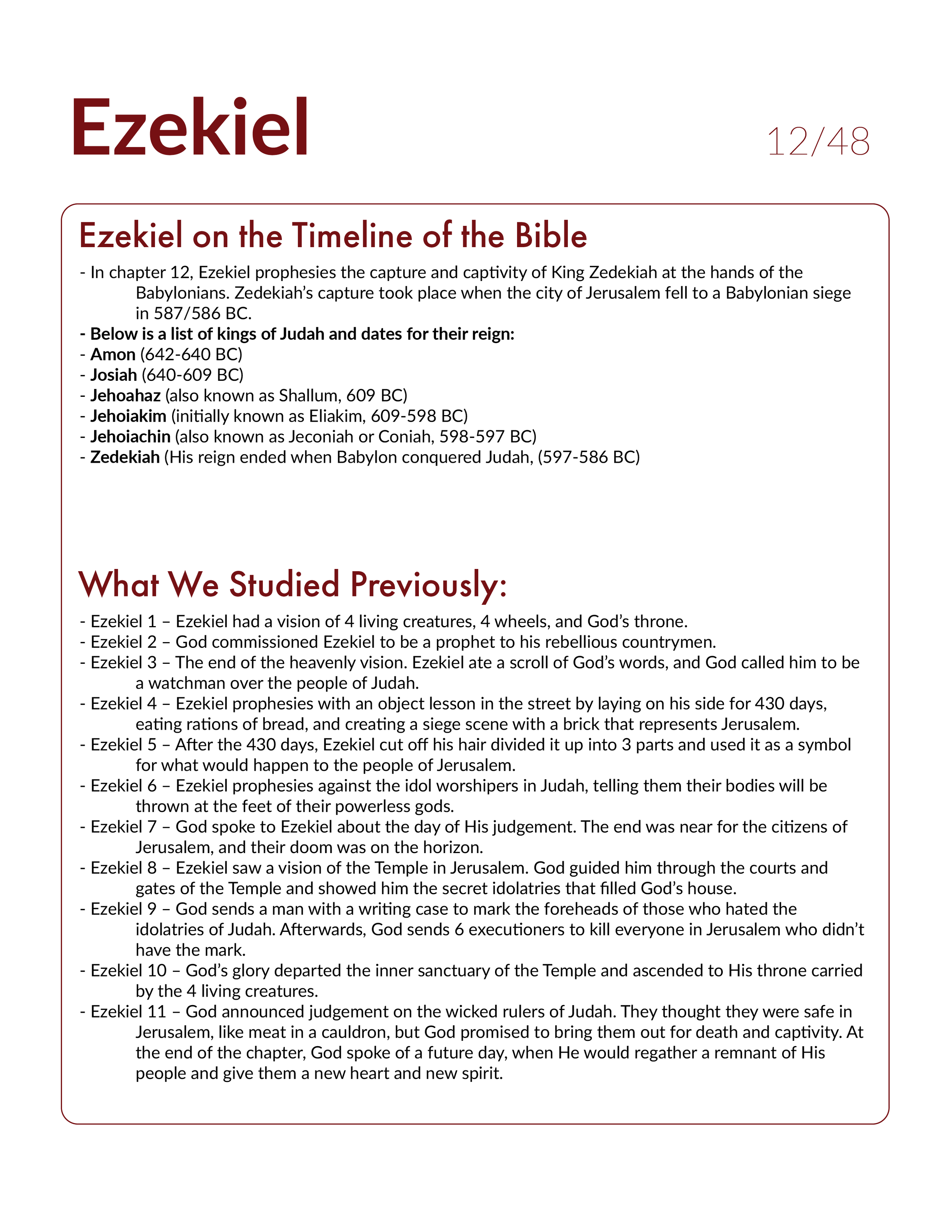
1 Ezekiel 12 delivers a vivid prophetic enactment by the priest and prophet Ezekiel to illustrate the impending doom, capture, and deportation of Jerusalem’s residents by the Babylonian Empire. Set during the sixth century BCE exile, the chapter combines dramatic street theater with direct divine oracles to shatter the false hopes of unrepentant Israelites living both in exile and back in Judah.
Historical and Theological Context of Ezekiel 12
Understanding 1 Ezekiel 12 requires stepping back into the tumultuous geopolitical landscape of the ancient Near East during the early sixth century BCE. The Neo-Babylonian Empire, under the aggressive leadership of King Nebuchadnezzar II, had already launched campaigns against the Kingdom of Judah. In 597 BCE, Nebuchadnezzar besieged Jerusalem, captured King Jehoiachin, and carried away a significant wave of Judean elites, craftsmen, and nobility into exile by the Kebar River in Mesopotamia. Ezekiel, himself a priest from the lineage of Zadok, was among these early deportees.
Back in Jerusalem, a puppet king named Zedekiah reigned under Babylonian oversight, while the remaining population and political factions nursed dangerous delusions. Many wrongly believed that because the grand temple of Yahweh stood untouched in Jerusalem, divine protection was guaranteed, and the Babylonian threat would soon evaporate. Other false prophets actively fed these illusions, preaching peace and stability.
Ezekiel’s prophetic ministry directly challenged this cognitive dissonance. Chapters 8 through 11 of the book depict Ezekiel experiencing a visionary journey to Jerusalem, where he witnesses rampant idolatry within the temple precincts, leading to the departure of the glory of God. Building upon this spiritual diagnosis, 1 Ezekiel 12 shifts from visionary judgment to tangible, inescapable physical reality. The chapter serves as a stark wake-up call, bridging the gap between abstract theological warnings and the hard geopolitical consequences of rebellion against God and broken covenants.
The Sign of the Exile's Baggage: Verses 1–16
The opening section of the chapter outlines a multi-part prophetic drama commanded directly by God. Ezekiel is instructed to act out the plight of a captive before the eyes of his fellow exiles.
| Prophetic Action | Historical/Spiritual Significance |
|---|---|
| Packing exile baggage | Simulates the sudden, mandatory displacement of Judeans. |
| Digging through the wall | Represents secret escape under siege conditions. |
| Covering the face | Symbolizes blindness, shame, and Zedekiah's blinding. |
| Eating trembling food | Depicts the anxiety, starvation, and fear of siege. |
The Daytime Preparation
God addresses Ezekiel, noting that he lives among a "rebellious house" that has eyes to see but refuses to see, and ears to hear but refuses to hear. To penetrate this stubbornness, Ezekiel must pack his belongings for exile during broad daylight, serving as visual preparation for the community.
The Evening Departure
As evening falls, while the exiles watch, Ezekiel digs through the mud-brick wall of his dwelling. He hoists his baggage onto his shoulder and steps out into the night with his face covered so he cannot see the ground. God explains that this pantomime is a sign to the house of Israel.
Application to King Zedekiah
The enactment directly foreshadows the fate of King Zedekiah and the citizens of Jerusalem. When the final Babylonian siege breaches Jerusalem's walls in 586 BCE, the leaders will desperately pack their belongings, break through city defenses by night, and attempt flight. Yet, as Ezekiel explicitly prophesies, Zedekiah will be captured near the plains of Jericho, brought before Nebuchadnezzar at Riblah, judged, and taken to Babylon—though he will never see the land, fulfilling the enigmatic prophecy that he would die there without seeing it. Meanwhile, the general populace and military defenders will be scattered to the winds, with the sword pursuing them.
The Parabolic Warning of Anxiety and Rations: Verses 17–20
Following the enactment of the exile's baggage, 1 Ezekiel 12 features a shorter, equally stark oracle regarding the daily conditions of upcoming judgment.
God tells Ezekiel to eat his food with trembling and to drink his water with anxiety and dismay. When the people of the land ask what this behavior means, the prophet is directed to deliver an uncompromising message about the inhabitants of Jerusalem and the land of Israel. The daily bread will be eaten with anxiety, and the water will be drunk in horror because their land will be stripped bare of everything it contains on account of the violence of all who dwell in it.
This passage emphasizes that the judgment is not merely political displacement; it is the comprehensive disruption of ordinary human life. The psychological toll of a prolonged military siege—marked by strict rationing, terror, and the collapse of the agricultural economy—is brought home to the exiles. God underscores that abundance and security are gifts tied to covenant faithfulness, and persistent rebellion strips a society of its fundamental stability.
Deconstructing Popular Proverbs: Verses 21–28
The final segment of the chapter addresses the psychological and theological pushback Ezekiel received from his audience. Humans facing crisis often invent coping mechanisms, and the Judean exiles were no exception.
The Proverb of Delay
Two specific proverbs circulated among the populace, which God commands Ezekiel to dismantle:
- "The days go by and every vision comes to nothing."
- "The visions that Ezekiel sees are for many years from now, and he prophesies about the distant future."
The exiles used these rationalizations to dismiss immediate accountability. By pushing the fulfillment of prophetic warnings into a distant, indefinite future, they felt free to continue their compromised lifestyles without fear of immediate consequences.
The Divine Rebuttal
God counters these complacent proverbs with absolute finality. Through Ezekiel, the divine message is clear: "None of my words will be delayed any longer; whatever I say will be fulfilled."
This declaration draws a sharp line between genuine divine revelation and wishful thinking. In biblical theology, God's patience is not perpetual absence of justice; rather, it is an opportunity for repentance. When a society repeatedly spurns grace, a point of irreversibility is reached. Ezekiel's contemporaries would live to see the fulfillment of the words in their own lifetimes, proving that divine speech carries active, creative, and executive power.
Key Themes Explored in 1 Ezekiel 12
A deep reading of this chapter reveals several recurring theological and anthropological motifs foundational to the prophetic literature of the Hebrew Bible.
- Auditory and Visual Stubbornness: The repeated motif of having eyes but not seeing highlights a profound spiritual hardening. Sin is portrayed not merely as a moral failure, but as a cognitive distortion that blinds people to objective reality.
- The Reality of Consequences: Prophecy in the Hebrew Bible is conditional upon repentance, but when generations pass the tipping point of persistent rebellion, prophecy shifts from warning to deterministic certainty.
- Corporate and Individual Responsibility: While kings like Zedekiah bear unique accountability for political failure, the entire community shares in the suffering caused by systemic societal violence and idolatry.
Frequently Asked Questions
What is the main point of 1 Ezekiel 12?
The primary point is to forcefully debunk the false hopes of the Judean exiles and Jerusalem residents, assuring them through prophetic enactment and direct speech that the destruction of Jerusalem and the exile of King Zedekiah are imminent and unavoidable.
How does Ezekiel act out the exile in this chapter?
Ezekiel packs his belongings by day, digs a hole through the mud wall of his house at dusk, hoists his baggage onto his shoulder, and walks out into the night with his face covered, symbolizing the terror, secrecy, and suddenness of the flight from a besieged Jerusalem.
Who was King Zedekiah in relation to this prophecy?
Zedekiah was the final king of Judah before the Babylonian destruction of Jerusalem in 586 BCE. Ezekiel’s prophecy accurately foreshadowed his desperate night escape from the besieged city, his subsequent capture, and his exile to Babylon without seeing the land.
Why did the Israelites doubt Ezekiel’s prophecies?
The Israelites doubted Ezekiel because they believed Jerusalem was permanently safe due to the presence of the temple, and they comforted themselves with proverbs claiming that prophetic visions would only come to pass in the distant future.
How does 1 Ezekiel 12 relate to the rest of the book of Ezekiel?
It serves as the bridge between Ezekiel’s visions of temple corruption and divine departure (Chapters 8–11) and the historical reality of the siege of Jerusalem recorded later in Chapter 24, reinforcing the integrity and accuracy of the prophetic word.
Practical Takeaways and Next Actions
For modern readers, students of ancient history, and theologians examining 1 Ezekiel 12, the text provides a timeless reminder about the danger of willful blindness and the certainty of moral accountability.
- Examine Assumptions: Evaluate personal or cultural habits of dismissing long-term consequences in favor of short-term comfort.
- Value Truth Over Comfort: Resist the temptation to embrace comforting falsehoods simply because they align with desired outcomes.
- Contextualize History: Read prophetic texts within their precise ancient Near Eastern historical contexts to appreciate both their original audience's experience and their literary craft.