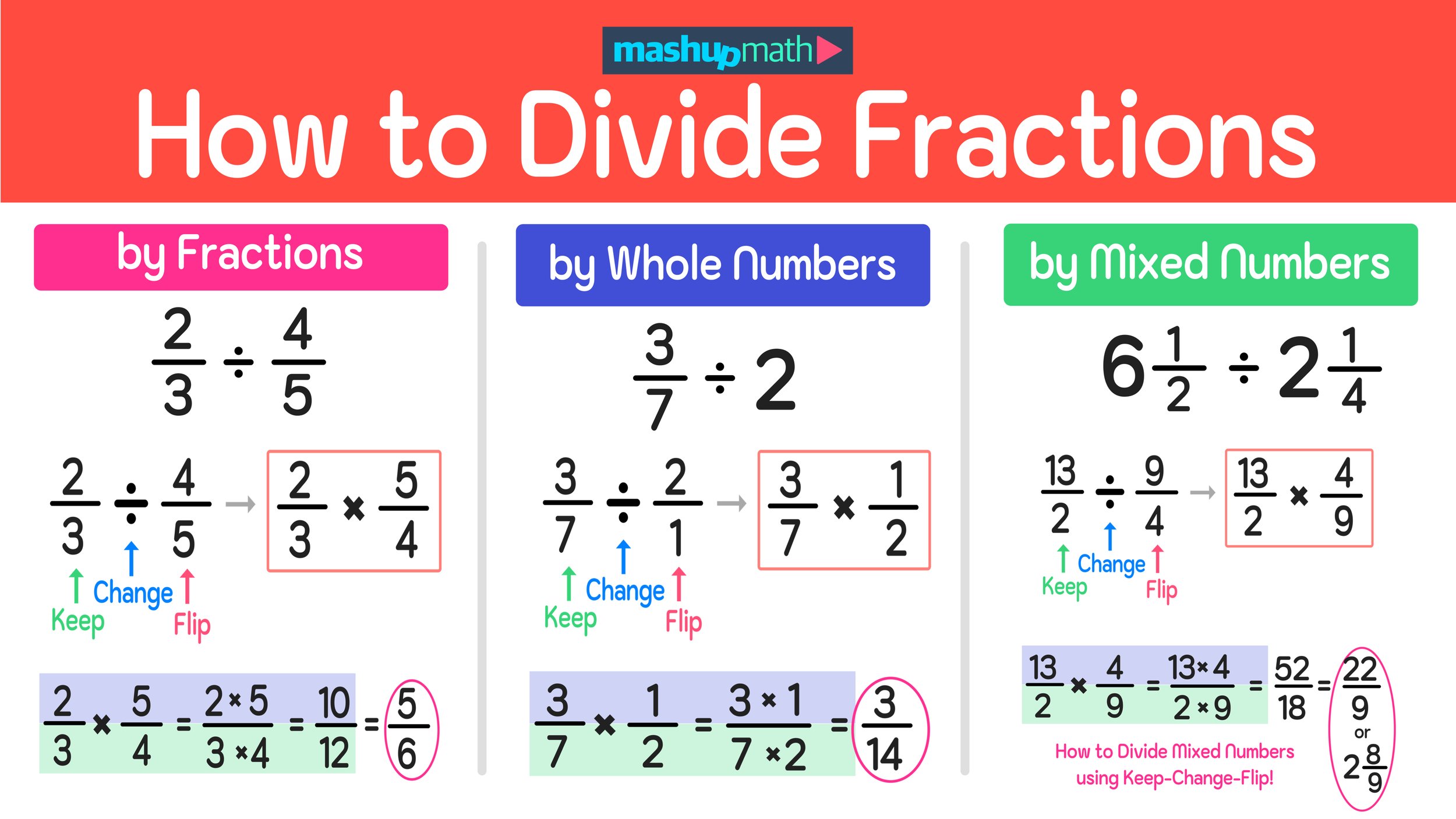
The result of dividing 1/3 by 2 is 1/6. To solve this, you treat the whole number 2 as the fraction 2/1, find its reciprocal (1/2), and multiply it by the original fraction. This process, known as the "Keep, Change, Flip" method, yields a numerator of 1 and a denominator of 6.
Calculating fractions is a fundamental skill in mathematics that extends far beyond the classroom. Whether you are scaling down a recipe in 2026, adjusting measurements for a home improvement project, or analyzing data in a professional setting, understanding the relationship between parts and wholes is essential. While a calculator can provide a quick answer, understanding the underlying logic of why 1/3 divided by 2 equals 1/6 ensures that you can handle more complex algebraic equations and real-world problem-solving scenarios with confidence.
The Mathematical Components of the Problem
To solve the expression "1/3 divided by 2," we must first identify the mathematical roles of each number. In any division problem, there are two primary entities: the dividend and the divisor.
- The Dividend (1/3): This is the number that is being divided. In our case, it is a proper fraction where the numerator (1) is smaller than the denominator (3). This represents one-third of a whole unit.
- The Divisor (2): This is the number by which the dividend is being divided. Even though it is a whole number, in the world of fraction arithmetic, it is helpful to view every whole number as having an implicit denominator of 1. Therefore, 2 is equivalent to the fraction 2/1.
The goal is to determine how many times the divisor fits into the dividend, or more practically in this case, what one-half of one-third actually represents.
The Step-by-Step Calculation: Keep, Change, Flip
The most reliable method for dividing fractions is the "invert and multiply" strategy, colloquially known by many students and educators as Keep, Change, Flip. This method simplifies the division process into a multiplication problem, which is generally easier to execute.
Step 1: Keep the First Fraction
The first step is to "keep" the dividend exactly as it is. In this problem, the dividend is 1/3. You do not change the numerator or the denominator at this stage.
Step 2: Change the Operation
Division is the inverse operation of multiplication. To solve the problem using the reciprocal, we must "change" the division sign (÷) to a multiplication sign (×).
Step 3: Flip the Second Number
This is where we find the reciprocal of the divisor. A reciprocal is what you get when you switch the numerator and the denominator of a fraction.
- First, express the whole number 2 as a fraction: 2/1.
- Next, "flip" it to find the reciprocal: 1/2.
Step 4: Multiply and Simplify
Now that the problem has been transformed from "1/3 ÷ 2" to "1/3 × 1/2," you simply multiply across the numerators and denominators.
- Multiply the Numerators: 1 × 1 = 1
- Multiply the Denominators: 3 × 2 = 6
The resulting fraction is 1/6. Since 1 and 6 have no common factors other than 1, the fraction is already in its simplest form.
Visualizing the Division: The Pizza Analogy
Mathematics is often easier to grasp when visualized through physical objects. Imagine you have a pizza that has been cut into three equal slices. You currently have only one of those slices remaining, which represents 1/3 of the original pizza.
Now, suppose you want to share that remaining 1/3 slice equally with a friend. You are dividing that 1/3 portion by 2. When you cut that single slice (which was 1/3 of the whole) directly in half, what size is the resulting piece in relation to the original, full pizza?
If you were to cut every 1/3 slice of the original pizza in half, you would end up with 6 equal pieces in total. Therefore, the half-slice you are left with is exactly 1/6 of the entire pizza. This visualization confirms that dividing a third into two parts results in a sixth.
The Role of the Reciprocal in Division
Why do we flip the second fraction? This is a common point of confusion. In mathematics, dividing by a number is the exact same thing as multiplying by its multiplicative inverse (the reciprocal).
The concept of the reciprocal is rooted in the identity property of multiplication, which states that any number multiplied by its reciprocal equals 1. For example, $2 \times 1/2 = 1$.
When we divide 1/3 by 2, we are essentially asking, "What is one-half of one-third?" In mathematical language, the word "of" almost always signifies multiplication. Therefore, "half of a third" becomes $1/2 \times 1/3$. Whether you approach it as division or multiplication by a reciprocal, the logic remains consistent and the answer remains 1/6.
Converting the Result: Decimals and Percentages
In some technical or scientific fields, you may need to represent the result of 1/3 divided by 2 as a decimal or a percentage rather than a fraction.
Decimal Conversion
To convert 1/6 into a decimal, you divide the numerator by the denominator ($1 \div 6$).
- 1 divided by 6 is approximately 0.1666...
- This is a repeating decimal, often written as $0.1\bar{6}$ in mathematical notation.
Percentage Conversion
To convert the result into a percentage, multiply the decimal by 100.
- $0.1666... \times 100 = 16.67%$ (rounded to two decimal places).
Understanding these conversions is useful for interpreting data. For instance, if a project is one-third complete and you divide the remaining task into two equal phases, each phase represents approximately 16.67% of the total project scope.
Common Mistakes When Dividing Fractions by Whole Numbers
Even though the process is straightforward, several common errors can lead to the wrong answer. Identifying these pitfalls is the best way to ensure accuracy.
- Forgetting to Flip the Divisor: A common mistake is to simply multiply the fractions without finding the reciprocal. This would lead to $1/3 \times 2 = 2/3$, which is incorrect. Remember, dividing by 2 should result in a smaller number, not a larger one.
- Flipping the Dividend Instead: Some students accidentally flip the first fraction instead of the second. This would result in $3/1 \times 2 = 6$, which is the answer for $2 \div (1/3)$, not $1/3 \div 2$.
- Only Dividing the Denominator: Occasionally, people might try to divide the denominator by the whole number (e.g., $1 / (3 \div 2)$), leading to $1/1.5$, which is cumbersome and mathematically non-standard.
- Misidentifying the Whole Number: It is vital to remember that 2 is $2/1$, not $1/2$. The "flip" happens after you identify the whole number as a fraction.
Comparison Table: Operations with 1/3 and 2
To see how division fits into the broader context of arithmetic, consider the following table comparing different operations using the same two numbers.
| Operation | Mathematical Expression | Process | Result (Fraction) | Result (Decimal) |
|---|---|---|---|---|
| Division | $1/3 \div 2$ | $1/3 \times 1/2$ | 1/6 | 0.1667 |
| Multiplication | $1/3 \times 2$ | $1/3 \times 2/1$ | 2/3 | 0.6667 |
| Addition | $1/3 + 2$ | $1/3 + 6/3$ | 7/3 (or 2 1/3) | 2.3333 |
| Subtraction | $2 - 1/3$ | $6/3 - 1/3$ | 5/3 (or 1 2/3) | 1.6667 |
| Inverse Division | $2 \div 1/3$ | $2/1 \times 3/1$ | 6/1 (or 6) | 6.0000 |
Practical Applications in 2026
In the year 2026, the need for quick mental math and fractional understanding remains high in several specialized and everyday areas.
Culinary Arts and Home Cooking
If a recipe serves six people and calls for 1/3 cup of a specific spice, but you are only cooking for three people, you need to cut the recipe in half. Dividing 1/3 by 2 tells you that you only need 1/6 cup of that spice.
Construction and DIY
If you have a wooden plank that is 1/3 of a meter long and you need to cut it into two equal pieces for a symmetrical design, each piece must be exactly 1/6 of a meter. Precision in these calculations prevents material waste.
Financial Budgeting
Suppose 1/3 of a monthly budget is allocated to "Discretionary Spending," and that category is split equally between two different hobbies. Each hobby then receives 1/6 of the total monthly budget.
Troubleshooting Complex Fractions
Sometimes you may encounter "1 3 divided by 2" written in a way that suggests a mixed number. If the input was intended to be 1 and 3/x, the calculation would change significantly.
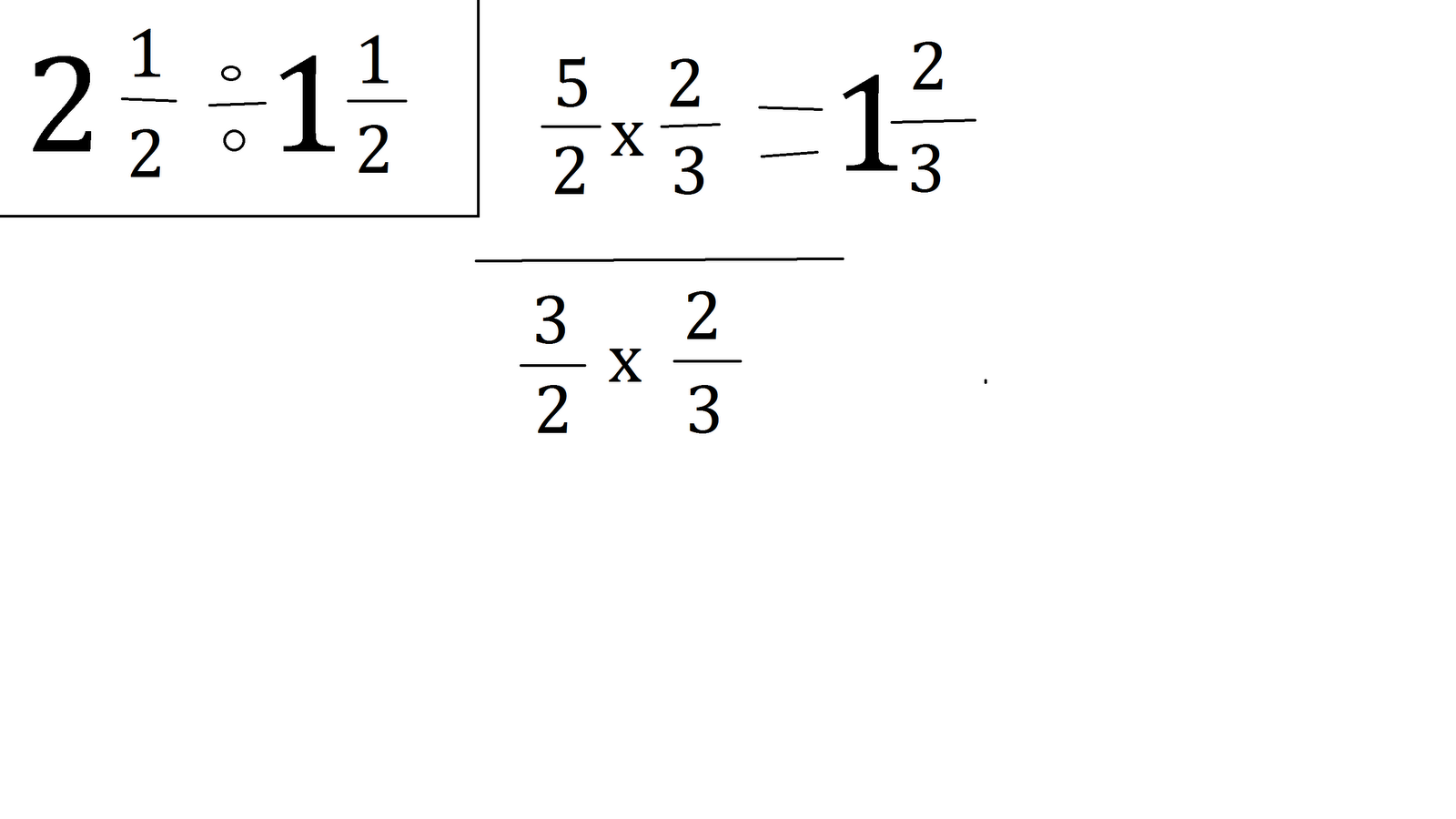
However, assuming the intent is the literal division of the fraction 1/3 by the integer 2, the "Keep, Change, Flip" method is the gold standard. If you encounter a problem where the dividend is a mixed number (like 1 and 1/3), you must first convert it to an improper fraction ($4/3$) before proceeding with the division by 2 ($4/3 \times 1/2 = 4/6 = 2/3$).
Advanced Context: Dividing by Fractions vs. Whole Numbers
It is worth noting the difference in outcome when the divisor is a fraction versus when it is a whole number.
- When you divide by a whole number greater than 1 (like 2), the quotient (the result) will be smaller than the original dividend. (1/6 is smaller than 1/3).
- When you divide by a proper fraction (like 1/2), the quotient will be larger than the original dividend. For example, $1/3 \div 1/2 = 2/3$.
This is a helpful "sanity check" to perform after completing a calculation. Since we divided 1/3 by a whole number (2), our answer of 1/6 correctly shows a decrease in value.
Frequently Asked Questions
Is 1/3 divided by 2 the same as 1/3 of 2?
No. The phrase "1/3 of 2" implies multiplication ($1/3 \times 2$), which equals 2/3. Dividing 1/3 by 2 is asking for half of one-third, which equals 1/6. The order of numbers and the wording of the operation significantly change the outcome.
How do I divide 1/3 by 2 on a standard calculator?
To perform this on a calculator, you should first convert 1/3 to its decimal form by entering $1 \div 3$, which gives you 0.3333. Then, divide that result by 2. The calculator will display 0.1666667, which is the decimal equivalent of 1/6.
Can I simplify 1/6 any further?
No, 1/6 is in its simplest form. A fraction is fully simplified when the numerator and denominator have no common factors other than 1. Since 1 is the numerator, no further reduction is possible.
What if the problem was 2 divided by 1/3?
If the numbers were reversed, you would keep the 2 (as 2/1), change the sign to multiplication, and flip 1/3 to 3/1. The calculation would be $2/1 \times 3/1 = 6$. This is a very different result, highlighting that division is not commutative; the order of numbers matters.
Why is 1/6 smaller than 1/3?
In fractions, a larger denominator means the "whole" is being divided into more pieces. Because the whole is divided into 6 pieces instead of 3, each individual piece is smaller. Therefore, 1/6 is half the size of 1/3.
Recommendation for Accuracy
When working with fractions, always double-check your result by multiplying the quotient by the divisor. In this case, multiply 1/6 (the answer) by 2 (the divisor).
- $1/6 \times 2 = 2/6$
- $2/6$ simplifies to 1/3
Because this multiplication returns you to your original dividend, you can be 100% certain that the calculation is correct. For ongoing math success, practice converting whole numbers to fractions ($x/1$) as your very first step to avoid confusion during the "flip" phase of the operation.