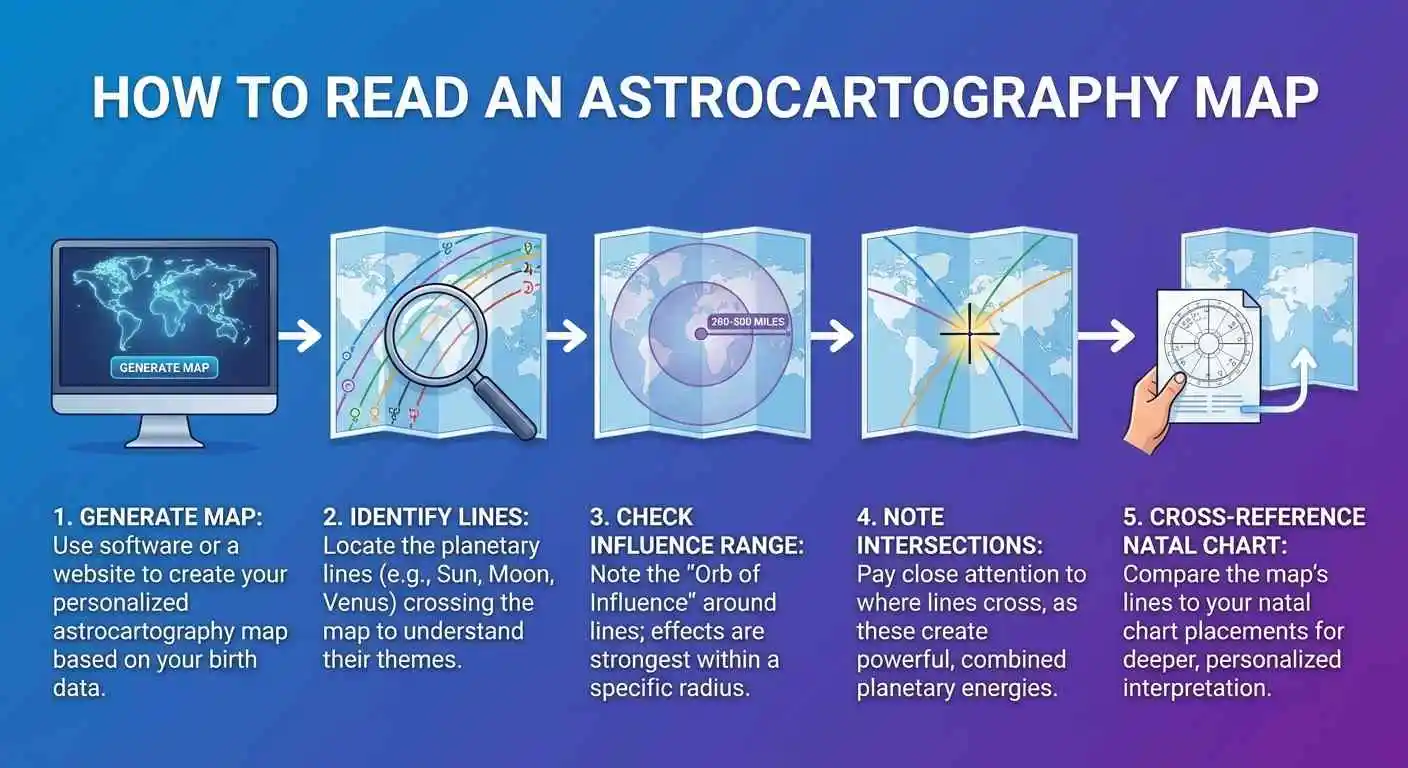
Astrocartography maps are specialized astrological tools that project your birth chart onto a geographic map to identify locations where specific planetary influences are strongest. By calculating where planets were rising, setting, or culminating at the exact moment of your birth, these maps highlight "power lines" that can indicate where you might experience success in career, love, or personal transformation.
As we move through 2026, the use of locational astrology has evolved from a niche practice into a mainstream tool for digital nomads, expatriates, and anyone seeking a deeper connection to their environment. Understanding an astrocartography map requires more than just looking at colorful lines on a screen; it demands an integration of technical astrological principles with practical life goals.
The Foundations of Astrocartography Maps
Astrocartography, a term popularized and trademarked by the late Jim Lewis in the 1970s, is technically known as locational astrology. While traditional astrology focuses on when events might happen, astrocartography focuses on where they are most likely to manifest.
The core premise is based on the idea that your natal chart—the snapshot of the sky at your birth—is not static. As the Earth rotates, the positions of the planets relative to the horizon and the meridian change. An astrocartography map calculates these positions across the entire globe simultaneously. If you were born in New York, the Sun might have been in your 10th House (career), but at that same moment, in Tokyo, the Sun was rising on the Eastern horizon. Astrocartography maps these specific geographic longitudinal and latitudinal points to show you where every planet in your chart "hits" one of the four cardinal angles of the sky.
The Significance of Jim Lewis and Modern Evolution
Before the digital age, calculating these maps was an arduous process involving spherical trigonometry and manual plotting. Jim Lewis revolutionized the field by using early computer technology to generate world maps overlaid with planetary lines. Today, in 2026, high-powered software and accessible web interfaces like Astro.com and Astro-Seek allow anyone with an accurate birth time to generate these maps in seconds. However, the interpretation remains a complex art that combines psychology, geography, and ancient Hellenistic and modern astrological techniques.
Decoding the Four Cardinal Angles
When you look at an astrocartography map, you will notice four primary abbreviations attached to every planetary line: AC, DC, MC, and IC. These represent the "angles" of the chart, and they dictate how a planet’s energy will manifest in a specific location.
1. The Ascendant (AC) Line: The Self and Vitality
The AC line represents the point where a planet was rising on the eastern horizon at your birth. This is the most personal angle. When you live or travel near an AC line, you embody the qualities of that planet. People will perceive you through the lens of that planet, and you will likely feel a surge in physical energy and self-expression related to its nature.
2. The Descendant (DC) Line: Relationships and Others
The DC line marks where a planet was setting on the western horizon. This angle governs your interactions with other people, including romantic partners, business associates, and even "open enemies." Living on a DC line often draws people into your life who embody that planet's energy, or it highlights your own needs within a partnership.
3. The Midheaven (MC) Line: Career and Public Image
The MC line is the highest point a planet reaches in the sky (culmination). This is the angle of "doing" rather than "being." It governs your reputation, career trajectory, and social status. If you are looking to advance your professional life or gain public recognition, MC lines are the primary areas to investigate on your map.
4. The Imum Coeli (IC) Line: Home and Foundations
The IC line (Latin for "Bottom of the Sky") represents the lowest point of the meridian. This angle is deeply internal, governing your sense of belonging, your home life, your ancestry, and your private self. IC lines are ideal for retirement, starting a family, or engaging in deep psychological or spiritual "inner work."
Planetary Line Interpretations
Every planet carries a different "signature." When combined with the angles mentioned above, they create a specific environmental "vibe."
| Planet | Core Theme | Best Used For | Potential Challenges |
|---|---|---|---|
| Sun | Identity, Vitality | Self-confidence, leadership, being seen. | Ego conflicts, overexposure. |
| Moon | Emotion, Nurturing | Finding a home, emotional security, family. | Hypersensitivity, mood swings. |
| Mercury | Communication | Writing, teaching, commerce, local travel. | Mental restlessness, anxiety. |
| Venus | Love, Money | Romance, luxury, artistic pursuits, ease. | Overindulgence, laziness. |
| Mars | Action, Drive | Physical fitness, starting a business, ambition. | Conflict, accidents, irritability. |
| Jupiter | Expansion, Luck | Education, wealth, spirituality, growth. | Excess, unrealistic expectations. |
| Saturn | Structure, Duty | Hard work, discipline, building long-term. | Heavy burdens, loneliness, delays. |
| Uranus | Innovation, Change | Breaking patterns, technology, rebellion. | Instability, sudden disruptions. |
| Neptune | Spirituality, Dreams | Creative arts, healing, mysticism. | Confusion, escapism, lack of boundaries. |
| Pluto | Transformation | Power, deep healing, total rebirth. | Intensity, power struggles, crisis. |
Beneficial vs. Challenging Lines
While many people seek out "Venus MC" lines for fame and fortune or "Jupiter AC" lines for happiness, every line has a shadow side. For example, a Jupiter line can lead to over-expansion or financial carelessness if the natal Jupiter is poorly placed. Conversely, a Saturn line, often feared for its association with hard work, can be the perfect place for a writer to finish a novel or for a professional to establish a rock-solid reputation through disciplined effort.
In 2026, professional astrocartographers increasingly emphasize the "Natal Context." This means that if your birth chart shows a very difficult Mars (e.g., Mars in Fall or harshly aspected), moving to your Mars line may trigger those difficulties more intensely than it would for someone with a well-placed Mars.
Advanced Concepts: Relocated Charts and Parans
An astrocartography map is a bird's-eye view, but it is not the final word. To get a high-resolution understanding of a location, practitioners use two additional tools: Relocated Charts and Parans.
Relocated Charts
An astrocartography line shows where a planet is exactly on an angle. However, even if you aren't on a line, your entire chart "shifts" when you move. If you move 500 miles East, your houses will rotate. A planet that was in your 12th House (hidden) at birth might move into your 1st House (visible) in a relocated chart for your new city. A relocated chart provides the specific house placements that an ACG map lacks.
Parans (Latitude Crossings)
Parans are "hidden" lines that occur at specific latitudes where two planets are simultaneously on angles. For example, if Jupiter is rising while the Sun is setting at 40° North latitude, that entire latitude across the globe carries a "Sun-Jupiter" influence. Parans are crucial because they explain why you might feel a strong planetary influence in a city that doesn't seem to have any direct ACG lines passing through it.
How to Generate and Read Your Own Map
To start your journey with astrocartography maps in 2026, follow these technical steps to ensure accuracy.
- Secure Accurate Birth Data: You must have your exact birth time from a birth certificate. Even a 5-minute discrepancy can shift a line by dozens of miles.
- Use a Reliable Engine:
- Astro.com: Navigate to "Extended Chart Selection" and select "AstroCartoGraphy" under the Special Charts section.
- Astro-Seek: Use their "Astrocartography" tool for a highly interactive Google Maps-style interface.
- Identify Your Intent: Are you looking for love (Venus/Moon), career (Sun/Jupiter/Mars), or spiritual solitude (Neptune/IC lines)?
- Check for "Orbs": The influence of a line is strongest within 50 to 100 miles. Some astrologers allow for an "orb" of up to 300 miles, but the intensity diminishes as you move further away.
- Look for Crossings: Where two lines intersect is a "hotspot" of combined energy. A Venus/Jupiter crossing is often considered one of the most auspicious points on a map.
Practical Strategies for Using Your Map
You do not necessarily have to move to a location to benefit from its planetary line. In our hyper-connected 2026 environment, "Remote Activation" is a common strategy.
- Remote Work: If you have a Jupiter MC line running through London but you live in New York, seeking clients or employers based in London can activate that Jupiter energy in your career.
- Targeted Travel: Short-term trips to specific lines can be used to "recharge." A weekend on a Sun AC line can boost your confidence before a major life event.
- Relocation Planning: If you are planning a permanent move, compare three potential cities. Look at the ACG lines, the relocated charts for each city, and the local Parans.
- The "Shadow" Work: Don't automatically dismiss Saturn or Pluto lines. If you are in a phase of life where you need to heal from trauma or build a foundation, these "heavy" lines provide the necessary pressure to facilitate that growth.
Frequently Asked Questions
What if I don't have any lines near me?
Most people do not live directly on a planetary line. This does not mean your location is "neutral." You are still living in a relocated chart. Furthermore, check your Parans (latitude crossings). Almost every location on Earth is influenced by at least one Paran. You can also look at "Minor Lines" (aspects like sextiles or trines), which are subtler but still influential.
Can a "good" line be bad?
Yes. A Venus line (love/beauty) can be difficult if your natal Venus is heavily afflicted by Saturn or Pluto. In such a case, the Venus line might bring lessons regarding boundaries in relationships or financial loss rather than simple romance. Always consult your natal chart’s condition for that specific planet.
How far away from a line can I be to feel it?
Most practitioners use a 100-mile orb for the strongest effects. Between 100 and 300 miles, the energy is present but becomes a background "hum" rather than a primary "voice." Beyond 300 miles, the influence is generally considered negligible compared to the relocated chart's house placements.
Does astrocartography work for everyone?
Astrocartography is a tool for mapping potential, not a guarantee of fate. While the energetic "weather" of a location changes, your personal maturity, choices, and current life transits play a massive role. A Jupiter line won't make you a millionaire if you don't have a business plan, but it might make the process of building that business feel more supported by external circumstances.
Recommendation for Next Actions
If you are new to astrocartography maps, your first step should be to generate a free map on a reputable site like Astro-Seek to identify your "Grand Lines" (the major planetary lines). Once you have identified 2-3 locations of interest, do not book a plane ticket immediately. Instead, generate a relocated chart for those specific cities. Observe which houses your planets fall into. If a city has a great Venus line but moves your Sun into the 12th house, you might find love but feel "invisible" or drained in your career. Balancing the ACG lines with the relocated house positions is the key to a successful move. For major life changes, consulting a certified locational astrologer is recommended to navigate the nuance of Parans and complex aspects.