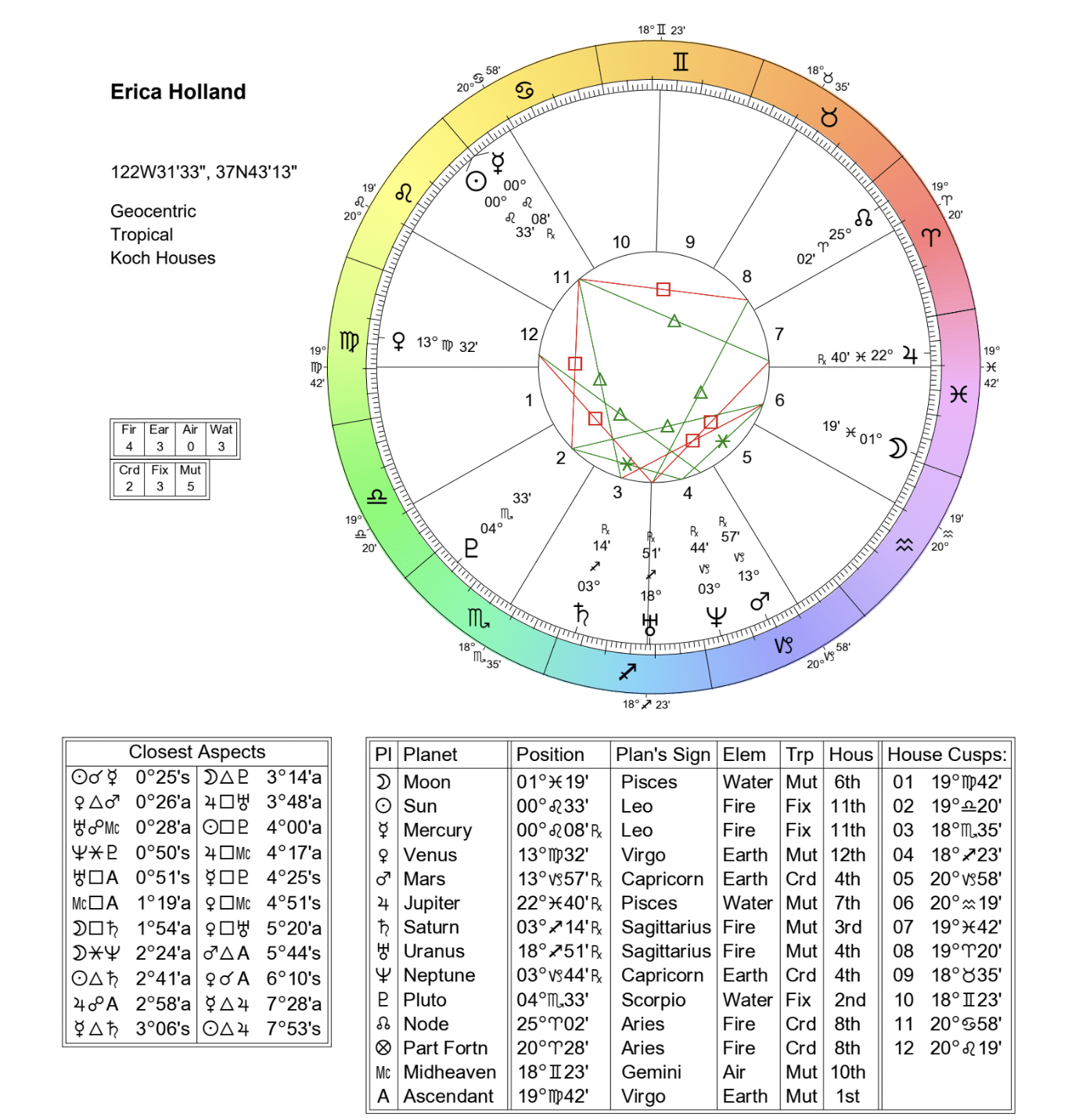
Astrology natal chart interpretation is the process of synthesizing the positions of the planets, zodiac signs, and houses at the exact moment of an individual's birth to understand their character and life path. By evaluating the "Big Three"—Sun, Moon, and Ascendant—alongside planetary aspects, one can uncover a comprehensive psychological and archetypal blueprint.
Understanding a natal chart (often called a radix or birth chart) requires more than just knowing your "star sign." It is a multi-layered practice that combines astronomical mathematics with symbolic analysis. As of 2026, while sophisticated software and artificial intelligence can generate these charts instantly, the art of interpretation remains a skill focused on finding themes, contradictions, and narratives within the cosmic map.
The Essential Data for Chart Calculation
Before beginning an interpretation, you must ensure the underlying data is precise. A natal chart is a snapshot of the sky from a specific vantage point on Earth. Because the Earth rotates approximately one degree every four minutes, even a small error in birth time can shift the Ascendant or the house placements of the planets.
To cast an accurate chart, you require three specific pieces of information:
- Date of Birth: The day, month, and year.
- Exact Time of Birth: Ideally sourced from a birth certificate. "Rounded" times (like 2:00 PM) are often less reliable than specific times (like 2:12 PM).
- Location of Birth: The city and country are necessary to determine the latitude, longitude, and correct time zone (including Daylight Savings adjustments).
In 2026, most practitioners use high-precision tools such as Astro.com or professional software like AstroGold to ensure the mathematical calculations—including the precession of the equinoxes in certain systems—are handled correctly.
The "Big Three": The Foundation of the Personality
The most common entry point for astrology natal chart interpretation is the "Big Three." These three placements provide the broad strokes of an individual's identity, emotional world, and outward persona.
The Sun: The Core Identity
The Sun represents the ego, the "will to be," and the central life force. It describes what drives a person and where they seek to shine. When interpreting the Sun, look at its sign to understand the style of the identity and its house to see where that energy is most active. For example, a Sun in Aries in the 10th House suggests an individual whose core identity is tied to leadership and professional ambition.
The Moon: The Emotional Interior
While the Sun is the "day self," the Moon is the "night self." It governs the subconscious, emotional needs, habits, and how an individual seeks comfort. The Moon’s sign reveals how a person processes feelings. A Moon in Scorpio might process emotions with intensity and a need for privacy, while a Moon in Libra may seek harmony and external validation to feel secure.
The Ascendant (Rising Sign): The Lens and Mask
The Ascendant is the zodiac sign that was rising over the eastern horizon at the moment of birth. It represents the physical body, the first impression one makes on others, and the "lens" through which they view the world. It also determines the "Chart Ruler"—the planet that governs the Ascendant sign—which acts as a primary director for the entire chart's energy.
The Planets as Functional Archetypes
In astrology natal chart interpretation, planets are viewed as "actors" in a play. Each planet represents a specific psychological function or drive. These are generally divided into three categories:
Personal Planets
These planets move quickly and have the most direct impact on individual personality traits.
- Mercury: Communication, intellect, and how we process information.
- Venus: Values, relationships, beauty, and what we find attractive.
- Mars: Drive, ambition, aggression, and how we take action.
Social Planets
These planets bridge the gap between the individual and society, moving more slowly through the signs.
- Jupiter: Expansion, luck, philosophy, and where we seek growth.
- Saturn: Structure, discipline, karma, and our greatest challenges or responsibilities.
Outer (Generational) Planets
Because Uranus, Neptune, and Pluto move so slowly, they stay in a single sign for years, affecting entire generations. Their placement by house is often more significant for individual interpretation than their placement by sign.
- Uranus: Innovation, rebellion, and sudden change.
- Neptune: Intuition, dreams, illusion, and spirituality.
- Pluto: Transformation, power, death, and rebirth.
The Twelve Houses: The Stages of Life
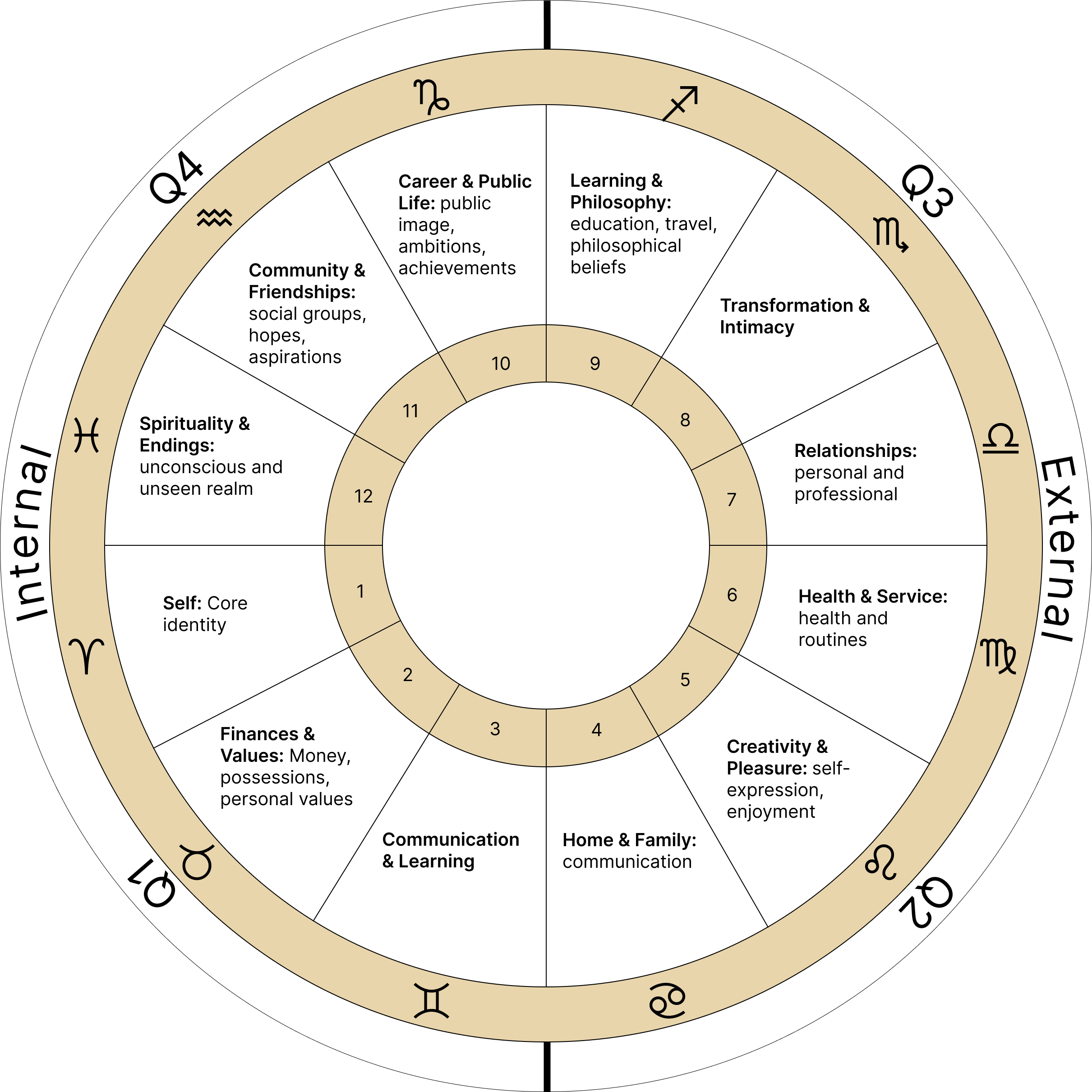
The houses represent the different "stages" or areas of life where the planetary energies manifest. There are several house systems available (such as Placidus or Whole Sign), but the meanings of the twelve houses remain consistent across Western astrology.
| House | Primary Focus | Life Areas Involved |
|---|---|---|
| 1st | Self | Physical appearance, vitality, beginnings, the "I am." |
| 2nd | Resources | Finances, personal values, self-worth, possessions. |
| 3rd | Connection | Communication, siblings, local travel, early education. |
| 4th | Roots | Home, family, ancestry, the private life, the mother/nurturer. |
| 5th | Creativity | Joy, romance, children, hobbies, self-expression. |
| 6th | Wellness | Daily routines, health, service, work environment, pets. |
| 7th | Partnership | Marriage, business partners, open enemies, "The Other." |
| 8th | Transformation | Shared resources, intimacy, taxes, inheritance, the occult. |
| 9th | Expansion | Higher education, long-distance travel, philosophy, law. |
| 10th | Legacy | Career, public reputation, status, the father/authority figure. |
| 11th | Community | Friendships, groups, hopes, social causes, networking. |
| 12th | Subconscious | Solitude, hidden things, spirituality, endings, undoing. |
Understanding Aspects: The Conversation Between Planets
Aspects are the geometric angles formed between planets in the chart. They describe how different parts of the personality interact with one another. Aspects are measured in degrees, and a small "orb" of influence is allowed (usually 5 to 10 degrees).
Major (Ptolemaic) Aspects
- Conjunction (0°): Two planets are in the same spot. Their energies are fused and inseparable. This is a powerful, neutral aspect that depends on the planets involved.
- Sextile (60°): A harmonious, supportive aspect that suggests opportunity and talent, though it requires some effort to activate.
- Square (90°): An aspect of tension and friction. It creates "dynamic stress" that forces growth and action. It often represents internal or external obstacles.
- Trine (120°): The most harmonious aspect. Energy flows easily between the planets, often representing innate talents that the person may take for granted.
- Opposition (180°): Two planets are directly across from each other. This creates a "tug-of-war" effect, usually manifesting as a need to balance two opposing areas of life or projecting one side of the energy onto others.
The Synthesis: How to Read the Chart as a Whole
The most common mistake in astrology natal chart interpretation is looking at placements in isolation. A "Mars in Pisces" might suggest a passive drive, but if that Mars is in a "Square" aspect to a "Sun in Sagittarius," the individual may actually be quite restless and assertive.
To synthesize the chart, follow these steps:
- Identify the Dominant Element: Count how many planets are in Fire, Earth, Air, and Water signs. A lack of an element or a surplus of one can define a person's general temperament.
- Locate the Chart Ruler: Find the planet that rules the Ascendant. For example, if you are a Scorpio Rising, your chart ruler is Pluto (modern) or Mars (traditional). The house and sign of this planet tell you where the "soul’s purpose" is focused.
- Look for Stelliums: A stellium occurs when three or more planets are clustered in one sign or house. This creates a massive concentration of energy that will dominate the individual's life story.
- Evaluate the Hemispheres: Are most planets at the top of the chart (Southern Hemisphere)? This suggests a public, career-oriented life. Are they at the bottom (Northern Hemisphere)? This points toward a more private, subjective, or home-centered life.
Navigating Technical Nuances
In 2026, many students of astrology find themselves choosing between Modern and Traditional/Hellenistic techniques. Modern astrology tends to focus on psychological archetypes and the outer planets (Uranus, Neptune, Pluto). Traditional astrology often uses "Whole Sign" houses and focuses more on concrete life events and the "Seven Visible Planets" (Sun through Saturn).
When interpreting a chart, it is helpful to remain consistent with one system until you understand its logic. Mixing systems prematurely can lead to "interpretative soup," where contradictions are not explored but rather ignored.
Common Mistakes to Avoid
Interpretation is an art that requires discipline. Beginners often fall into the trap of "fatalistic" thinking—viewing a "Square" aspect as a permanent curse. In reality, astrology suggests tendencies and archetypal patterns, not a fixed script.
Another frequent error is ignoring the Modality of the signs. Cardinal signs (Aries, Cancer, Libra, Capricorn) initiate action. Fixed signs (Taurus, Leo, Scorpio, Aquarius) sustain and stabilize. Mutable signs (Gemini, Virgo, Sagittarius, Pisces) adapt and change. A chart heavy in Mutable energy will interpret "Saturnian discipline" very differently than a chart heavy in Fixed energy.
Frequently Asked Questions
Which house system is the most accurate?
There is no single "most accurate" house system. Placidus is the most common in modern Western astrology and is excellent for psychological nuances. Whole Sign houses are preferred by many traditional astrologers for their clarity in predicting life topics. For those born at extreme latitudes (very far north or south), systems like Porphyry or Whole Sign are often more mathematically stable.
What does it mean if a planet is in "Retrograde" in my natal chart?
A natal retrograde (indicated by an 'R' or 'Rx' next to the planet) suggests that the planet's energy is turned inward. For example, Mercury Retrograde in a birth chart doesn't mean the person can't communicate; it often means they are more reflective, introspective, or have a unique, non-linear way of processing thoughts.
Can I interpret my chart without a birth time?
You can still find the signs of your planets, but you will not know your Ascendant or your House placements. Without a birth time, you can create a "Solar Sign" chart (placing the Sun on the 1st House cusp), which provides some general information but lacks the specific "where" and "how" provided by a timed chart.
How do I handle "Intercepted" houses?
In some house systems like Placidus, a house can be so large that it completely contains a zodiac sign, meaning that sign does not appear on any house cusp. This is called an interception. It often symbolizes qualities that feel "hidden" or difficult to access initially, requiring more conscious effort to develop.
Does a "bad" chart exist?
No. Every chart is a balance of challenges (squares and oppositions) and gifts (trines and sextiles). A chart with "too many" easy aspects can lead to complacency, while a chart with many "difficult" aspects often belongs to high achievers who have learned to master their internal friction.
Practical Next Steps for Interpretation
To move from basic knowledge to fluent interpretation, start by keeping a "Transit Journal." Observe how the current movements of the planets in 2026 interact with your natal placements. For instance, when the current Mars crosses your natal Venus, take note of your social interactions or financial decisions.
Synthesizing a chart is a lifelong study. For those seeking professional-grade accuracy, joining organizations like the International Society for Astrological Research (ISAR) provides access to peer-reviewed techniques and ethical guidelines for reading charts for others. Ultimately, the goal of astrology natal chart interpretation is self-awareness—using the map of the heavens to better navigate the terrain of the Earth.