The AQ1 (technically the Aqara Motion Sensor P1) is a high-performance Zigbee 3.0 sensor designed to detect human movement and ambient light levels. It is widely considered the best choice for most users due to its exceptional five-year battery life, adjustable detection timeouts, and native compatibility with Matter, Apple Home, and Amazon Alexa.
The landscape of smart home technology in 2026 is defined by a shift away from complex, fragmented systems toward "invisible" automation. At the center of this movement is the AQ1. While many enthusiasts initially gravitated toward specialized, expensive occupancy sensors, the AQ1 has maintained its position as the industry benchmark for general-purpose automation. It bridges the gap between affordable entry-level hardware and the high-reliability requirements of modern smart homes.
Whether you are looking to automate your hallway lighting, bolster your home security system, or manage energy consumption by turning off HVAC units in empty rooms, the AQ1 provides the necessary data points with minimal maintenance. This article explores the technical specifications, practical applications, and ecosystem integration that make the AQ1 the most sensible sensor investment for the average household.
Technical Specifications and Hardware Architecture
Understanding why the AQ1 is so resilient requires a look at its internal hardware. Unlike earlier generations of motion sensors that suffered from frequent battery changes and "blind periods," the AQ1 was engineered for longevity and granular control.
PIR Sensing and the Fresnel Lens
The AQ1 utilizes a high-sensitivity Passive Infrared (PIR) sensor. This technology works by detecting the infrared radiation (heat) emitted by people or animals. To maximize its effectiveness, the sensor is housed behind a custom-designed Fresnel lens. This lens divides the surrounding area into zones; as a heat source moves from one zone to another, the sensor registers a change in infrared energy and triggers a motion event.
In the AQ1, this lens provides a wide 170-degree field of view for up to 2 meters and a 150-degree field of view for distances up to 7 meters. This versatility allows it to be placed in the corner of a large living room or positioned discreetly in a narrow corridor without losing detection efficacy.
The Power Revolution: Five-Year Battery Life
One of the primary friction points in smart home adoption is "battery anxiety." The AQ1 addresses this by utilizing two CR2450 button-cell batteries combined with an ultra-low-power Zigbee 3.0 chip. In a standard household environment with moderate traffic, the AQ1 is rated to last up to five years. This effectively makes it a "set it and forget it" device, which is crucial for sensors often mounted on high ceilings or in difficult-to-reach corners.
Integrated Illuminance Sensor
Most users do not just need to know if a person is in the room; they need to know if the room is dark enough to warrant turning on the lights. The AQ1 includes a built-in light sensor (illuminance sensor) that reports brightness levels in lux. This allows for sophisticated "if-then" logic: If motion is detected AND light level is below 20 lux, then turn on the kitchen lights. By combining these two sensors into one housing, the AQ1 reduces the number of devices needed in a single room.
Ecosystem Compatibility and the Matter Standard
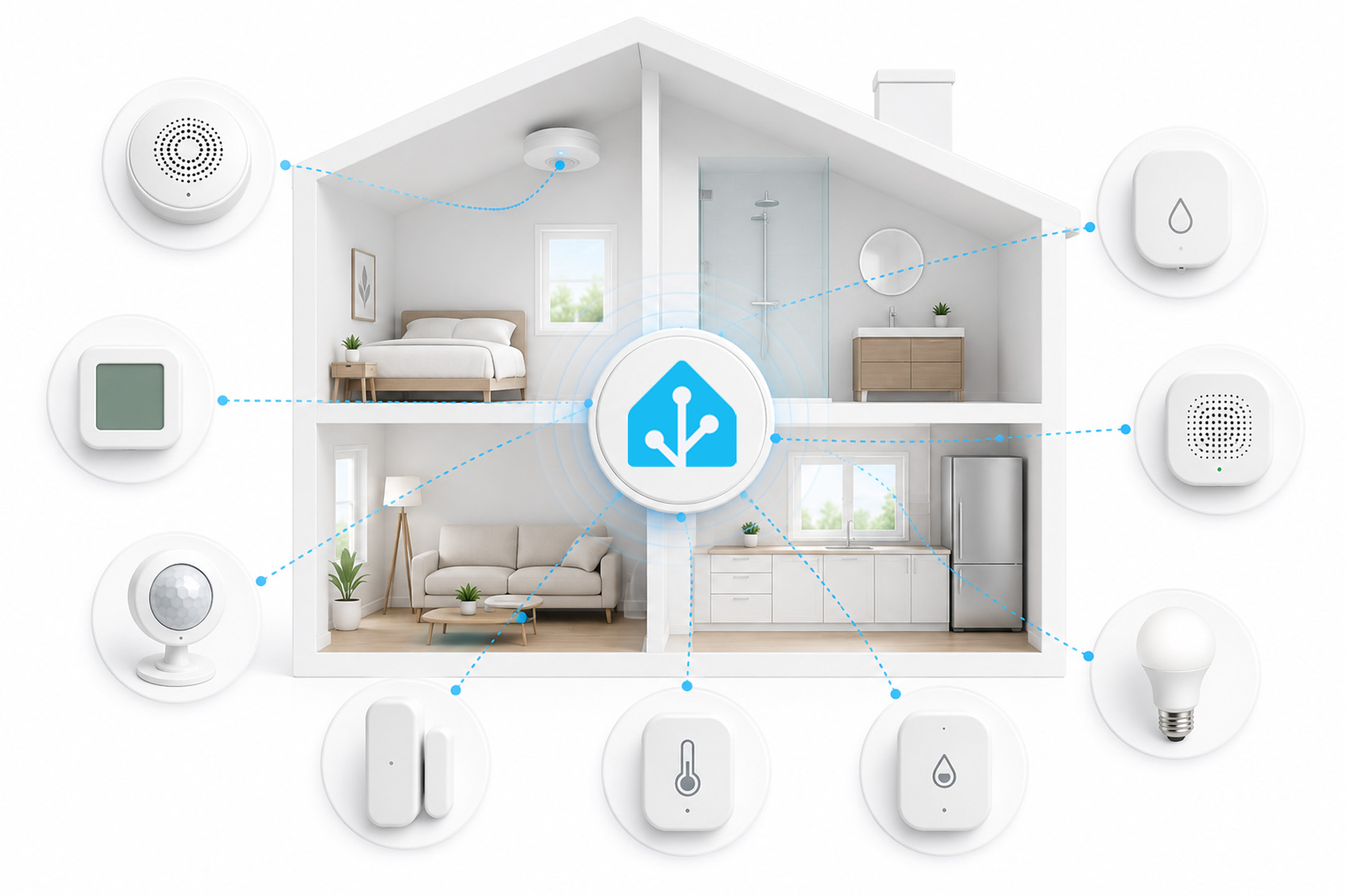
In 2026, compatibility is no longer defined by proprietary "works with" stickers, but by adherence to the Matter standard. The AQ1, when paired with an Aqara Matter-enabled bridge (such as the Hub M3 or M2), surfaces as a native device across all major platforms.
- Matter over Bridge: The AQ1 uses the Zigbee 3.0 protocol to communicate with a hub, which then translates that signal into Matter. This ensures that the sensor responds almost instantaneously (sub-100ms latency) while remaining visible to Google Home, Samsung SmartThings, and Apple Home simultaneously.
- Apple HomeKit: For users in the Apple ecosystem, the AQ1 supports HomeKit Secure Video triggers and automations natively. It appears as two separate sensors: a motion sensor and a light sensor.
- Local Execution: Because it uses Zigbee, the AQ1 does not require an active internet connection to trigger local automations. If your hub and smart bulbs are also local, your lights will still turn on even if your ISP goes offline.
Performance Customization: Sensitivity and Timeouts
The feature that truly separates the AQ1 from generic budget sensors is its software-defined flexibility. Historically, motion sensors had a fixed "cool-down" period—usually 60 to 120 seconds—during which they would not report new motion. This led to "dark room syndrome," where lights would turn off while someone was still in the room because the sensor hadn't reset yet.
Adjustable Detection Timeout
The AQ1 allows users to configure the detection timeout anywhere from 1 second to 200 seconds. For a bathroom where you want lights to turn off quickly after you leave, a 30-second timeout is ideal. For a living room where you might be sitting relatively still, a longer timeout prevents the lights from flickering off during a movie.
Three Sensitivity Levels
Not every room requires the same level of vigilance. The AQ1 features three sensitivity modes:
- High: Best for large rooms where you need to detect movement at a distance (up to 7 meters).
- Medium: The standard setting for most hallways and bedrooms.
- Low: Ideal for households with large pets. By reducing the sensitivity, you can prevent a dog or cat from accidentally triggering the security alarm or the lights at 3:00 AM.
Comparative Analysis: How the AQ1 Ranks
To understand its value proposition, it is helpful to compare the AQ1 against other popular sensors available in 2026.
| Feature | AQ1 (Aqara P1) | Philips Hue Motion | IKEA Vallhorn | Eve Motion |
|---|---|---|---|---|
| Protocol | Zigbee 3.0 / Matter | Zigbee / Matter | Zigbee | Thread / Matter |
| Battery Life | ~5 Years | ~2 Years | ~2 Years | ~1-2 Years |
| Field of View | 170 Degrees | 100 Degrees | 60-100 Degrees | 120 Degrees |
| Timeout Logic | Adjustable (1-200s) | Fixed/Software | Fixed (3m/10m) | Adjustable |
| Light Sensor | Yes (Lux) | Yes (Lux) | No (Day/Night) | Yes (Lux) |
| Price Point | Moderate | High | Low | High |
The AQ1 wins on battery life and field of view, making it the most "versatile" option for users who don't want to replace batteries every year or buy multiple sensors for a single large room.
Optimal Placement and Installation Strategies
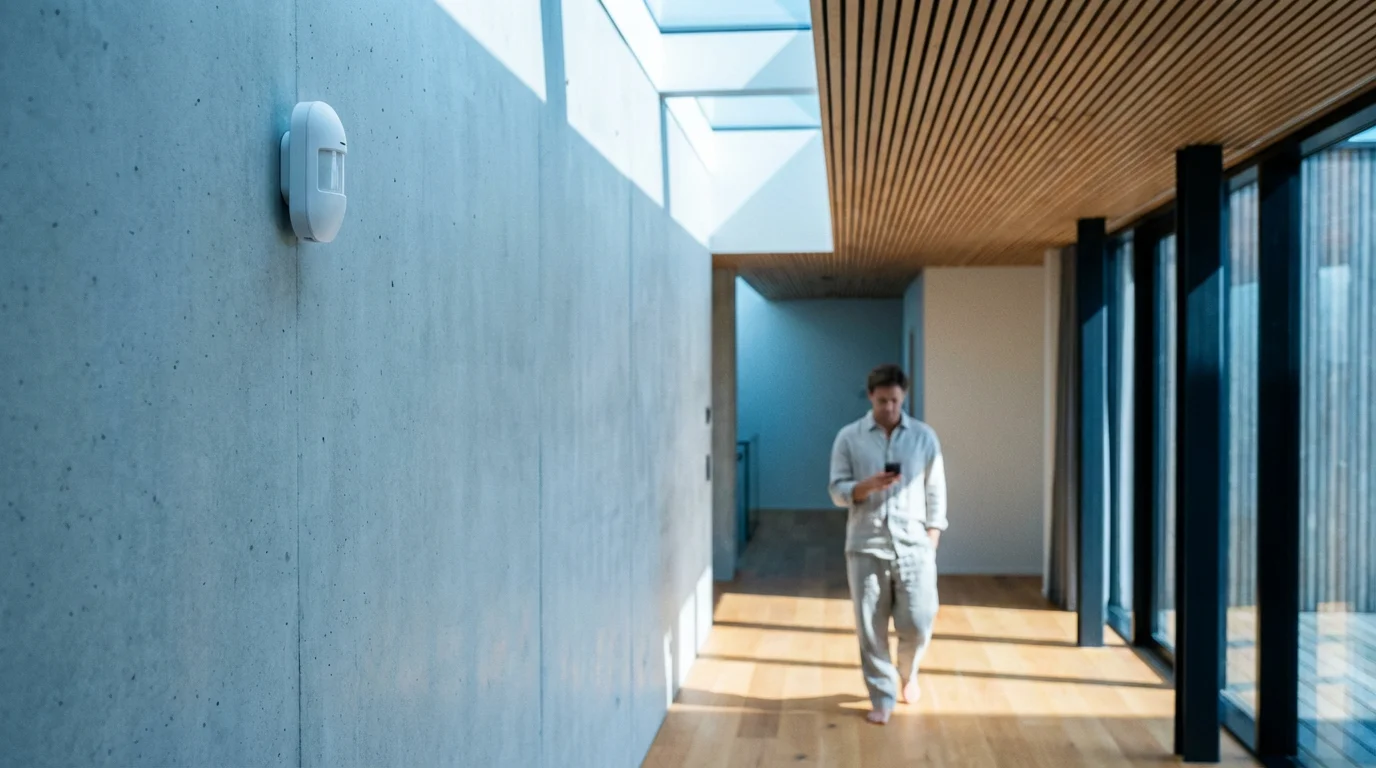
To get the most out of the AQ1, placement is more important than configuration. Because PIR sensors are more sensitive to movement across their field of vision rather than movement toward the sensor, the AQ1 should be placed strategically.
Corner Mounting for Maximum Coverage
The AQ1 comes with a 360-degree adjustable stand. For a standard room, mounting the sensor roughly 2.1 meters (7 feet) high in a corner provides the best results. This allows the 170-degree lens to cover the entire floor area. The stand uses a 3M adhesive backing, but for a permanent 2026-standard install, many users prefer small screw-in mounts to avoid the sensor falling during humid summer months.
Avoiding False Triggers
While the AQ1 is sophisticated, it is still subject to the laws of physics. To avoid false positives:
- Keep away from heat sources: Do not point the sensor directly at a radiator, fireplace, or HVAC vent. The sudden rush of warm air can be interpreted as human movement.
- Avoid direct sunlight: Rapid changes in sunlight hitting the lens can trigger the PIR sensor.
- Pet Masking: If you have pets but want the sensor to detect humans, mount the sensor upside down or use electrical tape to "mask" the bottom half of the lens. This creates a "pet alley" where the floor-level movement is ignored, but head-height movement is captured.
Common Use Cases and Advanced Automations
Once the AQ1 is integrated into your hub, you can move beyond simple light switches. In 2026, the most effective smart homes use "cascading logic."
The "Dynamic Bathroom" Routine
Using the AQ1's illuminance and motion data, you can create a routine that adjusts based on the time of day. Between 7:00 AM and 10:00 PM, motion triggers the lights at 100% brightness. However, between 11:00 PM and 6:00 AM, motion only triggers the lights at 10% brightness and in a warm amber hue, preserving your circadian rhythm and making it easier to fall back asleep.
Energy Management and HVAC
The AQ1 can act as a presence-based thermostat trigger. If no motion is detected in a home office for more than 30 minutes, the smart plug connected to the space heater or the smart TRV (Thermostatic Radiator Valve) can automatically switch to "Eco Mode." This is one of the fastest ways to see a return on investment (ROI) from the sensor.
Security Integration
When your home is set to "Away" mode, the AQ1 shifts from a convenience tool to a security tool. It can trigger sirens, send critical alerts to your phone, and command smart cameras to start recording or turn toward the zone where motion was detected.
Troubleshooting and Maintenance
While the AQ1 is highly reliable, occasional issues can arise, particularly regarding connectivity or "ghost" triggers.
- Interference: If the sensor frequently drops offline, check the proximity to your Zigbee hub or a Zigbee repeater (such as a smart plug). In 2026, 2.4GHz Wi-Fi congestion is common; ensuring your Zigbee channel does not overlap with your Wi-Fi channel is a standard fix.
- Delayed Response: This is often caused by a "sleepy" Zigbee end-device. If the AQ1 takes more than a second to trigger, it may be struggling to reach the hub. Adding a single Zigbee 3.0 repeater between the sensor and the hub usually solves this.
- Cleaning the Lens: Dust and spiderwebs can significantly degrade PIR performance. A quick wipe with a microfiber cloth every six months is recommended to maintain the 7-meter detection range.
Frequently Asked Questions
Can the AQ1 detect me if I am sitting still on the couch?
PIR sensors like the AQ1 require a change in infrared energy to trigger, meaning they are best at detecting "movement." If you are perfectly still, the sensor may eventually report "no motion." For true stationary presence detection, you might consider a mmWave presence sensor, but for 90% of home tasks, the AQ1’s adjustable timeout (setting it to 5 or 10 minutes) effectively masks this limitation.
Do I need an Aqara Hub to use the AQ1?
While the AQ1 is a Zigbee device and can technically pair with universal Zigbee coordinators (like Home Assistant's SkyConnect or a Zigbee2MQTT setup), using an official Aqara Hub is the only way to access the granular sensitivity settings and the ultra-low 1-second timeout. Standard Zigbee drivers often limit these advanced features.
Is the AQ1 waterproof for outdoor use?
No, the AQ1 is rated for indoor use only. It does not have an IP rating for water resistance. If you need outdoor motion detection, it is better to place the AQ1 inside a weather-resistant housing or choose a dedicated outdoor sensor that can withstand rain and extreme temperature fluctuations.
How does the light sensor handle rapid changes, like a car driving by?
The AQ1 reports illuminance changes based on specific thresholds or time intervals to prevent "thrashing" (turning lights on and off repeatedly). It is designed to ignore momentary flashes of light, focusing instead on the sustained ambient light level of the room.
Can the AQ1 distinguish between a human and a large dog?
Out of the box, no. It detects heat signatures. However, by using the "Low" sensitivity setting and placing the sensor at a higher elevation (above 2.5 meters), you can effectively filter out smaller heat signatures from pets while still capturing the larger heat signatures of humans.
Final Recommendation
For the vast majority of users in 2026, the AQ1 (Aqara P1) remains the most balanced smart home sensor on the market. It avoids the high cost and power-hungry nature of mmWave sensors while offering significantly more control and longevity than the "budget" sensors found in big-box stores.
If you are just starting your smart home journey, begin by placing one AQ1 in your most-frequented hallway and another in a bathroom. The immediate improvement in daily convenience—never having to touch a light switch again—will demonstrate why this specific device has become the "standard" for the modern intelligent home. For the best experience, ensure you are running the latest Matter-compatible firmware on your Aqara bridge to future-proof your setup for years to come.