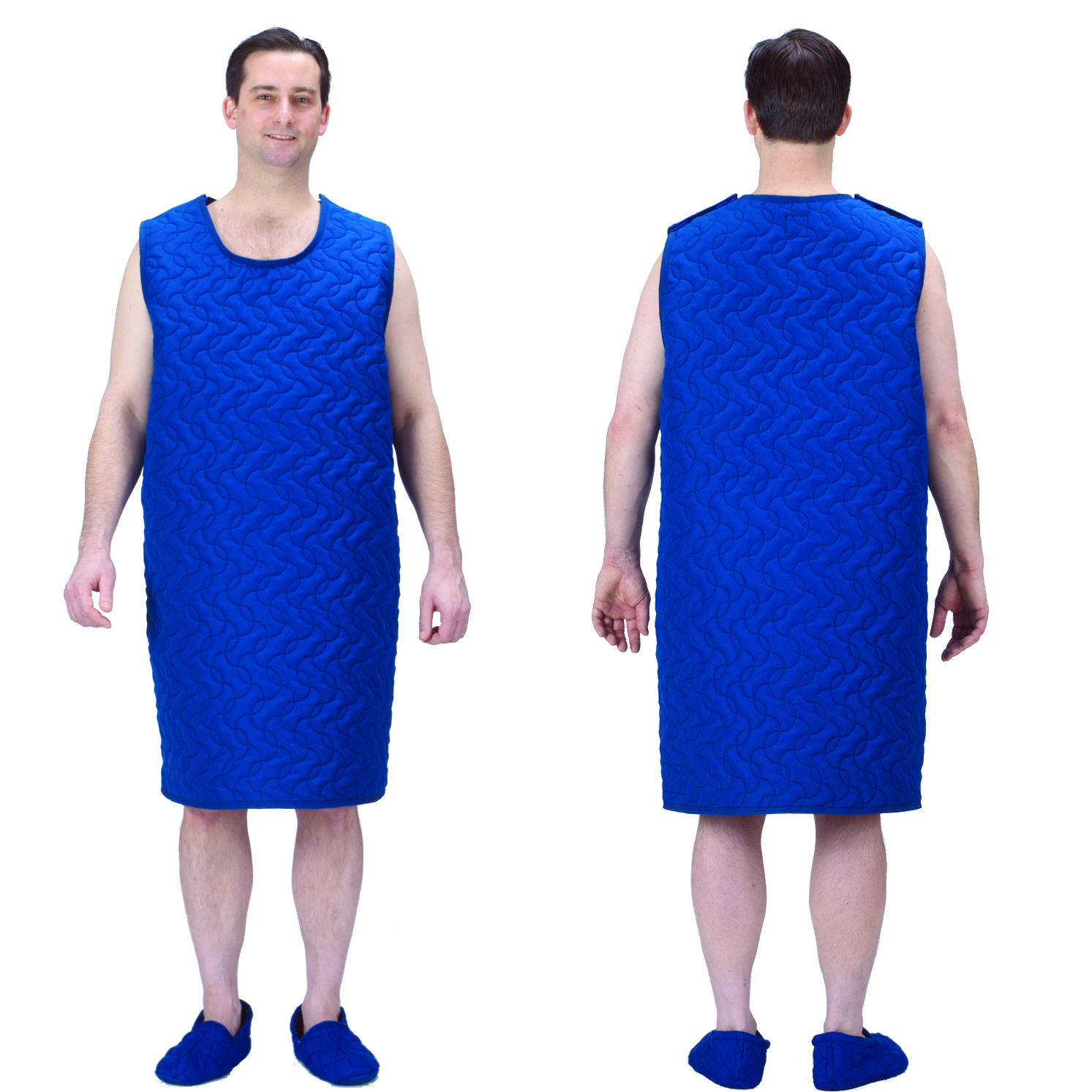
An anti-suicide smock, often referred to as a safety smock or Ferguson gown, is a specialized, heavy-duty garment designed specifically for individuals at high risk of self-harm or suicide within institutional settings. These garments are engineered from tear-resistant, quilted fabric that cannot be rolled, folded, or braided into a ligature, effectively preventing the wearer from using the clothing to commit suicide by hanging or strangulation.
In high-acuity environments such as correctional facilities, psychiatric hospitals, and emergency rooms, the primary objective of staff is the preservation of life. When a person is placed on "suicide watch," standard clothing and bedding are removed because they can be easily manipulated into ropes or ties. The anti-suicide smock serves as a critical safety intervention, providing the individual with a form of modest covering while mitigating the risk of ligature-based injuries. As we look at the standards of care in 2026, the integration of these garments remains a cornerstone of ligature-resistant environments, balanced by evolving protocols regarding patient dignity and psychological trauma.
The Engineering of an Anti-Suicide Smock: Materials and Construction
The effectiveness of an anti-suicide smock lies not in its appearance, but in its material science and structural integrity. Unlike standard textiles, these garments must withstand extreme tensile force and resist all attempts at shredding.
Advanced Fabric Composition
Modern anti-suicide smocks are typically constructed from high-denier polyester or nylon blends. The fabric is often double- or triple-layered and quilted in a specific pattern. This quilting serves a dual purpose: it increases the overall thickness, making it nearly impossible for the wearer to fold the fabric into a tight cord, and it ensures that even if a small tear occurs, the damage remains localized and does not allow the material to be stripped into long ribbons.
By 2026, many manufacturers have integrated antimicrobial treatments into the fibers to manage hygiene in long-term use scenarios. The weight of the fabric is also a calculated factor; it must be heavy enough to resist manipulation but breathable enough to prevent overheating, as thermal regulation is a concern for patients in crisis.
Reinforced Stitching and Seam Integrity
The seams of a safety smock are the most vulnerable points. To combat this, manufacturers utilize "lock-stitching" or "bar-tack" reinforcement. The thread used is typically a high-tensile synthetic that is stronger than the fabric itself. This ensures that even under significant duress—such as a patient attempting to pull the garment apart using their teeth or feet—the seams remain intact.
Furthermore, these smocks are designed with no "anchor points." There are no loops, pockets, or reinforced collars that could be used to snag the garment on a fixture. The necklines and armholes are generously sized to prevent the fabric from being used as a restrictive band around the neck or limbs.
Closure Systems
Standard fasteners like buttons, zippers, and drawstrings are strictly prohibited in the design of anti-suicide garments. Instead, smocks utilize heavy-duty hook-and-loop (Velcro) closures. These closures are strategically placed—usually at the shoulders or back—to allow staff to dress and undress the individual easily while ensuring the wearer cannot easily remove the garment or use the fastening mechanism for harm. The hook-and-loop material itself is often recessed or covered by a flap of the quilted fabric to prevent skin irritation or its use as an abrasive tool.
Clinical and Correctional Criteria for Deployment
The decision to place an individual in an anti-suicide smock is never made lightly. It is a restrictive intervention that follows a comprehensive risk assessment by medical or mental health professionals.
The Role of Risk Assessment
Before a smock is issued, a clinician typically conducts a Suicide Risk Assessment (SRA). This involves evaluating the individual's current intent, plan, and access to means. If the risk is deemed "imminent" or "high," and the individual cannot be kept safe through constant observation alone, the transition to a ligature-resistant environment occurs. This process involves:
- Removal of Personal Effects: All jewelry, belts, shoelaces, and standard clothing are confiscated.
- Strip Search or Safety Search: Conducted to ensure no contraband or harmful items are hidden on the person.
- Issuance of Safety Gear: The anti-suicide smock is provided along with, in some cases, a safety blanket or "suicide blanket" made of the same tear-resistant material.
Institutional Environments
- Correctional Facilities: In jails and prisons, smocks are used in "administrative segregation" or "medical observation" cells. The goal is to maintain the 8th Amendment rights of the prisoner (avoiding cruel and unusual punishment) while fulfilling the facility's "duty to protect."
- Psychiatric Hospitals: In clinical settings, the focus is on therapeutic stabilization. The smock is seen as a temporary measure until the patient’s medication or therapy reduces their level of acute crisis.
- Emergency Departments: Often used for patients awaiting transfer to a dedicated psychiatric bed, especially if the ER lacks a dedicated "safe room."
Technical Specifications and Industry Standards
For procurement officers and safety auditors, understanding the technical benchmarks for these garments is essential. A smock that fails to meet these standards is a liability.
| Feature | Specification Requirement | Purpose |
|---|---|---|
| Material | 1000+ Denier Quilted Polyester/Nylon | Prevents tearing and shredding into strips. |
| Tensile Strength | Minimum 400 lbs resistance | Ensures the garment cannot be broken by hand. |
| Stitching | Box-stitch or Bar-tack with Bonded Thread | Prevents seam failure and thread unraveling. |
| Closure Type | High-cycle Hook-and-Loop | Eliminates ligature points like zippers/buttons. |
| Fire Retardancy | CAL TB 133 or NFPA 701 compliant | Prevents the smock from being used to start fires. |
| Weight | 4 to 6 lbs (approximate) | Provides physical weight to discourage folding. |
Implementation and the Question of Patient Dignity
While the primary function of an anti-suicide smock is physical safety, the psychological impact on the wearer cannot be ignored. The term "turtle suit"—a common slang term in correctional settings—highlights the often dehumanizing perception of these garments.
Best Practices for Humane Use
In 2026, psychiatric guidelines emphasize "trauma-informed care." This means that while safety is paramount, the manner in which a smock is implemented matters.
- Communication: Staff should explain why the smock is being used, framing it as a protective measure rather than a punishment.
- Regular Review: The need for the smock should be reviewed at least every 24 hours. The goal is always to return the individual to standard clothing as soon as the acute risk subsides.
- Modesty: Modern smocks are designed to be longer and more opaque than older versions, ensuring that the patient's dignity is maintained even if they are not wearing undergarments (which are often also removed for safety).
Common Mistakes in Implementation
One of the most frequent errors in institutional settings is the "blanket application" of safety smocks to all patients in a unit, regardless of individual risk. This leads to several issues:
- Desensitization: Staff may become less vigilant if every patient is in a smock, assuming the garment does all the work.
- Increased Trauma: For individuals with a history of sexual or physical abuse, being forced into a specialized garment after a search can be severely triggering, potentially escalating the crisis.
- Physical Discomfort: If not sized correctly, the heavy fabric can cause skin chafing or impede mobility, leading to falls.
Legal and Ethical Considerations
The use of anti-suicide smocks falls under various jurisdictional regulations and oversight bodies, such as the Joint Commission (TJC) in the United States or the Care Quality Commission (CQC) in the UK.
Jurisdictional Limits and Standards
In many jurisdictions, the use of a safety smock is classified as a "form of restraint" or "seclusion-adjacent" intervention. This means there are strict documentation requirements. Facilities must record:
- The specific behavior that necessitated the smock.
- The clinician who authorized the use.
- The periodic checks (usually every 15 minutes) performed by staff.
- The criteria for removal.
Failure to follow these protocols can lead to litigation, particularly if an individual manages to harm themselves despite the garment, or if the garment is used punitively.
Ethical Dilemmas
The core ethical conflict is "autonomy vs. beneficence." While the facility has a duty to keep the person alive (beneficence), forcing them into a smock overrides their personal choice (autonomy). In 2026, the consensus remains that life-preservation takes precedence in acute crises, but only as a "last resort" measure.
Procurement and Maintenance
For facility managers, the lifecycle of an anti-suicide smock is a matter of both safety and budget.
Cost Considerations
A high-quality anti-suicide smock typically costs between $150 and $300 USD (in 2026 pricing). While this is significantly more expensive than a standard $15 hospital gown, the durability and specialized nature of the garment justify the cost. Most facilities maintain a "par level" based on their average daily population of high-risk individuals.
Laundering and Longevity
Because these garments are used in high-stress environments, they are frequently exposed to bodily fluids. They must be able to withstand industrial laundering at high temperatures.
- Thermal Resistance: The hook-and-loop closures and synthetic fibers can be damaged by extreme dryer heat. Following the manufacturer’s drying instructions is vital to prevent the "stiffening" of the fabric, which can make it brittle and more prone to cracking.
- Inspection Protocols: After every wash, smocks must be inspected for "stress points." If the quilting begins to unravel or the hook-and-loop loses its "grip," the garment must be decommissioned immediately. A compromised smock is a safety hazard.
Frequently Asked Questions
Can someone still hang themselves while wearing an anti-suicide smock?
While the smock itself is designed to be impossible to use as a ligature, safety is never 100% guaranteed if the environment is not also secure. The smock prevents the garment from being used, but the individual must still be placed in a "ligature-resistant" room (no protruding shower heads, door hinges, or vents) and remain under frequent observation.
How long can a person stay in a safety smock?
There is no fixed maximum time, but clinical guidelines suggest it should be used for the shortest duration possible. Usually, this ranges from a few hours to a few days. If a person requires a smock for more than 72 hours, it generally indicates that their treatment plan needs an urgent clinical review, as the current environment is not facilitating stabilization.
Are there different sizes available?
Yes. Manufacturers produce smocks ranging from Small to 4XL or larger. Proper sizing is critical; a smock that is too large can be cumbersome and trip the wearer, while one that is too small may be uncomfortable and increase the patient’s agitation.
Do patients wear anything under the smock?
In the most high-risk cases, nothing is worn underneath. However, some facilities have introduced "safety underwear"—made of the same tear-resistant material—to provide an extra layer of modesty and dignity while maintaining the same safety profile.
Is the anti-suicide smock the same as a "straightjacket"?
No. A straightjacket (a traditional physical restraint) is designed to immobilize the arms. An anti-suicide smock allows full range of motion. The wearer can walk, eat, and use the restroom independently. The smock’s only restriction is the inability to use the fabric as a tool for self-harm.
Practical Recommendation for Facilities
For organizations looking to update their suicide prevention protocols in 2026, the focus should be on a multimodal safety approach. The anti-suicide smock is an essential tool, but it is not a standalone solution.
- Standardize Procurement: Ensure all smocks meet current fire retardancy and tensile strength standards (e.g., ISO or local equivalents).
- Staff Training: Move beyond "how to put it on" and include training on how to interact with a patient in a smock to reduce the psychological impact of the intervention.
- Environmental Audits: Regularly audit the rooms where smocks are used. A safety smock is ineffective if there are still exposed pipes or non-breakaway fixtures in the cell or hospital room.
- Dignity-First Policy: Implement "Safety Undergarments" as a standard alongside the smock whenever the risk level allows for it, as this significantly improves patient cooperation and reduces the "punitive" feel of the intervention.
By viewing the anti-suicide smock as a temporary, life-saving medical device rather than a piece of correctional uniform, facilities can better navigate the complex intersection of safety, law, and human rights.