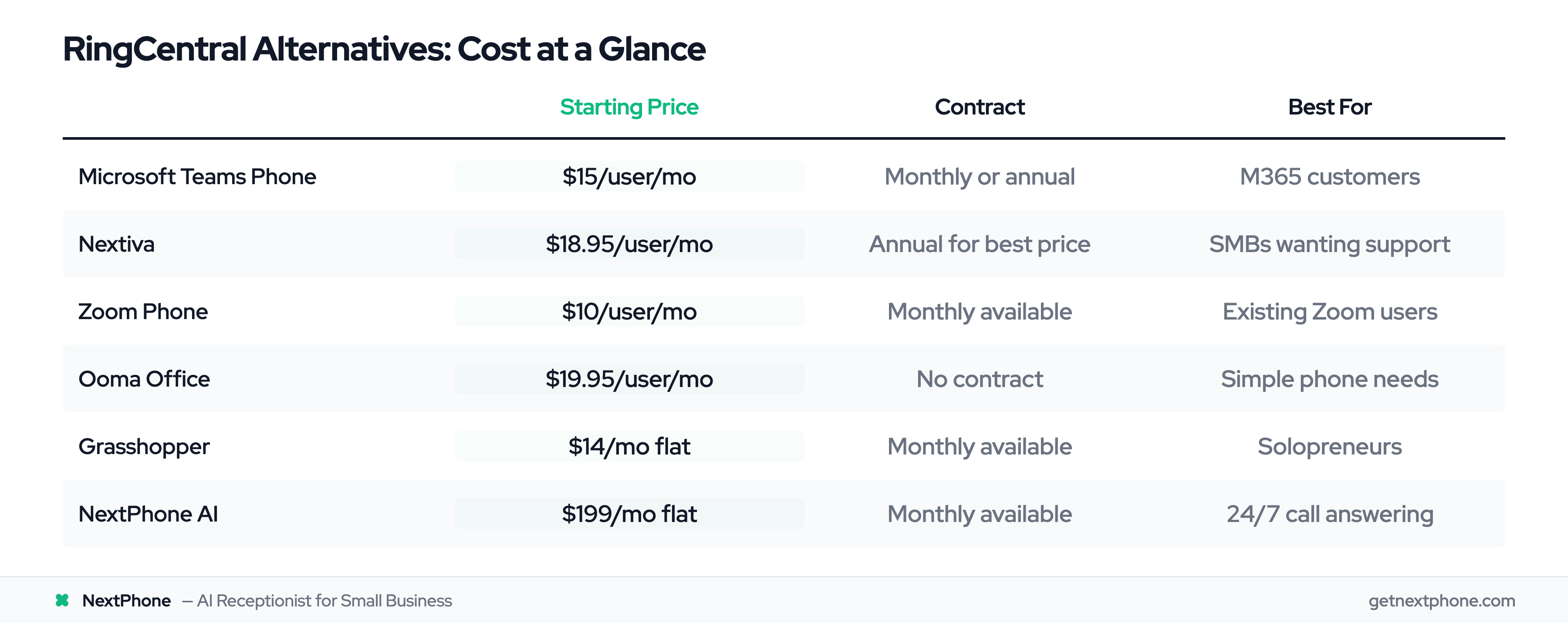
Choosing an alternative to RingCentral involves balancing cost, AI-driven automation, and ease of use. Top contenders in 2026 include Dialpad for its native AI intelligence, Nextiva for unified customer experience management, and Microsoft Teams for seamless integration within the M365 ecosystem, each offering distinct advantages over RingCentral’s increasingly complex interface and tiered pricing.
The unified communications as a service (UCaaS) market has shifted significantly by 2026. While RingCentral remains a dominant force due to its extensive feature set and historical reliability, many modern businesses are migrating toward leaner, more "intelligent" platforms. The primary drivers for this shift are often the desire for deeper native artificial intelligence (AI) integration, simpler user interfaces, and more transparent pricing structures that do not penalize smaller teams for needing advanced features.
Why Businesses Look Beyond RingCentral
RingCentral’s legacy as a pioneer in the cloud PBX space is both its strength and its weakness. As of 2026, many IT decision-makers find the platform’s interface to be cluttered—a result of years of feature layering. While powerful, the learning curve can be steep for non-technical staff.
Complexity and Feature Bloat
One of the most cited reasons for seeking an alternative is "feature fatigue." RingCentral offers a massive array of tools, from fax-to-email to advanced webinar hosting. However, a modern agile business might only require high-quality voice, video, and sophisticated team messaging. Paying for a massive suite of features that remain unused creates unnecessary overhead and complicates the administrative backend.
Pricing Tiers and Hidden Costs
Historically, RingCentral’s most advanced features—such as real-time analytics, automated call recording, and certain CRM integrations—were gated behind higher-tier plans. In 2026, many competitors offer these as standard features. Furthermore, the cost of adding international numbers or toll-free minutes can scale quickly on RingCentral, prompting growing businesses to seek platforms with more inclusive global packages.
Support and Response Times
As a massive corporation, RingCentral's customer support can sometimes feel impersonal. Mid-market businesses often report challenges in getting rapid, high-level technical assistance for complex integration issues. This has opened the door for "boutique" enterprise providers who prioritize white-glove service and dedicated account management.
Dialpad: The Leader in AI-First Communications
Dialpad has positioned itself as the primary alternative for organizations that prioritize data-driven insights and automation. By 2026, Dialpad’s proprietary "Ai" (built on its acquisition of TalkIQ years ago) has matured into a seamless part of the user experience, rather than an add-on.
Native AI Integration
Unlike platforms that bolt on third-party AI tools, Dialpad’s AI is baked into the core engine. This allows for real-time transcription with high accuracy, automated sentiment analysis, and "Live Coaching" for sales and support teams. During a call, Dialpad can detect specific keywords or customer frustration and provide the agent with talking points or links to internal documentation immediately.
Ease of Deployment
Dialpad is famously "hardware-light." While it supports desk phones, the platform is optimized for a software-first approach. For modern businesses with remote or hybrid workforces, the ability to deploy a full-scale contact center across the globe in minutes—without configuring complex VLANs or hardware—is a massive advantage over RingCentral’s more traditional setup requirements.
Nextiva: Bridging the Gap Between Communication and CRM
Nextiva has evolved from a standard VoIP provider into a comprehensive "Customer Experience" platform. In 2026, their NextOS platform serves as a centralized hub that combines communication with basic CRM and survey tools.
Unified Customer View
The standout feature of Nextiva is its ability to provide a 360-degree view of the customer. When a call comes in, the agent doesn't just see a name; they see a timeline of every interaction that person has had with the company across phone, email, chat, and social media. This level of context is often only available in RingCentral through expensive third-party integrations with Salesforce or Zendesk.
Reliability and "Amazing Service"
Nextiva has built its reputation on its "Amazing Service" promise. Their onboarding process is generally more hands-on than RingCentral’s, making it an ideal choice for businesses that lack a dedicated internal IT team to manage the migration. Their network architecture, which utilizes multiple data centers with carrier-grade switches, has maintained a high uptime record throughout the mid-2020s.
Zoom Workplace: Expanding Beyond Video Conferencing
What was once just a video tool has become a full UCaaS suite. Zoom Workplace (formerly Zoom One) is now a formidable competitor to RingCentral, particularly for businesses that are already comfortable with the Zoom interface.
The Power of Familiarity
The "Zoom fatigue" of the early 2020s has been replaced by "Zoom fluency." Most employees already know how to use the interface. Switching from RingCentral to Zoom Phone and Zoom Team Chat requires minimal training, reducing the "productivity dip" that usually accompanies a platform migration.
Zoom Phone Performance
Zoom Phone has been recognized for its high-quality audio and simplicity. In 2026, its integration with Zoom Rooms and Zoom Events makes it a powerhouse for companies that frequently host large-scale hybrid meetings or webinars. Its global coverage has expanded to compete directly with RingCentral’s footprint, often at a lower price point for comparable features.
Microsoft Teams Phone: The Logical Choice for Enterprise Ecosystems
For organizations already utilizing the Microsoft 365 suite, Microsoft Teams Phone is the most logical and cost-effective alternative.
Deep Ecosystem Integration
The primary advantage here is the "Single Pane of Glass" philosophy. Employees stay within the Teams app for everything: file sharing in OneDrive, collaborative editing in Word, and now, external phone calls. This eliminates the need to toggle between RingCentral and Microsoft apps, which significantly improves workflow efficiency.
Copilot for Teams
By 2026, Microsoft’s Copilot has become an essential business tool. The AI can summarize meetings, generate action items, and even suggest follow-up emails based on a phone conversation. While RingCentral has its own AI features, they cannot match the level of integration found between Microsoft Teams and the broader Office 365 environment.
8x8: Robust Global Connectivity and Advanced Analytics
8x8 remains a top choice for businesses with a heavy international presence and those who require granular data on their communication performance.
Global Reach and Compliance
8x8 owns much of its international infrastructure, which often leads to better call quality and lower latency in regions where RingCentral might rely on third-party carriers. They also maintain a high standard of compliance certifications (HIPAA, FISMA, GDPR), making them a favorite for healthcare and financial services sectors.
Advanced Analytics
While RingCentral offers analytics, 8x8’s platform provides deeper insights into speech analytics and cross-channel trends. In 2026, their "X Series" plans allow businesses to mix and match user types (e.g., standard users vs. contact center agents) on a single invoice, providing more flexibility than RingCentral’s more rigid tiering.
Comparison of Top Alternatives
The following table compares the key metrics of these platforms as of 2026.
| Platform | Primary Strength | Best For | AI Capabilities |
|---|---|---|---|
| Dialpad | Native, real-time AI | Sales & Support Teams | Best-in-class real-time transcription & coaching. |
| Nextiva | Customer Journey mapping | SMBs wanting CRM features | High; focuses on sentiment and customer health. |
| Zoom | Ease of use/Familiarity | Video-centric cultures | Strong; focuses on meeting summaries and chat. |
| MS Teams | M365 Integration | Large Enterprises | Integrated Copilot for cross-app intelligence. |
| 8x8 | Global connectivity | Multi-national operations | Robust speech and interaction analytics. |
Technical Requirements and Migration Strategy
Switching from RingCentral to a new provider requires a structured approach to avoid operational downtime. Business communication is the lifeline of most organizations, and a failed migration can result in lost revenue and damaged reputation.
Porting Phone Numbers (LNP)
Local Number Portability (LNP) is the process of moving your existing phone numbers to a new carrier. Under FCC guidelines (or local equivalents globally), your current provider cannot legally block a valid port request. However, the process takes time—typically 7 to 14 business days.
- Action Step: Do not cancel your RingCentral subscription until all numbers have been successfully ported and tested on the new system.
Network Readiness Assessment
Modern UCaaS platforms rely on high-speed internet and low latency. Before switching, perform a "VoIP Readiness Test" on your network.
- Bandwidth: Ensure you have at least 100kbps (up/down) per concurrent call.
- Quality of Service (QoS): Configure your routers to prioritize voice traffic (SIP packets) over data traffic like file downloads.
- E911 Compliance: Ensure your new provider can accurately transmit the physical location of your employees to emergency responders, especially for remote workers.
Hardware Compatibility
If you have invested heavily in physical desk phones for RingCentral (such as Poly or Yealink models), verify that they are "unlocked." Most RingCentral-provided hardware can be repurposed for other providers, but they may require a factory reset and a firmware update to connect to a new SIP server.
Avoiding Common Pitfalls During Implementation
Many businesses fail to account for the human element of a technology switch. Even the best platform will fail if the staff does not adopt it.
- Over-complicating the Transition: Don't try to switch phone systems and CRMs at the same time. Stagger the implementation to allow staff to master the new communication tool first.
- Neglecting Mobile Users: Ensure the mobile app of your chosen alternative is tested by your field staff. RingCentral's mobile app is quite robust; ensure your alternative matches that reliability on both iOS and Android.
- Ignoring API Needs: If your RingCentral account was tied into specialized software (like a proprietary ERP), ensure the new provider has an open API or a pre-built connector available in their app gallery.
Cost-Benefit Analysis: Beyond the Monthly Subscription
When evaluating the cost of an alternative, look beyond the "per user, per month" sticker price.
- Implementation Fees: Does the provider charge for onboarding?
- International Rates: If you call outside your home country, compare the per-minute rates or the cost of international "zone" add-ons.
- Integration Costs: Does the provider charge extra to connect to Salesforce or Microsoft 365?
- Training and Support: Is 24/7 live support included, or is it a paid "Premium Support" tier?
In 2026, the real value of a communication platform lies in its ability to save time through automation. A platform that is $5 cheaper per month but lacks automated meeting summaries might actually be more expensive when you calculate the cost of employee time spent manual note-taking.
Frequently Asked Questions
Is it hard to move my numbers away from RingCentral?
No, but it requires precision. You must provide the new carrier with a "Letter of Authorization" (LOA) and a copy of your recent RingCentral bill. The information—including the service address and the billing name—must match exactly, or the port request will be rejected.
Can I keep my existing desk phones?
In most cases, yes. Most modern RingCentral phones are standard SIP devices (like those from Poly, Cisco, or Yealink). You will need to "re-provision" them to point to your new provider's servers. Some providers, like Nextiva and 8x8, offer "buy-back" programs where they give you a credit for your old hardware if you buy new phones from them.
Which alternative is best for a remote-only workforce?
Dialpad and Zoom Workplace are generally considered the strongest for remote-only teams. They were built with a software-first mindset, meaning their desktop and mobile apps are often more stable and feature-rich than those originally designed for desk-phone-centric environments.
Are these alternatives as secure as RingCentral?
Yes. All major UCaaS providers in 2026 utilize SRTP (Secure Real-time Transport Protocol) for voice encryption and TLS (Transport Layer Security) for signaling. If your industry requires specific compliance (like HIPAA or SOC2), verify that the provider will sign a Business Associate Agreement (BAA).
Do I need a specialized IT person to manage these systems?
While you don't necessarily need a full-time telecommunications engineer, having someone comfortable with basic networking and cloud administration is helpful. Most of these platforms use a web-based "Admin Portal" that is much simpler to manage than old-fashioned on-premise PBX systems.
Final Recommendation
If your business is currently feeling the weight of RingCentral’s complexity or costs, the best path forward depends on your existing tech stack. For Microsoft-centric organizations, the transition to Microsoft Teams Phone is nearly essential for long-term efficiency. For businesses that live and die by their sales and support performance, the AI-driven insights of Dialpad offer a competitive edge that RingCentral’s older architecture struggles to match. Begin by auditing your current usage—identify which RingCentral features you actually use and which ones are just noise—then choose the platform that aligns most closely with your core workflows.