Air India’s domestic business class often fails to justify its significant price premium because the experience remains inconsistent across a fragmented fleet. Despite the completed merger with Vistara, the "cabin lottery" between retrofitted aircraft and aging legacy planes, combined with the rising quality of mid-tier Premium Economy, makes the 3x–4x fare jump difficult to rationalize for short-haul flights.
For travelers navigating the Indian skies in 2026, the choice between a standard economy seat and the elusive luxury of the front cabin has never been more complex. Under the stewardship of the Tata Group, Air India has undergone a massive transformation through the Vihaan.AI program, yet the domestic business class product continues to face scrutiny. While the airline has successfully integrated Vistara’s fleet and service standards, several structural and operational factors contribute to a value proposition that frequently falls short of its high asking price.
The Persistence of the Cabin Lottery
One of the primary reasons the premium for Air India domestic business class feels unjustified is the lack of product consistency. By 2026, although Air India has inducted hundreds of new A320neo and A321neo aircraft, a significant portion of the domestic narrow-body fleet still consists of legacy airframes.
When you book a business class ticket on a route like Delhi to Mumbai or Bengaluru to Kolkata, you are paying for a standardized "Business" experience. However, the hardware you actually receive can vary wildly:
- The Modernized Experience: On newer or recently retrofitted A321neos (largely inherited from the Vistara configuration or the new Air India cabin design), you receive a plush leather seat with 40-42 inches of pitch, extendable leg rests, and modern pedestal features.
- The Legacy Experience: On older A320s that have not yet rotated through the full refurbishment cycle, you may find yourself in a seat that, while wider than economy, features manual recline mechanisms that are often stiff, outdated upholstery, and a general lack of charging ports or contemporary storage.
For a business traveler paying ₹25,000 to ₹40,000 for a 120-minute flight, this inconsistency is the antithesis of luxury. When the "soft product" (service and food) is the only guaranteed upgrade, the "hard product" (the seat) becomes a gamble that many find not worth taking.
The "Premium Economy" Middle Ground
The introduction and expansion of the Premium Economy cabin across the domestic network have fundamentally disrupted the value of Business Class. In 2026, Air India’s Premium Economy offers a dedicated cabin, increased legroom (33-36 inches), and an upgraded meal service compared to Economy.
The price delta is the deciding factor here. Typically, a Premium Economy seat costs 1.5x to 2x the price of a standard Economy fare. In contrast, Business Class often starts at 4x the Economy fare. For a flight under three hours, the incremental comfort of a wider Business Class seat rarely outweighs the efficiency of a Premium Economy seat.
Travelers have noted that the "bridge" provided by Premium Economy satisfies 80% of the needs—priority boarding, a quieter cabin, and better food—at 40% of the cost of a Business Class ticket. This makes the jump to the very front of the plane feel like an exercise in diminishing returns.
Ground Realities: The Airport Experience Equalizer
A significant portion of a Business Class fare is intended to cover "ground services," including priority check-in, lounge access, and priority baggage handling. However, the operational reality at India’s major hubs like Indira Gandhi International (DEL) and Chhatrapati Shivaji Maharaj International (BOM) often minimizes these advantages.
The Lounge Overcrowding Issue
In 2026, airport lounges in India remain heavily congested due to the widespread availability of lounge access via high-end credit cards. While Air India maintains dedicated enclaves for its Business Class passengers and Flying Returns "Maharajah" members, the transition from the chaotic terminal to a crowded lounge often fails to provide the "oasis" of calm that justifies a premium price.
Security and Immigration
Even with a Business Class ticket, passengers must often navigate the same security queues as Economy passengers. While the DigiYatra biometric system has streamlined domestic travel for everyone, it has also acted as a great equalizer. A tech-savvy Economy traveler using DigiYatra can often clear security faster than a Business Class passenger relying on a "Priority" lane that may or may not be adequately staffed.
Catering Quality vs. Flight Duration
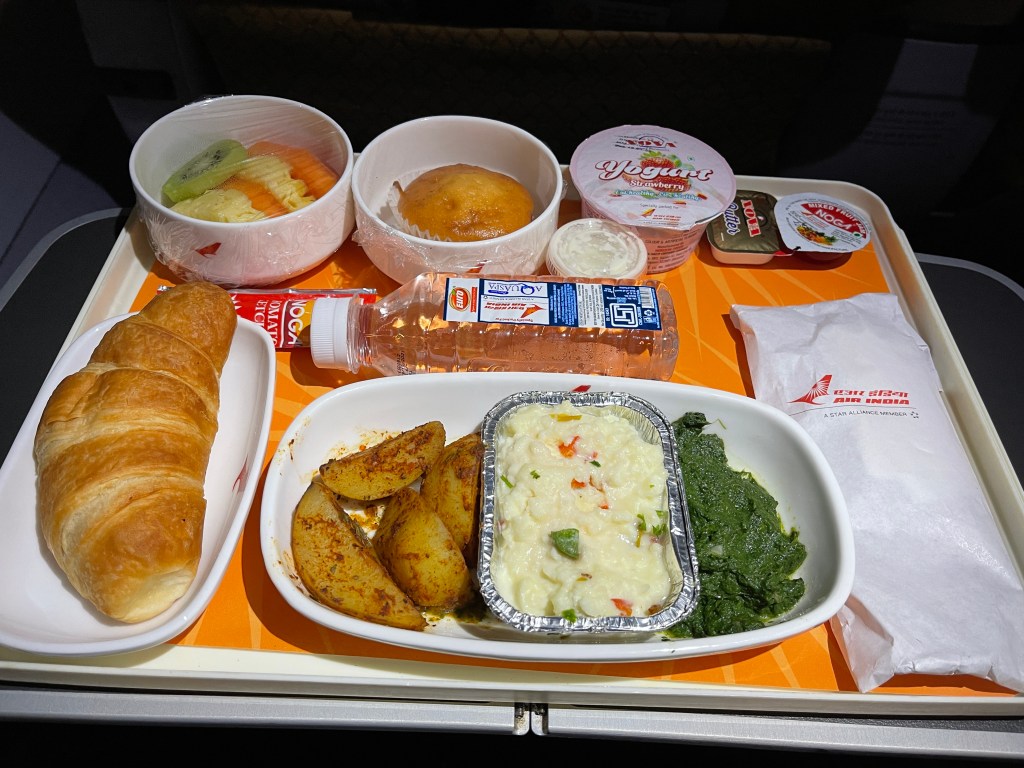
Air India has traditionally excelled in its domestic catering, offering hot, multi-course meals even on relatively short sectors. However, the utility of a full-course meal on a 60-to-90-minute flight is questionable.
In the 2026 service model, the time window for meal service on short routes is extremely narrow. Flight attendants must rush to serve and clear trays, often leaving passengers with less than 20 minutes to actually enjoy their food. For many corporate travelers, the "luxury" of a heavy meal at 8:00 AM or 10:00 PM is less attractive than an extra 30 minutes of sleep or the ability to work on a laptop—the latter of which is often hampered by the large meal trays used in Business Class.
Competition from "IndiGo Stretch"
The competitive landscape in 2026 has been significantly altered by the maturity of IndiGo Stretch. As the country's largest carrier, IndiGo’s foray into a "coupe" style business product on high-density routes has created a price ceiling that Air India struggles to compete with.
IndiGo Stretch offers a simplified business class: a comfortable seat, priority service, and a curated meal, but without the "frills" of a full-service lounge or hot plated meals. Because IndiGo’s pricing is often 20-30% lower than Air India’s traditional Business Class, many travelers find it a more pragmatic choice for domestic business trips.
Detailed Feature Comparison: Domestic Tiers in 2026
The following table breaks down the typical domestic offering on a metro-to-metro route (e.g., BOM-DEL) to illustrate where the value resides.
| Feature | Air India Economy | Air India Premium Economy | Air India Business Class | IndiGo Stretch (Competitor) |
|---|---|---|---|---|
| Seat Pitch | 29-30 inches | 33-36 inches | 40-42 inches | 36-38 inches |
| Seat Configuration | 3-3 | 3-3 (with more space) | 2-2 | 2-2 |
| Meal Service | Standard Hot Meal | Upgraded Hot Meal | Multi-course Plated Meal | Pre-packed Premium Meal |
| Baggage Allowance | 15-20kg | 20-25kg | 35-40kg | 30kg |
| Lounge Access | No | No (Usually) | Yes | No (Optional Add-on) |
| Typical Price Multiple | 1x (Base) | 1.6x – 2.1x | 3.5x – 4.5x | 2.5x – 3.0x |
When the Premium Is Worth It
While the general consensus for 2026 suggests that the domestic business class premium is often excessive, there are specific scenarios where the expense is justifiable:
- Excess Baggage Requirements: If you are traveling with 35kg or more of luggage, the excess baggage fees in Economy can nearly equal the price of a Business Class ticket. In this case, the upgrade pays for itself through the increased allowance.
- Connecting from International Flights: If you are on a single PNR (ticket) connecting from an international long-haul Business Class flight, the domestic leg is included in the premium. The seamless transfer and baggage handling add significant value here.
- Last-Minute Flexible Bookings: On certain high-demand days, the price gap between a "Flex" Economy ticket and a Business Class ticket narrows significantly. If the difference is less than 30%, the added comfort and points accrual make sense.
- Flying Returns Tier Status: For those chasing or maintaining "Global" or "Maharajah" status within Air India’s loyalty program, the 200% points accrual in Business Class is a strategic investment in future international upgrades.
Frequently Asked Questions
1. Has the Vistara merger improved Air India's domestic business class?
Yes, the merger has standardized the "soft product"—meaning the service training, meal quality, and crew etiquette are now much closer to Vistara's award-winning standards. However, the "hard product" (the physical seats) remains inconsistent because it takes years to retrofit an entire fleet of older Air India aircraft to match the Vistara configuration.
2. Is lounge access guaranteed with every domestic business class ticket?
Generally, yes. Air India provides lounge access to all Business Class passengers at major airports. However, at smaller Tier-2 or Tier-3 cities, there may not be a dedicated lounge, or Air India may use a shared facility that does not offer the same level of amenities found in Delhi or Mumbai.
3. How does the "New Air India" cabin differ from the old one?
The new cabins, introduced on A350s and new-delivery A320neos in 2024-2025, feature a sophisticated burgundy and silver color palette, USB-C charging ports at every seat, and ergonomic headrests. The old cabins often have beige or red fabric seats with limited tech integration and worn-out cushions.
4. Can I upgrade from Economy to Business Class at the airport?
Air India often offers "Instant Upgrades" at the check-in counter if seats are available. In 2026, these are priced dynamically. If you can secure an airport upgrade for ₹7,000 to ₹10,000 on a major route, it represents much better value than booking the Business Class fare outright.
5. Does Air India domestic business class offer Wi-Fi?
As of 2026, Wi-Fi is being progressively rolled out across the new A320neo and A321neo fleet. While Business Class passengers may receive a complimentary messaging pack, full high-speed streaming usually requires an additional fee, even in the premium cabin.
Practical Recommendation
For the majority of domestic flights in India that are under 2.5 hours, Air India Business Class is not a value-optimized purchase. The most strategic way to travel in 2026 is to book Premium Economy. You receive the necessary "breathing room," priority handling, and a quality meal without the exorbitant price tag of the front cabin.
Reserve Business Class only for transcontinental domestic routes (such as Delhi to Kochi or Mumbai to Guwahati), where the 3.5-hour duration allows you to actually utilize the seat's comfort and the full meal service, or when you are carrying significant excess baggage that would otherwise incur high fees.