Accelerated MSN programs are intensive, fast-tracked graduate degrees designed for individuals with a non-nursing bachelor's degree or current RNs seeking advanced practice roles. These programs condense several years of clinical and theoretical education into 15 to 36 months, allowing students to enter high-level nursing roles, specialized practice, or healthcare leadership significantly faster than traditional pathways.
The landscape of nursing education has shifted dramatically as we move through 2026. With an aging population and a persistent shortage of primary care providers, the demand for Master of Science in Nursing (MSN) graduates—particularly those in advanced practice roles—has reached a critical point. For career changers and ambitious registered nurses, accelerated MSN programs offer a rigorous but efficient route to high-impact, high-compensation roles in the healthcare sector.
Defining the Accelerated MSN Landscape
To understand accelerated MSN programs, one must first distinguish between the two primary pathways they serve. While "accelerated" implies speed, the structure depends entirely on the student's starting point.
Direct Entry MSN (For Non-Nurses)
Commonly referred to as a "Direct Entry" or "Master's Entry" program, this path is designed specifically for individuals who hold a bachelor’s degree in a field other than nursing (e.g., biology, psychology, or even business). These programs are the true "accelerators" of the nursing world. They take a student from zero nursing experience to a Master’s degree in approximately three years.
The first portion of the program—usually 12 to 18 months—is a "pre-licensure" phase where students complete the equivalent of a Bachelor of Science in Nursing (BSN). After passing the NCLEX-RN exam, they transition immediately into graduate-level coursework to finish their MSN.
RN-to-MSN (For Current Nurses)
For those who already hold an Associate Degree in Nursing (ADN) or a nursing diploma, accelerated RN-to-MSN programs bypass the traditional requirement of completing a standalone BSN. By "bridging" the undergraduate and graduate requirements, these programs allow RNs to earn their Master's in as little as 20 to 24 months. These are ideal for working professionals who want to move into administration, education, or advanced practice roles like Nurse Practitioner (NP).
Prerequisites and Admission Rigor in 2026
Gaining admission to an accelerated MSN program is notoriously competitive. Because these programs move at a relentless pace, admissions committees look for candidates who have already demonstrated academic excellence and emotional resilience.
Academic Requirements
Most programs require a minimum cumulative GPA of 3.0, though the most prestigious institutions often see averages closer to 3.5 or 3.7. For direct entry candidates, the following prerequisite courses are standard and must usually have been completed within the last five to seven years:
- Anatomy and Physiology I & II (with lab)
- Microbiology (with lab)
- General or Organic Chemistry
- Statistics
- Human Growth and Development
- Nutrition
The "Holistic" Review Process
By 2026, many universities have moved toward a holistic admissions process. This means that while GPA is important, schools heavily weigh your personal statement, letters of recommendation, and relevant volunteer or work experience. They are looking for "grit"—the ability to handle a 60-hour-per-week commitment of study and clinical rotations without burning out.
The Curriculum: Speed vs. Depth
A common concern regarding accelerated MSN programs is whether the speed compromises the quality of education. In reality, these programs are often more rigorous because they do not have the "fluff" or extended breaks found in traditional four-year degrees.
The Pre-Licensure Phase
For direct entry students, the first year is a whirlwind of clinical foundations. You will learn the "mechanics" of nursing: how to start IVs, conduct physical assessments, and understand pharmacology. This phase is heavily focused on the American Association of Colleges of Nursing (AACN) Essentials, ensuring that students meet the same competencies as BSN graduates before they move into advanced theory.
Graduate Specialization
Once the foundational nursing skills are mastered, the curriculum shifts to advanced topics. This is where you choose your "track." Common specializations include:
- Family Nurse Practitioner (FNP): Providing primary care across the lifespan.
- Psychiatric Mental Health Nurse Practitioner (PMHNP): Addressing the surging demand for mental health services.
- Adult-Gerontology Acute Care: Working in ICU or emergency settings.
- Nurse Educator: Training the next generation of nurses in academic or clinical settings.
- Informatics: Managing healthcare data to improve patient outcomes.
Clinical Hour Requirements
Accelerated programs do not cut corners on clinical hours. To sit for board certification in 2026, students must still complete a minimum of 500 to 750 supervised clinical hours (depending on the specialty). In an accelerated format, this often means spending three to four days a week in a hospital or clinic while simultaneously attending evening lectures or completing online modules.
Comparing Program Paths
The following table outlines the key differences between the various MSN pathways available in 2026 to help you determine which fits your current professional status.
| Program Type | Target Audience | Typical Duration | Final Credential | Clinical Hours (Approx.) |
|---|---|---|---|---|
| Direct Entry MSN | Non-nursing Bachelor's holders | 30–36 Months | RN License + MSN | 1,000+ (Total) |
| Accelerated RN-to-MSN | Current ADN/Diploma RNs | 20–24 Months | MSN | 500–750 |
| Traditional MSN | Current BSN-prepared RNs | 18–24 Months | MSN | 500–750 |
| Bridge MSN | Non-nursing Master's holders | 24–30 Months | RN License + MSN | 1,000+ |
Financial Considerations and ROI
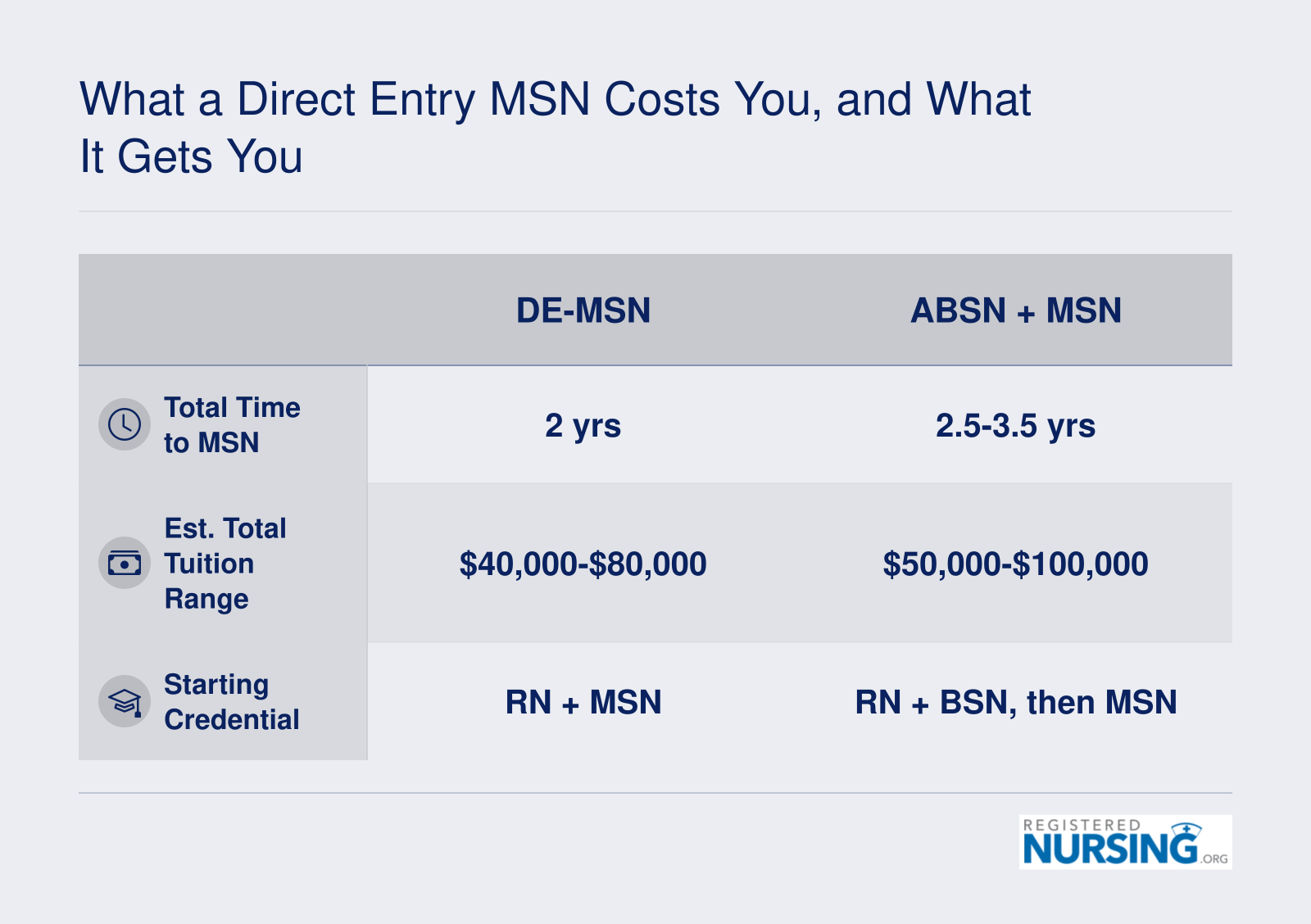
The cost of an accelerated MSN can be significant. In 2026, tuition for these programs ranges from $40,000 to over $120,000, depending on whether the institution is public or private. However, the Return on Investment (ROI) remains one of the highest in the education sector.
Funding Your Fast-Track Degree
Because these programs are graduate-level, students are eligible for higher federal loan limits than undergraduates. Additionally, there are several specific funding avenues:
- HRSA Scholarships: The Health Resources and Services Administration offers scholarships and loan repayment programs for nurses who commit to working in underserved areas after graduation.
- Employer Tuition Reimbursement: Many hospital systems will pay for an RN's MSN if they commit to staying with the organization for a set number of years.
- Nurse Faculty Loan Program (NFLP): For those specializing in nursing education, this program can forgive up to 85% of student loans in exchange for four years of teaching post-graduation.
Salary Expectations
The financial justification for an MSN is clear. According to the Bureau of Labor Statistics, advanced practice nurses (NPs, CRNAs) earn a median salary well above $125,000, with specialized roles in urban areas or acute care often exceeding $160,000 in 2026.
Choosing the Right Program: Accreditation and Quality
With the rise of online and hybrid models, vetting the quality of an accelerated MSN program is more important than ever.
Essential Accreditations
Never enroll in a program that is not accredited by either the Commission on Collegiate Nursing Education (CCNE) or the Accreditation Commission for Education in Nursing (ACEN). Accreditation ensures that the program meets national standards for nursing education and is required for you to sit for national certification exams and obtain state licensure.
Online vs. In-Person
In 2026, many accelerated MSN programs offer "hybrid" formats where theory classes are online, but clinicals and intensive skills labs are performed in person.
- Synchronous Online: Requires you to be logged in at specific times for live lectures.
- Asynchronous Online: Allows you to view lectures on your own schedule—highly valuable for those balancing work.
- Clinical Placement: The best programs handle clinical placements for you. Be wary of programs that require you to find your own preceptors, as this can be incredibly difficult in a crowded healthcare market.
The Challenges: Is an Accelerated MSN Right for You?
The "accelerated" nature of these programs is not an exaggeration. The pace is relentless. Students often report that the workload is equivalent to a full-time job plus overtime.
Mental and Physical Toll: You will likely be studying for 40 hours a week on top of 24 to 36 hours of clinical rotations. This leaves very little time for outside employment. Most direct entry programs explicitly discourage or even forbid students from working during the pre-licensure phase.
Learning Curve: For those coming from non-science backgrounds, the sheer volume of memorization and critical thinking required in pharmacology and pathophysiology can be overwhelming. You aren't just learning to pass a test; you are learning to make life-or-death decisions.
Frequently Asked Questions
1. Can I work while enrolled in an accelerated MSN program?
For direct entry students, working is generally not recommended during the first 12–15 months due to the intensity of the pre-licensure clinicals. RN-to-MSN students, however, often work part-time or even full-time if their program is structured for working professionals with asynchronous online classes.
2. Is an MSN better than a DNP (Doctor of Nursing Practice)?
In 2026, the MSN remains the standard entry-level degree for most advanced practice roles. However, there is a gradual shift toward the DNP as the terminal degree for clinical practice. If you plan to move into executive leadership or high-level policy, you might eventually need a DNP, but an MSN is more than sufficient for clinical practice and carries a lower initial cost and time commitment.
3. How do clinical rotations work in accelerated programs?
Clinical rotations are typically arranged in "blocks." You might spend six weeks focusing on pediatrics, followed by six weeks in psychiatric care. Because the program is accelerated, these blocks happen back-to-back with very few breaks in between.
4. What is the NCLEX-RN pass rate requirement?
When researching programs, always look for their NCLEX-RN pass rates. A reputable accelerated MSN program should have a pass rate of 90% or higher. If the rate is lower, it may indicate that the program is rushing through foundational material too quickly for students to retain it.
5. Are online accelerated MSN programs respected by employers?
Yes, provided they are CCNE or ACEN accredited. Employers in 2026 focus on your clinical experience, your certification, and your performance during residency or interviews. They generally do not differentiate between an online MSN and a traditional one, as the clinical requirements are identical.
Practical Recommendation for Prospective Students
If you are considering an accelerated MSN in 2026, your first step should be a thorough audit of your prerequisites. Many community colleges offer these courses online, and completing them with high grades is the best way to prove your readiness for a graduate-level nursing workload.
Once your prerequisites are in order, prioritize programs that offer clinical placement support. The stress of the curriculum is high enough without the added burden of cold-calling hospitals to find a preceptor. Finally, reach out to current students or alumni of the programs you are considering; their "on-the-ground" perspective is the most valuable tool you have in determining if the program’s culture and pace align with your learning style.