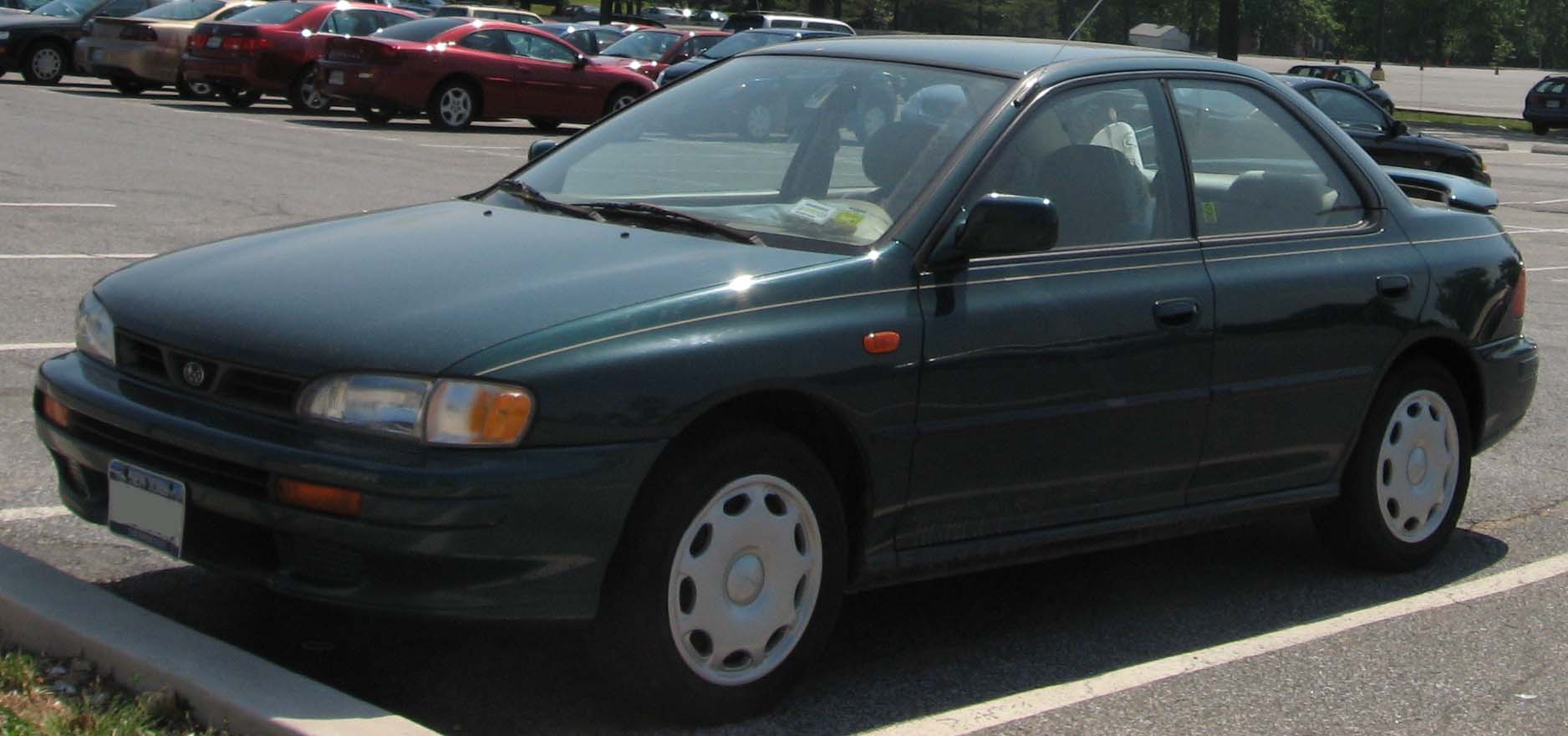
The 1993 Subaru Impreza launched as a sophisticated replacement for the aging Leone, introducing the EJ-series boxer engine and a refined Symmetrical All-Wheel Drive system to the compact segment. It established the foundation for Subaru's dominance in the World Rally Championship and defined the brand's identity as a manufacturer of durable, driver-centric, and all-weather capable vehicles.
The Dawn of the Impreza: Replacing the Leone
In the early 1990s, Subaru faced a significant crossroads. Their primary compact offering, the Leone (sold as the Loyale in North America), was a rugged but increasingly dated platform that could no longer compete with the refinement of the Honda Civic or the Toyota Corolla. Subaru needed a vehicle that could serve two masters: a practical, economical commuter for the global mass market and a rigid, high-potential platform for the World Rally Championship (WRC).
The 1993 Impreza was the answer. Developed under the leadership of Isamu Akiba, the Impreza was designed to be smaller and more nimble than the mid-sized Legacy, yet more advanced than the entry-level Justy. When it debuted in late 1992 for the 1993 model year, it brought a level of chassis rigidity and mechanical sophistication rarely seen in the "economy" class. It wasn't just a new car; it was a new philosophy for Subaru, shifting the brand from a niche manufacturer of "farm cars" to a serious contender in the global performance and lifestyle markets.
1993 Launch Specifications: A Technical Breakdown
The 1993 Impreza launch was characterized by variety. Unlike many competitors that offered a single engine and front-wheel-drive layout, Subaru leveraged its unique engineering DNA to offer multiple Boxer engine configurations and its signature All-Wheel Drive (AWD).
The EJ Engine Family
At the heart of the 1993 Impreza was the EJ-series horizontally opposed four-cylinder engine. This "Boxer" layout allowed the engine to sit lower in the engine bay, significantly dropping the vehicle's center of gravity compared to the inline-four engines found in the Toyota Corolla or Nissan Sentra.
- 1.8L SOHC (EJ18): This was the primary engine for the North American launch. It produced approximately 110 horsepower and 110 lb-ft of torque. While not a powerhouse, its "over-square" design made it remarkably durable and smooth.
- 2.2L SOHC (EJ22): Available in higher trims and the "LS" Sportswagon, the 2.2L provided a more robust 135 horsepower. This engine remains legendary among enthusiasts in 2026 for its "bulletproof" reliability, often reaching 300,000 miles with basic maintenance.
- 1.6L SOHC (EJ16): Offered primarily in European and Asian markets, this version prioritized fuel efficiency and met specific displacement tax brackets.
Drivetrain and Transmission
The 1993 model offered two distinct AWD systems depending on the transmission choice, a distinction that defined Subaru’s "Symmetrical AWD" marketing for decades.
- Manual Transmission (5-Speed): These models utilized a continuous AWD system with a viscous-coupling locking center differential. It maintained a 50/50 power split between the front and rear wheels under normal conditions.
- Automatic Transmission (4-Speed): These featured an "Active Torque Split" AWD system. It used an electronically controlled multi-plate transfer clutch to vary power distribution based on sensor input, typically defaulting to a 90/10 front-to-rear split during steady cruising to save fuel.
Body Styles: Versatility in the Compact Segment
Subaru launched the 1993 Impreza with two primary body styles: a traditional four-door sedan and a unique five-door "Sportswagon." A two-door coupe would follow shortly after, but the initial launch focused on these two.
The Sedan (GC Chassis)
The sedan was aimed squarely at the traditional compact market. It featured a relatively conservative "three-box" design but was praised for its excellent visibility. The thin A-pillars and large glass area—a Subaru hallmark—made the car feel much larger inside than its exterior dimensions suggested. The GC chassis was remarkably light, with base models weighing in at just under 2,400 pounds, providing a power-to-weight ratio that made even the 1.8L engine feel adequate.
The Sportswagon (GF Chassis)
The Sportswagon was not a traditional long-roof estate. Instead, it was more of a "short-wagon" or a large hatchback. This design was intentional; Subaru wanted to offer the utility of a wagon without the "uncool" image associated with larger family haulers. The Sportswagon featured a slightly higher roofline than the sedan, offering 24 cubic feet of cargo space with the seats up, making it a favorite for outdoor enthusiasts—a demographic Subaru would eventually own completely.
The Birth of a Rally Legend: The WRX and 555 Connection
While the standard 1993 Impreza was a solid commuter, the performance world was shaken by the simultaneous launch of the Impreza WRX (World Rally eXperimental) in the Japanese Domestic Market (JDM). Although the WRX wouldn't reach North American shores until 2002, its development in 1993 was the catalyst for the Impreza's global legacy.
Subaru’s racing partner, Prodrive, helped transition the rally program from the larger Legacy RS to the smaller, more agile Impreza chassis. The 1993 launch coincided with the debut of the iconic "555" blue and yellow livery. With drivers like Ari Vatanen and later Colin McRae, the 1993 Impreza proved immediately competitive.
The 1993 JDM WRX featured a turbocharged 2.0L EJ20 engine producing 240 horsepower, a staggering figure for a compact car in the early 90s. It featured a vented hood, a functional intercooler, and uprated suspension. This car established the "blue car, gold wheels" trope that remains a symbol of performance engineering in 2026.
Comparison: 1993 Impreza vs. Competitive Landscape
To understand the 1993 Impreza’s impact, one must look at what else was on the showroom floor that year. While most competitors focused on front-wheel drive and economy, Subaru gambled on the added cost and complexity of AWD.
| Feature | 1993 Subaru Impreza L (AWD) | 1993 Honda Civic EX | 1993 Toyota Corolla DX |
|---|---|---|---|
| Engine | 1.8L Flat-4 (Boxer) | 1.6L Inline-4 (VTEC) | 1.8L Inline-4 |
| Horsepower | 110 hp | 125 hp | 115 hp |
| Drivetrain | Full-Time All-Wheel Drive | Front-Wheel Drive | Front-Wheel Drive |
| Curb Weight | ~2,550 lbs | ~2,450 lbs | ~2,400 lbs |
| Suspension | 4-Wheel Independent | 4-Wheel Double Wishbone | MacPherson Strut |
| Key Advantage | All-weather traction/Stability | High-revving engine/Efficiency | Reliability/Resale Value |
The table illustrates that while the Impreza was slightly heavier and less powerful than the class-leading Civic EX, it offered the unique value proposition of AWD. In 1993, AWD was usually reserved for expensive luxury sedans or dedicated off-roaders. Bringing this tech to a car costing under $15,000 (at the time) was a revolutionary move.
Heritage and Global Impact: The Impreza in 2026
As of 2026, the 1993 Subaru Impreza is officially a "classic" vehicle, having surpassed the 30-year mark. Its legacy is visible in three distinct areas:
1. The Democratization of All-Wheel Drive
Before the Impreza, AWD was a "feature." After the Impreza’s success, AWD became the "identity" of Subaru. The 1993 model's success in snowy regions like New England, the Pacific Northwest, and Northern Europe proved that consumers were willing to pay a slight premium for the safety and capability of four driven wheels.
2. The Enthusiast Culture
The 1993 GC chassis is considered by many "Subarists" to be the purest expression of the brand. Its mechanical throttle, lack of complex driver aids, and lightweight frame make it a favorite for restoration. In 2026, we see a booming market for "restomodding" these early Imprezas, often swapping in modern STI engines into the light 1993 shells.
3. Engineering Consistency
The basic layout introduced in 1993—the Boxer engine mated to a symmetrical drivetrain—remains the blueprint for Subaru’s lineup today. While the electronics and safety systems have evolved, a 1993 Impreza owner would find the engine bay of a 2026 model surprisingly familiar. This engineering consistency has fostered a massive secondary market for parts and knowledge.
Ownership and Maintenance in 2026
For collectors or enthusiasts looking to acquire a 1993 Impreza today, several "era-specific" factors must be considered. While the mechanicals are robust, three decades of age present specific challenges.
- The "Rear Quarter Rust": Like many Japanese cars of the 90s, the 1993 Impreza is prone to corrosion in the rear wheel arches, especially in "salt belt" regions. Finding a "slick-top" (non-sunroof) sedan with clean quarters is the "holy grail" for collectors.
- Timing Belts and Head Gaskets: While the 1.8L and 2.2L engines were less prone to the head gasket failures that plagued the later 2.5L engines, they still require strict adherence to timing belt intervals (every 60,000–100,000 miles).
- Parts Availability: As of 2026, many OEM interior trim pieces and specific sensors are becoming "NLA" (No Longer Available). Owners often rely on JDM importers or the robust 3D-printing enthusiast community for replacement clips and plastic components.
- The "Boxer Burble": The 1993 model featured unequal-length exhaust headers (UEL), which created the distinct, rhythmic exhaust note that many owners preserve or enhance with aftermarket systems.
Common Myths About the 1993 Launch
There are several misconceptions about the first-year Impreza that often circulate in enthusiast circles.
Myth: All 1993 Imprezas were All-Wheel Drive. Fact: In the first year, Subaru actually offered Front-Wheel Drive (FWD) versions of the Impreza to keep the base price competitive. These are rare today, as most were driven into the ground or converted to AWD by enthusiasts, but they did exist as the "standard" trim.
Myth: The 1993 22B was available at launch. Fact: The legendary 22B STi did not arrive until 1998. The 1993 launch was purely about the base Impreza and the standard WRX (in Japan). The wide-body, 2.2L turbo monster was a later celebration of Subaru's three consecutive WRC titles.
Frequently Asked Questions
Did the 1993 Subaru Impreza have airbags?
Yes, for the North American market, the 1993 Impreza was equipped with a driver-side airbag as standard equipment. This was a significant selling point at the time, as many budget compacts were still transitioning away from automatic "motorized" seatbelts to meet safety regulations.
What was the fuel economy of the 1993 AWD model?
The 1993 Impreza with the 1.8L engine and AWD typically achieved around 22-25 MPG in combined driving. While lower than a FWD Honda Civic of the same era, it was considered efficient for an all-wheel-drive vehicle, which traditionally suffered from significant "parasitic loss" in the drivetrain.
Is the 1993 Impreza a good "first car" in 2026?
From a mechanical learning perspective, yes. It is easy to work on and very forgiving. However, from a safety perspective, it lacks modern crumple zones, side-curtain airbags, and electronic stability control. It is best suited as a weekend project or a vehicle for an experienced driver who appreciates mechanical purity.
What is the difference between the "L" and "LS" trims in 1993?
The "L" was the volume-selling trim, featuring the 1.8L engine and basic creature comforts. The "LS" was the luxury tier, often coming with the larger 2.2L engine, upgraded upholstery, cruise control, and power windows/locks—features that were not yet universal in the compact segment.
Can you still find parts for the 1993 Impreza?
Mechanical parts (brakes, suspension, engine gaskets) remain widely available because Subaru used similar designs for nearly 20 years. However, cosmetic parts like dashboard components, door cards, and specific 1993-only grill inserts are increasingly difficult to source and often require searching specialized salvage yards.
Final Recommendation for Enthusiasts
If you are looking to experience the origins of Subaru's modern era, the 1993 Impreza is the definitive starting point. For collectors, prioritize the 1993 Impreza LS Sportswagon with the 2.2L engine; it represents the perfect blend of utility and the "over-engineered" durability that built Subaru's reputation. Always inspect the rear shock towers and wheel arches for structural rust before purchasing. While it may not have the raw speed of the later STI models, the 1993 launch version offers a tactile, lightweight driving experience that is increasingly rare in the modern, sensor-heavy automotive landscape of 2026.