A Tenants in Common (TIC) 1031 exchange allows multiple investors to pool their capital to purchase institutional-grade real estate, providing a pathway to defer capital gains taxes while maintaining a fractional ownership interest. This strategy enables investors to transition from active management to passive ownership in large-scale properties that would otherwise be beyond their individual financial reach.
Understanding the Basics of TIC 1031 Exchanges
To understand a Tenants in Common 1031 exchange, one must first recognize the fundamental mechanics of a Section 1031 exchange under the Internal Revenue Code. A 1031 exchange permits an investor to defer the payment of capital gains taxes upon the sale of an investment property, provided the proceeds are reinvested into a "like-kind" replacement property within strict statutory timeframes.
A TIC arrangement is a legal structure where two or more parties hold undivided fractional interests in a single piece of property. When combined with a 1031 exchange, it allows a taxpayer to satisfy the "like-kind" requirement by purchasing a fractional interest in a larger property rather than acquiring a whole building. This is particularly attractive for those seeking to exit the day-to-day responsibilities of property management—often referred to as "management-intensive" assets—in favor of a passive, institutional-grade commercial portfolio.
1. Fractional Ownership and the "Undivided Interest"
The hallmark of a TIC is that each owner holds an undivided interest in the entire property. Unlike a partnership or a corporation where you own shares in an entity, a TIC investor holds a direct deeded interest in the real estate itself. This distinction is critical for tax purposes; because the IRS views a TIC interest as a direct interest in real estate, it qualifies as "like-kind" property for 1031 exchange purposes. Each tenant in common has the right to possess the whole property, and their interest is typically represented as a percentage of the total property value.
2. Eligibility Under IRS Revenue Procedure 2002-22
The IRS provided specific guidance for TIC arrangements in Revenue Procedure 2002-22. This document outlines the conditions under which the IRS will issue a private letter ruling that a TIC interest is not a "security" or a "partnership interest." While the revenue procedure is not law, it serves as the industry standard for structuring TIC 1031 offerings. Key requirements include limitations on the number of co-owners (typically no more than 35), restrictions on the management agreement, and the requirement that each owner must be able to sell or encumber their interest independently.
3. Passive Income and Asset Management
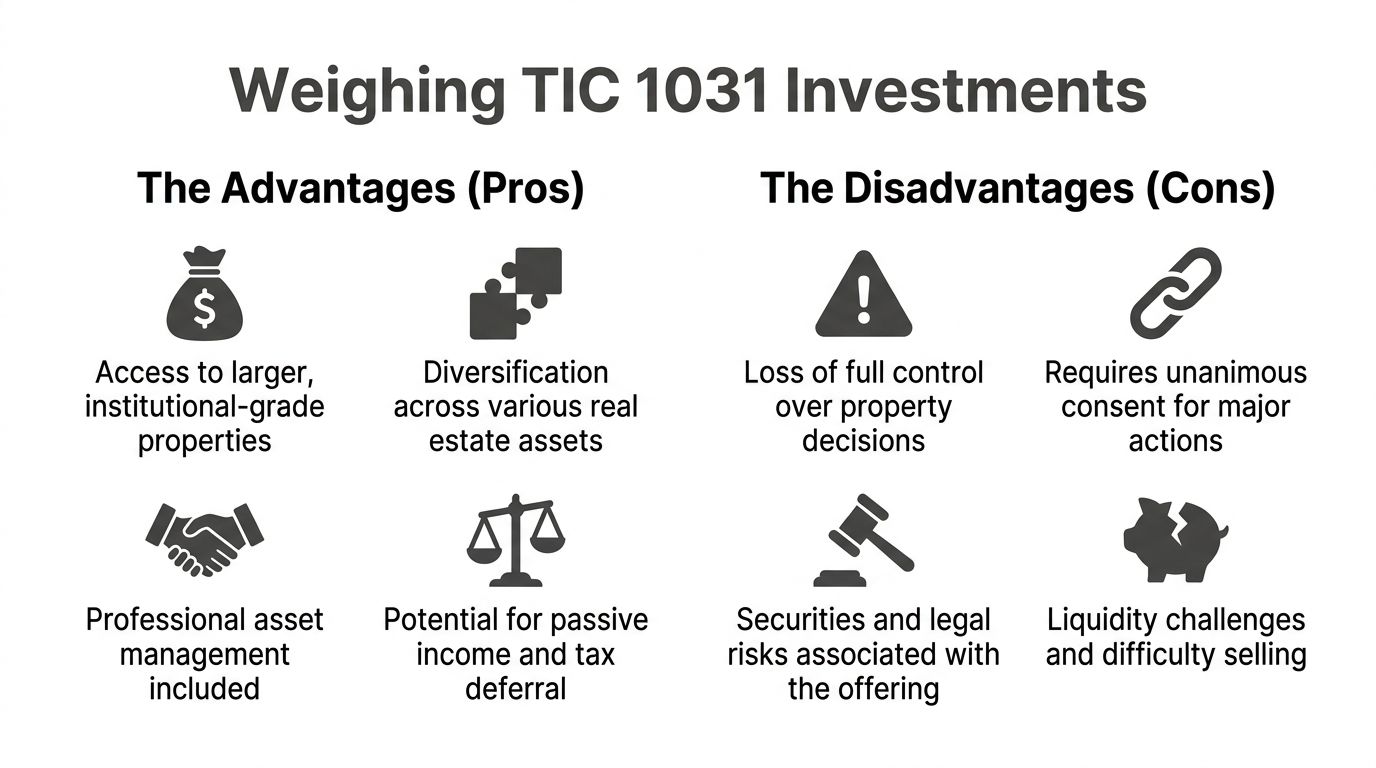
One of the most significant benefits of a TIC 1031 exchange is the transition from active to passive management. Investors often find themselves dealing with "the three Ts": tenants, toilets, and trash. By utilizing a TIC 1031, an investor can exchange a managed apartment building or commercial space for a fractional interest in a high-quality property—such as a medical office building, industrial complex, or retail center—that is already managed by a professional sponsor. The investors receive pro-rata distributions of the net rental income without being involved in the day-to-day operations.
4. Meeting the "Like-Kind" Requirement
The IRS defines "like-kind" broadly. In the context of real estate, almost all investment real estate is considered like-kind to other investment real estate. You can exchange a residential duplex for a fractional interest in a multi-family apartment complex or a self-storage facility. The critical requirement is that the property must be held for productive use in a trade or business or for investment, and the taxpayer must be a direct owner of the real estate or an interest that qualifies as such.
5. Strict Deadlines: The 45-Day and 180-Day Rules
The 1031 exchange process is governed by two rigid deadlines. Within 45 days of selling the original property (the "relinquished property"), the investor must formally identify potential replacement properties in writing. Following this, the acquisition of the replacement property (the "replacement property") must be completed within 180 days of the sale of the relinquished property. Missing these deadlines by even a single day results in the disqualification of the tax deferral, making the entire capital gain taxable in the year the property was sold.
6. The Role of the Qualified Intermediary (QI)
No investor may touch the proceeds from the sale of their relinquished property. If the funds touch the investor's personal or business bank account, the exchange is invalidated. To comply with this, investors must engage a Qualified Intermediary (QI). The QI holds the funds in an escrow account, prepares the necessary documentation for the exchange, and ensures that the funds are transferred directly to the seller of the replacement property. The QI acts as a neutral third party to ensure compliance with the Internal Revenue Code.
7. Non-Recourse Debt and Financing
Most TIC 1031 offerings are structured with existing non-recourse financing. When an investor completes an exchange, they must replace the debt they had on their relinquished property with an equal or greater amount of debt on the replacement property to avoid "boot"—which is taxable gain. Because TIC interests often come with pre-arranged, non-recourse debt, the investor does not need to qualify for a personal mortgage for the replacement property. This simplifies the process significantly, as the loan is typically secured by the property itself rather than the individual investor’s creditworthiness.
8. Potential for Institutional-Grade Assets
The TIC 1031 exchange provides individual investors with access to the type of large-scale commercial real estate that is usually reserved for institutional players like pension funds and REITs. By pooling capital with other TIC investors, the group can acquire high-value assets—such as a $50 million distribution center—that offer greater stability, longer lease terms, and higher-quality credit tenants compared to the average retail investor's single-family or small multi-family rental property.
9. Diversification Through Fractionation
TIC 1031 exchanges allow for a strategic level of diversification. An investor who previously owned a single large property can sell it and distribute the proceeds across multiple TIC interests in different geographic locations or different asset classes. For example, rather than putting 100% of their equity into a single replacement apartment building, an investor could divide their 1031 proceeds into three separate TIC investments, such as a grocery-anchored shopping center in the Midwest, a self-storage facility in the South, and an industrial park in the West.
10. Risks and Exit Limitations
While TIC exchanges offer many advantages, they are not without risks. Unlike owning a single property, a TIC investor has limited control over management decisions, as these are dictated by the master lease or the sponsor’s agreement. Furthermore, the liquidity of a TIC interest is lower than that of a standalone property; selling a fractional interest often requires the consent of other owners or the sponsor. It is essential to conduct thorough due diligence on the sponsor, the market conditions of the asset, and the long-term business plan for the property.
Comparison Table: TIC 1031 vs. Direct Ownership
| Feature | TIC 1031 Exchange | Direct Ownership |
|---|---|---|
| Management | Professional (Passive) | Hands-on (Active) |
| Control | Limited (Fractional) | Full (Owner) |
| Capital Requirement | Lower (Fractional) | High (Full Price) |
| Debt Liability | Non-recourse (typically) | Often Personal Guarantee |
| Diversification | High (Easily split across assets) | Low (Concentrated) |
| Liquidity | Restricted | Market-Dependent |
Frequently Asked Questions
Can I manage the property myself in a TIC 1031 exchange? Generally, no. The IRS rules for TIC 1031 arrangements—specifically those meant to avoid being taxed as a partnership—require that management functions be handled by a professional third party. Any attempt by an individual owner to act as the primary manager often violates the Revenue Procedure 2002-22 guidelines, potentially risking the tax-deferred status of the exchange.
What happens if one of the other co-owners defaults? In a well-structured TIC offering, the operating agreement specifically delineates how default scenarios are handled. Typically, the master tenant or sponsor has mechanisms to address shortfalls. However, it is vital to read the Private Placement Memorandum (PPM) carefully, as this document outlines the specific legal recourse available to the other owners in the event of an individual owner's default.
Is a TIC interest considered a security? While TIC interests are real estate under property law, they are often regulated as securities by the SEC when marketed as investment offerings. This is a common point of confusion. Investors should ensure they are working with licensed professionals (often FINRA-registered brokers) when evaluating TIC 1031 investment opportunities to ensure full regulatory compliance.
Are there minimum investment amounts? Yes. TIC offerings typically have minimum investment thresholds, often ranging from $100,000 to $250,000 per investor. These minimums are set by the sponsor to manage the administrative costs associated with maintaining a limited number of co-owners on the property deed.
What is the tax implication of "boot"? "Boot" refers to any cash or other non-like-kind property received in a 1031 exchange. If you trade down in value or reduce your debt load, the difference is considered taxable boot. This amount is subject to capital gains tax and potentially depreciation recapture, which is why balancing the purchase price and debt level is a foundational step in the exchange process.
Final Recommendation
For investors seeking to transition from active real estate management to a more passive investment style while preserving tax-deferred growth, the Tenants in Common 1031 exchange is a powerful tool. Before proceeding, engage a tax attorney or a certified public accountant familiar with Section 1031 to review your specific situation. Ensure that your choice of Qualified Intermediary is well-vetted and that you perform rigorous due diligence on the investment sponsor. As with all financial decisions, professional advice tailored to your 2026 tax status and long-term wealth goals is essential.