An F-1 student is a non-immigrant individual who has been granted legal status to enter the United States temporarily to pursue full-time academic studies or language training. This status is specifically for those enrolled in SEVP-certified institutions, ranging from universities and colleges to high schools and language academies, for the duration of their program.
The F-1 visa classification is the most common category for international students seeking to access the American educational system. Unlike immigrant visas, the F-1 status is strictly temporary and requires the student to maintain a permanent residence abroad that they have no intention of abandoning. As of 2026, the regulatory framework governing these students remains rooted in the Immigration and Nationality Act, overseen by the U.S. Department of Homeland Security (DHS) and the U.S. Department of State. Understanding the nuances of this status is critical for any prospective student, as a single administrative error can result in the loss of legal standing and future inadmissibility to the United States.
The Core Definition and Purpose of F-1 Status
To be classified as an F-1 student, an individual must be enrolled in a "full course of study." This is not a subjective term; it is strictly defined by the educational institution and federal regulations. For undergraduate students at a university, this typically means a minimum of 12 credit hours per semester. For graduate students, the requirement may vary depending on the specific department’s definition of full-time enrollment.
The primary purpose of the F-1 program is to facilitate international educational exchange while ensuring that the primary intent of the visitor remains academic. This distinguishes F-1 students from M-1 students, who pursue vocational or non-academic programs, and J-1 students, who are part of exchange programs often funded by the government or specific organizations. The F-1 status is designed for degree-seeking students—those pursuing a Bachelor’s, Master’s, Doctorate, or a recognized certificate from a traditional academic institution.
Eligibility and Prerequisites for F-1 Applicants
Securing F-1 status is a multi-stage process that begins long before a student reaches a U.S. embassy or consulate. The eligibility criteria are rigorous and require extensive documentation.
Academic Acceptance
The first prerequisite is acceptance into a school certified by the Student and Exchange Visitor Program (SEVP). Not every American school can host international students. Institutions must undergo a federal certification process to prove they are legitimate educational entities capable of monitoring and reporting on the status of their international students. Once accepted, the school issues a Form I-20, Certificate of Eligibility for Nonimmigrant Student Status. This document is the cornerstone of the F-1 identity.
Financial Sufficiency
A prospective F-1 student must demonstrate that they have the financial resources available to cover the full cost of their education and living expenses for at least the first year of study, with a credible plan for funding the remainder of the program. This is a common point of visa denial. Applicants must provide bank statements, scholarship letters, or affidavits of support from sponsors. The U.S. government requires this to ensure that international students do not become "public charges" or find themselves forced into illegal employment to survive.
Non-Immigrant Intent
Under Section 214(b) of the Immigration and Nationality Act, every applicant for a non-immigrant visa is presumed to be an intending immigrant until they prove otherwise. An F-1 applicant must convince the consular officer that they have strong ties to their home country—such as family, property, or job prospects—that will compel them to return once their studies are complete.
The Role of SEVP and SEVIS
The Student and Exchange Visitor Program (SEVP) is the Department of Homeland Security entity that manages the Student and Exchange Visitor Information System (SEVIS). For an F-1 student, SEVIS is the digital shadow that follows their entire academic career in the United States.
Every F-1 student is assigned a unique SEVIS ID number, found on the top right of the Form I-20. Before applying for a visa, the student must pay the SEVIS I-901 fee, which funds the operation of this tracking system. Throughout the student's stay, the school’s Designated School Official (DSO) uses SEVIS to report vital events, including:
- Initial enrollment and registration.
- Changes in local address.
- Requests for employment authorization.
- Disciplinary actions or academic probation.
- Completion of the program or withdrawal.
Failure to maintain an active and accurate SEVIS record can lead to the immediate termination of F-1 status, requiring the student to leave the U.S. or apply for reinstatement.
Step-by-Step Application Process in 2026
Navigating the transition from an applicant to an F-1 student involves several high-stakes steps. While the timeline can vary by country, the general sequence remains consistent.
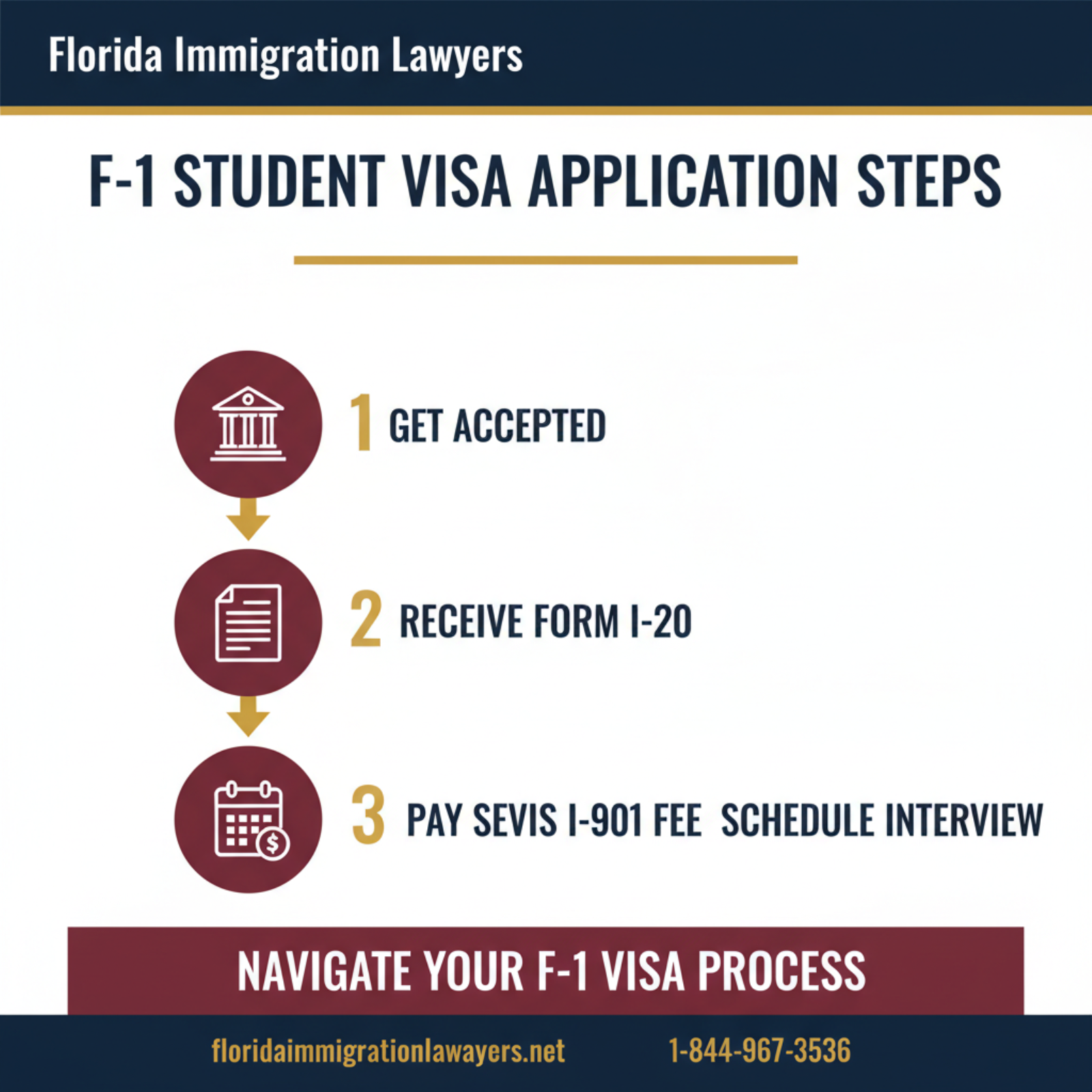
- Obtain the Form I-20: After academic admission, your school will mail or digitally transmit your I-20. Verify that all biographical information, the program start date, and the financial figures are correct.
- Pay the SEVIS I-901 Fee: This is currently handled through the FMJfee.com website. You must keep the receipt as proof of payment for your visa interview.
- Complete the DS-160: This is the Online Nonimmigrant Visa Application. It requires detailed information about your background, travel history, and social media presence.
- Schedule the Visa Interview: Interviews are conducted at U.S. Embassies or Consulates. In 2026, wait times can fluctuate significantly based on seasonal demand and local staffing levels.
- The Interview: Consular officers will verify your academic credentials, your financial ability, and your intent to return home. They will also confirm that your English proficiency is sufficient for your chosen program, unless you are coming specifically for a language training program.
- Entry into the United States: A visa does not guarantee entry. At the port of entry (airport or border crossing), a Customs and Border Protection (CBP) officer will inspect your documents and issue an I-94 arrival/departure record, usually marked with "D/S" (Duration of Status).
Rights and Limitations: Employment for F-1 Students
One of the most complex aspects of being an F-1 student is the restriction on employment. The F-1 status is for studying, not for working, but there are specific, narrow exceptions.
On-Campus Employment
F-1 students are generally permitted to work on-campus for up to 20 hours per week while school is in session and full-time during breaks. This work does not require USCIS approval, but it must be located on the school premises or at an off-campus location educationally affiliated with the school.
Curricular Practical Training (CPT)
CPT is for employment that is an integral part of an established curriculum, such as a required internship or practicum. It must be authorized by the DSO in SEVIS before the student begins working. If a student uses 12 months or more of full-time CPT, they become ineligible for OPT.
Optional Practical Training (OPT)
OPT is temporary employment that is directly related to the student’s major area of study. Most students use this for 12 months after graduation (Post-Completion OPT). Students in Science, Technology, Engineering, and Mathematics (STEM) fields may be eligible for a 24-month extension, allowing for a total of 36 months of work authorization in the U.S.
Economic Hardship
In rare cases, if a student suffers "severe economic hardship" due to unforeseen circumstances beyond their control (such as a currency devaluation or a natural disaster in their home country), they may apply to USCIS for off-campus work authorization. This is a difficult and lengthy application process.
Maintaining F-1 Status: Essential Rules
Maintaining status is the student's responsibility. Losing status can lead to "unlawful presence," which can result in being barred from the U.S. for years.
- Full Course Load: You must be enrolled full-time every mandatory semester. If you need to take fewer credits, you must obtain a "Reduced Course Load" (RCL) authorization from your DSO beforehand for specific medical or academic reasons.
- Keep Documents Valid: Your passport must be valid for at least six months into the future. Your I-20 must always reflect your current program and must not expire.
- Reporting Changes: Any change of address or change of major must be reported to the DSO within 10 days.
- Travel Signatures: Before leaving the U.S. for a vacation, you must have your DSO sign the second page of your I-20. This signature confirms you are in good standing and eligible to return.
- The 60-Day Grace Period: After successfully completing your program (including any authorized OPT), you have 60 days to depart the U.S., transfer to another school, or change to a different visa status. You cannot work during this grace period.
Comparing F-1 to Other Student and Exchange Visas
| Feature | F-1 (Academic Student) | J-1 (Exchange Visitor) | M-1 (Vocational Student) |
|---|---|---|---|
| Primary Goal | Degree or certificate at academic institution | Educational/cultural exchange | Vocational or non-academic training |
| Funding Requirement | Personal, family, or school funds | Often requires government or institutional funding | Personal or family funds |
| Work Authorization | CPT, OPT, STEM OPT | Academic Training (AT) | Very limited (only post-completion) |
| Home Residency Rule | Not applicable | May require 2-year return home (212e) | Not applicable |
| Grace Period | 60 days | 30 days | 30 days |
| Transfer Flexibility | Generally high | Complex; requires sponsor approval | Very restricted after 6 months |
Common Mistakes and Challenges
Many students inadvertently violate their status because they misunderstand the rules or rely on advice from peers rather than their DSO.
Unauthorized Employment: This is the most common reason for status termination. Even "remote" work for a company in the student's home country or "gig economy" work (like driving for a delivery service) is generally considered illegal without specific U.S. work authorization.
Online Course Limits: F-1 students are limited in the number of online credits they can count toward a full course of study. Generally, only one class or three credits per semester can be fully online. If a student takes too many online courses, they are considered to be out of status.
Falling Below Full-Time: Students sometimes withdraw from a difficult class without realizing it puts them below the 12-credit threshold. Always consult the DSO before dropping any course.
Frequently Asked Questions
Can an F-1 student apply for a Social Security Number (SSN)?
An F-1 student can only apply for an SSN if they have authorized employment. This typically requires a job offer letter for on-campus work or an Employment Authorization Document (EAD) for OPT. The SSN is for tax reporting purposes and does not grant any additional legal rights or benefits.
Can I travel outside the U.S. during my F-1 program?
Yes, provided you have a valid F-1 visa stamp in your passport, an I-20 with a recent travel signature from your DSO (usually within the last year, or six months if on OPT), and a valid passport. If your visa stamp has expired but your I-20 is valid, you can remain in the U.S., but you must renew your visa at an embassy abroad before you can re-enter.
What happens if I fail a class?
Failing a class does not automatically result in a loss of status, provided you remain enrolled in a full course of study and are making "normal progress" toward your degree. However, if failing a class prevents you from graduating by the end date listed on your I-20, you must apply for a program extension before the I-20 expires.
Can my family come with me?
Yes. Spouses and unmarried children under 21 can apply for F-2 status. F-2 dependents are not allowed to work in the U.S. under any circumstances. They may study part-time, and children may attend primary and secondary school full-time.
Is there a limit to how many times I can be an F-1 student?
There is no explicit federal limit on how many degrees you can pursue. Many students complete a Bachelor's, a Master's, and a PhD, all on F-1 status. However, you must show academic progression. Moving from a Master's degree back to a second Bachelor's degree can sometimes trigger scrutiny during visa renewal, as it may appear to be an attempt to prolong your stay rather than advance your education.
Practical Next Actions
If you are considering becoming an F-1 student, your first step is to research schools that fit your academic goals and verify their SEVP certification via the DHS School Search Tool. Once accepted, prioritize your financial documentation, as this is the most frequent hurdle in the visa process. Always maintain a direct line of communication with your school’s International Student Office; the DSO is your most valuable resource for staying legal and maximizing the opportunities provided by your F-1 status in 2026.