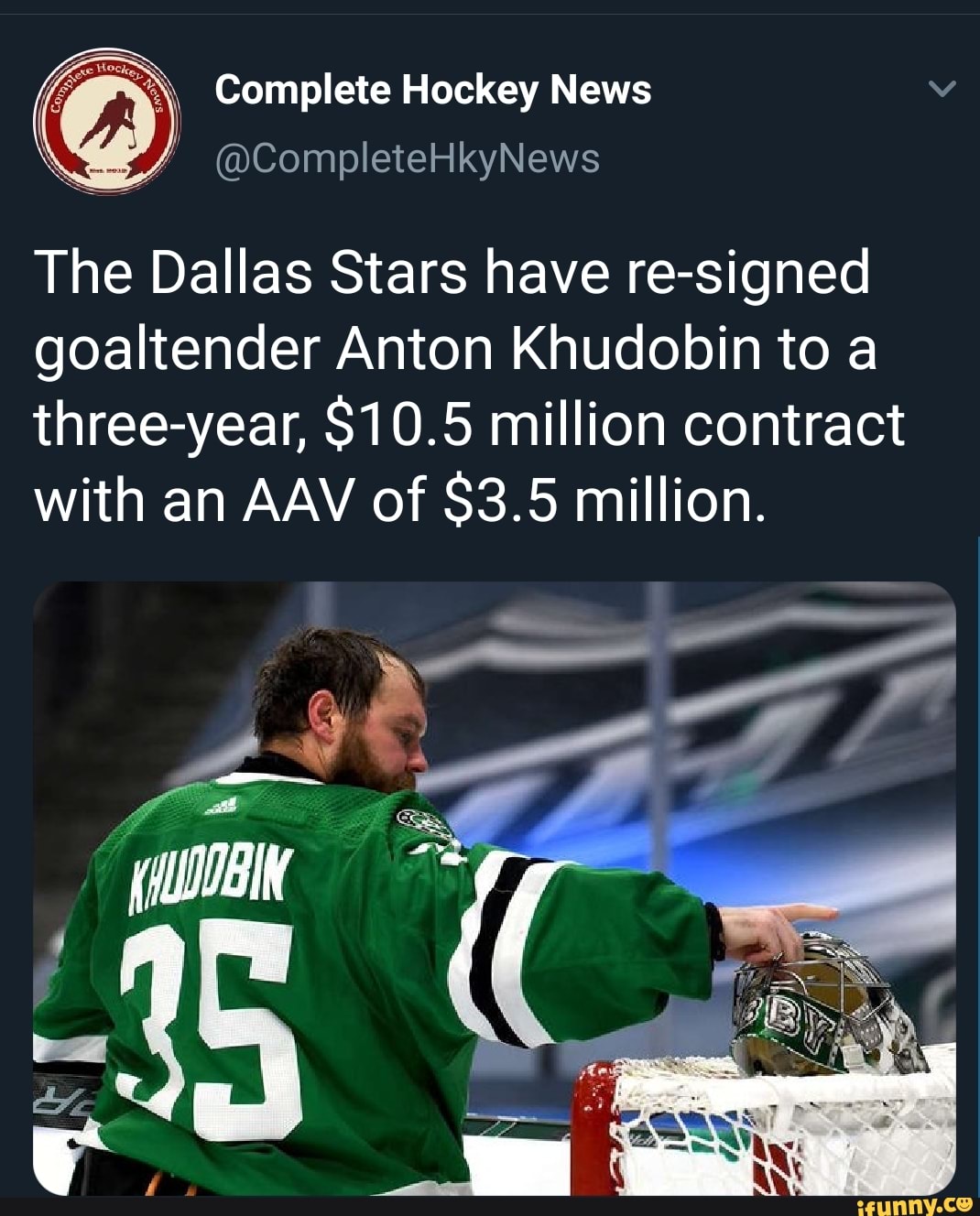
Anton Khudobin’s most significant contract with the Dallas Stars was a three-year, $10 million extension signed on October 9, 2020. The agreement carried an average annual value (AAV) of $3.33 million and included a modified no-trade clause. This deal followed his historic performance in the 2020 Stanley Cup Playoffs and concluded after his trade to the Chicago Blackhawks in early 2023.
The Context of the 2020 Extension: "Dobby" and the Bubble
To understand the specifics of the contract Anton Khudobin signed in 2020, one must look at the unique circumstances of the NHL "bubble" during the COVID-19 pandemic. Khudobin, affectionately known as "Dobby" by teammates and fans, entered the 2020 playoffs as the backup to Ben Bishop. However, due to Bishop's injuries, Khudobin was thrust into the starting role.
His performance was nothing short of legendary in Stars lore. He led the team to the Stanley Cup Final, posting a .917 save percentage over 25 games. As an unrestricted free agent (UFA) heading into the short 2020 offseason, Khudobin held significant leverage. The Stars faced a dilemma: Bishop’s health was a major question mark, and Khudobin had proven he could carry the workload of a number-one goaltender.
The resulting three-year deal was seen as a reward for his postseason heroics and a necessary insurance policy for the franchise. At the time of signing, the $3.33 million AAV was considered a fair market rate for a high-end 1B goaltender or a short-term bridge starter.
Detailed Financial Breakdown of the $10 Million Deal
The contract was structured to provide Khudobin with increasing cash flow over the three-year duration, despite the flat cap hit. Under the NHL Collective Bargaining Agreement (CBA), the "cap hit" is calculated as the total value of the contract divided by the number of years, but the actual salary paid can vary year to year.
| Season | League/Team | Base Salary | Signing Bonus | Cap Hit (AAV) |
|---|---|---|---|---|
| 2020-21 | NHL (Dallas Stars) | $2,500,000 | $0 | $3,333,333 |
| 2021-22 | NHL / AHL (Texas Stars) | $3,750,000 | $0 | $3,333,333 |
| 2022-23 | AHL / Chicago Blackhawks | $3,750,000 | $0 | $3,333,333 |
Year 1: 2020-21
In the first year of the deal, Khudobin earned a base salary of $2.5 million. This was lower than the AAV, which is a common structure to manage cash flow during seasons where revenue uncertainty (like the pandemic-impacted 2021 season) might affect escrow payments.
Year 2: 2021-22
The salary jumped to $3.75 million in the second year. This year marked the beginning of Khudobin’s struggles with form and health. Despite the high salary, his performance dipped, leading to him being placed on waivers.
Year 3: 2022-23
The final year also carried a $3.75 million salary. By this point, Khudobin was primarily playing in the American Hockey League (AHL) for the Texas Stars. The contract was eventually moved to the Chicago Blackhawks at the 2023 trade deadline to facilitate the acquisition of Max Domi.
Structural Clauses: The Modified No-Trade Clause (MTC)
A critical component of Anton Khudobin's contract was the inclusion of a Modified No-Trade Clause (MTC). This clause was active throughout the entire three-year duration of the agreement.
Under the terms of his MTC, Khudobin was required to provide the Dallas Stars with a list of four teams to which he could not be traded. While a four-team list is relatively narrow compared to the 10- or 15-team lists often seen in veteran contracts, it still provided Khudobin with a small measure of control over his destination.
In the NHL, an MTC is a valuable tool for players who want to avoid specific markets for family or personal reasons, but it rarely prevents a trade entirely if a team is determined to move the salary. For the Stars, this clause became a hurdle only toward the end of the contract when they sought to clear cap space. Ultimately, his trade to Chicago was handled smoothly as he was in the final year of the deal and looking for a fresh start.
Performance vs. Pay: The Decline and Injury Impact
When the contract was signed, the expectation was that Khudobin would split starts with Ben Bishop or eventually a young Jake Oettinger. However, several factors led to the contract becoming a burden on the Stars' salary cap.
- The Rise of Jake Oettinger: Oettinger’s rapid development into a franchise goaltender made Khudobin’s $3.33 million cap hit redundant. By 2021, Oettinger had seized the starter's role, leaving Khudobin as an expensive backup.
- Health Issues: In March 2022, Khudobin underwent significant right hip surgery (arthroscopy and labral repair). This injury severely limited his lateral mobility, which was the hallmark of his "battle-fly" playing style. Recovering from hip surgery is notoriously difficult for goaltenders over the age of 35.
- Statistical Regression: Following his .930 regular-season save percentage in 2019-20, his numbers fell to .905 in 2020-21 and plummeted to .879 in his final nine games with the NHL squad in 2021-22.
The disconnect between his $3.75 million salary and his AHL assignment became a point of contention for fans, though the Stars organization remained professional, frequently praising Khudobin’s mentorship of younger players in the minors.
The Waiver Process and AHL Cap Implications
When the Dallas Stars decided to move Khudobin to the AHL, they utilized the "waiver" system. Because Khudobin was on a one-way contract, he still received his full $3.75 million salary while playing for the Texas Stars. However, the NHL CBA allows for a "buried" cap relief.
In the 2021-22 and 2022-23 seasons, the buried contract relief was calculated as the League Minimum Salary plus $375,000. For example, with a league minimum of $750,000, the Stars could "bury" $1.125 million of Khudobin's $3.33 million cap hit. This left roughly $2.2 million in "dead" cap space counting against the Stars' NHL roster while he was in the minors.
This financial reality made Khudobin a difficult asset to trade. Most teams were unwilling to take on a $3.33 million cap hit for a goaltender who was no longer performing at an NHL level, especially with the league's flat cap environment of that era.
The Final Act: The Trade to Chicago
The resolution of the contract came on March 2, 2023. The Dallas Stars were looking to bolster their offense for a playoff run and targeted Max Domi of the Chicago Blackhawks. To make the salaries work under the cap, the Stars included Khudobin’s contract in the deal.
Technically, Chicago took on the remainder of Khudobin’s $3.33 million cap hit. This was a "salary dump" for Dallas, allowing them to fit Domi's contract into their structure. For Chicago, a rebuilding team at the time, taking on Khudobin’s expiring contract was a way to reach the "cap floor" (the minimum amount a team must spend) while acquiring draft capital.
Khudobin played one game for the Blackhawks before the season ended, marking the official conclusion of the three-year deal signed back in 2020.
Comparative Analysis: Khudobin vs. Contemporary Goaltender Contracts
To assess whether the Stars made a sound investment, it is helpful to compare Khudobin's deal with other goaltender contracts signed around the same period.
| Player | Team | Date Signed | Terms | AAV |
|---|---|---|---|---|
| Anton Khudobin | Dallas Stars | Oct 2020 | 3 Years, $10M | $3.33M |
| Thomas Greiss | Detroit Red Wings | Oct 2020 | 2 Years, $7.2M | $3.6M |
| Cam Talbot | Minnesota Wild | Oct 2020 | 3 Years, $11M | $3.66M |
| Braden Holtby | Vancouver Canucks | Oct 2020 | 2 Years, $8.6M | $4.3M |
In 2026, looking back at this data, Khudobin’s AAV was actually at the lower end of the "starter-tier" market in 2020. While the contract eventually became a cap hindrance due to injury and the emergence of Oettinger, the initial signing was consistent with NHL market values for proven veteran goaltenders. The primary difference was the third year; while Greiss and Holtby received two-year deals, the Stars gave Khudobin a third year to lower the AAV and reward his playoff performance.
Legacy of the Contract in Dallas
Despite the eventual move to the AHL and the trade to Chicago, the contract is generally viewed through a lens of gratitude by the Dallas front office. It was a "performance-earned" contract. Without Khudobin's play in the 2020 bubble, the Stars would not have reached their first Stanley Cup Final since 2000.
Financially, the contract served as a lesson in the risks of long-term commitments to goaltenders in their mid-30s. However, the Stars' ability to manage the cap—even with $2.2 million buried in the minors—allowed them to remain competitive and eventually transition seamlessly into the Jake Oettinger era.
Frequently Asked Questions
Did Anton Khudobin have a signing bonus in his Dallas Stars contract?No, Anton Khudobin's three-year, $10 million contract signed in 2020 did not include any signing bonuses. The entire $10 million was paid out in base salary: $2.5 million in the first year, and $3.75 million in both the second and third years. This is somewhat unusual for high-value NHL contracts, which often use signing bonuses to protect against buyouts or potential lockouts.
How much of Khudobin's salary stayed on the Stars' cap while he was in the AHL?When the Stars sent Khudobin to the Texas Stars (AHL), they received a cap relief of $1.125 million. Since his AAV was $3.33 million, the "dead money" remaining on the Dallas Stars' NHL salary cap was approximately $2.208 million. This remained the case until he was traded to Chicago in 2023.
Was the contract "front-loaded" or "back-loaded"?Khudobin’s contract was "back-loaded." He earned $2.5 million in the first year (2020-21) and $3.75 million in the final two years. Back-loading a contract can sometimes be a disadvantage for a team looking to trade a player, as the acquiring team must pay more in actual cash than the average cap hit.
What happened to the contract after the trade to Chicago?Upon being traded to the Chicago Blackhawks in March 2023, Chicago became responsible for the remaining pro-rated portion of his $3.75 million salary and the $3.33 million cap hit. The contract expired on July 1, 2023, making Khudobin an unrestricted free agent.
Why did the Stars give Khudobin a three-year deal instead of two?The third year was likely a concession to keep the annual cap hit lower. At the time, the Stars were tight against the salary cap. By spreading the $10 million over three years ($3.33M AAV) instead of two ($5M AAV), they maintained more flexibility to sign other players for the 2020-21 season.
Practical Recommendation: When evaluating veteran goaltender contracts, focus on the "buried cap" penalty. As seen in the Khudobin case, a contract that seems manageable at $3.33 million can become a significant obstacle if the player is moved to the minors, as nearly 66% of the cap hit may still count against the NHL roster. For team managers, limiting term to two years for goalies over 34 is the standard protocol to avoid "dead cap" scenarios.