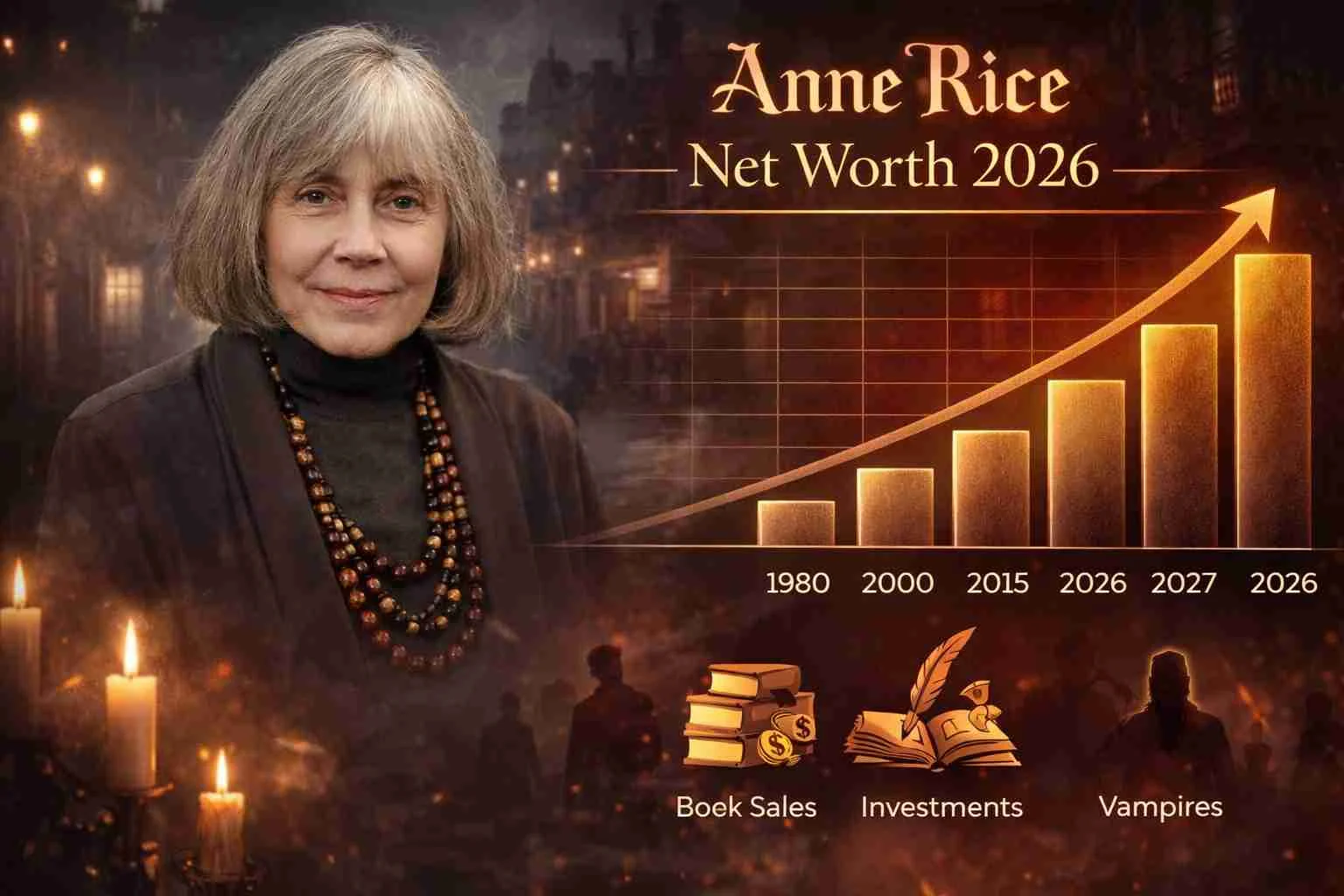
At the time of her passing in December 2021, iconic author Anne Rice possessed an estimated net worth of approximately $50 million. Built across a five-decade career, her wealth stemmed from selling over 100 million books worldwide, lucrative film rights, extensive historic real estate investments, and a major rights acquisition by AMC Networks in 2020.
The Financial Architecture of a Literary Empire
To understand Anne Rice’s financial standing, one must examine the scale of her literary output and its commercial performance. Born Howard Allen Frances O'Brien in New Orleans in 1941, Rice published under her chosen name as well as pseudonyms such as A. N. Roquelaure and Anne Rampling. Her debut novel, Interview with the Vampire (published in 1976 by Alfred A. Knopf), initially received mixed critical reception but gradually gained a dedicated readership through paperback editions, establishing the baseline for a multi-million-dollar literary career.
Over the course of her lifetime, Rice wrote over 30 novels. Her primary commercial vehicle, The Vampire Chronicles, spanned 15 books from 1976 to 2018. The commercial peak of her publishing career aligned with the release of sequels such as The Vampire Lestat (1985) and The Queen of the Damned (1988), both of which topped international bestseller lists.
Her total global book sales surpassed 100 million copies across hardcovers, paperbacks, translations, and digital editions. In publishing economics, author earnings derive from a combination of advance payments, hardback royalties (typically 10% to 15% of retail price), paperback royalties (usually 6% to 10%), and international translation rights. For an author of Rice’s stature, backend royalties generated steady seven-figure annual income even during periods between new releases.
- Global Book Royalties: 100M+ Copies Sold (30+ Titles)
- Film & TV Licensing: 1994 WB Film, 2020 AMC Master Deal
- Real Estate Holdings: New Orleans Mansions & CA Assets
- Estate & Licensing Rights: Posthumous Immortal Universe Royalties
Rice also diversified her literary output into alternative sub-genres. Writing as A. N. Roquelaure, she published The Sleeping Beauty quartet, an explicit erotic series that achieved significant long-term backlist sales. Under the name Anne Rampling, she published contemporary erotic novels like Exit to Eden (1985) and Belinda (1986). This multi-strand publishing strategy ensured that her estate drew income from distinct market segments, providing financial resilience across shifting publishing trends.
Screen Adaptation Rights and Hollywood Monetization
Film and television adaptations provided a secondary driver of Rice’s overall wealth, offering upfront option fees, purchase rights, and backend gross profit points.
The 1994 Warner Bros. Breakthrough
The financial turning point for Rice’s media rights occurred with the 1994 film adaptation of Interview with the Vampire: The Vampire Chronicles, directed by Neil Jordan and starring Tom Cruise and Brad Pitt. Rice initially sold the film rights to Lorimar Productions in 1976 for a modest fee, but after several years in development hell, the rights shifted to Warner Bros.
Rice was retained to draft the screenplay, earning additional writing and consulting fees. The film achieved major global commercial success, grossing over $223 million worldwide against a $60 million production budget. Beyond the direct option payout and screenwriting compensation, the film drove substantial backlist book sales, selling millions of tie-in paperback copies in 1994 and 1995.
Subsequent Film Licensing
In 2002, Warner Bros. released Queen of the Damned, combining plot elements from both The Vampire Lestat and The Queen of the Damned. Although the film achieved modest theatrical revenues ($45 million worldwide), the transaction generated licensing revenues and maintained public visibility for her book catalog.
The 2020 AMC Networks Landmark Rights Acquisition
The largest single media rights deal of Rice’s career occurred in May 2020, when AMC Networks acquired the comprehensive television and film rights to 18 of her novels, including both The Vampire Chronicles and The Lives of the Mayfair Witches series.
Prior to this deal, the rights had drifted through various option agreements with major studios, including Universal Pictures and Paramount Television. In 2020, Rice and her son, novelist Christopher Rice, structured a single comprehensive deal with AMC Networks. The deal granted AMC control over the intellectual property to create an interconnected TV narrative catalog known as the "Immortal Universe."
While exact financial terms were protected under non-disclosure agreements, industry analysts estimated the transaction to be worth tens of millions of dollars in combined upfront acquisition fees, executive producer salaries for Anne and Christopher Rice, and ongoing royalty structures tied to future television production greenlights.
Historic Real Estate Portfolio: New Orleans and Beyond
A defining element of Anne Rice’s wealth was her extensive involvement in real estate. Unlike many high-net-worth public figures who invest primarily in liquid equity markets, Rice allocated a significant portion of her earnings into historical architecture, predominantly in New Orleans, Louisiana, as well as high-value residential property in Southern California.
The New Orleans Properties
During her return to New Orleans from California in 1988, Rice acquired several notable historical structures, converting her financial success into architectural preservation:
- 1239 First Street (Rosegate Mansion): Located in New Orleans' historic Garden District, this 1857 Greek Revival and Italianate home served as Rice’s primary residence for years and was the explicit inspiration for the fictional Mayfair family home in The Lives of the Mayfair Witches. Purchased in 1989, the estate became a central cultural landmark in the city before Rice sold it in 2004 for approximately $3.3 million.
- St. Elizabeth’s Orphanage (1314 Napoleon Avenue): In 1993, Rice purchased this massive 47,000-square-foot former girls' orphanage, built in the 1860s. She undertook extensive restoration efforts, using the space to house her personal art collections, a vast doll collection, and private events. Rice sold the property in 2003 for roughly $3.3 million, after which it was converted into luxury residential condominiums.
- St. Charles Avenue Mansions: Rice owned several additional properties along the historic St. Charles Avenue streetcar line, including multi-family housing units and historic homes used as private offices and guest spaces for visiting artists and researchers.
| Property | Location | Historical Role |
|---|---|---|
| 1239 First St (Rosegate) | Garden District | Primary home; Mayfair Witches model |
| St. Elizabeth's | Napoleon Avenue | 47,000 sq ft orphanage & museum |
| St. Charles Avenue Homes | Uptown NOLA | Creative offices & guest properties |
| Rancho Mirage & La Jolla | Southern CA | Post-2005 primary west coast homes |
The California Transition
In 2005, following the death of her husband, poet and painter Stan Rice, in 2002, Anne Rice relocated to Southern California. She liquidated a major portion of her New Orleans real estate portfolio and acquired properties in Rancho Mirage, California, and later a luxury ocean-view home in La Jolla, California. Her La Jolla residence was eventually listed for sale for over $3 million after she moved back to New Orleans in her final years, illustrating her ongoing strategy of holding high-grade residential real estate assets.
Comprehensive Overview of Financial Engines
The table below provides a structured overview of the underlying income sources, historical milestones, and asset values that collectively constituted Anne Rice's financial profile.
| Wealth Engine | Historical & Asset Context | Revenue Mechanics & Impact |
|---|---|---|
| Global Publishing Royalties | Over 30 novels published across 45 years; 100M+ global units sold. | Primary revenue stream; hardback/paperback royalties, international licensing, digital rights. |
| Film Rights & Screenplays | Interview with the Vampire (1994), Queen of the Damned (2002), Exit to Eden (1994). | Multi-million dollar rights options, screenwriting royalties, and backend profit sharing. |
| AMC Networks Catalog Sale | Master agreement in 2020 transferring rights to 18 key novels across two major series. | Eight-figure upfront buyouts, retained executive producer credits, ongoing licensing fees. |
| Historic Real Estate | Holdings across New Orleans (Garden District, Uptown) and Southern California (La Jolla). | Long-term equity preservation, capital gains upon liquidation, architectural assets. |
| Secondary Intellectual Property | Pseudonymous releases (A. N. Roquelaure erotic novels, Anne Rampling contemporary fiction). | Steady backlist royalties targeting specialized adult publishing markets. |
Posthumous Estate Management and Ongoing Revenues
When Anne Rice died on December 11, 2021, at age 80 due to complications from a stroke, her estate passed to her primary beneficiary, her son Christopher Rice. Managing a major authorial estate involves navigating legacy royalties, intellectual property rights management, and media production partnerships.
The Growth of AMC’s Immortal Universe
The decision to consolidate her catalog rights with AMC Networks shortly before her death secured long-term revenue streams for her estate. Since 2022, AMC has expanded the "Immortal Universe" with multiple television productions:
- Anne Rice's Interview with the Vampire: Debuted in 2022 to critical acclaim and received multi-season renewals.
- Anne Rice's Mayfair Witches: Premiered in early 2023, expanding the television footprint and driving renewed print sales for the 1990 novel The Witching Hour.
- The Talamasca: Additional spin-off series in development exploring the secret organization central to Rice’s mythology.
Under the contractual arrangements set up in 2020, her estate receives executive producer compensation, series production royalties, and promotional backlist sales gains generated whenever new seasons launch.
- ANNE RICE ESTATE
- PUBLISHING BACKLIST
- Print & Digital Royalties
- Audiobooks & Foreign Rights
- AMC MEDIA RIGHTS
- Television Royalties
- Merchandising & Licensing
- PUBLISHING BACKLIST
Book Backlist Resurgence
Television adaptations consistently create renewed demand for source literature. Following the premiere of AMC's adaptations, Rice's backlist saw spikes in digital book sales and audiobook downloads across platforms like Amazon Audible and Apple Books. Because backlist titles carry lower ongoing marketing costs for publishers, royalty distributions from older catalog titles represent high-margin revenue for the estate.
Contextualizing Wealth Among Modern Literary Figures
Evaluating an author's net worth requires comparison against peers operating in similar commercial and genre spaces. While tech entrepreneurs or financial executives often build wealth through capital markets, fiction authors rely on a mix of IP licensing, international book distribution, and long-tail backlist royalties.
| Author | Estimated Net Worth | Details |
|---|---|---|
| J.K. Rowling | ~ $1.0 Billion | Harry Potter Global Franchise |
| Stephen King | ~ $500 Million | 400M+ Copies, Mass Film Adaptations |
| George R.R. Martin | ~ $120 Million | A Song of Ice and Fire / HBO IP |
| Anne Rice | ~ $50 Million | 100M+ Copies, Vampire / Gothic IP |
| Neil Gaiman | ~ $40 Million | Sandman, American Gods IP |
Genre Fiction Monetization
- J.K. Rowling ($1 Billion+): Achieved billionaire status due to global theme park integrations, film franchises, and extensive merchandising for Harry Potter.
- Stephen King ($500 Million): Represents the highest echelon of prolific horror fiction wealth, supported by more than 60 published novels and dozens of film/TV adaptations spanning five decades.
- George R.R. Martin ($120 Million): Built substantial late-career net worth through HBO's adaptation of A Song of Ice and Fire (Game of Thrones and House of the Dragon).
- Anne Rice ($50 Million): Occupies a premier tier of specialized genre monetization. Unlike broader horror or fantasy authors, Rice focused on gothic romance and erotic fiction, cultivating a highly focused audience that purchased hardcovers, collector's editions, and historical estate merchandise.
Rice's financial portfolio was characterized by strong physical asset accumulation (historic architecture) alongside her core intellectual property rights, setting her apart from contemporaries who maintained more liquid portfolios.
Key Takeaways for Evaluating Author Wealth
Analyzing the financial trajectory of Anne Rice illustrates several core principles of literary wealth creation:
- Catalog Ownership vs. Single Hits: Long-term net worth in publishing relies on building an extensive backlist. Rice's 30+ novels created a compounding royalty stream that endured across decades.
- Intellectual Property Consolidation: Contracting 18 titles to a single network (AMC) in 2020 yielded far greater structural value than fragmented single-book movie options.
- Diversification of Pseudonyms: Releasing adult and erotic fiction under alternative names (A. N. Roquelaure and Anne Rampling) allowed Rice to capture separate consumer demographics without diluting her core gothic brand.
- Real Estate as Equity Preservation: Reinvesting publishing profits into physical assets, such as historic New Orleans homes, preserved capital during periods between major book releases.
Frequently Asked Questions
What was Anne Rice’s estimated net worth at the time of her death?
When she passed away in December 2021, Anne Rice had an estimated net worth of approximately $50 million, gathered through book sales, screen rights, catalog licensing deals, and historical real estate assets.
How many books did Anne Rice sell in her lifetime?
Anne Rice sold over 100 million books globally across her career. Her titles were translated into dozens of languages and sold in hardcover, paperback, digital, and audiobook formats.
Who inherited Anne Rice’s estate and book royalties?
Her son, Christopher Rice—an accomplished novelist and screenwriter—is the primary executor and beneficiary of her estate. He actively oversees the management of her literary legacy and serves as an executive producer on AMC's adaptations of her work.
What was the value of the 2020 AMC deal for Anne Rice's works?
While official financial figures remain undisclosed due to confidentiality agreements, industry estimates place the comprehensive deal for the rights to 18 novels in the tens of millions of dollars. The agreement includes upfront compensation, retained royalties, and executive producer roles.
Did Anne Rice still own her historic New Orleans mansions when she died?
No. While Rice owned multiple historic New Orleans properties during the 1980s, 1990s, and early 2000s—including the famous Rosegate mansion on First Street and St. Elizabeth's Orphanage—she sold most of her New Orleans real estate portfolio between 2003 and 2005 when she relocated to California, though she later returned to live in New Orleans during her final years.
Final Perspective
Anne Rice’s financial standing reflected the immense commercial power of her character creations and her long-term ownership of gothic literature. By retaining control over her intellectual property until the right strategic opportunity emerged—such as the landmark 2020 AMC acquisition—she built a sustainable estate structure. For researchers, literary historians, and media analysts, Rice serves as a prime case study in converting specialized genre fiction into a lasting multi-medium commercial legacy.