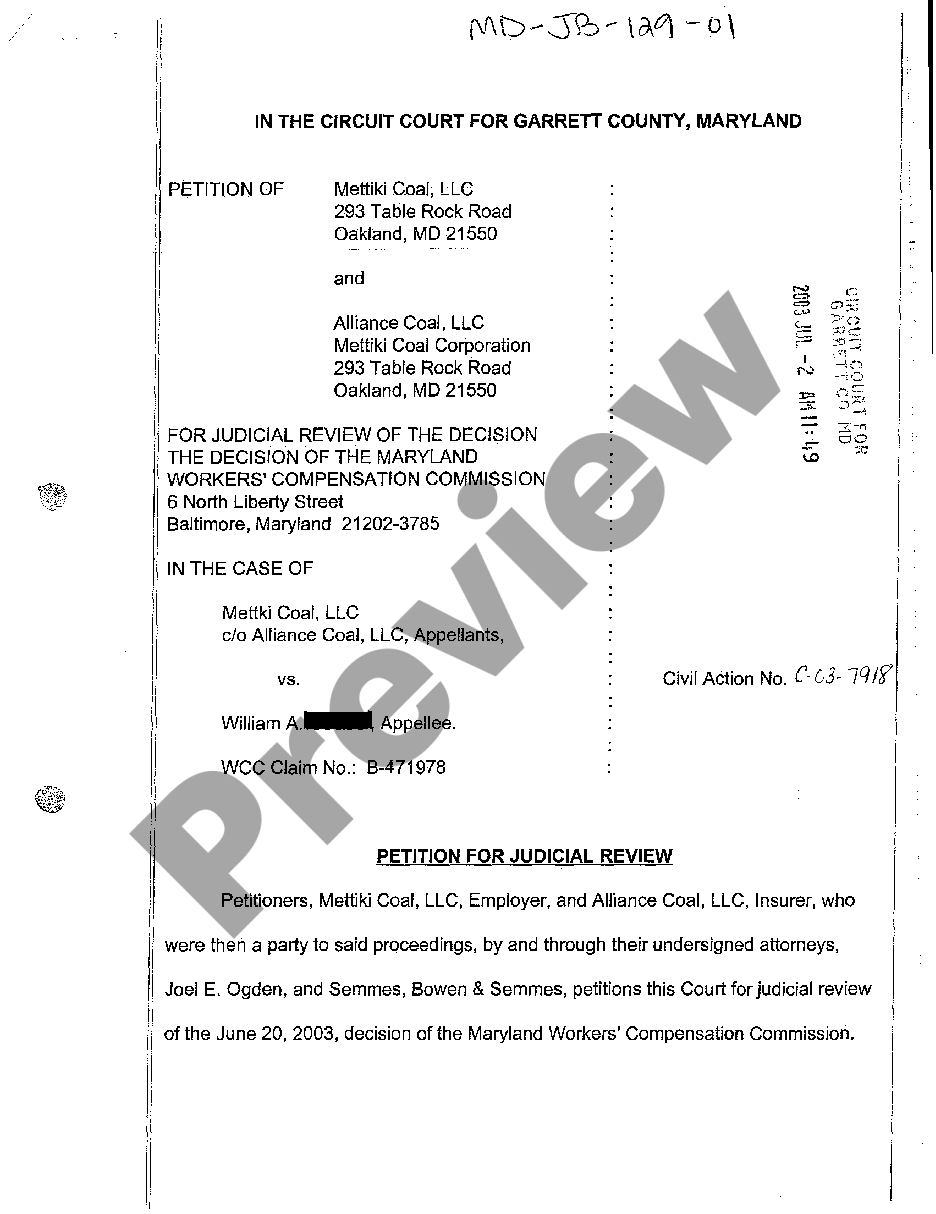
To amend a workers’ compensation petition in Louisiana, you must file an amended Form LDOL-WC-1008 with the Office of Workers’ Compensation Administration (OWCA). If the defendant has not yet filed an answer, you may amend once without court permission. If an answer has been filed, you must obtain written consent from the opposing party or "leave of court" from the Workers' Compensation Judge.
In the complex landscape of Louisiana labor law, the initial filing of a Disputed Claim for Compensation (Form 1008) is rarely the final word in a case. As medical treatments progress, new diagnostic evidence emerges, or insurance carriers change their benefit structures, the need to modify the original legal filing becomes a procedural necessity. In 2026, the Office of Workers’ Compensation Administration (OWCA) continues to adhere to strict procedural rules derived from both the Louisiana Administrative Code and the Louisiana Code of Civil Procedure. Navigating these rules requires a precise understanding of when an amendment is a right, when it is a privilege granted by a judge, and how it impacts the "prescription" (statute of limitations) of your claim.
Understanding the Louisiana Workers' Compensation Petition (Form 1008)
Before discussing amendments, one must understand the foundation of the claim. In Louisiana, workers' compensation disputes do not begin in District Court. Instead, they are initiated within the OWCA, a specialized administrative agency. The Form 1008, officially titled the Disputed Claim for Compensation, serves as the "petition" that starts the formal litigation process.
This document outlines the essential facts of the case, including the date of the accident, the nature of the injury, the average weekly wage, and the specific benefits being sought (e.g., Temporary Total Disability, Permanent Partial Disability, medical expenses, or penalties and attorney fees). Because injuries often evolve—for instance, a minor back strain diagnosed in January might be identified as a herniated disc requiring surgery by June—the law allows for the 1008 to be updated. An amendment is essentially a legal bridge that ensures the court's records reflect the most current medical and financial realities of the injured worker's situation.
The Legal Framework for Amendments in 2026
The right to amend a petition in a Louisiana workers' compensation case is primarily governed by Louisiana Code of Civil Procedure (CCP) Article 1151, which is applied to compensation cases via La. R.S. 23:1310.3.
Under current 2026 standards, the procedural path for an amendment depends entirely on the current status of the litigation:
1. Amendment as a Matter of Right
A plaintiff (the injured worker) may amend their petition once without seeking permission from the judge or the employer, provided that the defendant has not yet filed a formal Answer to the original 1008 claim. This is known as an amendment "as a matter of course." During this window, the worker has the absolute right to correct errors, add defendants, or expand on the nature of the injuries.
2. Amendment by Leave of Court or Consent
Once the employer or their insurer has filed an Answer, the original petition becomes "joined." At this stage, the worker no longer has a unilateral right to change the filing. To amend, they must:
- Obtain Written Consent: The employer’s attorney may agree to the amendment. This is common when the amendment is a minor technical correction.
- Motion for Leave of Court: If the employer objects, the worker must file a motion asking the Workers’ Compensation Judge (WCJ) for "leave" (permission) to amend.
Louisiana law generally favors a liberal amendment policy. Judges are instructed to grant leave to amend unless the amendment is sought in bad faith, causes undue delay, or results in unfair prejudice to the defendant.
Common Reasons for Amending a 1008 Form
In the 2026 legal environment, several factors frequently trigger the need for an amended petition. These are not merely administrative updates but are often strategic necessities for a successful recovery.
Addition of New Medical Diagnoses
It is common for the initial Form 1008 to be filed shortly after an accident when the full extent of the injury is unknown. If a worker later discovers that an injury originally thought to be a soft-tissue strain is actually a chronic condition or requires specialized surgery, the petition must be amended to include these specific medical issues. This ensures that the eventual judgment or settlement covers all affected body parts.
Claiming Penalties and Attorney Fees
Under La. R.S. 23:1201, insurers are required to pay benefits and authorize medical treatment timely. If an insurer "arbitrarily and capriciously" denies a claim or delays payment after the original 1008 was filed, the worker must amend the petition to specifically demand statutory penalties and attorney fees. Failing to amend to include these claims can result in the worker being barred from recovering them at trial.
Correcting the Average Weekly Wage (AWW)
The amount of weekly indemnity benefits is based on the worker’s earnings prior to the accident. If the employer reported an incorrect AWW on the original filing, an amendment is necessary to ensure the worker receives the correct "comp rate." This often involves adding details about overtime, bonuses, or fringe benefits that were initially overlooked.
Adding New Defendants
In some cases, the worker may discover that the employer was actually a subcontractor and that a "statutory employer" (the general contractor) is also liable. Alternatively, they may find that the wrong insurance company was named. Adding a new party requires an amendment and raises complex questions regarding the statute of limitations.
The Procedure: Step-by-Step Guide to Filing
As of 2026, the OWCA prefers electronic filing through its updated case management portal, though paper filings are still accepted in certain districts.
- Draft the Amended Form 1008: You must use the standard LDOL-WC-1008 form. It is best practice to clearly label the top of the form as "FIRST AMENDED DISPUTED CLAIM FOR COMPENSATION."
- Incorporate by Reference: Rather than re-writing the entire history of the case, you may state that you are "amending and supplementing" the original petition and that all allegations in the original petition are incorporated as if rewritten at length, except where modified by the amendment.
- File a Motion for Leave (if necessary): If the defendant has already answered, you must draft a "Motion for Leave to File Amended Disputed Claim for Compensation." You should attach the proposed amended 1008 to this motion as an exhibit.
- Serve the Opposing Party: Under Louisiana law, all amended pleadings must be served on the opposing counsel. This is typically done via the electronic filing system or by certified mail.
- Attend the Rule to Show Cause: If the employer objects to your amendment, the judge will set a hearing (a "Rule"). You must be prepared to explain why the amendment is necessary and why it does not unfairly surprise the defendant.
The Doctrine of "Relation Back" and Prescription
One of the most critical aspects of amending a petition in Louisiana is the concept of Prescription (what other states call the statute of limitations). Generally, a worker has one year from the date of the accident to file a claim.
If you attempt to amend your petition to add a new claim or a new defendant after that one-year period has passed, the amendment might be "prescribed" (expired) unless it relates back to the original filing. Under CCP Article 1153, an amendment relates back if the new claim or defense arises out of the "conduct, transaction, or occurrence" set forth in the original petition.
Relation Back and New Parties
Adding a new defendant after the prescriptive period is much more difficult. Louisiana courts apply the four-part test established in Ray v. Alexandria Mall:
- The amended claim must arise out of the same conduct/occurrence.
- The new defendant must have received notice of the institution of the action such that they are not prejudiced.
- The new defendant must know (or should have known) that but for a mistake in identity, the action would have been brought against them.
- The new defendant is not a "wholly new and unrelated" party.
| Scenario | Requirement for Amendment | Legal Authority | Impact on Prescription |
|---|---|---|---|
| Before Defendant Answers | No permission needed (one-time right). | CCP Art. 1151 | Relates back to original date. |
| After Defendant Answers | Leave of Court or Written Consent. | CCP Art. 1151 | Relates back if same occurrence. |
| Adding New Body Part | Usually allowed if related to accident. | CCP Art. 1153 | Relates back. |
| Adding New Defendant | Requires Motion for Leave; high scrutiny. | Ray v. Alexandria Mall | High risk of being prescribed. |
| Adding Penalty Claims | Specific facts of "arbitrary denial" needed. | La. R.S. 23:1201 | Generally relates back. |
Practical Challenges and Defense Strategies
When a worker amends a petition, the employer and their insurer often respond with specific legal maneuvers. In 2026, defense counsel frequently uses the "Dilatory Exception of Vagueness" if the amendment does not provide enough detail about the new claims.
Furthermore, if an amendment introduces a significantly new medical theory, the defense will likely request a Second Medical Opinion (SMO) or a court-appointed Independent Medical Examination (IME). This can delay the trial date, as the judge must allow the defendant enough time to investigate the new allegations.
It is also important to note that an amendment "restarts" the clock for the defendant’s answer. Once the amended petition is served, the employer typically has 15 days to file a new Answer or a responsive exception. This procedural reset can be used by either side to gain tactical advantages in the scheduling of discovery and depositions.
Impact on Mediation and Trial
In Louisiana, most workers' compensation districts require a mandatory mediation before a trial date is set. If a petition is amended after a mediation has already occurred, the judge may order a second, "supplemental" mediation. The logic is that the parties cannot effectively settle a case if the underlying claims (the 1008) have changed significantly since the last time they sat at the negotiating table.
At trial, the Workers’ Compensation Judge is bound by the "pleadings." This means the judge can only rule on the issues specifically raised in the original and amended petitions. If you realize during the trial that you forgot to ask for a specific benefit, it is often too late. While CCP Article 1154 allows for "amendment to conform to the evidence" during the trial, this is risky and often rejected if the defendant can show they were not prepared to defend against the unpled issue.
FAQs
Can I amend my petition more than once?
Yes, but you only have the right to do so once without permission before the Answer is filed. For a second or third amendment, or any amendment after the Answer, you must obtain leave of court or the employer’s consent. Judges usually allow multiple amendments if they are based on new medical developments.
Does an amendment delay my trial date?
Potentially. If the amendment introduces complex new issues or new defendants, the judge will likely push back the trial to allow for "discovery" (the gathering of evidence/depositions) related to those new issues. If the amendment is merely correcting a typo or a wage calculation, it usually does not impact the trial schedule.
What happens if I forget to list a body part in the amendment?
If a body part is not listed in the 1008 or its amendments, the insurer is not legally obligated to pay for treatment for that body part, and the judge may not have the authority to award benefits for it. It is vital to be exhaustive when listing injuries in your amended petition.
Is there a deadline to amend before the trial?
While there is no strict statutory deadline, most judges include a "cutoff date" for amending pleadings in their Scheduling Order. In 2026, these dates are strictly enforced. If you attempt to amend after the cutoff date, you will have to show "good cause," which is a much higher legal burden.
Do I need a lawyer to amend my petition?
While pro se litigants (those representing themselves) are allowed to file amendments, the rules regarding "relation back," prescription, and motions for leave are highly technical. An error in an amendment can result in the permanent loss of the right to claim certain benefits or penalties.
Practical Recommendation
If you are navigating a workers' compensation claim in Louisiana in 2026, treat your Form 1008 as a living document. Do not wait until the eve of trial to update your claims. As soon as a new diagnosis is confirmed or a benefit is improperly denied, begin the process of drafting an amendment. If the defendant has already filed an Answer, immediately reach out to the defense attorney to ask for "consent to file a supplemental and amending petition." Obtaining this consent in writing can save weeks of litigation time by avoiding the need for a formal motion and hearing. Always ensure that every new allegation is tied directly to the original date of the accident to protect your claim against prescription challenges.