Basketball is a high-paced team sport where two teams of five players compete to score points by shooting a ball through a hoop ten feet high while adhering to specific movement and contact restrictions. The winning team is the one that accumulates the most points through field goals and free throws within the regulation time.
Since its invention by Dr. James Naismith in 1891, basketball has evolved from a simple gym exercise into a complex global phenomenon. By 2026, while the core objective remains the same, the nuances of officiating, player movement, and tactical regulations have become highly specialized. This guide provides a comprehensive breakdown of the rules governing modern basketball, covering everything from basic court dimensions to the technicalities of the "gather step" and defensive rotations.
The Foundation: Court, Equipment, and Personnel
To understand the rules, one must first understand the environment in which they are applied. While the "spirit" of the rules is universal, the physical dimensions can vary slightly between the NBA, FIBA (international), and NCAA (college) levels.
The Court and Dimensions
In the professional 2025-2026 season, a standard NBA court measures 94 feet long by 50 feet wide. FIBA courts are slightly smaller, measuring 28 meters by 15 meters (approximately 91.9 by 49.2 feet).
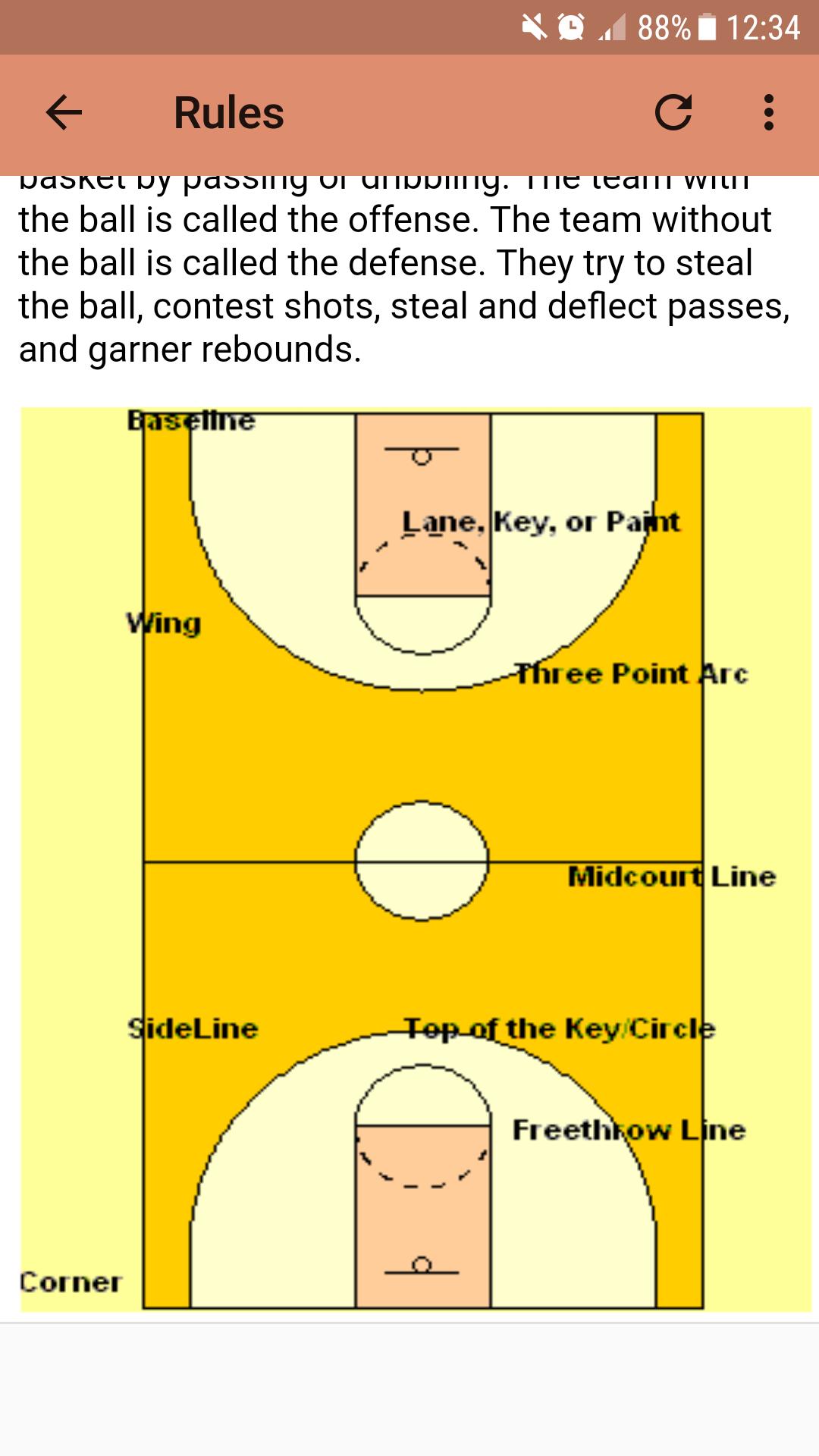
The most critical markings on the court include:
- The Baseline and Sidelines: These define the "in-bounds" area. If a player touching the ball steps on or over these lines, the ball is considered out of bounds.
- The Midcourt Line: Divides the court into two halves. Once an offensive team advances the ball past this line, they cannot return it to their backcourt (a "backcourt violation").
- The Three-Point Arc: A semi-circle that determines the value of a field goal. Shots made from outside this line are worth three points.
- The Key (The Paint): A rectangular area leading from the baseline to the free-throw line. It is the site of intense physical play and is subject to the "three-second rule."
- The Free-Throw Line: Located 15 feet from the backboard, where players take uncontested shots following certain fouls.
Team Rosters and Positions
Each team has five players on the court at any given time. While modern basketball has moved toward "positionless" play, the traditional roles remain the framework for most strategies:
- Point Guard (PG): The primary ball-handler and playmaker.
- Shooting Guard (SG): Typically the team's best perimeter shooter.
- Small Forward (SF): A versatile player capable of scoring and rebounding.
- Power Forward (PF): Usually plays near the basket and focuses on rebounding and interior defense.
- Center (C): The tallest player, responsible for shot-blocking and "rim protection."
Game Structure and Timing
The duration of a game is one of the primary differences between various leagues. In 2026, the following standards apply:
- NBA: Four 12-minute quarters (48 minutes total).
- FIBA/WNBA: Four 10-minute quarters (40 minutes total).
- NCAA (Men’s): Two 20-minute halves (40 minutes total).
- NCAA (Women’s): Four 10-minute quarters (40 minutes total).
The Shot Clock
To prevent teams from stalling, a shot clock is used. In the NBA and FIBA, teams have 24 seconds to attempt a shot that hits the rim. If the shot clock expires before the ball leaves the player's hand or if the shot fails to hit the rim, it is a shot-clock violation, and the opposing team gains possession. In NCAA Men's basketball, the shot clock is 30 seconds.
Overtime
If the score is tied at the end of regulation, the game enters overtime (OT). In the NBA and FIBA, overtime periods last 5 minutes. If the score remains tied after the first OT, subsequent periods are played until a winner is determined.
Scoring Rules and Values
Points are awarded based on where the shooter is positioned and the circumstances of the play.
- Three-Point Field Goal: Any basket made from beyond the three-point arc. The player’s feet must be behind the line when the shot is released; they can land inside the arc after the ball is gone.
- Two-Point Field Goal: Any basket made from inside the three-point arc during active play. This includes layups, dunks, and mid-range "jumpers."
- One-Point Free Throw: Awarded after certain fouls. These are taken from the free-throw line while the clock is stopped.
Basket Interference and Goaltending
Rules strictly govern when a player can touch the ball near the hoop.
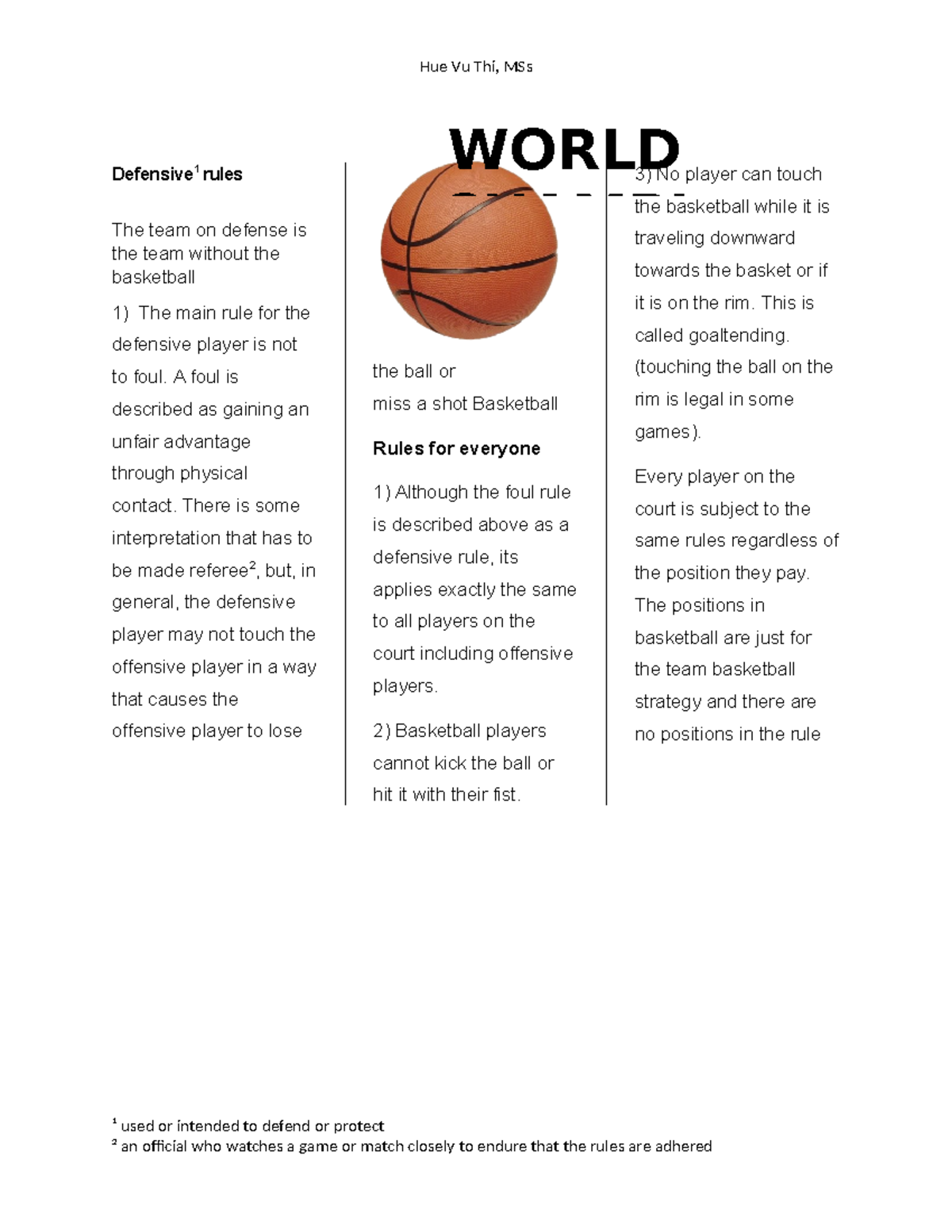
- Goaltending: An offensive or defensive player cannot touch the ball when it is on its downward flight toward the rim and has a chance to go in. If a defender commits goaltending, the basket is awarded. If an offensive player does it, the basket is cancelled.
- Basket Interference: A player cannot touch the ball, the rim, or the net while the ball is on the rim or within the cylinder of the hoop. FIBA rules differ slightly, allowing players to touch the ball once it hits the rim, whereas the NBA forbids touching the ball while any part of it is within the imaginary cylinder above the basket.
Ball Handling and Movement Violations
Violations are infractions that do not involve physical contact but result in a loss of possession.
Traveling
A player "travels" if they take too many steps without dribbling the ball. In the modern era, the "gather step" (or "zero step") has become a point of contention and technical focus. When a player receives the ball while moving or finishes a dribble, the first step taken as they gain full control is the "gather step." Following this, they are allowed two more steps before they must pass or shoot.
Double Dribble
A player cannot dribble the ball, stop and hold it with two hands, and then start dribbling again. Additionally, dribbling with both hands simultaneously is a double-dribble violation.
Carrying (Palming)
This occurs when a player places their hand under the ball while dribbling, momentarily bringing the ball to a rest while their hand is underneath it, before continuing the dribble. This is often called "palming" and is strictly officiated in 2026 to prevent ball-handlers from gaining an unfair advantage during crossovers.
Timed Violations
- 3-Second Rule: An offensive player cannot remain in the opponent’s restricted area (the key) for more than three consecutive seconds while their team has control of the ball.
- 5-Second Inbound: A player has five seconds to pass the ball into the court from out-of-bounds.
- 8-Second (or 10-Second) Backcourt Rule: In the NBA and FIBA, a team has 8 seconds to move the ball from their backcourt to the frontcourt. In the NCAA, this limit is 10 seconds.
Fouls: Personal, Technical, and Flagrant
Fouls involve illegal physical contact or unsportsmanlike conduct.
Personal Fouls
Personal fouls are the most common. They include:
- Reaching In: Attempting to steal the ball but making contact with the ball-handler’s arm or body.
- Blocking: Using the body to impede an opponent's path without having established a legal guarding position.
- Charging (Offensive Foul): An offensive player running into a defender who has already established a stationary, legal guarding position.
- Illegal Screen: An offensive player moving while "setting a pick" to block a defender.
The "Foul Out" Limit: In the NBA, a player is disqualified from the game after committing 6 personal fouls. In FIBA and NCAA play, the limit is 5 personal fouls.
Technical Fouls
Technical fouls are non-contact fouls usually related to "conduct." Examples include:
- Arguing with an official.
- Using profane language.
- Hanging on the rim excessively (unless to avoid injury).
- Having too many players on the court. In most leagues, two technical fouls result in an automatic ejection.
Flagrant Fouls
These are fouls involving excessive or violent contact.
- Flagrant 1: Unnecessary contact. The opposing team receives two free throws and possession of the ball.
- Flagrant 2: Unnecessary and excessive contact. This results in two free throws, possession, and the automatic ejection of the offending player.
The Bonus and Penalty Phase
When a team commits a certain number of fouls in a single period, they enter the "penalty" or "bonus."
- NBA: After the 4th team foul in a quarter, every subsequent non-shooting foul results in two free throws for the opponent.
- NCAA: The "1-and-1" rule applies. After the 7th team foul in a half, a player fouled in a non-shooting situation gets one free throw; if they make it, they get a second. After the 10th foul, it becomes a "double bonus" (two guaranteed shots).
Rule Comparison Table: NBA vs. FIBA vs. NCAA
| Feature | NBA (Professional) | FIBA (International) | NCAA Men (College) |
|---|---|---|---|
| Game Length | 4 x 12 min quarters | 4 x 10 min quarters | 2 x 20 min halves |
| Shot Clock | 24 Seconds | 24 Seconds | 30 Seconds |
| 3-Point Distance | 23.75 ft (22 ft corners) | 6.75 m (22.1 ft) | 22.15 ft |
| Foul Out Limit | 6 Fouls | 5 Fouls | 5 Fouls |
| Timeouts | 7 per game | 5 per game | 4 or 5 (varies by TV) |
| Backcourt Rule | 8 Seconds | 8 Seconds | 10 Seconds |
| Defensive 3-Sec | Yes (Illegal Defense) | No | No |
Advanced Defensive Regulations
Defensive Three-Second Rule (NBA Only)
Unlike FIBA or NCAA, the NBA enforces a "Defensive Three-Second Rule." A defender cannot stay in the paint for more than three seconds unless they are actively guarding an opponent (within arm's length). This rule was designed to open up the lane for drives and prevent "camping" under the basket.
The Restricted Area
Underneath each basket is a small semi-circle known as the "restricted area." A secondary defender cannot establish a legal guarding position (to draw a charge) inside this arc. If contact occurs here, it is almost always ruled a blocking foul on the defender.
Common Mistakes and Misconceptions
- "All contact is a foul": Basketball is a contact sport. Incidental contact—contact that does not affect the player's rhythm, speed, balance, or resistance (RSBR)—is often not whistled.
- "The ball can't hit the backboard first on an inbound": A player can actually pass the ball off the backboard to themselves or a teammate during an inbound, provided they don't violate other movement rules.
- "Reaching is always a foul": A defender can "reach" as long as they only make contact with the ball. If they hit the ball-handler's hand while it is in contact with the ball, it is often considered "part of the ball" and not a foul.
- "Jump Ball vs. Possession Arrow": In the NBA, every "held ball" situation results in a physical jump ball between the two involved players. In the NCAA and FIBA, a "possession arrow" system is used, alternating which team gets the ball during such ties.
Frequently Asked Questions
What is a "clear path" foul?
A clear path foul occurs when a defender fouls an offensive player who has the ball and a clear path to the basket on a transition play, with no other defenders between the player and the hoop. This results in two free throws and the offensive team retaining possession. It is designed to prevent "strategic" fouls that stop easy fast-break points.
Can a player step out of bounds without the ball?
A player who steps out of bounds on their own volition cannot be the first person to touch the ball upon returning to the court. Doing so is a violation. However, if they are forced out of bounds by contact, they may return and play as long as they re-establish both feet in-bounds first.
What is the difference between a block and a charge?
The distinction depends on whether the defender's torso was stationary and their feet were "set" before the offensive player initiated contact. If the defender is moving laterally when contact occurs, it is usually a blocking foul. If the defender is stationary and takes the hit in the chest, it is an offensive charge.
How does the "Bonus" work in the final minutes?
In the NBA, if a team has not yet reached the penalty limit, they are allowed only two fouls in the final two minutes of a quarter before the opponent enters the bonus, regardless of how many fouls were committed earlier in that quarter. This prevents teams with "fouls to give" from excessively disrupting the end of the game.
What happens if a player dunks and the backboard breaks?
Under modern rules, specifically in the NBA, breaking the backboard or causing the basket to become unlevel through an intentional non-athletic move can result in a technical foul. However, most modern hoops are "breakaway" rims designed to flex to prevent shattering.
Practical Recommendation for New Players
If you are looking to master the rules of basketball, the best approach is to focus on footwork first. Most violations—such as traveling, double-dribbling, and charging—stem from improper foot placement or losing track of your pivot foot.
As of 2026, many local leagues follow FIBA or modified NCAA rules. Before playing in a competitive setting, verify the specific shot clock and foul limits of your organization. For those following professional play, the Official NBA Rulebook and the FIBA Official Basketball Rules remain the definitive sources for the most recent regulatory updates and officiating interpretations.