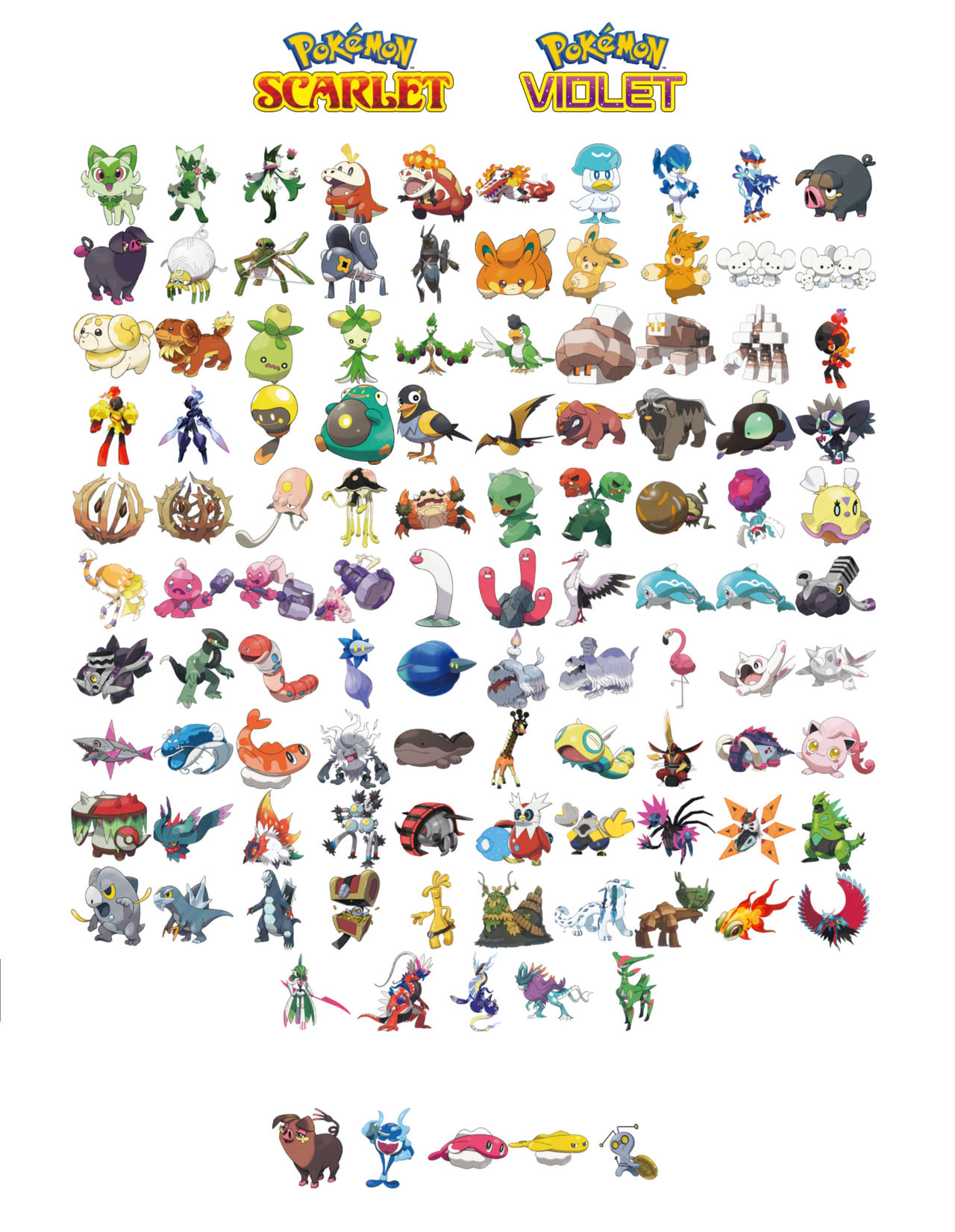
Pokémon Generation 9 introduced exactly 120 new species, bringing the National Pokédex from #906 (Sprigatito) to #1025 (Pecharunt). These additions are featured across the base games Pokémon Scarlet and Pokémon Violet, as well as the two-part DLC expansion, The Hidden Treasure of Area Zero, consisting of The Teal Mask and The Indigo Disk.
The ninth generation of Pokémon, which debuted in late 2022 and concluded its primary content cycle moving into 2026, represents one of the most ambitious shifts in the franchise's history. By introducing the Paldea region—a sprawling open world inspired by the Iberian Peninsula—Game Freak implemented significant changes to how players interact with new species. From the introduction of "Paradox Pokémon" to the landmark 1,000th Pokémon milestone, Gen 9 expanded the roster with a focus on biological convergence, ancient history, and futuristic speculation.
The Paldean Starters and Early Route Species
The journey in Gen 9 begins with the traditional choice between three starter Pokémon. These three lines set the tone for the generation's design philosophy, which emphasizes strong thematic identities and signature moves that define the competitive meta.
The Starter Lines
- Sprigatito, Floragato, and Meowscarada: The Grass-type line evolves into a Grass/Dark magician. Meowscarada became a staple in competitive play due to its Hidden Ability, Protean, and its signature move, Flower Trick, which always results in a critical hit and never misses.
- Fuecoco, Crocalor, and Skeledirge: The Fire-type line culminates in a Fire/Ghost singer. Skeledirge is unique for its signature move, Torch Song, which raises its Special Attack every time it is used, making it a formidable "snowball" sweeper in longer battles.
- Quaxly, Quaxwell, and Quaquaval: The Water-type line becomes a Water/Fighting dancer. Quaquaval’s signature move, Aqua Step, increases its Speed stat, allowing it to outpace opponents as the battle progresses.
Common Early-Game Additions
Beyond the starters, players immediately encounter species like Lechonk, the Normal-type hog that became an early fan favorite, and Tarountula, the Bug-type spider. These early routes also introduced Pawmi, the "Pika-clone" of the generation, which is notable for being the first of its kind to have a three-stage evolutionary line (Pawmi, Pawmo, and Pawmot). Pawmot is particularly significant for its move Revival Blessing, which allows a player to fainted ally back to life—a mechanic previously unseen in the series.
Paradox Pokémon: Ancient and Future Variants
One of the defining features of Gen 9 is the introduction of Paradox Pokémon. These are not merely regional forms but are classified as entirely separate species found within the Great Crater of Paldea (Area Zero). They are divided strictly by version: Pokémon Scarlet features Ancient forms, while Pokémon Violet features Future forms.
Ancient Paradox Pokémon (Scarlet)
These species are primal, prehistoric ancestors of well-known modern Pokémon. They typically possess the ability Protosynthesis, which boosts their highest stat in harsh sunlight or when holding a Booster Energy.
- Roaring Moon: An ancient relative of Salamence (Dragon/Dark).
- Flutter Mane: An ancient relative of Misdreavus (Ghost/Fairy), which dominated the VGC (Video Game Championships) for several years.
- Great Tusk: An ancient relative of Donphan (Ground/Fighting).
Future Paradox Pokémon (Violet)
These species are mechanical, robotic descendants of modern Pokémon. They possess the ability Quark Drive, which boosts their highest stat on Electric Terrain or when holding a Booster Energy.
- Iron Valiant: A futuristic hybrid of Gardevoir and Gallade (Fairy/Fighting).
- Iron Hands: A robotic relative of Hariyama (Fighting/Electric).
- Iron Bundle: A robotic relative of Delibird (Ice/Water), surprisingly high in the competitive tiers due to its immense speed.
Convergent Evolution and Regional Variants
Gen 9 introduced a concept called "Convergent Species." Unlike Paldean Wooper (a traditional regional variant), these Pokémon are biologically unrelated to the species they resemble; they simply evolved to look similar due to environmental pressures.
- Wiglett and Wugtrio: While they look like Diglett and Dugtrio, they are Water-type garden eels rather than Ground-type moles.
- Toedscool and Toedscruel: These resemble Tentacool and Tentacruel but are Ground/Grass-type fungi that "walk" on the forest floor rather than swimming in the ocean.
Traditional regional variants also exist in Paldea, most notably Paldean Wooper (Poison/Ground), which evolves into the new species Clodsire. Paldean Tauros also appears in three distinct "Breeds": Combat Breed (Fighting), Blaze Breed (Fighting/Fire), and Aqua Breed (Fighting/Water).
New Evolutionary Mechanics and Requirements
Several Gen 9 Pokémon require specific actions beyond simple leveling to evolve. These mechanics were designed to encourage exploration and the use of the new "Let's Go" auto-battle feature.
- Walking with Pokémon: Species like Pawmo, Rellor, and Bramblin only evolve after the player walks 1,000 steps with them outside their Poké Ball using the Let's Go feature.
- The Gimmighoul Coin Quest: To evolve the Chest Form or Roaming Form of Gimmighoul into Gholdengo (#1000), the player must collect 999 Gimmighoul Coins scattered throughout the Paldea region. Gholdengo is highly prized for its "Good as Gold" ability, which makes it immune to all status moves.
- Specific Defeat Requirements: Bisharp evolves into the new Kingambit only if it defeats three other Bisharp that are holding a "Leader's Crest" item.
- Multiplayer Evolution: Finizen evolves into Palafin only when it levels up while the player is in a "Union Circle" session with at least one other person. Palafin is famous for its "Hero Form," which boasts base stats comparable to Legendary Pokémon.
The Legendary and Mythical Pokémon of Generation 9
Generation 9 features a robust list of Legendary Pokémon, divided between the box mascots, the "Treasures of Ruin," and the DLC additions.
Koraidon and Miraidon
The mascots of Scarlet and Violet respectively, these Pokémon serve as the player's primary mode of transportation throughout the game. Koraidon (Fighting/Dragon) represents the past and "Apex" biology, while Miraidon (Electric/Dragon) represents the future and technological perfection.
The Treasures of Ruin
Hidden behind shrines across Paldea, these four Dark-type Legendaries represent ancient calamities:
- Wo-Chien (Dark/Grass): The Tablets of Ruin.
- Chien-Pao (Dark/Ice): The Sword of Ruin.
- Ting-Lu (Dark/Ground): The Vessel of Ruin.
- Chi-Yu (Dark/Fire): The Beads of Ruin.
DLC Legendaries: The Teal Mask and Indigo Disk
The expansion pass introduced several critical new species that expanded the lore of the Terastal phenomenon.
- Ogerpon: The centerpiece of the Kitakami region, capable of changing its secondary typing and mask to gain different abilities and boosts.
- Terapagos: The source of the Terastal energy found in Area Zero. It possesses three forms: Normal, Terastal, and Stellar.
- The Loyal Three: Okidogi, Munkidori, and Fezandipiti—a trio of Poison-type heroes (or villains) in the Kitakami lore.
- Pecharunt: The final Mythical Pokémon of the generation, a Poison/Ghost type that controls others through "Binding Mochi."
Key New Pokémon Comparison Table
This table compares some of the most influential new species introduced in Generation 9, focusing on their unique characteristics and primary types.
| National Dex # | Name | Primary Type | Secondary Type | Unique Feature / Ability |
|---|---|---|---|---|
| #911 | Skeledirge | Fire | Ghost | Torch Song (Stat-boosting signature move) |
| #964 | Palafin | Water | None | Zero to Hero (Transformative ability) |
| #978 | Ting-Lu | Dark | Ground | Vessel of Ruin (Lowers opponent Sp. Atk) |
| #986 | Brute Bonnet | Grass | Dark | Ancient Paradox (Amoonguss relative) |
| #992 | Iron Hands | Fighting | Electric | Future Paradox (Hariyama relative) |
| #1000 | Gholdengo | Steel | Ghost | Good as Gold (Status move immunity) |
| #1017 | Ogerpon | Grass | Variable | Mask-based form and type changes |
| #1024 | Terapagos | Normal | Variable | Stellar Form (Tera-exclusive form) |
Competitive Impact and Strategy
As of 2026, the competitive landscape has been thoroughly defined by Gen 9 species. The "Power Creep" in this generation was notable, with many new Pokémon possessing base stat totals and abilities that overshadowed older favorites.
Flutter Mane and Iron Bundle became the gold standards for speed and special offense. Meanwhile, Kingambit redefined the endgame of competitive matches; its "Supreme Overlord" ability increases its Attack and Special Attack for every ally that has already fainted, making it the ultimate "reverse-sweep" threat.
The Terastal Phenomenon—the generation's central mechanic—allowed these new Pokémon to change their typing mid-battle. This added a layer of complexity where a Pokémon like the Fighting/Dragon Koraidon could suddenly become a Fire-type to resist Fairy moves or boost its Flare Blitz damage in the sun.
Frequently Asked Questions
How many new Pokémon were added in Gen 9?
A total of 120 new Pokémon were added. This includes 103 introduced in the base Pokémon Scarlet and Violet games and 17 additional species introduced through The Teal Mask and The Indigo Disk DLC expansions. This brought the total number of Pokémon species in the franchise to 1,025.
What is the 1,000th Pokémon?
The 1,000th Pokémon is Gholdengo, a Steel/Ghost type. It evolves from Gimmighoul when the player collects 999 Gimmighoul Coins. Gholdengo is themed after a surfer made of gold coins, celebrating the milestone of the National Pokédex reaching four digits.
Can you get all Paradox Pokémon in one version?
No, Paradox Pokémon are version-exclusive. Ancient Paradox Pokémon (like Roaring Moon and Great Tusk) are exclusive to Pokémon Scarlet. Future Paradox Pokémon (like Iron Valiant and Iron Hands) are exclusive to Pokémon Violet. To obtain the ones missing from your version, you must trade with another player or participate in online Tera Raid Battles.
Are there any new Eeveelutions in Gen 9?
No, Generation 9 did not introduce a new evolution for Eevee. The last time a new Eeveelution was added was in Generation 6 with the introduction of the Fairy-type Sylveon. Gen 9 focused instead on regional evolutions for other species, such as Dunsparce evolving into Dudunsparce and Girafarig evolving into Farigiraf.
What are the "Convergent" Pokémon?
Convergent Pokémon are new species that look almost identical to older Pokémon but are biologically different and have different types. Examples include Wiglett (which looks like Diglett but is a Water-type) and Toedscool (which looks like Tentacool but is a Ground/Grass-type). They are listed as separate entries in the Pokédex.
Summary and Next Actions
Generation 9 has provided one of the most diverse rosters in the history of the franchise, blending nostalgia with radical new concepts like Paradox forms and convergent evolution. Whether you are a casual collector aiming to complete the Paldean Pokédex or a competitive player looking to master the use of Gholdengo and Ogerpon, understanding the unique evolution methods and version exclusives is essential.
To complete your collection of all Gen 9 Pokémon, focus on:
- Collecting 999 Gimmighoul Coins early to secure the powerful Gholdengo.
- Utilizing the Union Circle to evolve Finizen into Palafin.
- Exploring Area Zero post-game to capture the Paradox Pokémon specific to your version.
- Trading for version exclusives, specifically the "Box Legendaries" (Koraidon/Miraidon) and the Paradox sets.
For those looking to dive deeper into the lore, ensure you complete the "Mochi Mayhem" epilogue in the DLC to capture Pecharunt, the final piece of the Gen 9 narrative puzzle.