New Zealand maintains a clean green reputation, yet air quality varies significantly across regions. Urban traffic and domestic wood burning during winter create localized pollution spikes, while the Ministry for the Environment and regional councils monitor pollutants like particulate matter and nitrogen dioxide to protect public health.
Overview of Air Quality in New Zealand
New Zealand is widely perceived as having pristine air, largely due to its geographical isolation in the Southern Ocean and low population density relative to its landmass. However, this general perception masks a more complex environmental reality. While vast rural areas, alpine zones, and coastal stretches enjoy exceptionally clean air with low background pollution, urban environments and specific inland valleys experience distinct seasonal air quality challenges.
The primary driver of air pollution in New Zealand is not heavy industrial manufacturing—which is relatively limited compared to larger industrialized nations—but rather human activity tied to home heating and transportation. Geography also plays a critical role. Many New Zealand towns and cities are nestled in narrow river valleys or enclosed basins, particularly in the central and southern regions of the South Island. During crisp winter nights, these topographical features trap cold air near the ground, forming strong temperature inversions that cap atmospheric mixing and concentrate pollutants close to the surface.
To manage and mitigate these risks, the New Zealand government implements the National Environmental Standards for Air Quality (NESAQ). These legally binding regulations set minimum standards for outdoor air quality to safeguard human health and the environment. Regional councils and unitary authorities are tasked with monitoring compliance, identifying polluted airsheds, and executing clean air strategies. Understanding how these systems operate requires a closer look at the specific pollutants of concern, regional variations, and the regulatory frameworks governing the nation's atmosphere.
Key Pollutants and Their Sources
The Ministry for the Environment identifies several key atmospheric constituents that degrade air quality and pose risks to public health. Monitoring programs focus heavily on these specific pollutants because their concentrations directly correlate with respiratory and cardiovascular hospital admissions.
Particulate Matter ($\text{PM}{10}$ and $\text{PM}{2.5}$)
Particulate matter represents the most widespread and persistent air quality challenge in New Zealand. This category includes microscopic solid or liquid particles suspended in the air, categorized by their aerodynamic diameter:
- $\text{PM}_{10}$: Coarse particles with a diameter of 10 micrometers or less, capable of penetrating the upper respiratory tract.
- $\text{PM}_{2.5}$: Fine particles with a diameter of 2.5 micrometers or less, small enough to pass deep into the lungs and enter the bloodstream.
In New Zealand, the dominant source of $\text{PM}{10}$ and $\text{PM}{2.5}$ during the colder months is domestic solid-fuel wood burners and open fires used for home heating. In urban centers, motor vehicle emissions—particularly from older diesel engines—add a significant fraction of fine particulates throughout the year. Additional contributions come from industrial processes, sea spray, and occasional trans-Tasman dust or smoke plumes blown across from Australian bushfires.
Nitrogen Dioxide ($\text{NO}_2$)
Nitrogen dioxide is a reddish-brown gas that irritates the airways of the human respiratory system. In New Zealand, transport is overwhelmingly the primary source of $\text{NO}_2$, with exhaust emissions from cars, trucks, and buses generating the vast majority of urban ambient concentrations. Consequently, elevated levels of nitrogen dioxide are typically recorded immediately adjacent to busy transport corridors, motorways, and congested inner-city intersections during peak commuting hours.
Other Regulated Pollutants
Under the NESAQ, monitoring is also mandated for three other criteria pollutants:
- Carbon Monoxide (CO): A colorless, odorless gas produced by incomplete combustion, historically linked to motor vehicle exhaust in congested urban canyons.
- Sulfur Dioxide ($\text{SO}_2$): Associated primarily with industrial emissions, shipping, and geothermal activity. New Zealand generally maintains very low ambient sulfur dioxide levels, save for localized industrial or geothermal zones.
- Ozone ($\text{O}_3$): Ground-level ozone is a secondary pollutant formed when nitrogen oxides and volatile organic compounds react in the presence of sunlight. While photochemical smog is less severe in New Zealand than in major global megacities, summer monitoring is maintained in larger metropolitan areas.
Regional Variations and Urban vs. Rural Splits
Air quality in New Zealand presents a distinct geographical dichotomy. Rural and coastal areas typically record excellent air quality indexes year-round, benefiting from clean maritime air masses sweeping across the Pacific Ocean and the Tasman Sea.
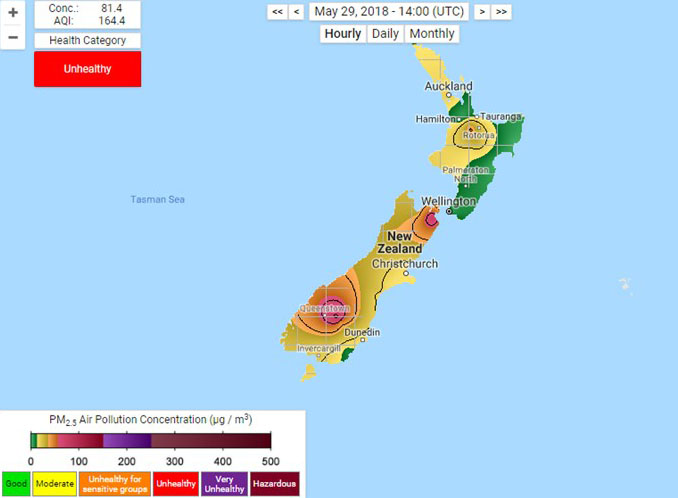
Conversely, populated urban centers and inland valley basins experience significant temporal and spatial variability.
| Region / Location Type | Primary Air Quality Issue | Dominant Pollutant Sources | Typical Seasonal Peak |
|---|---|---|---|
| Inland South Island Valleys (e.g., Alexandra, Christchurch, Timaru) | High winter particulate concentrations | Domestic wood burners and open coal/wood fires | Winter (June to August) |
| Major Metropolitan Centers (e.g., Auckland, Wellington) | Traffic-related pollution and localized congestion | Motor vehicle exhaust ($\text{NO}_2$ and fine particulates) | Year-round, with morning/evening peaks |
| Industrial / Geothermal Zones (e.g., parts of Rotorua, heavy industrial pockets) | Localized chemical or particulate emissions | Industrial processes, geothermal steam, shipping | Variable / Dependent on industrial output |
| Rural and Coastal Areas | High background purity | Natural sources (sea spray, distant pollens) | Minimal variation |
In smaller South Island towns such as Alexandra or Arrowtown, cold winter nights drive high demand for domestic heating. Because many households historically relied on open fires or outdated wood burners, ambient $\text{PM}_{10}$ concentrations during cold, calm winter evenings frequently exceed the daily threshold permitted by national standards.
In contrast, cities like Auckland face different pressures. While Auckland's coastal winds and frequent rain prevent the severe winter inversions seen in southern river valleys, its heavy reliance on private motor vehicles creates persistent nitrogen dioxide hotspots alongside busy motorways.
The National Environmental Standards for Air Quality (NESAQ)
The Resource Management Act 1991 (RMA) provides the primary legislative framework for managing New Zealand's environment. Within this framework, the National Environmental Standards for Air Quality establish specific, enforceable bottom lines for ambient air quality across the country.
The NESAQ sets out:
- Ambient Air Quality Standards: Maximum allowable concentrations for specific pollutants (e.g., a daily limit for $\text{PM}_{10}$ of 50 micrograms per cubic meter, with a permitted number of exceedances per year depending on the airshed).
- Prohibitions: Bans on certain activities known to cause severe air pollution, such as high-temperature waste incineration at unauthorized sites, discharge of specific toxic chemicals, and the use of certain older wood burner technologies in sensitive airsheds.
- Monitoring Requirements: Obligations for regional councils to monitor air quality in areas where standards are likely to be breached, ensuring transparent public reporting.
Airsheds that breach the NESAQ thresholds are formally classified as "polluted airsheds" by the Ministry for the Environment. Under the regulations, regional councils containing polluted airsheds are restricted from granting resource consents for certain types of industrial discharges until air quality improves and meets the required standards.
Monitoring, Measurement, and Reporting
Air quality monitoring in New Zealand is a collaborative effort between regional councils, unitary authorities, and the National Institute of Water and Atmospheric Research (NIWA).
Monitoring Network Infrastructure
Councils operate continuous air quality monitoring stations positioned in strategic locations representing worst-case exposure scenarios. These stations utilize specialized instrumentation:
- Tapered Element Oscillating Microbalances (TEOM) or Beta Attenuation Monitors (BAM) for real-time particulate matter measurement.
- Chemiluminescence analyzers for tracking nitrogen oxides.
- Meteorological sensors recording wind speed, wind direction, temperature, and relative humidity, which dictate how pollutants disperse or accumulate.
The New Zealand Air Quality Index (AQI)
To communicate technical monitoring data clearly to the public, New Zealand utilizes a standardized Air Quality Index. This color-coded scale categorizes ambient air quality into distinct bands:
- Good (Green): Air quality is satisfactory, and air pollution poses little or no risk.
- Acceptable (Yellow): Air quality is acceptable; however, sensitive individuals may experience minor irritation.
- Alert (Orange): Air quality is starting to degrade. People with respiratory or heart conditions, the elderly, and children should reduce outdoor exertion.
- Action (Red): Air quality is poor. General populations may experience health effects, and sensitive groups should avoid outdoor physical activity.
- Severe (Purple): Emergency conditions where the entire population is likely to be affected.
Public health agencies and regional council websites publish real-time AQI readings, allowing residents to check local conditions before planning outdoor activities.
Health Impacts of Air Pollution
Even in a country with high environmental standards, air pollution carries measurable public health consequences. According to health assessments commissioned by regulatory bodies, exposure to fine particulate matter and nitrogen dioxide contributes to premature mortality, hospital admissions for respiratory and cardiovascular illnesses, and lost work or school days.
Vulnerable Populations
Certain segments of the population face heightened vulnerability to degraded air quality:
- Children: Their lungs are still developing, and they breathe at a faster rate relative to their body weight, inhaling more pollutants per unit of body mass.
- Elderly Individuals: Pre-existing cardiovascular and respiratory conditions place older adults at higher risk of adverse acute reactions.
- People with Chronic Illnesses: Individuals suffering from asthma, chronic obstructive pulmonary disease (COPD), or ischemic heart disease experience exacerbated symptoms when exposed to elevated $\text{PM}_{2.5}$ or $\text{NO}_2$ levels.
Mitigation Strategies and Future Outlook
Addressing New Zealand's localized air quality challenges requires coordinated intervention from central government, regional authorities, and individual citizens.
Domestic Heating Upgrades
To curb winter particulate spikes, regional councils enforce strict rules regarding home heating appliances. Many councils offer targeted grants, subsidies, or advice programs to encourage homeowners to replace older, inefficient, high-emission wood burners and open fires with clean-heating alternatives. These modern alternatives include ultra-low emission wood burners (ULEBs), pellet fires, and high-efficiency heat pumps that generate significantly lower particulate emissions.
Transport and Urban Planning
Mitigating transport-related emissions involves a multi-pronged approach encompassing public transport investment, promotion of active transport (walking and cycling), and the electrification of the national vehicle fleet. As the proportion of electric vehicles (EVs) increases on New Zealand roads, tailpipe emissions of nitrogen dioxide and fine particulates are projected to decline in urban centers. Furthermore, urban planning strategies increasingly emphasize compact city design, reducing dependency on private automobile commuting.
Ongoing Challenges
Looking toward the future, New Zealand faces emerging air quality pressures alongside traditional ones. Climate change alters meteorological patterns, leading to more frequent droughts, stagnant atmospheric conditions, and an increased risk of trans-boundary smoke from intense bushfire seasons in neighboring Australia. Continued rigorous monitoring, strict adherence to environmental standards, and proactive community engagement remain essential for safeguarding New Zealand's air quality for future generations.
Frequently Asked Questions
Is air quality in New Zealand good compared to the rest of the world?
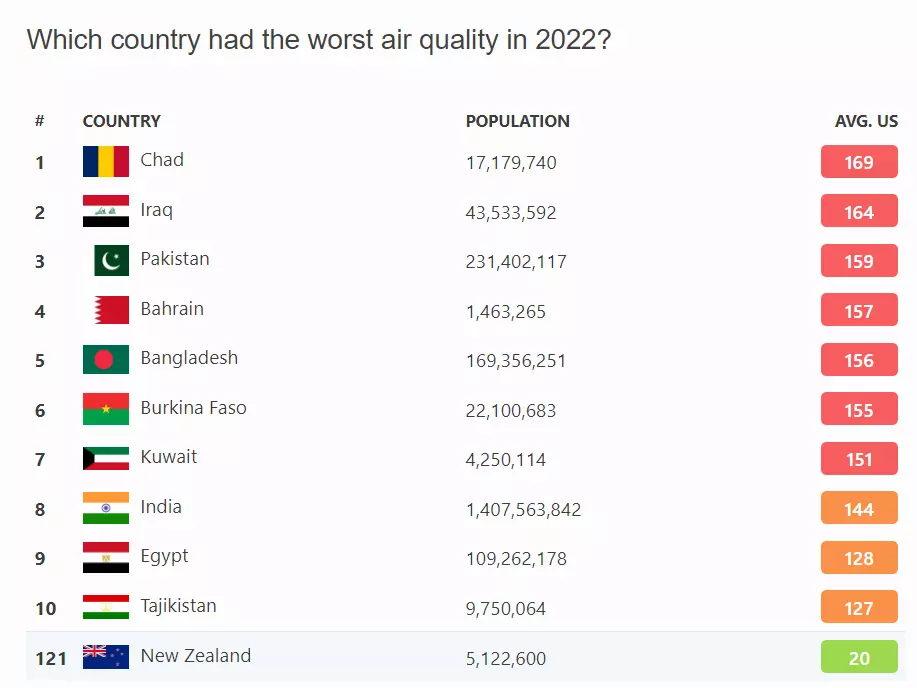
Yes. On a global scale, New Zealand generally enjoys high ambient air quality due to its low population density, lack of heavy heavy-manufacturing industry, and prevailing maritime winds. However, specific inland valleys experience severe winter pollution spikes from domestic wood burning, and major urban centers experience traffic-related nitrogen dioxide emissions.
What is the main cause of air pollution in New Zealand?
The primary source of particulate pollution ($\text{PM}{10}$ and $\text{PM}{2.5}$) is domestic home heating using wood burners and open fires during the winter months. In major urban centers, transport emissions from motor vehicles represent the dominant source of nitrogen dioxide and fine urban particulates.
How can I check the current air quality in my area?
Regional councils and unitary authorities across New Zealand operate local monitoring stations and publish real-time Air Quality Index (AQI) data on their official websites. Additionally, national environmental platforms and weather forecasting services provide regular updates on air quality status.
Are wood burners banned in New Zealand?
Traditional, high-emission wood burners and open fires are restricted or banned in many urban airsheds that fail to meet national environmental standards. However, modern ultra-low emission burners (ULEBs) that comply with strict emission limits are often permitted for installation when replacing older appliances.
What are the health effects of fine particulate matter ($\text{PM}_{2.5}$)?
Fine particulate matter is small enough to penetrate deep into the lungs and cross into the bloodstream. Long-term and short-term exposure is linked to respiratory irritation, reduced lung function, asthma attacks, cardiovascular disease, and premature mortality, particularly among vulnerable groups such as children and the elderly.