Accounts payable terms define the timeline, conditions, and incentives under which a business must pay its suppliers for goods or services received. These terms, typically specified on invoices or service contracts, dictate when payment is due, whether early payment discounts apply, and what penalties exist for late remittances, directly impacting a company’s working capital and vendor relationships.
The Role of Accounts Payable Terms in Business Operations
At its core, the accounts payable (AP) function serves as the gatekeeper for an organization’s cash outflows. When a company purchases inventory, office supplies, or professional services, it rarely pays immediately upon receipt. Instead, the transaction is governed by specific payment terms that balance the supplier’s need for timely cash flow with the buyer’s need to preserve liquidity.
These terms are not merely administrative details; they are strategic financial tools. For the buying organization, longer payment terms (such as "Net 60" or "Net 90") act as a form of interest-free financing, allowing the business to hold onto cash for a longer period to reinvest in growth or cover other operational expenses. For the supplier, these terms represent the agreed-upon window to receive compensation, which influences their own cash flow forecasting.
Understanding these terms requires familiarity with standard industry abbreviations. While "Net 30" is the most common default, the ecosystem of B2B commerce involves a variety of arrangements designed to manage credit risk and incentivize behavior.
Deciphering Common Payment Terminology
To manage a company’s AP department effectively, staff must be able to interpret standard shorthand. These terms are typically printed clearly on the footer or header of an invoice.
Net Terms
The most straightforward payment structure is "Net X." The "Net" signifies the total amount due, and "X" represents the number of days the buyer has to submit the full payment after the invoice date.
- Net 30: Payment is due within 30 days of the invoice date.
- Net 60: Payment is due within 60 days of the invoice date.
- Net 90: Payment is due within 90 days. This is common in long-term supply chain contracts or large enterprise agreements.
Discount Terms (EOM and Prox)
Suppliers often offer discounts to encourage early payment. This is frequently formatted as "2/10, Net 30." This means if the buyer pays the invoice within 10 days, they can take a 2% discount; otherwise, the full amount is due in 30 days.
- EOM (End of Month): The payment period begins on the first day of the month following the invoice date. For example, "2/10 EOM" means the discount is available if paid by the 10th of the month after the invoice was issued.
- Prox (Proximo): Similar to EOM, this term dictates payment is due in the following month. "Net 30 Prox" means the invoice is due 30 days into the following month.
Immediate and Advance Terms
- CIA (Cash in Advance): The buyer must pay before the goods are shipped. This is common for new vendors or high-risk accounts.
- COD (Cash on Delivery): Payment is required at the exact moment the goods or services are delivered.
- PIA (Payment in Advance): Similar to CIA, often used for custom orders or high-value capital equipment where the supplier needs to cover material costs before production begins.
Comparison of Payment Strategy Impacts
Choosing or negotiating the right terms involves balancing cash reserves against supplier relations and potential cost savings.
| Term Type | Primary Advantage | Main Risk | Best For |
|---|---|---|---|
| Net 30/60/90 | Preserves internal cash flow | Potential for late fees | Routine operational expenses |
| Early Pay Discount | Reduces total cost of goods | Requires high cash liquidity | High-margin inventory purchases |
| COD/CIA | Builds trust with vendors | Strains working capital | New vendors or volatile markets |
| Consignment | No capital tied up in inventory | Limited product availability | Testing new product lines |
Negotiating Terms with Vendors
In 2026, many businesses are focusing on optimizing their "Days Payable Outstanding" (DPO). DPO is a metric that indicates how long it takes a company to pay its invoices. While a higher DPO indicates better cash preservation, it must be balanced against the risk of damaging supplier relationships.
When negotiating terms, consider the following approach:
- Analyze Current Cash Position: Before requesting an extension from Net 30 to Net 60, ensure your organization can support the extended outflow without triggering late fees elsewhere.
- Evaluate Vendor Power: Large, sole-source suppliers are unlikely to budge on terms. Smaller vendors, however, may be willing to extend payment windows in exchange for long-term contract commitments or volume guarantees.
- Leverage Early Payment Programs: If you have excess cash, negotiate early payment discounts. A "2/10" discount effectively provides an annual percentage yield that often far exceeds what you would earn from keeping that cash in a standard savings account.
Common Mistakes in Accounts Payable Management
Operational errors in AP can lead to unnecessary costs and damaged credit ratings. Avoiding these mistakes is essential for a healthy financial department.
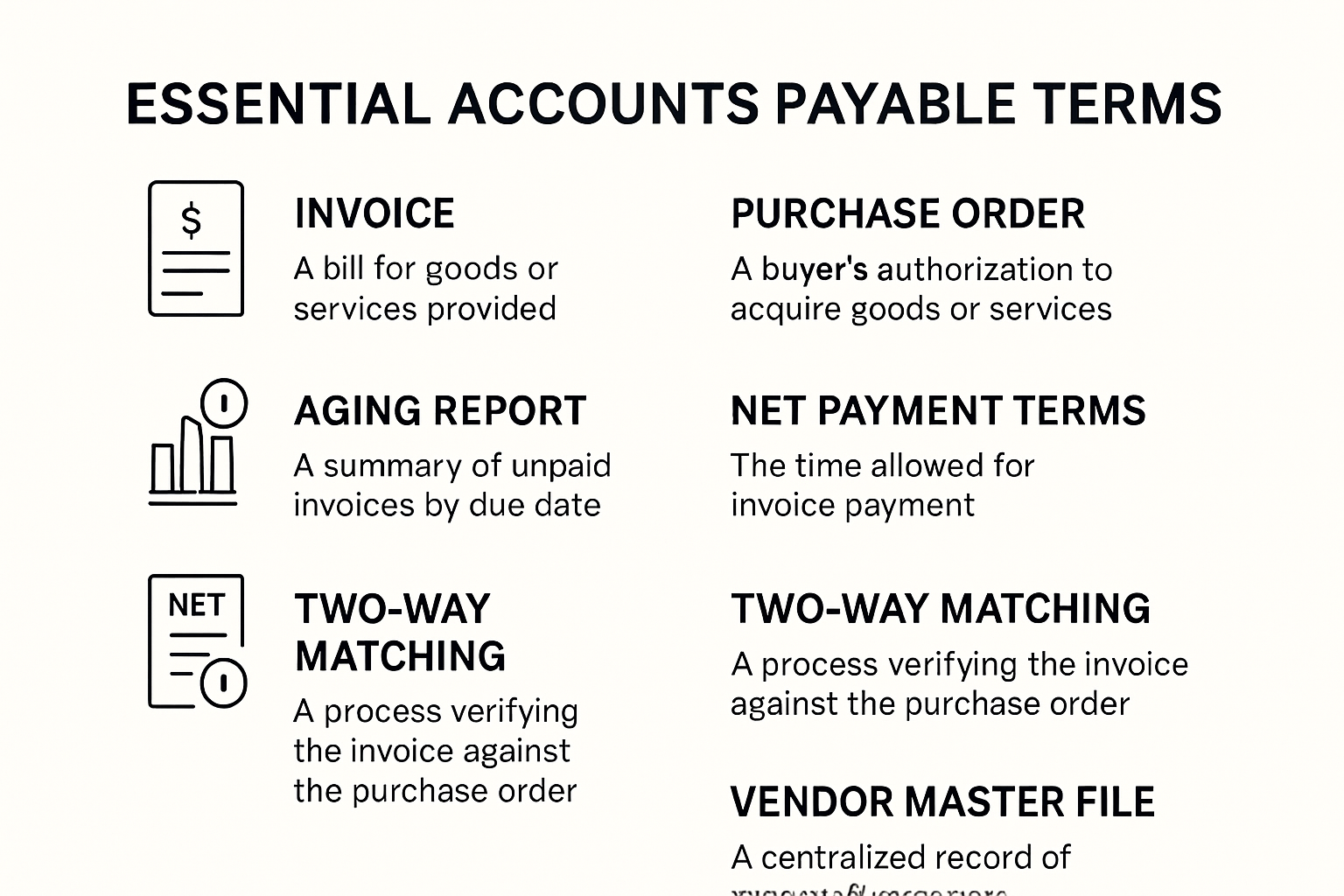
- Ignoring Invoice Verification: Never pay an invoice without matching it against a Purchase Order (PO) and a Receiving Report (the "Three-Way Match"). Paying an invoice without verifying that the goods were received is a primary source of financial leakage.
- Missing Discount Windows: If an organization’s workflow is too slow to approve invoices within the 10-day window required for a "2/10" discount, the company effectively loses money. If this happens consistently, the company should abandon the discount term and negotiate a longer "Net" term instead.
- Lack of Centralized AP Processing: Allowing different departments to handle their own payments often leads to inconsistent term usage. Centralizing AP ensures that terms are standardized and that the company can leverage its total spend volume to negotiate better conditions.
- Poor Communication with Suppliers: If a cash flow crunch makes a payment delay inevitable, proactive communication is critical. Contacting the vendor before the due date to explain the delay is significantly better than simply missing the deadline.
Implementing Automated AP Solutions
By 2026, manual data entry for AP is widely considered an inefficient practice. Modern AP software automates the "Three-Way Match" process and provides real-time visibility into upcoming payment obligations.
These platforms allow finance teams to:
- Set automatic reminders for payment dates to avoid late fees.
- Flag invoices that fall outside of negotiated terms.
- Categorize payments to identify which vendors offer the most favorable discount structures.
Automation also provides a digital audit trail, which is crucial for internal controls and tax compliance. When selecting an AP automation tool, ensure it integrates directly with your existing Enterprise Resource Planning (ERP) or accounting software to minimize manual sync errors.
Frequently Asked Questions
What is the difference between DPO and DSO? Days Payable Outstanding (DPO) measures how long a company takes to pay its suppliers. Days Sales Outstanding (DSO) measures how long it takes a company to collect money from its own customers. A healthy company tries to keep DSO low and DPO high, within reasonable industry standards.
Why would a vendor refuse to extend my payment terms? Vendors have their own cash flow requirements. If they rely on your payments to cover their payroll or raw material costs, extending terms would create a liquidity crisis for them. Additionally, if your payment history shows a pattern of late payments, they may be less inclined to offer favorable terms.
What happens if I miss a payment term deadline? Missing a deadline usually leads to three consequences: loss of early payment discounts, assessment of late fees (often specified as a percentage of the invoice), and potential suspension of credit lines. Frequent late payments can force a vendor to switch your account to "CIA" status permanently.
Are payment terms legally binding? Yes. Payment terms outlined in a purchase order or a master services agreement are legally enforceable components of a contract. Failing to adhere to them can lead to collections actions, legal disputes, or termination of the vendor relationship.
Should I always take an early payment discount? Not necessarily. If taking the discount consumes your cash reserves to the point where you must borrow money (at a high interest rate) to cover payroll or other critical expenses, the discount is counterproductive. Calculate the annual yield of the discount against your cost of capital before deciding.
Strategic Recommendation
The most effective way to manage accounts payable terms is to categorize your vendors by strategic importance and cash flow impact. For mission-critical suppliers, prioritize prompt payment to maintain priority status and favorable terms. For non-essential vendors, utilize standard Net terms to maximize your internal liquidity. Conduct a review of your current AP cycle at least quarterly to ensure that payment workflows align with your company’s broader financial objectives for 2026.