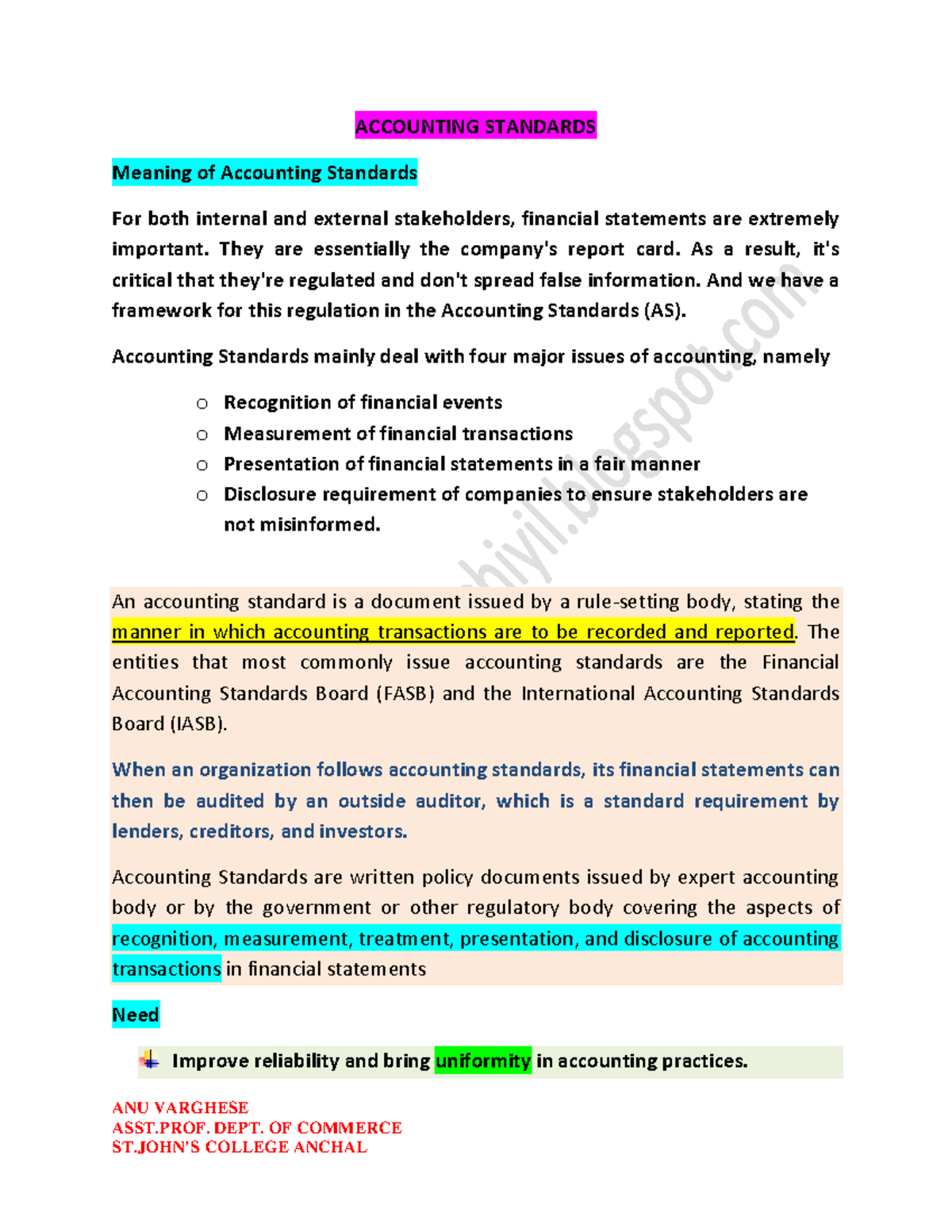
Accounting standards are the authoritative set of rules, principles, and procedures that govern the preparation, presentation, and reporting of financial statements. They provide a common language for financial reporting, ensuring that an organization's economic activities are recorded consistently, transparently, and comparably, allowing stakeholders to make informed decisions based on reliable financial data.
The Role of Accounting Standards in Financial Reporting
At their core, accounting standards serve as a bridge between a company’s operational activities and the stakeholders who rely on its financial performance—such as investors, creditors, regulators, and management. Without these standardized guidelines, every entity could theoretically record transactions according to its own preferences, leading to fragmented and incomparable financial data.
The primary objective of these standards is to foster "decision-usefulness." This means the information presented in balance sheets, income statements, and cash flow reports must be relevant and reliable. By requiring companies to adhere to a uniform methodology, standards minimize the risk of financial manipulation, accidental error, and subjective interpretation. When a company reports its revenue or assets according to a recognized standard, it provides a benchmark that analysts can use to compare its performance against competitors within the same industry or across different geographical markets.
Primary Regulatory Frameworks: GAAP and IFRS
The global financial system is largely anchored by two dominant, though distinct, frameworks: Generally Accepted Accounting Principles (GAAP) and International Financial Reporting Standards (IFRS).
Generally Accepted Accounting Principles (GAAP)
In the United States, the Financial Accounting Standards Board (FASB) establishes the Accounting Standards Codification (ASC). US GAAP is often described as "rules-based," meaning it provides highly specific guidance on how to handle various types of transactions. This approach aims to reduce ambiguity by offering clear-cut instructions, although it can lead to complex compliance requirements for entities operating in diverse industries.
International Financial Reporting Standards (IFRS)
Developed by the International Accounting Standards Board (IASB), IFRS is used in over 140 jurisdictions, including the European Union, Canada, Australia, and many parts of Asia and South America. IFRS is characterized as "principles-based." Instead of providing rigid, itemized rules for every transaction, it provides broad principles that accountants and management must apply to the substance of a transaction. This requires a higher degree of professional judgment to ensure that the spirit of the financial reporting objective is met.
The Essential Components of Accounting Standards
While the specific rules vary by jurisdiction, most robust accounting standards share a common structural foundation. These components ensure that the financial statements remain coherent over time.
- Recognition Criteria: Standards dictate when an item—such as an asset, liability, revenue, or expense—should be officially acknowledged in the financial statements. This prevents premature or delayed reporting.
- Measurement Principles: These rules define how the monetary value of an item is determined. Common measurement bases include historical cost (the original price paid) and fair value (the price an asset would fetch in an arm's length transaction in the current market).
- Presentation Requirements: Standards stipulate how information must be arranged on the face of the financial statements. This ensures that a reader can quickly locate critical items like net income or shareholder equity.
- Disclosure Mandates: Transparency goes beyond the numbers. Standards require companies to provide detailed footnotes explaining the accounting policies used, significant risks, and contingent liabilities that might affect the company’s future health.
Comparison of Financial Reporting Approaches
The following table summarizes the operational differences between the two most prominent accounting frameworks as of 2026.
| Feature | US GAAP | IFRS |
|---|---|---|
| Primary Philosophy | Rules-based (specific mandates) | Principles-based (conceptual framework) |
| Asset Valuation | Primarily historical cost | Frequent use of fair value revaluation |
| Inventory Methods | LIFO (Last-In, First-Out) permitted | LIFO strictly prohibited |
| Structure | FASB Accounting Standards Codification | International Accounting Standards (IAS/IFRS) |
| Flexibility | Lower; requires adherence to strict codes | Higher; requires significant professional judgment |
The Importance of Consistency and Comparability
For a globalized economy, the greatest challenge is reconciling these different standards. Investors often move capital across borders, and a company may have subsidiaries in multiple countries. If a firm uses GAAP for its US branch and IFRS for its European operations, the resulting consolidated financial statements may obscure the underlying economic reality.
Consistency ensures that an entity uses the same accounting policies from one period to the next. If a company suddenly changes how it calculates depreciation, its net income might appear to spike, creating a false impression of improved performance. Standards mandate that companies disclose changes in accounting policy and, where possible, restate prior-period figures to allow for a true "apples-to-apples" comparison.
Common Misconceptions Regarding Accounting Standards
A frequent error among non-accountants is the assumption that accounting standards provide an exact measurement of a company's "true worth." In reality, financial statements are a mix of historical cost and estimations.
For instance, estimating the useful life of a machine or the likelihood of collecting a specific debt involves subjective management judgment. Accounting standards do not eliminate this subjectivity; rather, they contain it within a rigorous framework of "prudence" and "neutrality." They ensure that estimates are based on reasonable assumptions and documented evidence, rather than mere guesswork.
Furthermore, it is a mistake to view accounting standards as static. While they provide stability, they are frequently updated to account for new economic realities. The rise of digital assets, complex cloud-based service agreements, and environmental, social, and governance (ESG) reporting are active areas where standard-setters are currently refining rules to keep pace with 2026 business environments.
Practical Steps for Businesses and Stakeholders
For businesses, the primary task is identifying the applicable framework based on location, listing status, and regulatory requirements.
- Identify Jurisdiction: Determine the legal requirements of your operating region. Publicly traded companies in the US must follow SEC-mandated GAAP, while those in the EU must generally follow IFRS.
- Engage Qualified Professionals: Because standards involve nuanced interpretation, maintaining a relationship with certified accounting professionals (CPAs or Chartered Accountants) is vital to ensure compliance and avoid audit risks.
- Review Disclosure Requirements: Always examine the "Notes to Financial Statements." This is where the most critical qualitative information resides, detailing the specific application of standards and potential impacts of upcoming policy changes.
- Monitor Updates: Standard-setting bodies like the FASB and IASB publish regular updates. Businesses should monitor these for changes in lease accounting, revenue recognition, or financial instrument reporting that might affect their balance sheet.
Frequently Asked Questions
Are accounting standards legally binding? Yes, they are generally mandatory for entities within the jurisdiction that adopts them. For public companies, financial reporting under specific standards is a condition for listing on stock exchanges and is required by government regulators like the Securities and Exchange Commission (SEC).
What happens if a company fails to follow these standards? Non-compliance can result in qualified audit opinions, regulatory fines, legal action by shareholders, and loss of investor confidence. It may also force a company to restate its financial history, which is often a costly and damaging process for its public image.
Does a small business need to follow the same standards as a multinational? While the conceptual goals are the same, many jurisdictions offer simplified versions or "SME" (Small and Medium-sized Entities) versions of accounting standards. These versions provide a less burdensome way for smaller companies to report accurate financial information without the complex disclosure requirements of a public conglomerate.
What is the difference between accounting standards and auditing standards? Accounting standards dictate how financial statements are prepared, whereas auditing standards dictate how an independent party evaluates those statements to ensure they are accurate and free from material misstatement. One creates the rules for the game; the other ensures the rules are being followed.
How do standards adapt to new technology like cryptocurrency? Standard-setting bodies are continuously reviewing emerging assets. As of 2026, many regulators have issued specific guidance on how to treat digital assets as intangible assets or inventory, depending on the business model, to ensure that the volatility and nature of crypto-holdings are fairly presented to investors.
Final Recommendation
If you are a business owner or an investor, your next action should be to verify the specific regulatory reporting framework required by your local tax authority and industry regulator. If you are preparing financial statements, consult the latest "Accounting Standards Codification" (for US GAAP) or the "IFRS Foundation Handbook" (for IFRS) to ensure that your current reporting practices align with the most recent requirements. When in doubt, seek a consultation with a certified public accountant who specializes in your specific sector, as industry-specific interpretations of these standards are often the most critical aspect of compliant reporting.