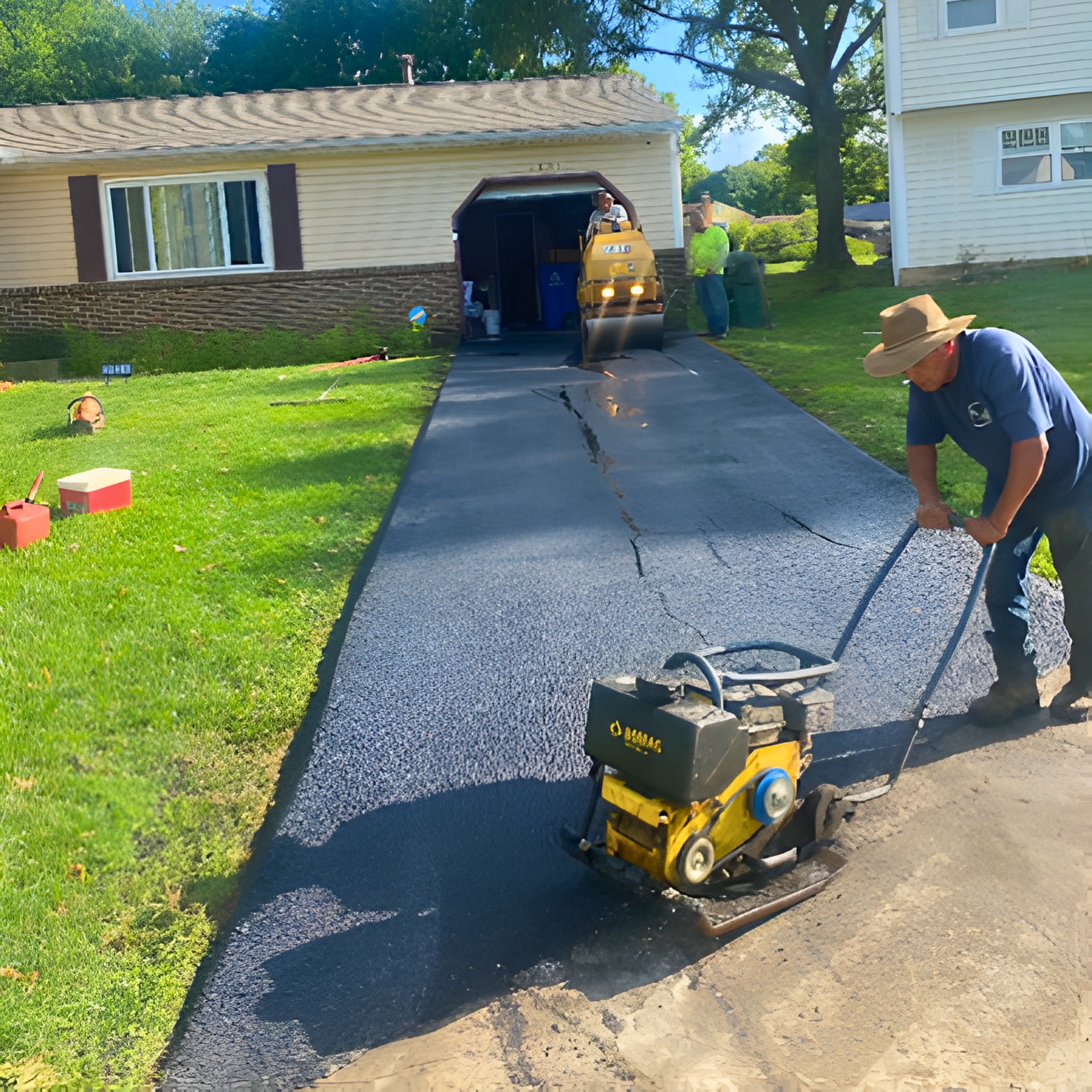
Selecting the ideal thickness for 9.5 mm asphalt involves balancing structural durability with surface smoothness. For a standard residential driveway, a compacted thickness of 1.5 to 2 inches of 9.5 mm asphalt over a stable 6-to-8-inch stone base is the industry standard for 2026, ensuring optimal compaction and long-term resistance to cracking.
Understanding 9.5 mm Asphalt Mix Designs
To choose the correct thickness, one must first understand what 9.5 mm asphalt actually represents. In the world of civil engineering and pavement construction, 9.5 mm refers to the Nominal Maximum Aggregate Size (NMAS). This means that while there may be some larger stones, the majority of the aggregate in the mix is 9.5 mm (approximately 3/8 of an inch) or smaller.
In 2026, 9.5 mm mixes—often categorized under Superpave or Marshall design specifications—are the preferred choice for residential "wearing courses" or surface layers. The smaller aggregate size allows for a tighter, more impermeable surface finish compared to 12.5 mm or 19 mm mixes. This "fine-graded" nature makes it exceptionally good at shedding water and providing a smooth aesthetic that homeowners prefer. However, because the aggregates are smaller, the structural load-bearing capacity is slightly lower than coarser mixes, which is why the thickness and the quality of the underlying base are so critical.
The 9.5 mm mix is typically composed of a blend of crushed stone, manufactured sand, and a liquid asphalt binder. The binder acts as the glue, while the 9.5 mm stone provides the skeleton. When choosing thickness, you are essentially determining how much "skeleton" is required to support the weight of your vehicles without the "glue" failing under tension.
The Rule of Three: The Science of Lift Thickness
A fundamental principle in asphalt paving is the relationship between aggregate size and "lift" thickness. A "lift" is a single layer of asphalt laid and compacted at one time. For 9.5 mm asphalt, the industry follows the 3-to-4 times rule.
To achieve proper density during compaction, the thickness of the asphalt layer should be at least three times the nominal maximum aggregate size. For a 9.5 mm mix, the math works as follows:
- Minimum Thickness: 9.5 mm x 3 = 28.5 mm (approx. 1.12 inches)
- Optimal Thickness: 9.5 mm x 4 = 38 mm (approx. 1.5 inches)
If you attempt to lay a 9.5 mm mix thinner than 1.12 inches, the heavy rollers used for compaction will crush the larger stones against the base rather than reorienting them into a tight matrix. This leads to a "honeycombed" or porous surface that allows water to penetrate, leading to rapid deterioration. Conversely, if the layer is too thick (exceeding 2.5 or 3 inches in a single lift), it becomes difficult to achieve uniform density throughout the layer, which can result in "shoving" or rutting over time as the asphalt moves under the weight of parked cars.
Determining Thickness Based on Driveway Use
The "right" thickness is not a universal number; it depends heavily on how you use your driveway and what lies beneath it. In 2026, residential needs vary from light-duty passenger vehicle storage to heavy-duty RV parking or delivery truck access.
Standard Passenger Vehicle Use
For a driveway that primarily hosts sedans, SUVs, and light trucks, a total asphalt thickness of 2 inches of 9.5 mm mix is generally sufficient. This is usually applied in a single lift over a prepared sub-base. The 2-inch thickness provides enough "body" to resist the thermal stresses of summer and the brittle nature of winter while maintaining a smooth texture.
Heavy-Duty and Oversized Vehicles
If you own a Class A motorhome, a heavy boat, or frequently have multi-axle delivery trucks turning around on your property, a 2-inch layer of 9.5 mm asphalt may be insufficient. In these cases, engineers recommend a two-layer approach. You might use a 2-inch base layer of a coarser 19 mm mix for structural strength, topped with a 1.5-inch surface layer of 9.5 mm asphalt for smoothness. This "thick-lift" strategy ensures that the weight of the heavy vehicle is distributed over a wider area of the soil.
The Role of the Sub-base
The asphalt is only as good as the ground it sits on. A common mistake is focusing solely on the 9.5 mm layer while neglecting the stone base. For a residential driveway, you should have at least 6 to 8 inches of compacted crushed stone (often called 21A or 3/4-inch minus). If your native soil is heavy clay, you may need a thicker stone base or a geotextile fabric to prevent the stone from sinking into the mud. No amount of 9.5 mm asphalt thickness can compensate for a failing sub-base.
9.5 mm Asphalt Thickness Comparison Table
| Usage Scenario | Recommended 9.5mm Thickness | Base Layer Requirement | Primary Benefit |
|---|---|---|---|
| Resurfacing/Overlay | 1.25 to 1.5 inches | Existing stable asphalt | Cost-effective refresh |
| Standard Driveway | 2.0 inches | 6-8" Crushed Stone | Balanced durability/cost |
| Heavy-Duty/RV Path | 1.5 inches (Top layer) | 2" Base Asphalt + 8" Stone | Maximum load support |
| Walkways/Paths | 1.0 to 1.25 inches | 4" Crushed Stone | Smooth pedestrian surface |
| Incline/Sloped Drives | 2.5 inches | 8-10" Crushed Stone | Resistance to sliding/erosion |
Environmental and Geographic Considerations in 2026
Geography plays a significant role in determining the appropriate thickness for 9.5 mm asphalt. In 2026, we are seeing more extreme weather patterns that require careful planning.
Cold Climates and Frost Heave
In northern regions where the ground freezes and thaws repeatedly, a slightly thicker 9.5 mm layer (around 2 inches) can provide better resistance to the tension caused by "frost heave." When the ground expands as it freezes, thin asphalt is more likely to snap. A thicker mat has more internal cohesion to withstand these upward pressures. Furthermore, the density of a 9.5 mm mix is crucial here; a well-compacted, 2-inch layer prevents water from seeping into the pavement, where it would otherwise freeze and cause "potholes" or "alligator cracking."
High-Heat Regions
In southern climates, the primary concern is "rutting" or "scuffing." Asphalt is a thermoplastic material, meaning it softens as it heats up. In 2026, record-breaking summer temperatures can make a driveway susceptible to the weight of stationary tires. A thickness of 1.5 to 2 inches of 9.5 mm asphalt is ideal here. If the asphalt is laid too thick in a high-heat zone without a rigid base, it can become "unstable," leading to waves or ridges in the surface where tires frequently turn (power steering scuffing).
The Importance of Compaction Density
When a contractor specifies a "2-inch thickness," they should be referring to the compacted thickness, not the "loose" thickness. Asphalt typically loses about 20% to 25% of its height during the rolling process. Therefore, to achieve a finished 2-inch 9.5 mm driveway, the contractor must initially spread roughly 2.5 inches of hot mix.
In 2026, advanced paving crews use infrared sensors and vibratory rollers to ensure that the 9.5 mm mix reaches at least 92% to 97% of its maximum theoretical density. If the thickness is inconsistent—say, 1 inch in some spots and 3 inches in others—the roller cannot apply even pressure. This leads to "low-density" areas that are prone to oxidation and raveling (where the small 9.5 mm stones begin to pop out of the surface). Choosing the right thickness is as much about uniformity as it is about depth.
New Construction vs. Overlays
The decision on thickness also hinges on whether you are building a new driveway or covering an old one.
New Construction
For a "full-depth" asphalt project starting from dirt, you are building a structure. Most residential codes in 2026 suggest a total of 3 to 4 inches of asphalt. Using 9.5 mm for the entire depth is possible but often more expensive than using a coarser mix for the bottom half. A common high-quality specification is 2 inches of 19 mm base mix followed by 1.5 inches of 9.5 mm surface mix.
Overlays (Resurfacing)
If your existing driveway is structurally sound but looks "bony" or has surface-level cracks, an overlay is a great option. For a 9.5 mm overlay, the recommended thickness is 1.5 inches. This is thick enough to provide a new structural "skin" and allow for the smoothing of minor dips, but thin enough to avoid creating massive lips or "tripping hazards" at the garage floor or sidewalk interface. Before an overlay, a "tack coat" (a sticky liquid asphalt) must be applied to ensure the new 9.5 mm layer bonds permanently to the old surface.
Common Mistakes When Specifying Thickness
- Going Too Thin to Save Money: Asking for a "1-inch skin coat" of 9.5 mm asphalt is a recipe for failure. Because the 9.5 mm stones are roughly 0.375 inches, a 1-inch layer only allows for about 2.5 stones of vertical stacking. This provides very little room for error and often results in the asphalt "peeling" off the base within three to five years.
- Ignoring the "Edge" Thickness: Driveways often fail at the edges where they meet the grass. If the contractor "feathers" the 9.5 mm mix too thin at the edges, it will crumble. Ensure the full specified thickness is maintained to the very edge of the pavement, or use a "beveled" edge or "thickened edge" design.
- Overestimating 9.5 mm Strength: 9.5 mm is a "finish" mix. If you have a steep incline where cars often spin their tires or where heavy trailers are jacked up, you may need a specialized "high-stability" 9.5 mm mix with a stiffer binder (PG 70-22 or similar) rather than just increasing the thickness.
Cost Considerations in 2026
As of 2026, the price of asphalt is heavily influenced by the cost of petroleum-based binders and the transportation of aggregates. On average, a 9.5 mm mix is slightly more expensive per ton than a coarser 19 mm base mix because it contains a higher percentage of liquid asphalt (the most expensive component).
Increasing your driveway thickness from 1.5 inches to 2 inches will increase the material volume by 33%. While this increases the upfront cost, the Life Cycle Cost (LCC) usually goes down. A 2-inch driveway may last 20-25 years with proper maintenance, whereas a 1-inch driveway might require replacement or major repairs in 10 years. In 2026, many homeowners find that the extra half-inch of 9.5 mm mix provides the best return on investment.
Frequently Asked Questions
Is 9.5 mm asphalt the same as "Top" or "Finish" coat?
Yes, in the residential sector, 9.5 mm is the most common size for what contractors call the "top" or "wearing" course. It is designed specifically to provide a smooth, dark, and aesthetically pleasing surface that is comfortable for walking and reduces tire noise.
Can I use 9.5 mm asphalt directly on top of dirt?
No. Asphalt is a flexible pavement and requires a rigid foundation. Placing 9.5 mm asphalt directly on soil—even if it is 3 inches thick—will result in rapid failure as the soil shifts and moisture weakens the asphalt from underneath. A minimum of 6 inches of compacted stone is required.
How do I know if my contractor actually laid the thickness I paid for?
The best way to verify thickness is through "tonnage tickets." Based on the square footage of your driveway and the target thickness (e.g., 2 inches), you can calculate the exact number of tons required. Ask your contractor for the weigh-house tickets from the asphalt plant. For 9.5 mm asphalt, a 2-inch compacted thickness typically requires approximately 110-115 pounds per square yard per inch of thickness.
What happens if the 9.5 mm asphalt is compacted when it's too cold?
In 2026, "Warm-Mix Asphalt" (WMA) technologies are common, but temperature is still vital. If a 1.5-inch layer of 9.5 mm asphalt cools below 175°F before the final rolling, it will not reach its target density. This results in a porous surface that will fail prematurely. Thinner layers cool much faster than thicker layers, which is why 2 inches is often safer for late-season paving.
Does 9.5 mm asphalt require a sealer?
While 9.5 mm asphalt is naturally denser and more water-resistant than coarser mixes, it still benefits from a sealcoat. In 2026, it is recommended to wait at least 12 months for the oils to cure before applying a high-quality sealer. This protects the binder from UV degradation and oxidation.
Recommendation for Next Actions
If you are planning a driveway project in 2026, your first step should be a professional site evaluation. Measure the total square footage and assess the current soil or pavement condition. For most homeowners, requesting a 2-inch compacted lift of 9.5 mm asphalt over a 6-inch stone base offers the best balance of longevity and price.
Ensure your written contract specifies "9.5 mm Nominal Maximum Aggregate Size" and explicitly states "compacted thickness." Once the job is underway, monitor the "tack coat" application if you are doing an overlay, and keep vehicles off the new surface for at least 48 to 72 hours to allow the binder to set properly in the 2026 heat.