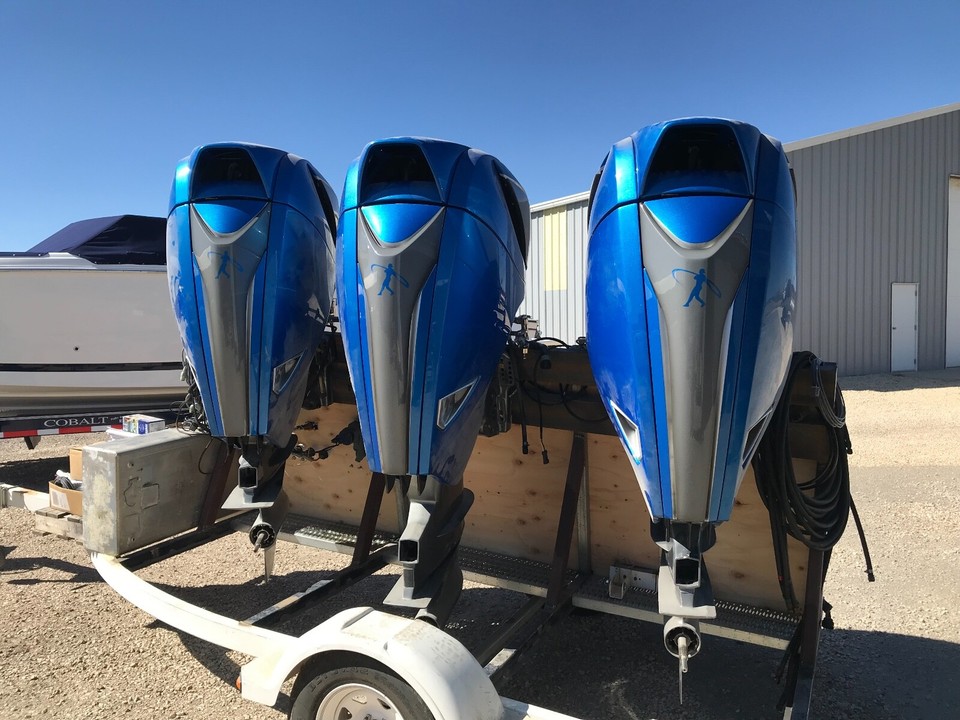
The Seven Marine 627 weighs approximately 1,094 pounds (496 kg) in its standard dry configuration. This weight makes it one of the heaviest outboard motors ever produced, a necessary trade-off for its 6.2-liter supercharged V8 engine and the robust ZF marine transmission required to manage its massive torque output.
The Seven Marine 627 was a revolutionary piece of marine engineering that redefined the limits of outboard power. While the brand, owned by Volvo Penta, ceased new production in the early 2020s to pivot toward sustainable technologies, the 627 remains a pinnacle of performance for high-end center consoles and luxury day boats in 2026. Understanding the weight of this engine is not merely a matter of curiosity; it is a critical calculation for boat designers, refit specialists, and owners who must ensure their transoms can support the immense static and dynamic loads generated by these powerhouses.
The Engineering Behind the Weight
To understand why the Seven Marine 627 tips the scales at over half a ton, one must look beneath the cowling. Unlike traditional outboards that use purpose-built vertical-crankshaft powerheads, Seven Marine utilized a horizontally mounted General Motors LSA V8 engine. This is essentially the same 6.2L small-block found in high-performance automotive applications, adapted for the marine environment.
The transition from a horizontal crankshaft to a vertical drive required a sophisticated transfer case and a heavy-duty ZF transmission. These components, while providing unparalleled shifting smoothness and the ability to handle over 600 lb-ft of torque, add significant mass compared to the simplified gear sets found in lower-horsepower outboards.
Powerhead and Supercharger
The core of the weight lies in the 6.2L aluminum block. While aluminum is light for its size, the addition of a 1.9L Twin-Vortices Series (TVS) supercharger, intercoolers, and a closed-loop cooling system adds considerable heft. The closed-loop system is particularly important as it uses a heat exchanger to keep salt water out of the engine block, extending its lifespan but increasing the dry weight of the unit.
The Midsection and Bracketing
To support a 1,000-pound motor moving at speeds of 70+ mph, the midsection and mounting brackets must be exceptionally strong. Seven Marine engineered a massive integrated mounting system that distributes the weight and torque across a larger area of the transom. This bracketry alone accounts for a significant portion of the weight difference when compared to 300hp or 400hp alternatives.
Weight Variations by Configuration
The "1,094 lbs" figure is a baseline. In real-world applications, the operational weight (often referred to as "wet weight") is higher once you account for fluids, propellors, and varied shaft lengths.
| Component / Configuration | Estimated Weight (lbs) | Estimated Weight (kg) |
|---|---|---|
| Standard Dry Weight (20" Shaft) | 1,094 lbs | 496 kg |
| Operational Weight (Fluids + Prop) | 1,145 lbs | 519 kg |
| 30" Shaft Extension Weight | 1,120 lbs | 508 kg |
| 39" Shaft Extension Weight | 1,165 lbs | 528 kg |
| Dual-Prop Lower Unit (CR) | +45 lbs | +20 kg |
The 627 was offered in multiple shaft lengths (20, 25, 30, 35, and 39 inches) to accommodate the massive transoms of modern "mega-center-consoles." A 39-inch shaft model, filled with oil and coolant and fitted with a high-pitch stainless steel propeller, can easily exceed 1,180 lbs.
Transom Stress and Structural Considerations
When a boat is designed for the Seven Marine 627, the weight is only half of the equation. The other half is the leverage. Because the engine sits off the back of the boat, its weight exerts a rotational force on the transom.
Static Load vs. Dynamic Load
In 2026, many older hulls are being considered for repowers. A boat originally designed for triple 300hp outboards (totaling roughly 1,800 lbs) might struggle if repowered with twin Seven Marine 627s (totaling roughly 2,200 lbs). While the weight increase is only 400 lbs, the center of gravity of the 627s often sits further aft, increasing the strain on the transom's laminate and stringer system.
Designers must also account for dynamic load—the force applied when the boat hits a wave at high speed. A 1,100-pound motor effectively "weighs" several times that amount during a hard landing. If the transom is not reinforced with carbon fiber or advanced composite Coosa board, the structural integrity can be compromised over time.
Flotation and Static Trim
The weight of the 627 affects how a boat sits at the dock. If too much weight is concentrated at the stern, the scuppers may sit below the waterline, leading to "wet feet" on the deck or, in extreme cases, drainage issues. Boat builders like HCB, Midnight Express, and Scout, who frequently rigged with Seven Marine, specifically engineered their hulls with additional buoyancy in the aft sections to counteract this weight.
Comparing the 627 to Modern Competitors
By 2026, the landscape of high-horsepower outboards has shifted. While Seven Marine led the way, other manufacturers have since entered the "super-outboard" category. Comparing their weights provides context for where the 627 stands in the history of marine propulsion.
Mercury V12 Verado 600hp
The Mercury V12 Verado is the primary spiritual successor to the 627 in terms of raw power. Despite having more cylinders (12 vs. 8), the Mercury V12 is actually heavier, weighing in at approximately 1,260 lbs. This makes the Seven Marine 627 significantly lighter than the Mercury V12, though the Mercury features an innovative steerable gearcase that keeps the heavy powerhead stationary, reducing the physical space required for engine articulation.
Yamaha XTO Offshore 450hp
The Yamaha XTO 450 is a more conventional outboard design but still a heavyweight at roughly 960 lbs. While it offers less horsepower than the 627, its weight-to-power ratio is competitive for users who do not require the extreme top-end speed of the supercharged V8.
Mercury Racing 500R
The Mercury Racing 500R represents the high-performance weight-saving school of thought. It weighs approximately 720 lbs. While it lacks the sheer displacement and "grunt" of the 7 Marine 627, it shows the massive weight gap between a purpose-built racing outboard and the luxury "heavy-duty" approach taken by Seven Marine.
Technical Maintenance Challenges of a 1,000lb Outboard
In 2026, maintaining a Seven Marine 627 requires specialized equipment. You cannot simply use a standard outboard stand or a light-duty shop crane to service these units.
- Specialized Hoists: Most marine technicians working on 627s use heavy-duty overhead gantry cranes. The sheer mass makes manual manipulation impossible and dangerous.
- Fluid Capacities: The 6.2L engine requires significantly more oil than a standard outboard. The closed-loop cooling system also requires periodic flushing and replacement of specialized coolant, adding to the "wet weight" and maintenance complexity.
- Anodes and Corrosion: Because there is so much metal (and different types of alloys) submerged, the sacrificial anode system is robust. Keeping an eye on these is vital, as the weight of the motor is supported by a bracket system that must remain structurally perfect to avoid catastrophic failure.
The Role of the ZF Transmission
A major contributor to the 627's weight is the ZF 2-speed transmission. At the time of its release, this was a revolutionary feature for an outboard. It allowed the engine to use a lower gear for massive hole-shot torque (getting a heavy boat on plane quickly) and then shift into a higher gear for top-speed efficiency.
The hardware required for a 2-speed shifting mechanism, including the hydraulic clutches and the gear sets capable of handling 627 horsepower, adds roughly 150-200 lbs to the engine's total weight compared to a direct-drive setup. However, for the target audience—owners of 40-foot to 65-foot center consoles—this weight penalty was considered an acceptable trade-off for the performance gains.
Performance and Efficiency Considerations
Does a 1,100-pound weight hinder performance? In the case of the 627, the answer is generally no, provided the hull is large enough. The torque curve of the supercharged 6.2L V8 is so aggressive that it overcomes the weight penalty almost instantly.
However, the weight does impact fuel efficiency at cruising speeds. Carrying an extra 2,000 to 4,000 lbs on the transom (in triple or quad configurations) requires more lift from the hull. This often necessitates the use of large trim tabs or interceptors to keep the bow down and the boat on an efficient running angle.
Buying and Owning a Seven Marine 627 in 2026
If you are looking at the secondary market or a refurbished vessel in 2026, the 627 remains a "statement" engine. While Volvo Penta has committed to supporting existing units with parts and service through their dealer network, prospective owners should be aware of the following:
- Transom Inspection: Always have a structural survey performed on any boat equipped with Seven Marine engines. Check for stress cracks around the mounting bolts.
- Weight Sensitivity: If you are repowering a boat that did not originally come with Seven Marines, consult a naval architect. Adding three 627s to a hull designed for light 350hp outboards can dangerously shift the center of gravity.
- Value Retention: Despite being out of production, the 627 maintains a cult following. Their unique sound (the unmistakable V8 growl) and aesthetic appeal keep them in demand for custom "boutique" boat builds.
FAQ
What is the exact dry weight of the Seven Marine 627?
The base dry weight is 1,094 lbs (496 kg). This applies to the 20-inch shaft model. Longer shaft versions and those equipped with the Contra-Rotating (CR) dual-prop lower unit will weigh more, typically between 1,120 and 1,180 lbs.
Is the Seven Marine 627 heavier than the Mercury V12 600?
No. The Mercury V12 Verado 600hp weighs approximately 1,260 lbs, making it about 166 lbs heavier than the Seven Marine 627. However, the Mercury's design integrates steering into the gearcase, which changes how that weight affects the boat's handling and space requirements.
Why did Volvo Penta stop making the Seven Marine 627?
Volvo Penta announced the discontinuation of the Seven Marine line in 2020 as part of a strategic shift toward "electromobility" and sustainable power solutions. While the 627 was a technical marvel, the industry trend was moving toward reduced emissions and integrated hybrid systems, which led to the retirement of the large-displacement, supercharged V8 outboard.
Can I install a Seven Marine 627 on a standard boat transom?
Generally, no. Most standard boat transoms are rated for engines in the 500–700 lb range. The 627 requires a transom specifically engineered for "super-heavy" outboards. Installing a 1,100-lb motor on an unreinforced transom can lead to structural failure, hull delamination, or poor sea-keeping characteristics.
Does the 627's weight include the oil and cooling fluids?
No, the 1,094-lb figure is the "dry weight." When you add engine oil, transmission fluid, and the coolant for the closed-loop system, the "wet weight" increases by approximately 40 to 50 lbs.
How does the weight of the 627 affect the boat's center of gravity?
Because outboards are mounted behind the transom, their weight has a significant effect on the longitudinal center of gravity (LCG). A heavy engine like the 627 shifts the LCG aft, which can cause the boat to "porpoise" (bounce) at high speeds if not corrected with proper hull design or trim adjustments.
Final Recommendation
When dealing with the Seven Marine 627 weight, the primary action for any owner or buyer in 2026 is to verify the vessel’s maximum weight capacity rating, not just its maximum horsepower rating. While a boat may be rated for 1,200 horsepower, it may not be rated for the 2,200+ lbs that a pair of 627s represents. Always prioritize structural reinforcement and ensure that your trailer and lift systems are rated for the increased mass. For those who can accommodate the weight, the 627 offers a level of displacement and torque that few modern engines can match.