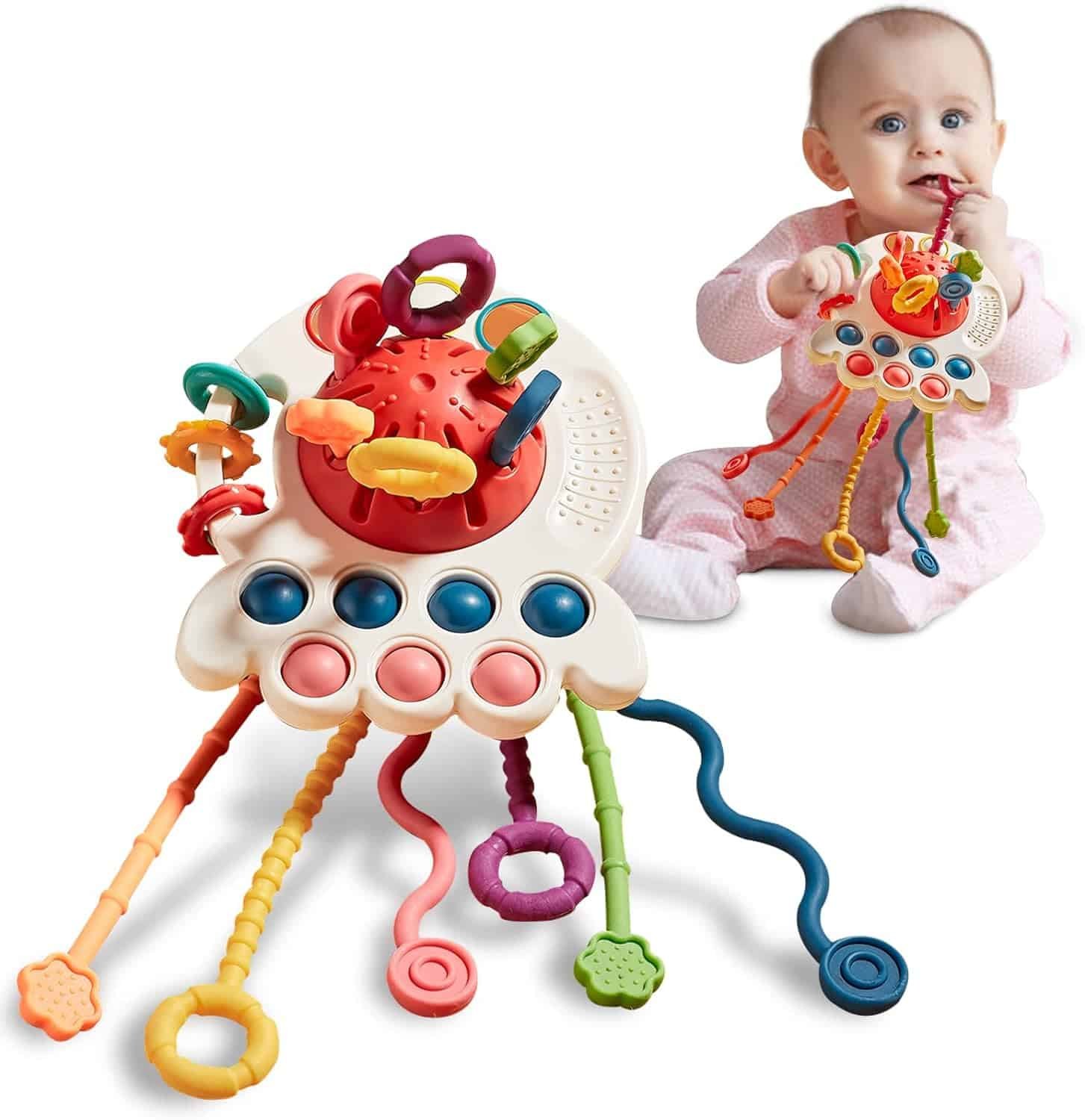
At 6 months, selecting Montessori toys requires focusing on materials that support sitting, the transition from palmar to pincer grasp, and the development of hand-to-hand transfer. Key options include the interlocking discs, soft fabric balls, and wooden rattles, which encourage sensory exploration and the refinement of motor coordination through purposeful, self-directed play.
The 6-month mark represents a pivotal "awakening" in infant development. Historically and within the 2026 Montessori framework, this period is characterized by the child’s transition from a more passive observer to an active explorer of their immediate environment. As your child begins to sit up—either independently or with minimal support—their perspective of the world shifts, necessitating a "prepared environment" that offers specific challenges suited to their emerging skills.
Understanding the Developmental Window at Six Months
To select the most appropriate Montessori toys, one must first understand the physiological and neurological shifts occurring at this age. By six months, most infants have moved past the "symbiotic period" (the first six to eight weeks) and are entering a stage where they can intentionally reach for and grasp objects.
The Refinement of the Grasp
At six months, the infant typically utilizes a palmar grasp, using the whole hand to wrap around an object. However, they are beginning to experiment with the strength of their fingers. Montessori materials for this age are designed to be thin enough for a small hand to encircle but substantial enough to provide tactile feedback. This is the prime time to introduce materials that encourage the hand-to-hand transfer, a skill that facilitates bilateral integration and communication between the left and right hemispheres of the brain.
Gross Motor Progression
The "Sensitive Period for Movement," as identified by Dr. Maria Montessori, is in full swing by the half-year mark. While many toys focus on fine motor skills, 6-month-old Montessori toys must also encourage core strength and the motivation to move. Toys that roll slowly away, such as the Montessori rolling bell or a textured ball, provide an incentive for the infant to lunge forward, eventually leading to the first stages of crawling.
Essential Montessori Toys for the 6-Month-Old
Selecting toys is not about quantity; the Montessori philosophy emphasizes a few high-quality, "passive" toys that require the child to be the "active" participant. Avoid battery-operated devices that perform for the child. Instead, look for the following specific items.
1. Interlocking Discs
The interlocking discs are perhaps the most iconic Montessori material for the 6th month. These consist of two wooden discs joined at a 90-degree angle.
- Purpose: They serve two main functions. First, they are easy to grasp and encourage the baby to pass the toy from one hand to the other. Second, when placed on the floor, they roll in a unique, slightly erratic pattern that stays within the baby's reach, encouraging them to move their body to retrieve it.
- Developmental Benefit: They promote the crossing of the body's midline, which is essential for future activities like reading and writing.
2. The Montessori Ball (The "Knot" or "Puzzle" Ball)
Unlike a standard smooth sphere, a Montessori ball is typically made of fabric with "petals" or indentations.
- Purpose: The unique shape prevents it from rolling too far away on a hardwood floor, which can frustrate a pre-crawler. The indentations make it easy for a 6-month-old to hook their fingers into the fabric.
- Developmental Benefit: It builds confidence in reaching and grasping while providing various textures (if made with different fabrics) for tactile stimulation.
3. The Rolling Bell and Cylinder
A wooden cylinder containing a bell provides immediate auditory feedback.
- Purpose: As the baby bats at the cylinder, it rolls and tinkles. This teaches the concept of cause and effect. The sound is natural and soothing, unlike the loud, synthesized sounds of electronic toys.
- Developmental Benefit: It encourages visual tracking as the baby watches the object roll and strengthens the arm muscles during "tummy time" or seated play.
4. Treasure Baskets for Heuristic Play
While not a single "toy," a treasure basket is a foundational Montessori practice. At 6 months, you can fill a low, sturdy basket with 5-7 everyday objects made of natural materials.
- Contents: A large sea shell, a stainless steel whisk, a wooden spoon, a silk scarf, and a large smooth stone.
- Developmental Benefit: This provides a rich sensory experience. The baby learns about weight, temperature (the coldness of metal vs. the warmth of wood), and texture in a way that plastic toys cannot provide.
Material Selection: Safety and Sustainability in 2026
When selecting developmentally appropriate options, the material is just as important as the function. In 2026, parents are encouraged to follow the U.S. Consumer Product Safety Commission (CPSC) guidelines for infant toys, ensuring that all items are free from small parts that could pose a choking hazard.
The Case for Natural Wood and Silicone
Montessori toys emphasize wood because of its "sensory information." Wood has a specific grain, weight, and even a faint scent. If the wood is unfinished or finished with food-grade beeswax or olive oil, it is perfectly safe for the "mouthing" phase that peaks at 6 months. High-quality, BPA-free silicone is also an acceptable modern addition to the Montessori shelf, especially for teething toys that require a different level of "give" for the child's gums.
Avoiding "The Battery Trap"
The primary rule of thumb in 2026 for Montessori environments remains: The toy should not do the work. If a toy lights up, talks, or moves on its own, the child becomes a passive observer. This can lead to a shorter attention span and a lack of creative problem-solving. True Montessori materials for 6-month-olds are "quiet," allowing the child to focus on their own internal discoveries.
Comparison of Key Montessori Materials for 6 Months
| Toy Name | Primary Skill | Material | Movement Type |
|---|---|---|---|
| Interlocking Discs | Midline Crossing / Hand Transfer | Wood | Rolling (Close range) |
| Puzzle/Knot Ball | Grasping / Kicking | Fabric/Cotton | Limited Rolling |
| Rolling Bell | Cause and Effect / Auditory | Wood & Metal | Continuous Rolling |
| Egg in Cup | Hand-Eye Coordination | Wood | Stationary / Vertical |
| Silicone Teether | Sensory / Oral Exploration | Food-grade Silicone | Stationary |
The Role of the "Prepared Environment"
Selecting the right toy is only half the battle; how you present it matters equally. In a Montessori home, toys are not dumped into a large toy box. Instead, they are placed on a low, child-height shelf.
- Limitation: Only 3 to 5 toys should be available at any given time. This prevents overstimulation and allows the 6-month-old to make a clear choice about what they want to work with.
- Order: Each toy should have its own "home" on the shelf. Even at 6 months, babies begin to absorb the order of their environment.
- The Floor Mirror: A horizontal mirror placed next to the play mat is a staple. It allows the infant to see their own movements, which aids in the development of self-awareness and gross motor coordination.
Common Mistakes When Selecting 6-Month Toys
Even with the best intentions, parents often fall into common traps that can hinder the Montessori approach:
- Age-Inappropriate Challenges: Providing a toy that is too difficult (like a complex shape sorter) can lead to frustration and a "giving up" mentality. Stick to single-step tasks like "putting an egg in a cup."
- Over-Saturation: Having too many toys out at once leads to "toy grazing," where the child moves quickly from one thing to another without deep concentration.
- Ignoring Safety for Aesthetics: Just because a toy is "wooden" doesn't mean it's Montessori or safe. Ensure any painted items use non-toxic, lead-free water-based stains, as a 6-month-old will spend a significant amount of time mouthing these objects. For more on safety standards, refer to ASTM International.
Frequently Asked Questions
Why is the interlocking disc better than a regular rattle?
The interlocking disc is specifically designed to encourage the transfer of an object from one hand to the other. While a rattle can be transferred, the unique geometry of the discs makes it almost intuitive for the baby to reach across their body, which is a foundational step for neurological development.
When should I rotate the toys on the shelf?
There is no fixed schedule, but a general rule is to observe the child. If they have mastered a toy and no longer engage with it, or if they are throwing it out of frustration or boredom, it is time to rotate. Usually, a rotation every 2–3 weeks is sufficient for a 6-month-old.
Can I use plastic toys in a Montessori environment?
While Montessori prefers natural materials, the "Montessori-ness" of a toy is defined more by its function than its material. If a plastic toy is simple, purposeful, and doesn't have batteries/electronics, it can still fit the philosophy. However, wood is preferred for its tactile and weighted properties.
Is the "Egg in Cup" too advanced for a 6-month-old?
Around 6 or 7 months, many babies develop the coordination to take the egg out of the cup. Putting it back in usually comes a bit later. Introducing it at 6 months allows the child to explore the two separate pieces and begin practicing the precise hand-eye coordination needed for the "fit."
How do I know if a toy is "developmentally appropriate"?
Look for toys that align with the child’s current "work." If your baby is focused on grasping, a teether or rattle is appropriate. If they are focused on sitting up, a weighted toy that stays put while they reach for it is better. Always follow the child’s lead.
Final Recommendations for Selection
When selecting Montessori toys for your 6-month-old in 2026, prioritize quality over quantity. Focus on toys that offer a "clear purpose," such as the auditory feedback of a bell or the tactile challenge of a fabric ball. Ensure that the environment remains uncluttered and that the materials used are safe for the intensive mouthing and manipulation characteristic of this age. By providing a few well-chosen tools, you support the infant’s natural drive toward independence and mastery of their own body.