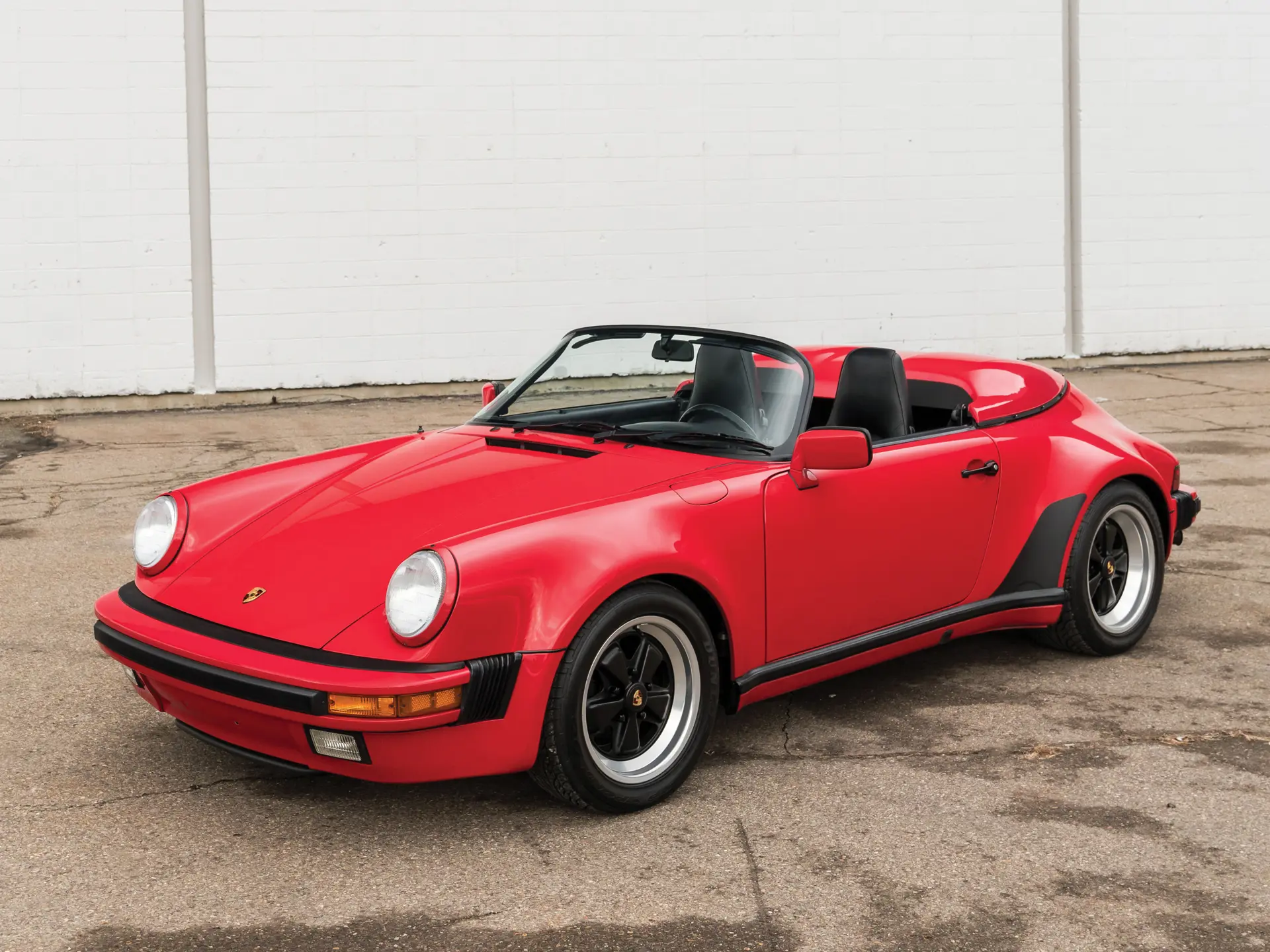
The 1989 Porsche 911 Speedster is a limited-production, open-top sports car that serves as a performance-oriented tribute to the original 356 Speedster. Built on the G-Series 3.2 Carrera platform, it is distinguished by its low-cut, raked windshield, a unique fiberglass "double-bubble" rear tonneau cover, and a simplified manual folding top.
For collectors and enthusiasts in 2026, the 1989 Speedster represents more than just a rare variant; it is the final, high-water mark of the original "G-Body" 911 architecture. As air-cooled Porsche values have stabilized at high premiums over the last few years, understanding the nuances of this specific model year—the only year the G-Series Speedster was produced—is essential for any serious acquisition or restoration project.
The Historical Context: Reviving a Legend
The 1989 Speedster was not an impulsive creation. The concept of a modern Speedster had been gestating within Porsche’s engineering department, led by Helmuth Bott, since the early 1980s. A prototype was famously shown at the Frankfurt Motor Show in 1983, but it took another six years for the production version to reach the public.
By 1989, the 911 was undergoing a massive transition. Porsche was preparing to launch the Type 964, which introduced coil springs and significantly updated aerodynamics. The 1989 Speedster was effectively a "swan song" for the torsion-bar 911, utilizing the tried-and-true 3.2-liter Carrera chassis and drivetrain. It was marketed as a purist’s driving machine, stripped of the luxuries found in the Targa or the standard Cabriolet, emphasizing the visceral connection between the driver, the road, and the elements.
Engineering and Performance Specifications
At its core, the 1989 Speedster shares its mechanical DNA with the 911 Carrera 3.2. However, the driving dynamics are subtly different due to the weight distribution changes caused by the unique bodywork and the removal of the heavy power-top mechanisms found in standard convertibles.
The Powerplant: 3.2-Liter Flat-Six
The vehicle is powered by the legendary air-cooled 3,164cc horizontally opposed six-cylinder engine. In North American trim, this engine produced approximately 214 horsepower and 195 lb-ft of torque, while European versions (without certain emissions constraints) often reached 231 horsepower.
The engine features the Bosch Motronic 2.1 Digital Motor Electronics (DME) system, which, in 1989, was the pinnacle of reliability for air-cooled Porsches. This system manages ignition timing and fuel injection with a level of precision that makes the '89 Speedster a reliable "touring" classic, even as it approaches 40 years of age.
The G50 Transmission
One of the most critical features of the 1989 model is the inclusion of the Getrag G50 five-speed manual transmission. Introduced to the Carrera line in 1987, the G50 replaced the older 915 gearbox. The G50 uses Borg-Warner synchromesh and a hydraulic clutch, offering significantly smoother, more precise shifts. For collectors in 2026, a G-Series 911 with a G50 transmission is generally considered the most desirable configuration for drivability.
Design and Aesthetic Distinctions
The 1989 Speedster is instantly recognizable, even to those who are not Porsche aficionados. Its silhouette is dominated by three specific design choices that set it apart from the standard 911 Cabriolet.
The "Cut" Windshield
The aluminum-framed windshield is approximately 3.1 inches (80mm) shorter than the standard Carrera windshield and is raked back at a 5-degree steeper angle. This gives the car a "slung-back" appearance and significantly alters the airflow over the cabin. Because of this design, the side windows are also unique to the Speedster, featuring a distinct "quarter-light" delete and a different glass curvature.
The "Double-Bubble" Tonneau
Replacing the rear seats is a large, color-matched fiberglass panel known as the "hump" or "clamshell." This panel serves two purposes: it provides a streamlined aerodynamic profile when the top is down, and it covers the storage area for the manual folding roof. This design transforms the 911 into a strict two-seater, emphasizing its role as a weekend car rather than a grand tourer.
Widebody vs. Narrowbody (M491 Option)
The vast majority of 1989 Speedsters (approximately 1,943 of the ~2,100 produced) were built with the M491 "Turbo-look" widebody. This gave the Speedster the flared fenders, wider Fuchs alloy wheels, and beefier suspension/braking components of the 911 Turbo (930), but without the turbocharger or the "whale tail" rear wing.
A very small number of "Narrowbody" Speedsters were produced—estimated at just 161 to 171 units globally. These versions utilized the standard Carrera body width. In the current 2026 market, these narrowbody versions command a significant price premium due to their extreme rarity and sleek, understated profile.
Technical Comparison: Speedster vs. Carrera Cabriolet
To understand the value proposition of the Speedster, it is helpful to compare it directly to its sibling, the 1989 3.2 Carrera Cabriolet.
| Feature | 1989 911 Speedster (Widebody) | 1989 911 Carrera Cabriolet |
|---|---|---|
| Engine | 3.2L Air-Cooled Flat-6 | 3.2L Air-Cooled Flat-6 |
| Transmission | G50 5-Speed Manual | G50 5-Speed Manual |
| Windshield | Raked/Shortened (Removable) | Standard Height (Fixed) |
| Roof Operation | Manual / Emergency Use Only | Power-Operated / Weather-Tight |
| Seating | 2-Seater (Rear Seat Delete) | 2+2 Configuration |
| Body Style | M491 Widebody (Standard) | Narrowbody (Standard) |
| Approx. Weight | 2,850 lbs (1,293 kg) | 3,000 lbs (1,360 kg) |
| Total Production | ~2,104 Units | ~4,800 Units (for 1989) |
The Driving Experience: A Raw Connection
Driving a 1989 Speedster is an exercise in sensory overload. Because the windshield is so low, wind buffeting is substantial at speeds over 50 mph. Porsche famously marketed the Speedster's roof as an "emergency" top, suggesting that it was not intended for use in heavy rain or extended inclement weather. The top lacks a traditional headliner and is notoriously difficult to seal perfectly against the shortened side windows.
However, on a winding road, the Speedster excels. The wider track of the M491 body provides exceptional mechanical grip, and the lack of a heavy power-roof mechanism lowers the center of gravity. The sound of the 3.2-liter engine—unfiltered by the insulation of a standard coupe—is a defining characteristic of the experience.
Market Value and Investment Potential in 2026
As of 2026, the 1989 Porsche 911 Speedster remains a blue-chip collectible. While the "Porsche fever" of the early 2020s has matured into a more discerning market, the Speedster has held its value better than standard Carreras due to its low production numbers and historical significance.
Valuation Tiers
- Concours/Collector Grade: Low-mileage (under 10,000 miles), "paint-to-sample" or rare color examples with full documentation and original "matching numbers" drivetrains can exceed $350,000 - $450,000.
- Driver Grade: Examples with 30,000 to 60,000 miles that have been well-maintained but driven regularly typically trade between $220,000 and $280,000.
- Narrowbody Premium: Because only about 161 narrowbody versions were made, they often fetch 30-50% more than their widebody counterparts when they appear at major auctions like RM Sotheby’s or Broad Arrow.
Key Value Drivers
- The Top Condition: Since the manual top is fragile and specific to this model, an original, tear-free top is a major value indicator.
- Documentation: Original window stickers, service logs, and the Porsche Production Specifications (PPS) or COA (Certificate of Authenticity) are mandatory for top-tier pricing.
- Color Scarcity: While Guard's Red and Grand Prix White were the most popular, colors like Silver Metallic or Black-on-Black are highly sought after.
Maintenance and Common Issues
Owning an air-cooled 911 requires specialized care, and the Speedster has a few unique quirks that owners should monitor.
- The Clamshell Latches: The fiberglass rear deck is heavy and held down by specific latches. If these are misaligned, the panel can vibrate or, in worst-case scenarios, crack.
- Windshield Seals: Because the windshield is unique, finding replacement rubber seals can be difficult and expensive. It is vital to keep these conditioned to prevent drying and cracking.
- Engine Top-End: Like all 3.2 Carreras, the valve guides can wear over time (typically between 75,000 and 100,000 miles), leading to increased oil consumption.
- DME Relay: This is a common failure point on all 1980s Porsches. Most experienced owners carry a spare relay in the glovebox, as a failure will leave the car unable to start.
For technical guidance and parts sourcing, many owners rely on Porsche Classic or independent specialists like Pelican Parts.
Frequently Asked Questions
Is the 1989 Speedster top waterproof?
Technically, no. Porsche officially described it as a "weather protection" top rather than a fully waterproof convertible top. It is a single-layer fabric roof without the complex sealing found on the standard Cabriolet. High-pressure car washes or heavy storms will likely result in some water ingress.
How can I verify if a 1989 Speedster is a genuine Narrowbody?
The easiest way is to check the option codes found on the sticker under the front trunk lid (the "frunk"). A standard Widebody Speedster will have the M491 option code. If that code is absent and the car has original narrow fenders, it is likely one of the rare narrowbody units. Verification via the Porsche VIN database is highly recommended.
Does the Speedster have a heater or air conditioning?
Most 1989 Speedsters were equipped with a heater (utilizing heat exchangers from the engine), and many were ordered with air conditioning. However, the AC systems in G-Series Porsches are notoriously weak compared to modern standards, and in an open-top car with a low windshield, its effectiveness is minimal.
Why is the 1989 model more desirable than the 1994 (964) Speedster?
Desirability is subjective, but many collectors prefer the 1989 version because it represents the classic "torsion bar" 911 feel. The 1989 model also had a higher production run for the widebody, which many enthusiasts find more aesthetically pleasing. The 964 Speedster (1994) was mostly built as a narrowbody and used the newer coil-spring suspension, offering a different, more modern driving dynamic.
Next Steps for Prospective Buyers
If you are looking to acquire a 1989 Porsche 911 Speedster in 2026, your first step should be a professional Pre-Purchase Inspection (PPI) by a technician specializing in air-cooled Porsches. Focus specifically on the integrity of the fiberglass tonneau and the condition of the G50 transmission's synchros.
Given the car's status as a high-value asset, consider participating in specialized communities such as the Porsche Club of America (PCA) to track specific VIN histories and former ownership. These cars often trade "off-market" between club members before ever reaching a public auction platform.