The Series 7 content outline—formally known as the General Securities Representative Exam (GSRE) outline—serves as the definitive blueprint for the knowledge, skills, and regulatory requirements expected of entry-level financial professionals in the United States. Maintained by the Financial Industry Regulatory Authority (FINRA), this document details the specific functional areas, weighing of topics, and task-based competencies that candidates must demonstrate to earn licensure for soliciting, purchasing, and selling various general securities products.
Understanding the Purpose of the Series 7 Content Outline
The Series 7 exam is a high-stakes assessment that validates a candidate's ability to perform the duties of a General Securities Representative. The official content outline is not merely a list of topics; it is a strategic map that guides your study plan. By dissecting the outline, you can align your preparation with the actual distribution of questions you will encounter on exam day.
The document is organized by "Functions," which represent the primary responsibilities of a registered representative. Each function is broken down into specific tasks and the associated knowledge required to execute those tasks effectively. Understanding this structure prevents you from spending disproportionate amounts of time on low-yield subjects while overlooking high-weighted areas that are critical to passing.
Breakdown of the Four Primary Functional Areas
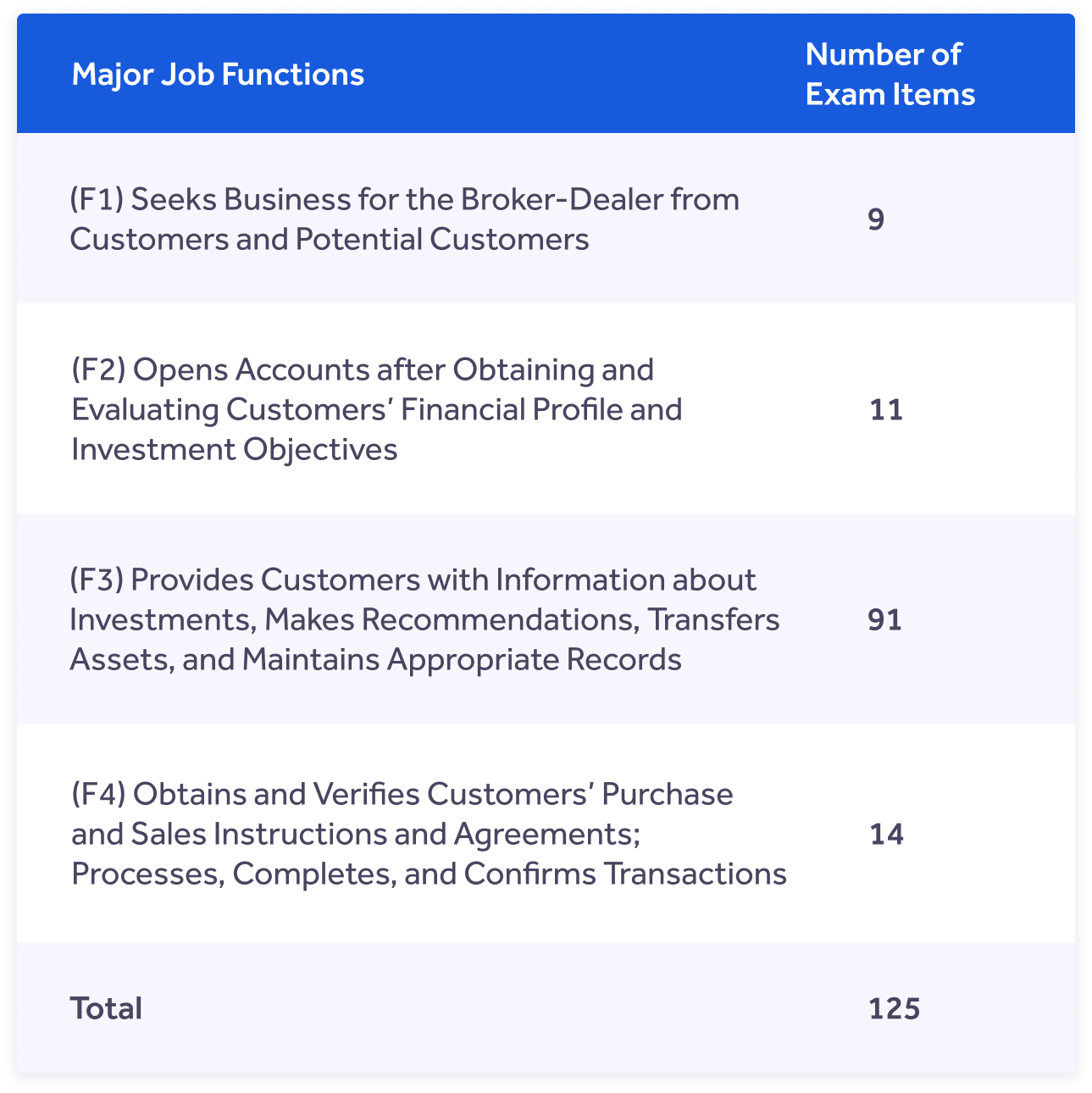
The Series 7 content outline is segmented into four distinct functions. Each function carries a specific percentage of the 125 scored questions on the exam.
Function 1: Seeks Business for the Broker-Dealer from Customers and Potential Customers (8 Questions)
This section focuses on the regulatory requirements for identifying and qualifying potential clients. Candidates must understand the rules regarding advertising, communication with the public, and the ethical standards for prospecting. It emphasizes the importance of understanding the firm’s specific business model and the limitations imposed by the Securities and Exchange Commission (SEC) and FINRA on how business is solicited.
Function 2: Opens Accounts after Obtaining and Evaluating Customers’ Financial Profile and Investment Objectives (11 Questions)
Before an account can be opened, a representative must perform essential due diligence. This includes the "Know Your Customer" (KYC) rule, which mandates that a representative obtain enough information to understand a client's risk tolerance, financial goals, time horizon, and liquidity needs. This section tests your ability to interpret financial data and apply it to account opening procedures, including the nuances of personal, corporate, and trust accounts.
Function 3: Provides Customers with Information about Investments, Makes Suitable Recommendations, Transfers Assets, and Maintains Appropriate Records (91 Questions)
This is the most heavily weighted section of the exam, accounting for nearly 73% of your total score. It covers the broad spectrum of investment products, including equities, debt instruments, mutual funds, variable annuities, options, and direct participation programs. You are tested on the mechanics of these products, the risk-reward profiles of each, and—most importantly—the suitability standards that govern how and why a recommendation is made to a client.
Function 4: Obtains and Verifies Customers’ Purchase and Sales Instructions, Enters Orders, and Follows Up (15 Questions)
The final function covers the operational side of trading. This involves the mechanics of order execution, settlement dates, confirmation statements, and the resolution of trading errors. Candidates must understand how orders are routed, the differences between various order types (market, limit, stop), and the regulatory requirements for ensuring that client transactions are processed accurately and in a timely manner.
Comparative Overview of Exam Weights
To optimize your study strategy, use the following table to prioritize your efforts based on the 2026 examination specifications.
| Function Number | Function Name | Weighting | Focus Area |
|---|---|---|---|
| Function 1 | Seeking Business | 6% | Prospecting and Communication |
| Function 2 | Opening Accounts | 9% | KYC and Account Suitability |
| Function 3 | Making Recommendations | 73% | Product Knowledge and Suitability |
| Function 4 | Processing Orders | 12% | Trade Execution and Settlement |
Strategic Approaches to High-Weight Topics
Given that Function 3 comprises nearly three-quarters of the exam, your study time must be heavily skewed toward the specific products and regulatory requirements listed within that section.
Equity and Debt Securities
The bedrock of the Series 7 is a firm understanding of stocks and bonds. You must master bond math—specifically how interest rates, yields, and durations correlate. Understand the differences between corporate, municipal, and U.S. government debt, particularly regarding tax implications and credit risk.
Options and Derivatives
Options strategies represent a significant portion of the complexity in the Series 7. You should be able to calculate break-even points, maximum gains, and maximum losses for various strategies, including calls, puts, spreads, and straddles. Do not just memorize formulas; understand the underlying intent of using options for either hedging or income generation.
Mutual Funds and Variable Products
Modern portfolios often rely heavily on pooled investment vehicles. You must understand the pricing of mutual funds (NAV calculations), the fee structures (loads vs. no-load, 12b-1 fees), and the regulatory differences between mutual funds and variable annuities. The latter includes a focus on the insurance component and the taxation of distributions.
Common Pitfalls and How to Avoid Them
Even with a detailed outline, many candidates struggle with the application of knowledge. Here are the most frequent mistakes made during preparation:
- Over-relying on Memorization: The Series 7 is designed to test your ability to apply rules to scenarios. Memorizing definitions is insufficient if you cannot determine why one product is more suitable for a client than another given a specific set of life circumstances.
- Neglecting Regulatory Compliance: Many candidates focus so intently on product knowledge that they ignore the "Rule" portions of the outline. Understanding the regulatory environment—including anti-money laundering (AML) and the Bank Secrecy Act—is essential for the non-product-specific questions.
- Ignoring the "Task-Based" Nature of the Exam: FINRA designs questions based on the daily tasks of a representative. When studying, ask yourself: "If I were sitting in front of a client, how would I handle this specific request or problem?"
- Mismanaging Time: With 125 questions and a generous time limit, some students become complacent. Use full-length, timed practice exams to simulate the mental fatigue of the actual testing environment.
Frequently Asked Questions
Is the Series 7 content outline updated annually?
FINRA periodically reviews and updates the content outline to reflect changes in securities law, market practices, and the evolving roles of registered representatives. While the core structure remains stable, ensure you are using the most current version available on the official FINRA website as of 2026.
Does the outline include math formulas?
The outline identifies the concepts you must understand, but it does not provide a "cheat sheet" of formulas. You are expected to know how to calculate current yield, yield to maturity, conversion ratios, and break-even points for options. You must memorize these formulas as part of your product knowledge preparation.
Can I skip certain sections of the outline?
No. While the weighting is unequal, the exam is cumulative. Ignoring a 6% section (Function 1) can be the difference between a passing score of 72% and a failing score. Approach the outline as a holistic requirement for your professional licensure.
How do I use the outline to track my progress?
Create a checklist based on the numbered tasks within each function in the official outline. As you complete your study of a specific sub-topic, check it off. If you consistently score low on practice questions related to a specific task, return to the source material to bridge that knowledge gap before moving to the next section.
Is the Series 7 an open-book exam?
No. The exam is conducted in a secure, proctored environment. You will be provided with a basic calculator and scratch paper, but you cannot bring any study guides, outlines, or electronic devices into the testing center.
Next Actions for Candidates
To prepare effectively, your first step should be to download the current Series 7 Exam Content Outline directly from the official FINRA website. Compare this against your existing study materials to ensure all listed tasks are covered. Create a study calendar that allocates 75% of your review time to Function 3, as this is where the vast majority of points are earned. Supplement your reading with high-quality, computer-based testing software that tracks your performance against each of the four functional areas.
By systematically mastering each task identified in the outline, you provide yourself with the highest probability of success. Consistency is key; aim to study in two-hour blocks that mirror the intensity of the actual exam. If you find yourself struggling with a specific concept, utilize primary source documentation—such as SEC investor bulletins or official FINRA rulebooks—to clarify complex regulatory requirements.