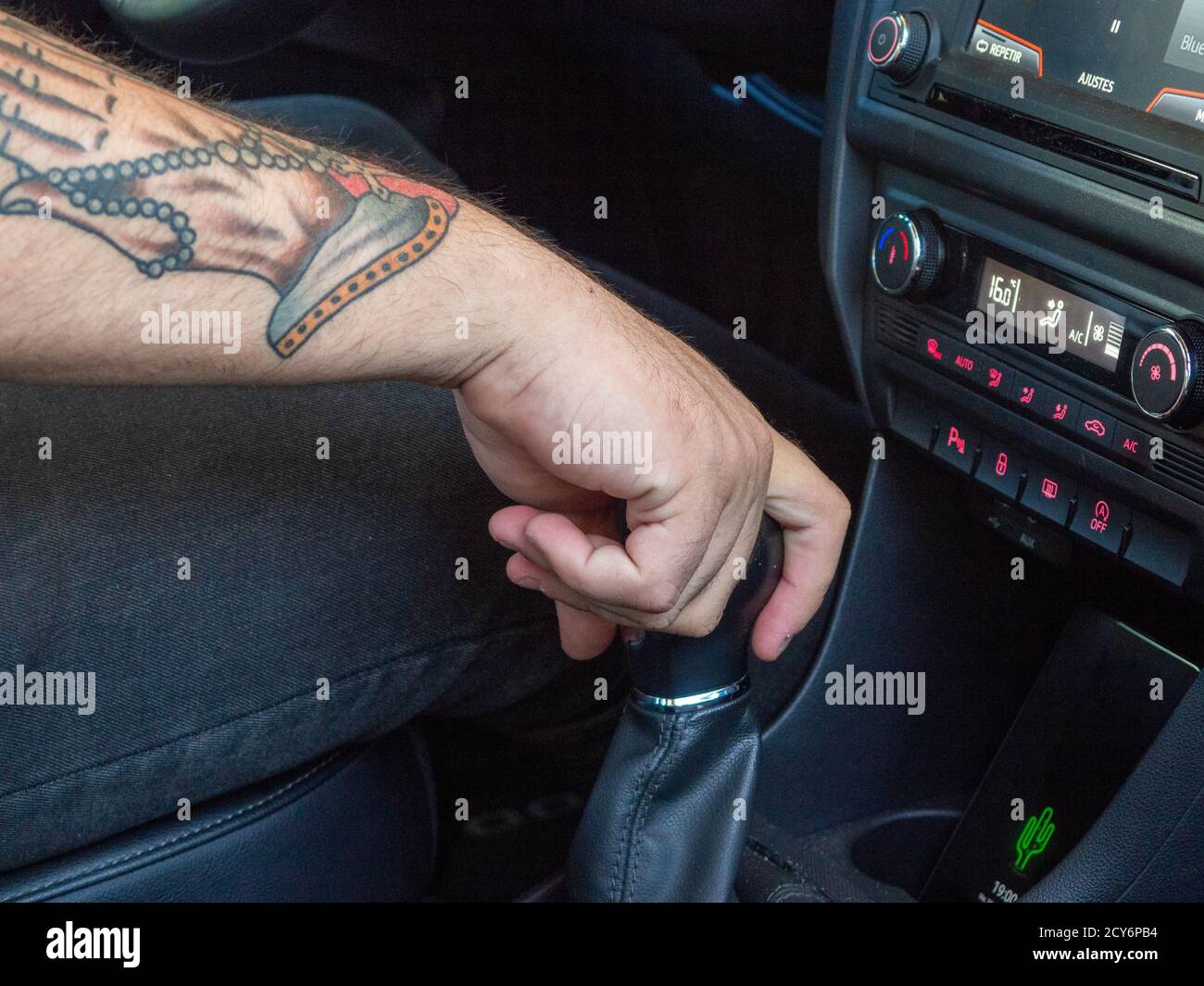
A manual transmission tattoo, most commonly depicted as a gear shift H-pattern, is a permanent tribute to the tactile art of driving. It symbolizes a preference for mechanical control, driver engagement, and the "purist" automotive philosophy. For many, it serves as a badge of honor within the "Save the Manuals" subculture, representing a deep-seated connection between the driver and the machine.
In the automotive landscape of 2026, where autonomous systems and electric drivetrains have become the industry standard, the manual transmission has transitioned from a utilitarian component to a cherished relic. Getting a manual transmission tattoo is no longer just about showing a love for cars; it is an act of preservation. It commemorates a specific era of internal combustion and human-centric engineering. Whether you are a lifelong gearhead or a professional driver, choosing this design requires a balance of artistic style and mechanical accuracy.
The Symbolism of "Rowing Your Own Gears"
The primary appeal of a manual transmission tattoo lies in its symbolism. Unlike an automatic transmission, which handles the complexities of torque and gear ratios behind the scenes, a manual gearbox requires the driver to be an active participant in the vehicle's operation. This "connection" is what enthusiasts seek to immortalize.
Control and Autonomy
The shift pattern represents the ability to control one's path. In a metaphorical sense, it suggests that the wearer is "in the driver's seat" of their own life. The physical act of shifting gears—depressing the clutch, finding the gate, and revving the engine—is a sequence that requires timing and finesse. A tattoo of this process speaks to a person’s appreciation for skill and manual labor.
The "Save the Manuals" Movement
By 2026, the "Save the Manuals" campaign has moved from a niche enthusiast slogan to a historical preservation movement. With most manufacturers having phased out three-pedal setups in favor of dual-clutch transmissions (DCTs) or single-speed EV gearboxes, the H-pattern has become a symbol of defiance. It is a visual protest against the sanitization of the driving experience.
Nostalgia and Heritage
For many, the tattoo is a tribute to a first car or a father-son/mother-daughter bonding experience. Learning to drive a stick shift is often seen as a rite of passage. The tattoo captures that specific moment in time, linking the wearer to a lineage of drivers who value the mechanical soul of an automobile over modern convenience.
Choosing the Correct Shift Pattern
The most critical technical aspect of a manual transmission tattoo is the shift pattern itself. Not all manual gearboxes are created equal, and getting the wrong pattern can be a source of constant "correction" from other enthusiasts. It is essential to choose a pattern that reflects either a specific car you love or a layout that is historically significant.
The Standard 5-Speed Pattern
This is the most recognizable design. Usually, it features gears 1 through 5 in a standard H-layout, with "Reverse" (R) typically located to the far right and down, or far left and up. The simplicity of the 5-speed pattern makes it ideal for minimalist tattoos or small placements like the wrist.
The Modern 6-Speed Pattern
As engines became more powerful and fuel efficiency standards tightened, the 6-speed manual became the enthusiast standard. In these designs, the 6th gear is usually located below the 5th. The position of "Reverse" is the most debated element here; on a BMW, it is often to the left of 1st, while on a Subaru or many domestic US trucks, it may be to the right of 6th.
The "Dog-Leg" Gearbox
For those who want to show deep technical knowledge, the "dog-leg" pattern is a popular choice. Found in classic racing cars and certain vintage European models (like the BMW E30 M3 or Mercedes-Benz 190E 2.3-16), the dog-leg layout puts 1st gear down and to the left. This allows gears 2 and 3, and 4 and 5, to be aligned vertically for faster shifting on a track. A dog-leg tattoo immediately identifies the wearer as a connoisseur of racing history.
The Three-on-the-Tree and Heavy Machinery
While rare, some enthusiasts opt for column-shift diagrams ("three-on-the-tree") or complex 18-speed Eaton Fuller patterns found in heavy-duty semi-trucks. These designs are highly intricate and usually require a larger "canvas," such as the forearm or calf, to maintain legibility.
Technical Comparison of Common Shift Patterns
When planning your tattoo, use the following table to verify the layout that matches your vehicle or preference.
| Gearbox Type | Common Placement of Reverse (R) | Notable Example Vehicles | Aesthetic Complexity |
|---|---|---|---|
| Standard 5-Speed | Right-Down or Left-Up | Mazda Miata (NA/NB), Honda Civic | Low / Minimalist |
| Standard 6-Speed | Far Left-Up or Far Right-Down | VW Golf GTI, Ford Mustang, BMW M3 | Medium |
| Dog-Leg 5-Speed | Left-Up (1st is Left-Down) | Porsche 928, BMW E30 M3 | High (Enthusiast-tier) |
| Old-School 3-Speed | Column Dependent | 1960s Chevy C10, Ford F-100 | Medium / Vintage |
| Heavy Duty 10+ Speed | Multi-gate / Range Select | Peterbilt, Kenworth Tractors | Very High / Technical |
Design Styles and Artistic Interpretations
A manual transmission tattoo does not have to be a literal diagram. Depending on your personal style, the design can range from a tiny hidden symbol to a full-sleeve mechanical masterpiece.
Minimalist Line Work
The most popular approach is the simple "H-pattern." Using clean, fine lines and sans-serif typography for the numbers, this style works perfectly on the wrist, finger, or behind the ear. It is subtle and acts as a "secret handshake" for those who recognize the diagram.
Realistic Mechanical Art
For a more aggressive look, some choose to depict the actual gear lever, the leather boot, and the shift knob. This can be done in a photorealistic style, capturing the texture of the polished metal or the stitching on the leather. Adding "motion lines" can give the impression of the shifter being slammed into gear.
Bio-mechanical and "Torn Skin"
A staple of tattoo culture, the bio-mechanical style depicts the gears and linkages of the transmission as if they are part of the wearer’s anatomy. Imagine the skin "tearing away" on the forearm to reveal the internal synchros, cogs, and shift forks of a transmission. This signifies that the love for driving is "in your DNA."
American Traditional
Traditional tattoos use bold black outlines and a limited color palette (usually red, yellow, and green). A shift knob can be incorporated into a larger piece featuring roses, eagles, or pistons. This style ages very well and maintains its legibility over decades.
Sketch or Blueprint Style
Blueprint tattoos look like technical drawings from an engineering manual. They often include measurement lines, annotations, and a "grid" background. This is a favorite for automotive engineers or those who appreciate the math behind the machine.
Ideal Anatomical Placement
Where you place your tattoo is just as important as the design itself. For a manual transmission tattoo, the placement often mimics the physical interaction between the driver and the car.
The Shifting Hand (Wrist or Palm)
In countries with Left-Hand Drive (LHD) vehicles, like the United States, the right hand is the "shifting hand." In the UK, Japan, or Australia (RHD), it is the left. Many enthusiasts choose to get the H-pattern on the inner wrist or the "webbing" between the thumb and index finger of their shifting hand.
Note: Palm tattoos are notorious for fading quickly due to the constant friction and skin regeneration in that area. If you want a long-lasting piece, the inner forearm or the top of the hand is a safer bet.
The Forearm
The forearm offers a flat, wide surface that is perfect for more detailed designs, such as a full shifter assembly or a bio-mechanical piece. It is also easily visible when your arm is resting on the center console or window sill while driving.
The Leg (Calf or Shin)
If you want to include the "three-pedal" setup (Clutch, Brake, Gas), the leg is the most logical choice. A common design features the three pedals on the shin or calf, often with the word "STAY" on the left foot (clutch) and "DRIVE" on the right.
Technical Considerations for the Tattoo Artist
Because a shift pattern is a geometric design, it requires precision. Even a slight misalignment in the "H" can make the tattoo look amateurish. When consulting with an artist, keep these technical points in mind:
- Line Weight: If the lines are too thin, they may disappear as the tattoo ages. If they are too thick, the "gates" of the H-pattern may blur together (a process known as "blowout").
- Typography: Ensure the numbers (1, 2, 3, 4, 5, 6, R) are in a legible, classic font. Avoid overly scripted fonts that might make the numbers hard to distinguish.
- Symmetry: The H-pattern relies on perfect right angles and parallel lines. Experienced artists will use a stencil to ensure the geometry is flawless.
- Reverse Position: Double-check your specific car’s reverse position. For example, a Volkswagen owner might have "Reverse" to the left of 1st, while a Honda owner would have it to the right of 6th. Getting this "wrong" on your skin is a common mistake that is difficult to fix.
The Future of the Manual Transmission Tattoo in 2026
As we move deeper into the 2020s, the manual transmission is becoming a rare luxury or a dedicated track-day feature. In 2026, many major manufacturers have entirely ceased production of manual gearboxes for their base models. This scarcity has increased the "cool factor" of the manual tattoo.
It has become a symbol of a "lost art." Much like a tattoo of a vinyl record or a film camera, the manual transmission tattoo signals that the wearer values the process as much as the result. It is about the "how" of getting from point A to point B, not just the "where."
For younger enthusiasts who may have grown up in an era of EVs, getting this tattoo is often a way to connect with automotive history. It represents a desire for a visceral, analog experience in an increasingly digital world.
Frequently Asked Questions
Is the manual transmission tattoo considered "cringe" in the car community?
In most circles, it is respected as a sign of dedication to driving. However, like any niche tattoo, it can be seen as "gatekeeping" if the wearer uses it to look down on those who drive automatics. As long as it represents your personal passion, it is widely accepted as a classic automotive design.
Should I get my specific car's shift pattern or a generic one?
If you have a "forever car"—one that you have owned for years or a dream car you finally acquired—using its specific pattern adds a layer of personal history. If you simply love manual driving in general, a standard 5-speed or 6-speed H-pattern is the most timeless choice.
Does the "Reverse" gear always go in the same place?
No. This is the most common error. Manufacturers vary widely on "Reverse" placement. BMW and VAG (Volkswagen Audi Group) typically place it to the left of 1st gear. Many Japanese and American manufacturers place it to the right of the highest gear. Always verify your specific vehicle's layout before getting inked.
How much does a manual transmission tattoo typically cost?
For a small, minimalist H-pattern on the wrist, you can expect to pay a shop minimum, which in 2026 usually ranges from $100 to $180. For a larger, more detailed mechanical sleeve, costs can range from $500 to several thousand dollars depending on the artist's hourly rate and the complexity of the design.
What is the most painful spot for this tattoo?
If you are getting a small pattern on your wrist, the pain is moderate. However, if you choose the "shifting hand" palm or the top of the foot (to represent the pedals), these are considered high-pain areas due to the thin skin and high concentration of nerve endings.
Final Recommendation: Verification Before Inking
Before you sit in the tattoo chair, perform a "dry run" of your design. Print out the exact shift pattern you want and hold it up to your car's actual gear shifter. Verify that the numbers are in the correct gates and that the "R" is positioned accurately for your specific make and model. If you are going for a "Save the Manuals" text-based design, ensure the font matches the era of the cars you love (e.g., a 90s-style block font for JDM fans or a classic serif for European enthusiasts).
A manual transmission tattoo is more than just ink; it is a permanent connection to the mechanical world. By prioritizing technical accuracy and choosing a style that resonates with your personal driving history, you can ensure your tattoo remains a source of pride long after the last manual gearbox rolls off the production line.