Navigating the aftermath of a hit and run accident can feel isolating, overwhelming, and legally complex. When an at-fault driver flees the scene, victims face not only physical and emotional trauma but also significant financial hurdles. Hiring an attorney for a hit and run accident provides the critical legal leverage needed to investigate the crash, identify the fleeing driver, coordinate with law enforcement, and pursue maximum compensation through your own insurance policy or civil litigation.
Understanding Hit and Run Accidents and Legal Realities
A hit and run occurs when a driver involved in a traffic collision departs the scene without stopping to exchange identification, render aid, or report the incident to law enforcement. Legally, leaving the scene of an accident is classified as a serious criminal offense—often a misdemeanor or a felony depending on whether property damage, injury, or death occurred.
However, the criminal justice system focuses primarily on penalizing the offender, not compensating the victim. While a criminal prosecution may eventually yield restitution orders, criminal courts move slowly, and offenders frequently lack the liquid assets to pay court-ordered amounts. This structural gap makes hiring a civil attorney essential. A civil attorney pivots the focus away from state punishment and directs it squarely toward financial recovery for medical bills, lost wages, and property damage.
Victims often mistakenly believe that if the police cannot find the fleeing driver, compensation is impossible. In reality, experienced personal injury lawyers know how to tap into alternative coverage avenues, such as Uninsured Motorist (UM) bodily injury coverage, Personal Injury Protection (PIP), or medical payments (MedPay) provisions within the victim's own auto insurance policy. Navigating these policies requires strict adherence to notification deadlines and policy language—mistakes that can easily jeopardize a legitimate claim without qualified legal representation.
The Core Responsibilities of a Hit and Run Attorney
When you retain legal counsel following a hit and run crash, your attorney immediately steps in to shoulder the investigative and administrative burdens. Rather than leaving you to manage insurance adjusters while recovering from injuries, an attorney executes a multi-pronged strategy designed to protect your legal rights and maximize your recovery.
Independent Investigation and Evidence Preservation
Police departments are often overburdened, meaning they may lack the resources to conduct an exhaustive search for a fleeing motorist unless severe injuries or fatalities occurred. An attorney can hire private investigators, accident reconstructionists, and canvas the surrounding area for crucial evidence before it disappears. This includes securing:
- Surveillance Footage: Locating and preserving video from nearby residential doorbells, traffic cameras, and commercial security systems.
- Witness Testimony: Interviewing bystanders, pedestrians, and nearby motorists who may have noted a partial license plate or vehicle description.
- Physical Debris: Analyzing paint chips, broken glass, or vehicle fragments left at the scene to identify the make, model, and year of the suspect vehicle.
Managing Insurance Communications and Bad Faith Tactics
Dealing with your own insurance company after a hit and run can quickly become adversarial. Even though you pay premiums for Uninsured Motorist coverage, insurers frequently attempt to minimize payouts or deny claims. An attorney acts as a protective shield, handling all communications, submitting formal documentation, and preventing adjusters from using recorded statements against you. If an insurance carrier engages in unreasonable delay or wrongful denial, your attorney can hold them accountable for bad faith practices.
Comparative Recovery Pathways: Finding the At-Fault Driver vs. Uninsured Motorist Claims
The legal strategy deployed by your attorney depends heavily on whether law enforcement or private investigators successfully locate the fleeing driver. The two distinct scenarios involve different procedures, timelines, and sources of compensation.
| Recovery Factor | If the Driver is Identified and Located | If the Driver Remains Unidentified (Phantom Driver) |
|---|---|---|
| Primary Source of Recovery | At-fault driver’s auto liability insurance policy | Your own Uninsured Motorist (UM) coverage |
| Legal Cause of Action | Personal injury lawsuit for negligence | Breach of contract / insurance claim dispute |
| Potential for Punitive Damages | High (fleeing the scene demonstrates gross negligence) | Generally unavailable unless specific state criteria are met |
| Burden of Proof | Preponderance of the evidence showing negligence | Proof of physical contact (in many states) and fault of the phantom driver |
| Statutes and Deadlines | Standard state personal injury statute of limitations | Strict policy notification deadlines (often within 30 days) |
As outlined above, tracking down the motorist opens up options for maximum compensation, including liability policies and potential punitive damages. Conversely, relying on Uninsured Motorist coverage requires strict adherence to contractual terms, making professional legal guidance indispensable.
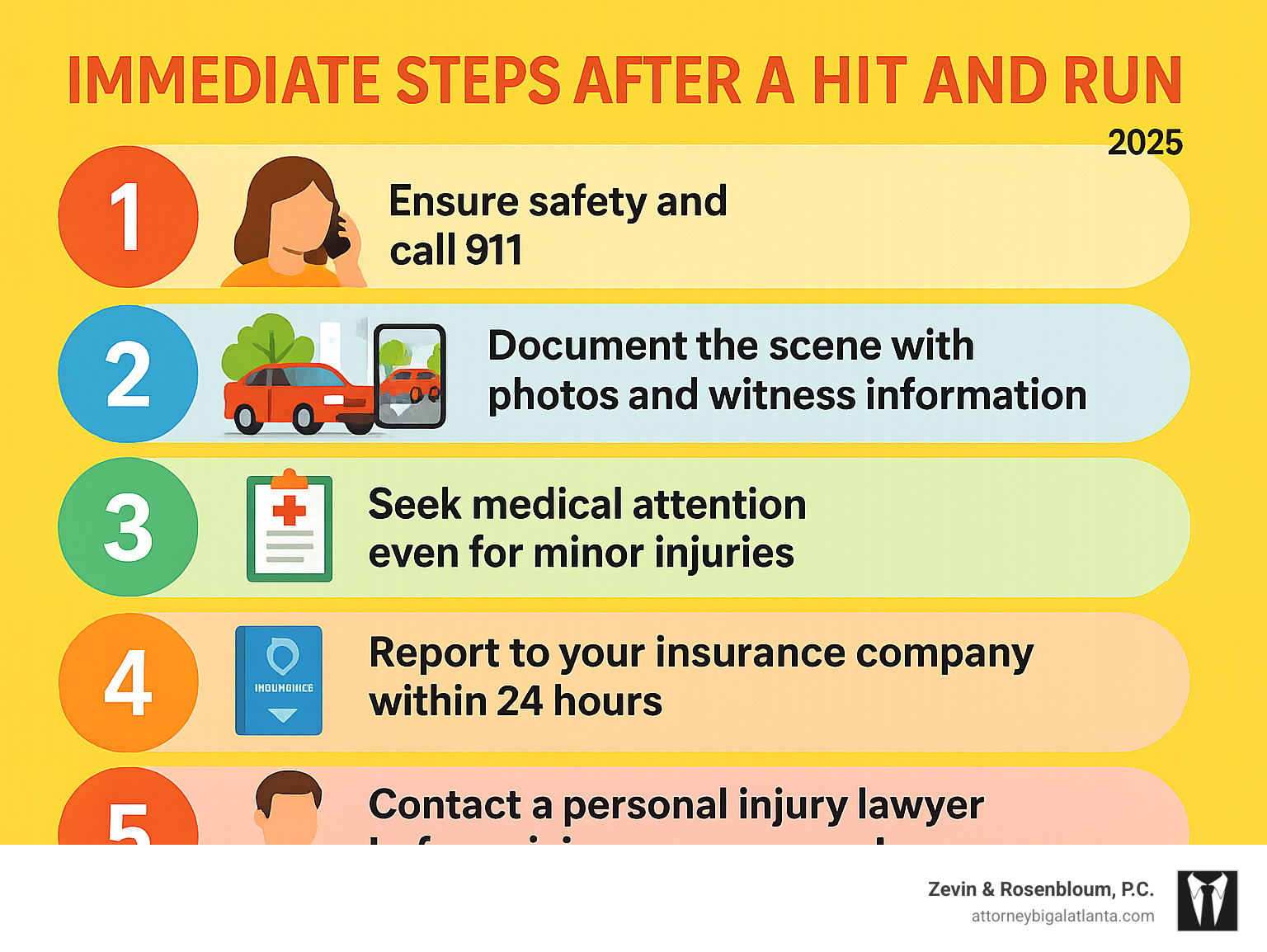
Steps to Take Immediately Following a Hit and Run
The actions you take in the minutes, hours, and days following a hit and run significantly impact the success of your legal claim. While your immediate priority must always be health and safety, preserving evidence early strengthens your attorney’s hand.
- Ensure Safety and Call 911: Move to a safe location if possible and report the collision immediately. Request both police and medical assistance. An official police report is a foundational document for any insurance claim or legal action.
- Gather and Record Details: While memory is fresh, write down or record every detail you can recall about the fleeing vehicle. Note the make, model, color, body style, partial or full license plate numbers, direction of travel, and any distinct physical characteristics or bumper stickers.
- Document the Scene: Use your smartphone to photograph vehicle damage, skid marks, debris fields, traffic lights, and your injuries. If there are witnesses, politely ask for their contact information before they leave.
- Seek Immediate Medical Attention: Visit an emergency room, urgent care clinic, or your primary physician immediately, even if you feel fine. Adrenaline often masks severe internal injuries or whiplash. Delaying medical care gives insurance adjusters ammunition to argue your injuries were unrelated to the crash.
- Consult a Qualified Attorney: Contact a personal injury lawyer before giving detailed statements to any insurance adjuster. Most hit and run attorneys offer free initial consultations and work on a contingency fee basis, meaning you pay nothing upfront.
Frequently Asked Questions
What if I did not get the license plate number of the fleeing car?
You can still recover compensation. Most auto insurance policies include Uninsured Motorist (UM) coverage, which is specifically designed to protect drivers injured by hit and run motorists. Your attorney will review your policy to determine your available coverage limits and help you file a formal claim with your insurer.
Will my insurance rates go up if I file a hit and run claim?
Under the laws of many states, insurers are prohibited from raising your premium or penalizing you for filing a claim where you were clearly not at fault, such as a hit and run accident. However, policies and state regulations vary, which is why reviewing your specific agreement with an attorney is vital.
Is there a time limit for filing a hit and run lawsuit?
Yes. Every state enforces a statute of limitations that strictly limits the timeframe for filing a personal injury lawsuit—typically ranging from one to three years from the date of the accident. Furthermore, your insurance policy likely imposes much shorter deadlines (often days or weeks) for formally notifying your insurer of a hit and run event.
What if the police cannot find the other driver?
If law enforcement closes the investigation without identifying the suspect, your legal case shifts toward maximizing your Uninsured Motorist claim. Your attorney will compile medical records, expert economic loss assessments, and accident reconstruction reports to prove the extent of your damages directly to your insurance provider.
How much does a hit and run attorney cost?
Reputable personal injury attorneys operate on a contingency fee arrangement. This means you do not pay any hourly rates or upfront retainers. Instead, the attorney’s fee is an agreed-upon percentage of the final settlement or court award recovered on your behalf. If no recovery is secured, you owe no attorney fees.
Next Steps and Professional Guidance
Navigating the aftermath of a hit and run accident requires prompt action, meticulous evidence preservation, and a clear understanding of insurance mechanics. Do not let a fleeing motorist or an uncooperative insurance company deny you the financial recovery you deserve. Schedule a free, confidential consultation with a qualified personal injury attorney to evaluate your policy coverage, protect your legal rights, and chart a clear path toward full recovery.