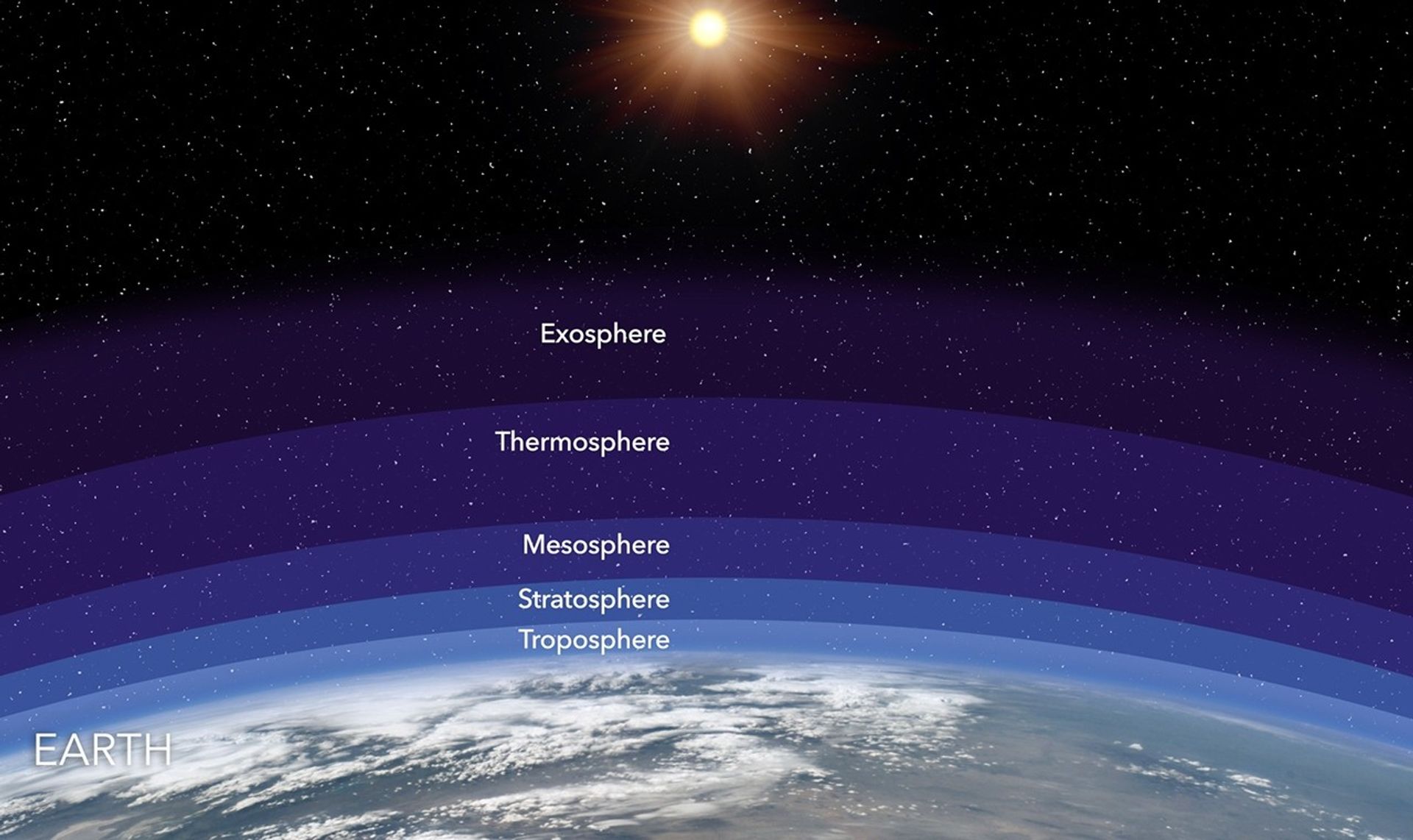
The distance of Earth's atmosphere extends approximately 10,000 kilometers (6,214 miles) from the planet's surface before finally merging with the solar wind. However, the most significant portion of atmospheric mass is concentrated within the first 16 kilometers, and the internationally recognized boundary of space, the Kármán line, is located at just 100 kilometers (62 miles).
Determining a singular "atmosphere distance" is a complex task because Earth’s gaseous envelope does not have a hard physical edge. Instead, it gradually thins out as altitude increases, with gas molecules becoming increasingly sparse until the vacuum of space takes over. As of 2026, scientific consensus categorizes the atmosphere into five primary layers, each defined by unique chemical compositions, temperature gradients, and physical behaviors. Understanding these distances is crucial for satellite deployment, aviation safety, and global communications.
The Gradient of Gas: Why the Atmosphere Lacks a Sharp Edge
To understand atmosphere distance, one must first understand the relationship between gravity and gas pressure. Earth's gravity pulls gas molecules toward the center of the planet. At sea level, the weight of the air above creates a pressure of approximately 101.3 kilopascals. As you move away from the surface, there is less air pressing down from above, which means the pressure drops and the air becomes "thinner."
Because gases are compressible, the atmosphere is most dense at the bottom. Roughly 75% of the atmosphere’s mass is contained within the troposphere, the layer closest to the ground. By the time you reach an altitude of 30 kilometers, you have already passed 99% of the atmosphere's total mass. However, the remaining 1% of gas molecules extends for thousands of kilometers into the exosphere. This creates a "fuzzy" boundary that makes defining the exact distance of the atmosphere a matter of scientific convention rather than a simple physical measurement.
The Primary Layers of Atmospheric Distance
Scientists divide the atmosphere into distinct regions based on temperature changes. These layers provide a roadmap for understanding how far the atmosphere stretches and how it behaves at different heights.
1. The Troposphere (0 to 12–18 km)
The troposphere is the layer where we live and breathe. Its distance varies depending on latitude and season; it is thicker at the equator (up to 18 km) and thinner at the poles (about 8 km). This is the region where nearly all weather phenomena occur. Temperature decreases with altitude in this layer, which is why mountain peaks are often covered in snow even in summer.
2. The Stratosphere (12–18 km to 50 km)
Above the troposphere lies the stratosphere. This layer is home to the ozone layer, which absorbs and scatters solar ultraviolet radiation. Unlike the troposphere, temperatures in the stratosphere actually increase with altitude because the ozone molecules are capturing energy from the sun. This temperature inversion makes the stratosphere very stable, which is why commercial pilots prefer to fly in the lower stratosphere to avoid the turbulence of the troposphere.
3. The Mesosphere (50 km to 85 km)
The mesosphere is the coldest part of Earth's atmosphere, with temperatures dropping as low as -90°C (-130°F). It is in this layer that most meteors burn up upon entry, as the air—though thin—is dense enough to create significant friction against fast-moving space debris. The distance of the mesosphere marks the transition into the "near-space" environment.
4. The Thermosphere (85 km to 600 km)
The thermosphere is a region of extreme temperature swings. High-energy X-rays and UV radiation from the sun are absorbed here, raising temperatures to as high as 2,500°C (4,500°F). However, because the air is so incredibly thin, an individual would not feel "hot" in the traditional sense; there are simply too few molecules to transfer heat to a surface. The International Space Station (ISS) orbits within this layer, typically at an altitude of approximately 400 kilometers.
5. The Exosphere (600 km to 10,000 km)
The exosphere is the outermost fringe of Earth's atmosphere. At this distance, the atmosphere is composed mainly of extremely low densities of hydrogen and helium. Molecules here are so far apart that they can travel hundreds of kilometers without colliding with one another. Some of these molecules eventually reach "escape velocity" and bleed off into deep space.
Defining the Boundary: The Kármán Line vs. The Geocorona
While the exosphere extends to 10,000 kilometers, the term "atmosphere distance" is often used to refer to the functional boundary of space. There are two primary ways researchers define where the atmosphere "ends."
The Kármán Line (100 km)
The Fédération Aéronautique Internationale (FAI), the world governing body for air sports and astronautical records, recognizes the Kármán line at 100 kilometers (62 miles) as the official start of space. This distance was proposed by physicist Theodore von Kármán. He calculated that at this altitude, the air becomes so thin that an aircraft would have to fly faster than orbital velocity to derive enough aerodynamic lift from the atmosphere to support itself. Essentially, above 100 km, you are no longer "flying" in the traditional sense; you are "orbiting."
The Geocorona (Up to 630,000 km)
Recent studies, including data from the SOHO observatory, have revealed that Earth’s atmosphere might actually stretch much further than previously thought. The "geocorona" is a cloud of hydrogen atoms that represents the very tail-end of the atmosphere. Observations have shown that this cloud extends as far as 630,000 kilometers away—well past the orbit of the Moon. While this is technically part of Earth's gaseous envelope, the density is so low that it is virtually indistinguishable from the vacuum of interplanetary space.
Comparison of Atmospheric Boundaries and Features
The following table summarizes the distances and key characteristics of the atmosphere as understood in 2026.
| Layer/Boundary | Altitude Range (km) | Key Characteristic | Notable Entities/Events |
|---|---|---|---|
| Troposphere | 0 – 15 | 75% of atmospheric mass | Weather, commercial aviation |
| Stratosphere | 15 – 50 | Ozone layer | Supersonic flight, weather balloons |
| Mesosphere | 50 – 85 | Coldest temperatures | Meteor ablation (shooting stars) |
| Kármán Line | 100 | Official space boundary | Astronaut status threshold |
| Thermosphere | 85 – 600 | High-energy absorption | ISS, Auroras, Starlink satellites |
| Exosphere | 600 – 10,000 | Planetary escape zone | Low Earth Orbit (LEO) satellites |
| Geocorona | Up to 630,000 | Hydrogen envelope | Extends past the Moon |
Factors Affecting Atmospheric Distance and Thickness
Atmospheric distance is not a static measurement. Several physical and solar factors cause the atmosphere to expand and contract over time.
Solar Activity and Thermal Expansion
The sun goes through an 11-year solar cycle. During periods of high solar activity (solar maximum), the thermosphere absorbs more radiation and heats up significantly. This heat causes the air to expand, pushing the "distance" of the atmosphere further out into space. For satellite operators in 2026, this is a critical concern, as an expanded atmosphere increases drag on satellites in Low Earth Orbit (LEO), causing them to lose altitude and eventually burn up if not boosted.
Diurnal and Seasonal Cycles
The atmosphere is thicker on the day-side of the planet than the night-side because the sun's heat causes the air to swell. Similarly, seasonal changes affect the height of the troposphere. In summer, the warmer air expands, raising the height of the tropopause (the boundary between the troposphere and stratosphere).
Gravitational Variations
Earth is not a perfect sphere; it is an oblate spheroid, bulging at the equator. Consequently, gravity is slightly weaker at the equator than at the poles. This weaker gravitational pull, combined with centrifugal force from the planet's rotation, allows the atmosphere to reach a greater distance at the equator.
Technical Implications of Atmospheric Distance
The distance of the atmosphere dictates how we interact with space and maintain global infrastructure.
Orbital Decay and Satellite Lifespan
Any satellite orbiting within the thermosphere or lower exosphere (below 1,000 km) is technically flying through the very edges of the atmosphere. Even though the air is incredibly thin, the cumulative effect of hitting gas molecules at speeds of 28,000 km/h creates drag. Over years or decades, this drag reduces the satellite's velocity, causing its orbit to decay. Precise mapping of atmospheric distance is required to calculate how much fuel a satellite needs to maintain its position.
Radio and Satellite Communications
The ionosphere, which overlaps with the mesosphere, thermosphere, and exosphere, contains a high concentration of ions and free electrons. This region is critical for radio communication. Depending on the density of the atmosphere at specific distances, radio waves may be reflected back to Earth (allowing long-distance "shortwave" communication) or pass through to reach satellites. Solar storms can change the "distance" and density of the ionosphere, leading to GPS errors or communication blackouts.
Measuring Atmosphere Distance in 2026
In 2026, scientists use a variety of sophisticated tools to monitor atmospheric distance and density in real-time.
- LIDAR (Light Detection and Ranging): Ground-based lasers shoot pulses of light into the sky. By measuring the light that bounces back from molecules and aerosols, researchers can calculate the density and height of different layers.
- Satellite Drag Analysis: By observing the precise orbital changes of satellites like the GRACE-FO, scientists can infer the density of the atmosphere at specific altitudes.
- Radio Occultation: This involves measuring how GPS signals from one satellite are bent as they pass through the atmosphere to reach another satellite. The amount of bending provides a profile of atmospheric pressure and temperature across various distances.
Common Misconceptions About Atmosphere Distance
Misconception 1: Space is an Empty Vacuum
Many believe that once you pass the 100 km Kármán line, there is "nothing." In reality, the atmosphere continues for thousands of kilometers. Space is never truly empty; it is filled with low-density plasma, gas, and dust. The Kármán line is an arbitrary human definition based on aerodynamics, not a physical wall where air stops existing.
Misconception 2: Gravity Ends Where the Atmosphere Ends
Gravity and atmosphere are often conflated. However, Earth's gravity extends millions of kilometers into space. The Moon is held in orbit by Earth's gravity, yet it is nearly 400,000 kilometers away—well beyond the dense parts of the atmosphere. An astronaut at 400 km altitude is still subject to about 90% of Earth's surface gravity; they only feel weightless because they are in a state of constant freefall (orbit).
Frequently Asked Questions
At what distance does the atmosphere become unbreathable?
For most humans, the "Death Zone" begins at approximately 8,000 meters (26,000 feet) above sea level. While the atmosphere technically contains 21% oxygen at this height, the pressure is so low that the human lungs cannot effectively absorb enough oxygen to sustain life for long periods. This is well within the troposphere.
Why is the 100 km distance used for space tourism?
Companies like Blue Origin and Virgin Galactic aim for altitudes around 80 km to 100 km. The 100 km (Kármán line) is a psychological and legal milestone. Crossing this distance allows participants to be officially recognized as "astronauts" by international aviation bodies, despite the fact that Earth's atmospheric influence extends much further.
Does the atmosphere's distance change due to climate change?
Yes. Increased CO2 levels cause the troposphere to warm and expand, but they actually cause the upper atmosphere (mesosphere and thermosphere) to cool and contract. This contraction reduces drag on space junk, which ironically makes the problem of orbital debris worse because old satellites and fragments stay in orbit longer instead of burning up.
Is there air on the Moon?
The Moon has an extremely thin "exosphere" containing traces of helium, neon, and hydrogen, but it is not a breathable atmosphere. In terms of distance, the Earth's geocorona (the outermost hydrogen layer) actually overlaps with the Moon, meaning the Moon technically orbits within the most distant fringe of Earth's atmosphere.
Summary and Next Actions
The distance of Earth's atmosphere is a variable measurement that depends on whether you are looking for biological viability (8 km), aerodynamic lift (100 km), or the final presence of planetary gas (10,000 km+). For practical purposes, the 100 km Kármán line remains the most important threshold for defining where "Earth" ends and "Space" begins.
If you are interested in tracking the current "thickness" or distance of the atmosphere—especially if you are involved in amateur radio or satellite tracking—it is recommended to monitor Space Weather Prediction Center (SWPC) reports. These provide daily updates on solar flux and geomagnetic activity, which are the primary drivers of atmospheric expansion and contraction in our current 2026 solar cycle.