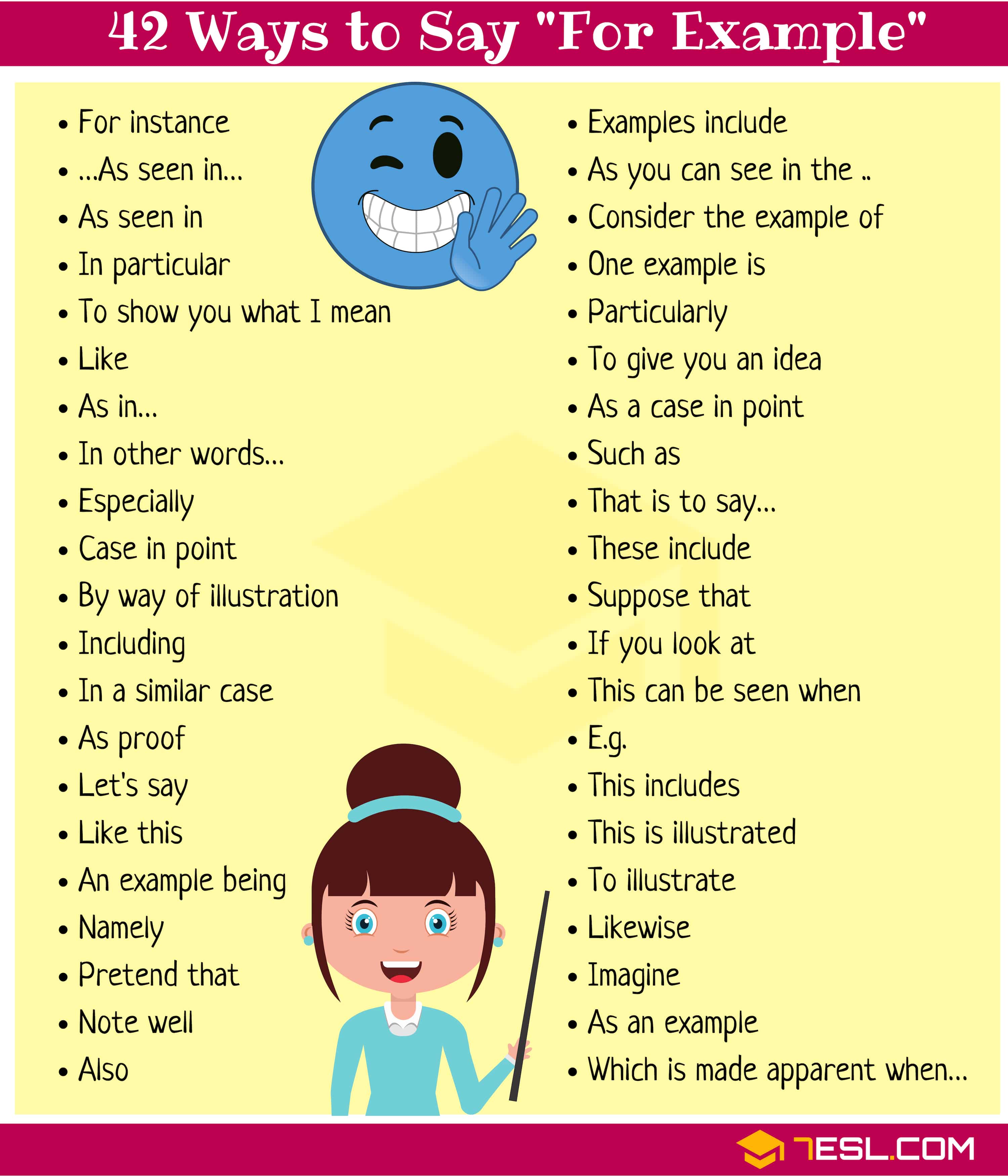
In an essay, you can replace "for example" with synonyms like for instance, to illustrate, specifically, or notably. Choosing the right alternative depends on whether you are introducing a brief list, a detailed case study, or a specific piece of evidence to support a broader claim.
The ability to vary your transitional phrases is a hallmark of sophisticated academic writing. While "for example" is a perfectly acceptable and grammatically correct phrase, its overreliance can lead to a repetitive, "staccato" rhythm that bores the reader and diminishes the perceived complexity of your argument. As we navigate the academic standards of 2026, the emphasis on fluid, cohesive prose has never been higher. Transitioning effectively between a general claim and specific evidence requires a diverse toolkit of vocabulary that signals to the reader exactly how the upcoming information relates to the previous statement.
The Strategic Importance of Transitional Variety
Transitional phrases act as the "signposts" of an essay. They tell the reader where they are and where they are going. If every signpost on a highway looked identical, the driver might stop paying attention to the specific information they provide. Similarly, if every piece of evidence in an essay is preceded by "for example," the reader begins to skim, missing the nuance of your supporting data.
In high-level academic discourse, the goal is to demonstrate a "lexical range"—the ability to use a wide variety of vocabulary accurately and appropriately. This is not about using "big words" for the sake of it; it is about choosing the most precise tool for the job. Some synonyms for "for example" imply a visual representation, while others suggest a logical narrowing of scope or a direct citation of evidence. By selecting the correct phrase, you provide a subtle hint about the nature of the evidence that follows, making your argument more persuasive and easier to follow.
Furthermore, the placement of these transitions affects the "flow" or "cadence" of your writing. Some phrases, like "for instance," work well at the beginning of a sentence. Others, like "such as," are better suited for the middle of a sentence to link a category to its members. Mastery of these variations allows you to control the speed and focus of your reader's attention.
Direct and Interchangeable Synonyms
When you simply need to swap out "for example" to avoid repetition, several direct synonyms function in nearly identical ways. These are the most versatile tools in your writing kit.
For Instance
"For instance" is the most common and direct alternative to "for example." In most academic contexts, the two are entirely interchangeable. However, some stylists suggest that "for instance" is slightly better suited for specific, singular cases, whereas "for example" is better for general illustrations.
- Example: "Many renewable energy sources have become cost-competitive. For instance, the price of solar photovoltaic modules has dropped by over 80% in the last decade."
To Illustrate
This phrase is slightly more formal and suggests a more detailed explanation is coming. It implies that the upcoming example will provide a "picture" or a clear model of the concept just discussed. It is particularly useful when moving from an abstract theory to a concrete application.
- Example: "The law of diminishing returns affects every stage of production. To illustrate, adding more workers to a single machine will eventually lead to lower per-worker productivity due to overcrowding."
As an Illustration
Similar to "to illustrate," this phrase functions as a noun-based transition. It is often used to introduce a longer anecdote or a complex data set that serves as a primary piece of evidence for a paragraph.
- Example: "As an illustration of this phenomenon, consider the 2023 economic shift in emerging markets, where digital infrastructure outperformed traditional manufacturing."
Narrowing the Scope: Precision Transitions
Sometimes, you aren't just giving an example; you are focusing the reader's attention on a specific subset of your topic. In these cases, using a phrase that implies "narrowing" is more effective than a generic "for example."
Specifically
Use "specifically" when you want to move from a broad category to a precise detail. This word signals that you are about to provide the exact data point or name that proves your point.
- Example: "The policy had several unintended consequences. Specifically, it reduced the amount of funding available for primary education in rural districts."
In Particular / Particularly
These phrases are used to highlight one example that is more important or representative than others. It tells the reader, "Of all the examples I could give, this one is the most relevant."
- Example: "The Mediterranean diet is linked to various health benefits, particularly a reduced risk of cardiovascular disease."
Notably
"Notably" is a powerful transition because it combines the function of an example with an evaluative judgment. It suggests that the example you are providing is significant, unusual, or especially worthy of the reader’s attention.
- Example: "Early 20th-century literature often explored the theme of urban isolation. Notably, James Joyce’s Dubliners provides a stark portrayal of paralysis within the city."
Evidence-Based and Verifiable Transitions
In scientific, legal, or highly technical essays, you often need to show that your example isn't just an anecdote, but a verified piece of evidence.
As Evidenced By
This phrase creates a strong logical link between your claim and your data. It is highly persuasive because it frames the example as "proof" rather than just an "illustration."
- Example: "The climate is changing at an accelerated rate, as evidenced by the record-breaking global temperatures recorded in 2024 and 2025."
As Demonstrated By
Use this when your example involves a process, an experiment, or a logical progression. It suggests that the example "shows" the truth of the statement through action or calculation.
- Example: "Modern encryption is highly resistant to brute-force attacks, as demonstrated by the recent failure of the 'X-Alpha' supercomputer to breach standard AES-256 protocols."
Such As
"Such as" is primarily used within a sentence to introduce a list of examples. Unlike "for example," which often starts a new sentence or follows a semicolon, "such as" connects the examples directly to the noun they modify.
- Example: "Common symptoms of the virus, such as fever, fatigue, and a persistent cough, often appear within five days of exposure."
Introducing Case Studies and Deep Dives
When your example is not a brief mention but a substantial part of your argument, you need a transition that prepares the reader for a deeper look.
A Case in Point
This is a sophisticated way to introduce a single, perfect example that embodies your entire argument. It is often used to start a new paragraph or a significant section of an essay.
- Example: "The failure of centralized planning often stems from a lack of local knowledge. A case in point is the agricultural reform program of the 1970s, which ignored regional soil variations."
Consider the Case of
This is an "imperative" transition—it asks the reader to actively think about a specific scenario. It is an engaging way to introduce evidence, making the reader feel like a participant in the logical investigation.
- Example: "Consider the case of the automotive industry, where the shift to electric vehicles has forced a complete reimagining of the global supply chain."
Comparison Table: Choosing the Right Transition
The following table summarizes the nuances of these phrases to help you select the most appropriate one for your specific context.
| Transition | Best Use Case | Tone / Register |
|---|---|---|
| For instance | Direct replacement for "for example" | Neutral / Academic |
| To illustrate | Introducing a complex or visual example | Formal |
| Specifically | Narrowing from a general category to a detail | Precise |
| Notably | Highlighting an especially important example | Evaluative |
| As evidenced by | Linking a claim directly to scientific/factual proof | Persuasive / Formal |
| Such as | Listing examples within a sentence | Neutral |
| A case in point | Introducing a definitive, detailed example | Sophisticated |
| Namely | Identifying specific items previously mentioned | Highly Precise |
Common Mistakes and Punctuation Rules
Using a variety of synonyms is only effective if they are used correctly. One of the most common mistakes in essay writing is "comma splicing" or improper punctuation around transitions.
The Semicolon vs. The Comma
When using "for example" or "for instance" to connect two independent clauses (sentences that can stand on their own), you must use a semicolon before the transition and a comma after it.
- Incorrect: "The experiment was a success, for instance, the bacteria grew at twice the expected rate."
- Correct: "The experiment was a success; for instance, the bacteria grew at twice the expected rate."
Redundancy
Avoid using "for example" and "such as" in the same breath. Phrases like "such as... for example" or "for example... etc." are redundant because both terms serve the same purpose.
- Incorrect: "There are many types of mammals, such as, for example, whales and bats."
- Correct: "There are many types of mammals, such as whales and bats."
The "e.g." vs. "i.e." Distinction
Many students use "e.g." and "i.e." interchangeably, but they have very different meanings.
- e.g. stands for exempli gratia, meaning "for example." Use this when providing a few samples from a larger group.
- i.e. stands for id est, meaning "that is" or "in other words." Use this when you are clarifying or restating a point more clearly, not giving an example.
- Pro Tip: In 2026, most academic style guides (APA, MLA) recommend using the English equivalents ("for example" or "that is") in the main text and reserving the Latin abbreviations for parenthetical citations.
Practical Recommendation for Essay Revision
When you reach the revision stage of your essay, use the "find" function (Ctrl+F or Cmd+F) to search for every instance of "for example." If you find more than two or three occurrences in a 1,500-word essay, it is time to diversify.
- Identify the function: Is the example a piece of evidence? Use "As evidenced by." Is it a clarification? Use "Specifically." Is it a major case study? Use "A case in point."
- Check the flow: Read the sentence aloud. If "for example" sounds clunky at the start of the sentence, try using "such as" in the middle of the previous sentence to combine them.
- Vary the placement: Don't start every example sentence with the transition. Try burying the transition in the middle of the sentence: "The results of the study, for instance, suggest that..."
By treating your transitions as strategic choices rather than repetitive fillers, you transform your essay from a list of facts into a cohesive, professional argument.
Frequently Asked Questions
Can I start a sentence with "Such as"?
Generally, no. "Such as" is a prepositional phrase that should follow the noun or category it is describing. Starting a sentence with "Such as" often results in a sentence fragment. If you want to start a new sentence, use "For instance" or "For example" instead.
Is "Like" acceptable in an academic essay?
"Like" is often considered too informal for high-level academic writing when used to introduce examples. "Such as" is the preferred alternative. While "like" implies a comparison (A is similar to B), "such as" indicates that the following items are members of the category mentioned.
How many examples should I provide?
The "rule of three" is a common guideline in rhetoric, suggesting that three examples provide a sense of completeness without becoming a tedious list. However, in a deep-dive essay, one well-explained "case in point" is often more valuable than five brief mentions.
Should I put a comma after "Notably" and "Specifically"?
Yes, when these words are used as introductory adverbs to start a sentence or a clause, they should be followed by a comma. This provides a brief pause that allows the reader to prepare for the specific information.
What is the most formal way to give an example?
"To illustrate" and "As evidenced by" are typically considered the most formal transitions. They are frequently found in peer-reviewed journals and legal briefs because they emphasize the logical relationship between the claim and the proof.