Amendments to the Indian Constitution are the formal changes made to the nation’s supreme law to adapt to evolving social, political, and economic needs. Under Article 368, the Parliament of India holds the power to amend the Constitution through specific legislative procedures, ranging from a simple majority to a special majority requiring state ratification, provided the "Basic Structure" of the document remains intact.
The Constitution of India is often described by jurists as a "living document." This characterization stems from its inherent ability to evolve. Unlike the United States Constitution, which is notoriously difficult to amend, or the British unwritten constitution, which can be changed by a simple act of Parliament, the Indian Constitution strikes a delicate balance between rigidity and flexibility. As of 2026, the document has undergone over 100 amendments, reflecting the dynamic nature of the world’s largest democracy.
The Legal Framework: Understanding Article 368
The primary authority for constitutional modification lies in Part XX, Article 368. This article grants Parliament the power to amend the Constitution by way of addition, variation, or repeal of any provision. However, this power is not absolute. The Supreme Court of India, through various landmark judgments, has established that Parliament cannot alter the "Basic Structure" of the Constitution—a doctrine that ensures the core values of secularism, federalism, and democracy remain protected.
The Scope of Parliamentary Power
While Article 368 provides the mechanism, the procedure varies depending on the significance of the provision being changed. The framers of the Constitution realized that while some administrative details might need frequent updates, the fundamental rights and the federal structure required a more rigorous protection. This led to a three-tier system of amendment.
Classification of Amendment Procedures
The Indian Constitution provides three distinct pathways for amendment, ensuring that while the document remains stable, it does not become an obstacle to progress.
1. Amendment by Simple Majority
Certain provisions of the Constitution can be amended by a simple majority of the members of each House present and voting, similar to the process for passing ordinary laws. Interestingly, these amendments are not technically considered "amendments under Article 368."
- Admission or establishment of new states: Changing the boundaries or names of existing states.
- Abolition or creation of legislative councils in states: As per Article 169.
- Salaries and allowances: Pertaining to the President, Vice-President, Judges, etc.
- Quorum in Parliament: Rules regarding the minimum number of members required to conduct business.
2. Amendment by Special Majority
Most amendments to the Constitution require a "Special Majority." This is defined as a majority of the total membership of each House and a majority of not less than two-thirds of the members of that House present and voting.
This method is used for:
- Fundamental Rights: Contained in Part III.
- Directive Principles of State Policy (DPSP): Contained in Part IV.
- All other provisions: Those not covered by the simple majority or the third category involving state ratification.
3. Special Majority and Ratification by States
When an amendment aims to change the federal structure or the distribution of powers between the Union and the States, a more stringent process is required. In addition to a Special Majority in Parliament, the amendment must be ratified by the legislatures of at least half of the States by a simple majority.
Provisions requiring this method include:
- Election of the President: Articles 54 and 55.
- Extent of executive power of the Union and States: Articles 73 and 162.
- The Supreme Court and High Courts: Provisions related to the judiciary.
- Distribution of legislative powers: The Seventh Schedule.
- Article 368 itself: Any change to the amendment process itself.
The Doctrine of Basic Structure
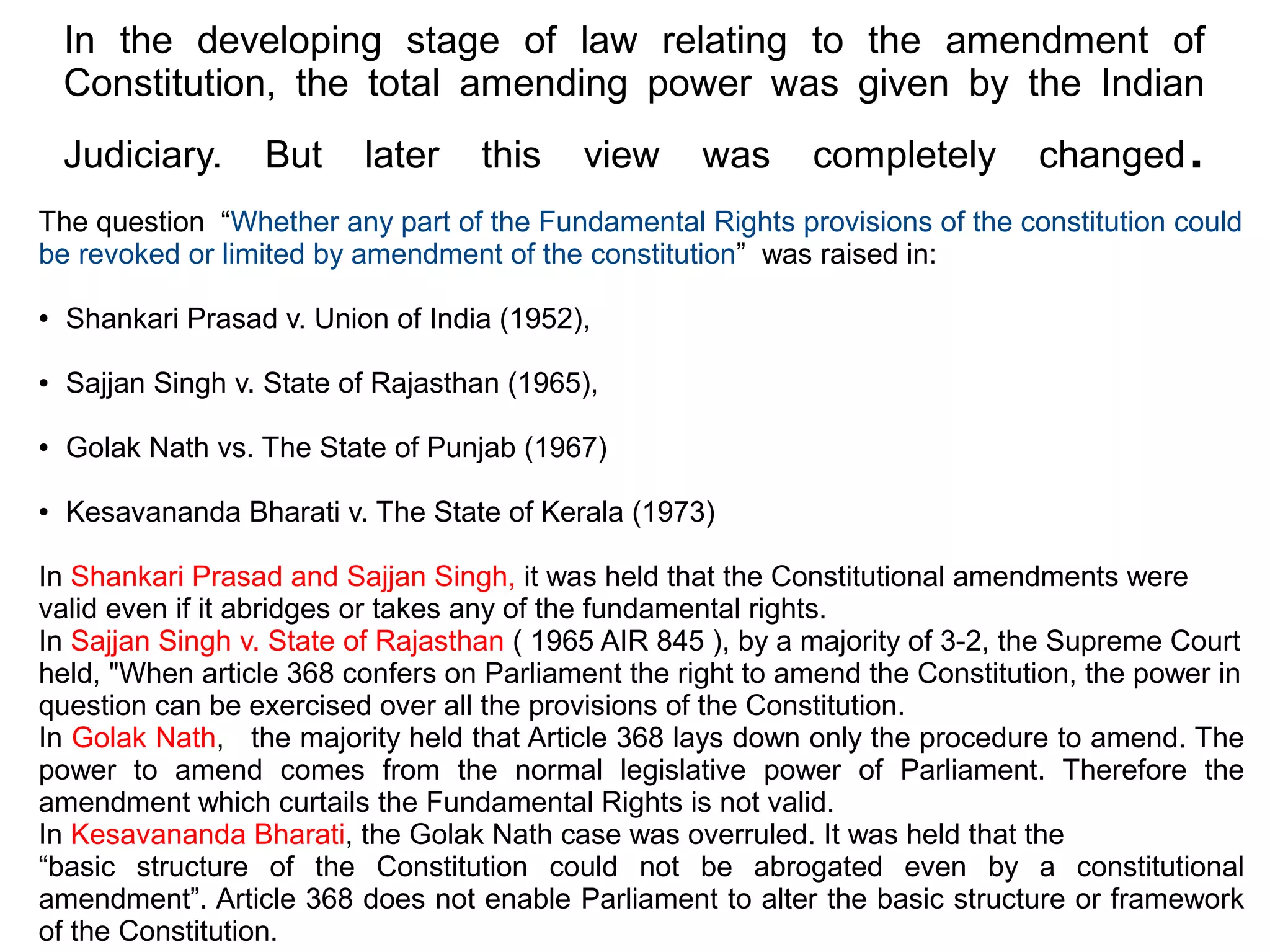
No discussion on Indian constitutional amendments is complete without the Basic Structure Doctrine. Emerged from the landmark Kesavananda Bharati v. State of Kerala (1973) case, the Supreme Court ruled that while Parliament has the power to amend any part of the Constitution, it cannot destroy the document’s identity.
The "Basic Structure" is not explicitly defined in the Constitution but has been interpreted by the courts to include:
- The supremacy of the Constitution.
- The republican and democratic form of government.
- The secular character of the Constitution.
- The separation of powers between the legislature, executive, and judiciary.
- The federal character of the Constitution.
This doctrine serves as a judicial check on the legislative branch, preventing any potential "constitutional overreach" that could jeopardize the democratic fabric of India.
Key Amendments and Their Historical Significance
Since its inception in 1950, several amendments have fundamentally reshaped the Indian polity. Below is a detailed look at the most influential changes.
The 1st Amendment (1951)
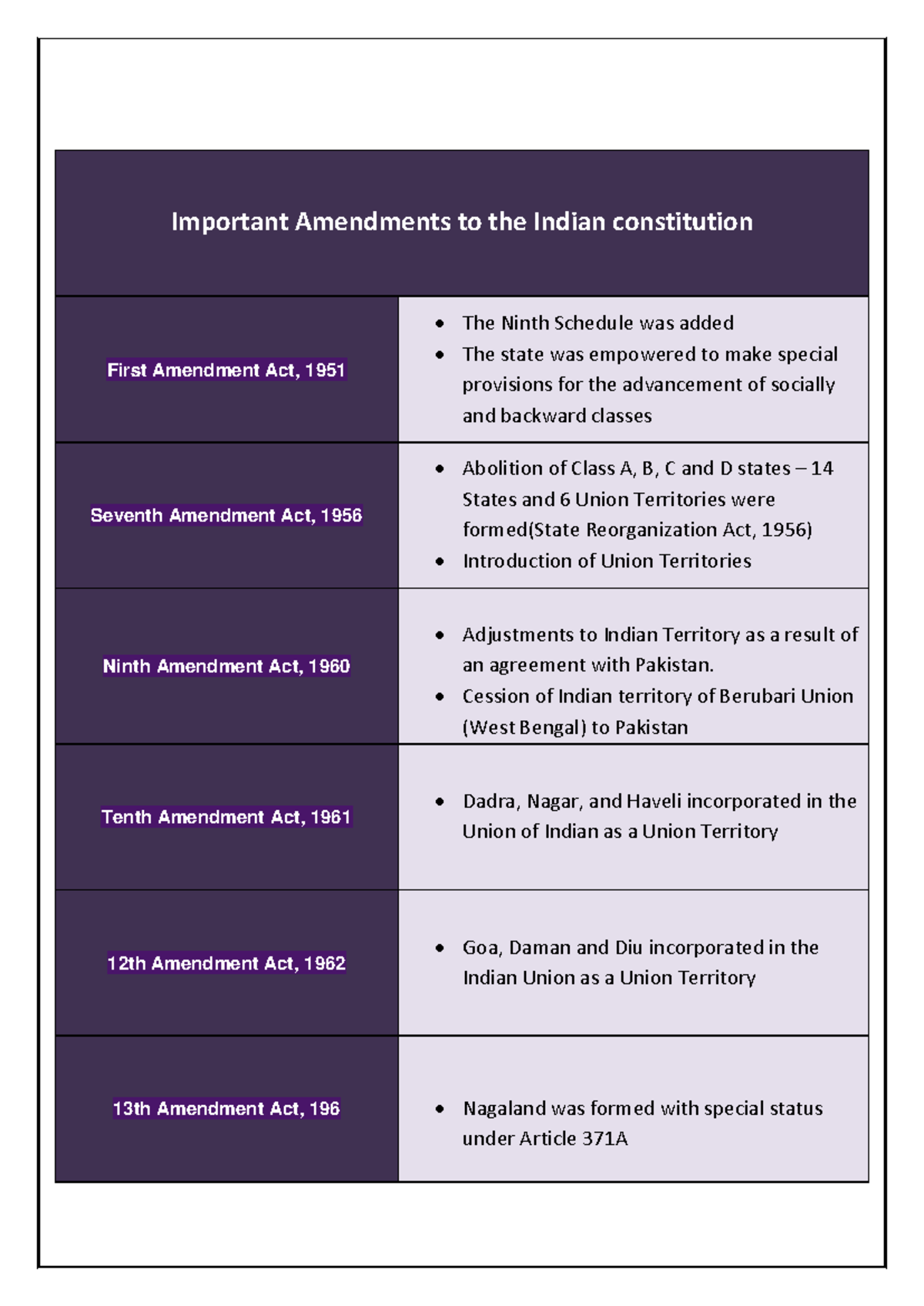
Enacted shortly after the Constitution came into force, the First Amendment was a response to judicial hurdles in land reform. It introduced the Ninth Schedule, which protected specific laws from judicial review on the grounds of violating fundamental rights. It also added reasonable restrictions on the freedom of speech and expression.
The 42nd Amendment (1976): The "Mini-Constitution"
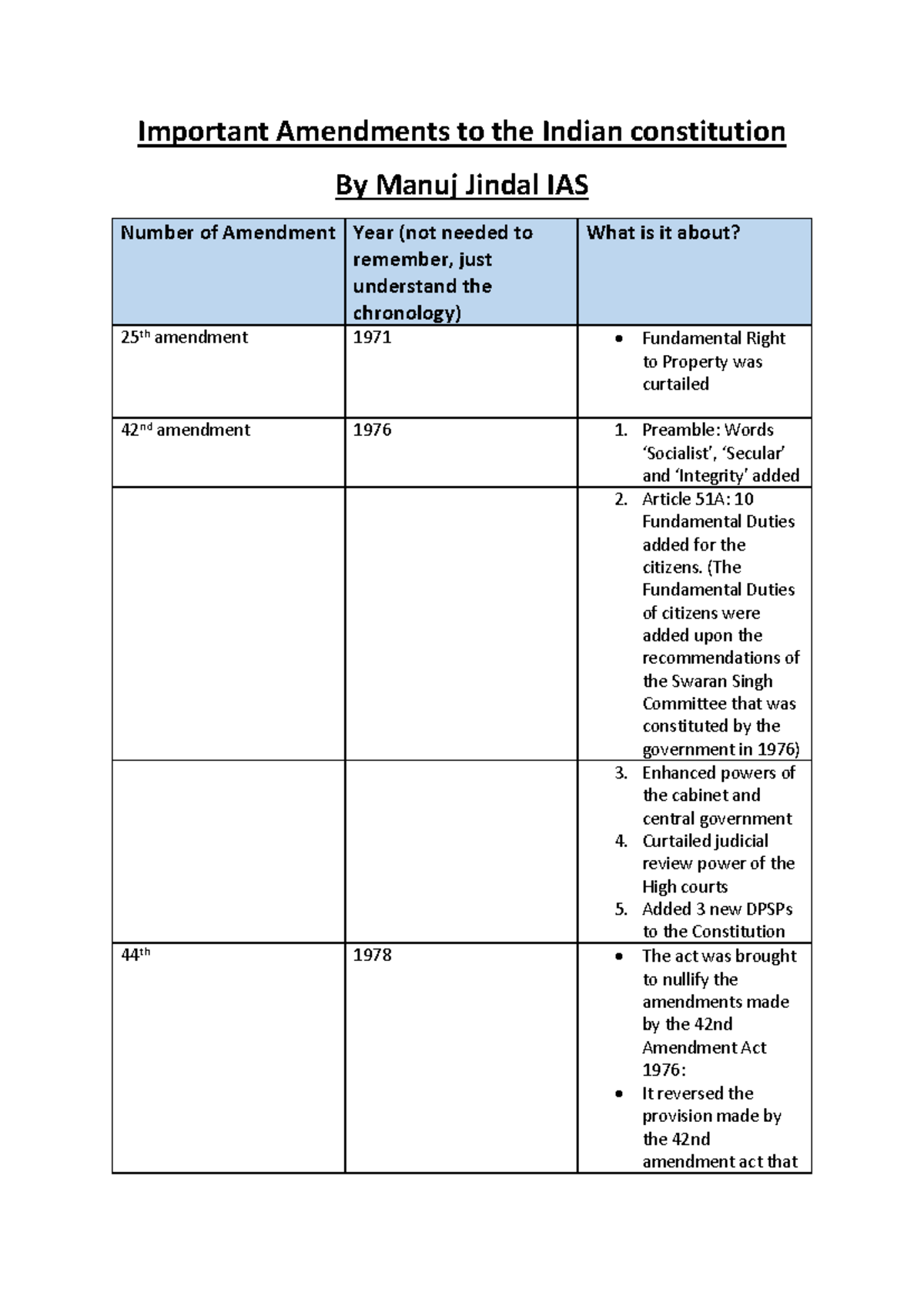
Passed during the Emergency, this is perhaps the most controversial and comprehensive amendment in Indian history. It sought to reduce the power of the Supreme Court and High Courts. Crucially, it added the words "Socialist," "Secular," and "Integrity" to the Preamble and introduced the Fundamental Duties (Part IV-A).
The 44th Amendment (1978)
Following the Emergency, the new government enacted the 44th Amendment to undo several changes brought by the 42nd Amendment. It restored the jurisdiction of the courts and modified the Emergency provisions to prevent future misuse. Notably, it removed the "Right to Property" from the list of Fundamental Rights and made it a mere legal right under Article 300A.
The 73rd and 74th Amendments (1992)
These amendments revolutionized local governance in India. The 73rd Amendment provided constitutional status to Panchayati Raj Institutions (rural local government), while the 74th Amendment did the same for Municipalities (urban local government). They mandated regular elections and reservation of seats for women and marginalized communities.
The 101st Amendment (2016)
This amendment paved the way for the Goods and Services Tax (GST). It necessitated a fundamental change in the taxing powers of both the Center and the States, requiring a Special Majority and ratification by more than half of the State legislatures.
The 106th Amendment (2023/24)
Commonly known as the Nari Shakti Vandan Adhiniyam, this amendment provides for 33% reservation for women in the Lok Sabha and State Legislative Assemblies. As of 2026, its implementation remains tied to the delimitation exercise, marking a significant milestone in gender-inclusive governance.
Comparative Overview of Major Amendments
The following table summarizes the impact of key amendments that have shaped contemporary India.
| Amendment No. | Year | Subject Matter | Primary Impact |
|---|---|---|---|
| 1st | 1951 | Land Reforms & 9th Schedule | Protected land reform laws from judicial review. |
| 7th | 1956 | Reorganization of States | Reorganized states on a linguistic basis; abolished old categories. |
| 24th | 1971 | Power of Parliament | Affirmed Parliament's power to amend any part of the Constitution. |
| 42nd | 1976 | "Mini-Constitution" | Added 'Secular' & 'Socialist' to Preamble; added Fundamental Duties. |
| 44th | 1978 | Post-Emergency Correction | Restored civil liberties; turned Right to Property into a legal right. |
| 52nd | 1985 | Anti-Defection Law | Disqualified members of Parliament/Assemblies for changing parties. |
| 61st | 1989 | Voting Age | Lowered the voting age from 21 to 18 years. |
| 73rd & 74th | 1992 | Local Self-Government | Constitutional status for Panchayats and Municipalities. |
| 86th | 2002 | Right to Education | Made free and compulsory education a Fundamental Right (Art 21A). |
| 101st | 2016 | GST Introduction | Created a unified indirect tax regime across India. |
| 103rd | 2019 | EWS Reservation | 10% reservation for Economically Weaker Sections in jobs/education. |
| 106th | 2023 | Women's Reservation | 33% reservation for women in Lok Sabha and State Assemblies. |
The Role of the Judiciary in the Amendment Process
In the Indian context, the judiciary acts as the "Guardian of the Constitution." While the Parliament has the power to initiate and pass amendments, the Supreme Court has the power of Judicial Review. If an amendment is found to violate the Basic Structure or the procedural requirements of Article 368, the court can declare it "ultra vires" (unconstitutional) and void.
This relationship between the legislature and the judiciary has often been a point of friction, but it is precisely this tension that prevents any single branch of government from becoming too powerful. Landmark cases like Golaknath v. State of Punjab and Minerva Mills v. Union of India further refined the boundaries of what can and cannot be changed.
Practical Challenges in Amending the Constitution
Amending the Constitution is rarely a purely legalistic affair; it is deeply political. Several challenges often arise during the process:
- Political Consensus: Achieving a two-thirds majority in both Houses is difficult in an era of coalition politics or polarized legislatures.
- State Ratification: For federal changes, getting 50% of states to agree can be a slow and arduous process, especially when different parties rule at the Center and in the States.
- Judicial Scrutiny: Major amendments are almost always challenged in the Supreme Court, leading to long periods of legal uncertainty.
- Public Perception: Changes to sensitive areas like reservations or fundamental rights often lead to widespread public debate and protest.
Frequently Asked Questions
Can the Preamble of the Constitution be amended?
Yes, the Preamble can be amended, provided the Basic Structure of the Constitution is not violated. This was established in the Kesavananda Bharati case. The Preamble has been amended only once so far, by the 42nd Amendment Act of 1976, which added the words "Socialist," "Secular," and "Integrity."
Does the President have the power to reject a Constitutional Amendment Bill?
No. Unlike ordinary bills, the President must give his assent to a Constitutional Amendment Bill. According to the 24th Amendment Act of 1971, it is mandatory for the President to sign the bill once it has been passed by both Houses of Parliament (and ratified by states, if necessary). The President cannot return the bill for reconsideration.
What is the difference between a Constitutional Amendment Bill and an Ordinary Bill?
An ordinary bill requires a simple majority and can be subject to a joint sitting of both Houses if there is a deadlock. A Constitutional Amendment Bill (under Article 368) requires a special majority, and there is no provision for a joint sitting. If the two Houses disagree, the bill fails.
Why is the 42nd Amendment called the "Mini-Constitution"?
It is called the "Mini-Constitution" because of its massive scale and the depth of changes it introduced. It affected the Preamble, dozens of articles, and several schedules. It attempted to shift the balance of power heavily toward the executive and the legislature, many of which were later reversed by the 44th Amendment.
Can fundamental rights be amended?
Yes, Parliament can amend Fundamental Rights using a Special Majority under Article 368. However, such amendments must not infringe upon the Basic Structure of the Constitution. For example, while the Right to Property was removed as a fundamental right, the right to equality or life cannot be abolished.
Next Steps for Students and Researchers
For those looking to deepen their understanding of Indian constitutional law in 2026, the best approach is to monitor the Supreme Court of India's latest rulings on constitutional validity. Official gazettes published by the Ministry of Law and Justice provide the most accurate text for new amendments. Studying the "Constituent Assembly Debates" is also highly recommended to understand the original intent of the framers before analyzing how amendments have steered that intent over the decades.