Alexander Astin’s research transformed higher education by shifting the focus from institutional prestige to the actual impact of the college experience on students. His seminal Theory of Student Involvement and the I-E-O Model provide the empirical framework used by universities in 2026 to measure student success beyond simple graduation rates, emphasizing that what students do in college matters as much as where they go.
The study of student development owes much of its modern quantitative and theoretical foundation to Alexander "Sandy" Astin. As a Professor Emeritus at UCLA and the founding director of the Higher Education Research Institute (HERI), Astin dedicated his career to understanding how the college environment influences student outcomes. His work moved the needle from a passive "input-based" view of education—where the quality of a school was judged by its endowment or the SAT scores of its incoming class—to an "outcome-based" view that prioritizes student growth, engagement, and the quality of effort.
The Philosophical Shift: From Resources to Results
Before Astin’s influence took hold, the "excellence" of a university was primarily measured by its resources and reputation. This "resource and reputation" model suggested that the best universities were those with the most books in the library, the most decorated faculty, and the most selective admissions processes. Astin challenged this by arguing that these factors do not necessarily equate to better student development.
In his view, the true measure of excellence is the "talent development" capacity of the institution. This means a university is effective only if it can demonstrate that its students have grown intellectually, socially, and personally because of their time on campus. This philosophical shift necessitated a new way of measuring the student experience, leading to the development of his most famous models.
The I-E-O Model: A Framework for Assessment
The I-E-O (Inputs-Environment-Outcomes) Model is perhaps Astin’s most enduring contribution to educational research and assessment. It provides a logical structure for researchers to isolate the effects of the college experience from the characteristics students bring with them to campus.
1. Inputs (I)
Inputs refer to the personal qualities, backgrounds, and experiences students possess at the time of entry. These include:
- Demographics: Age, race, gender, and socioeconomic status.
- Academic History: High school GPA, standardized test scores, and prior study habits.
- Psychological Factors: Self-esteem, career aspirations, political orientation, and values.
Astin argued that without accounting for these inputs, researchers cannot accurately claim that a college "caused" a specific outcome. For example, if a prestigious university has high-earning graduates, is it because the university provided a superior education (Environment), or because it recruited students who were already wealthy and well-connected (Inputs)?
2. Environment (E)
The environment encompasses the totality of the student’s experience during college. This includes everything the institution can control or influence:
- Academic Programs: Core curricula, major requirements, and pedagogy (e.g., active learning vs. lecturing).
- Institutional Characteristics: Size of the campus, faculty-to-student ratios, and whether the school is public or private.
- Peer Groups: The influence of friends, roommates, and student organizations.
- Faculty Interaction: Mentorship, research opportunities, and classroom engagement.
3. Outcomes (O)
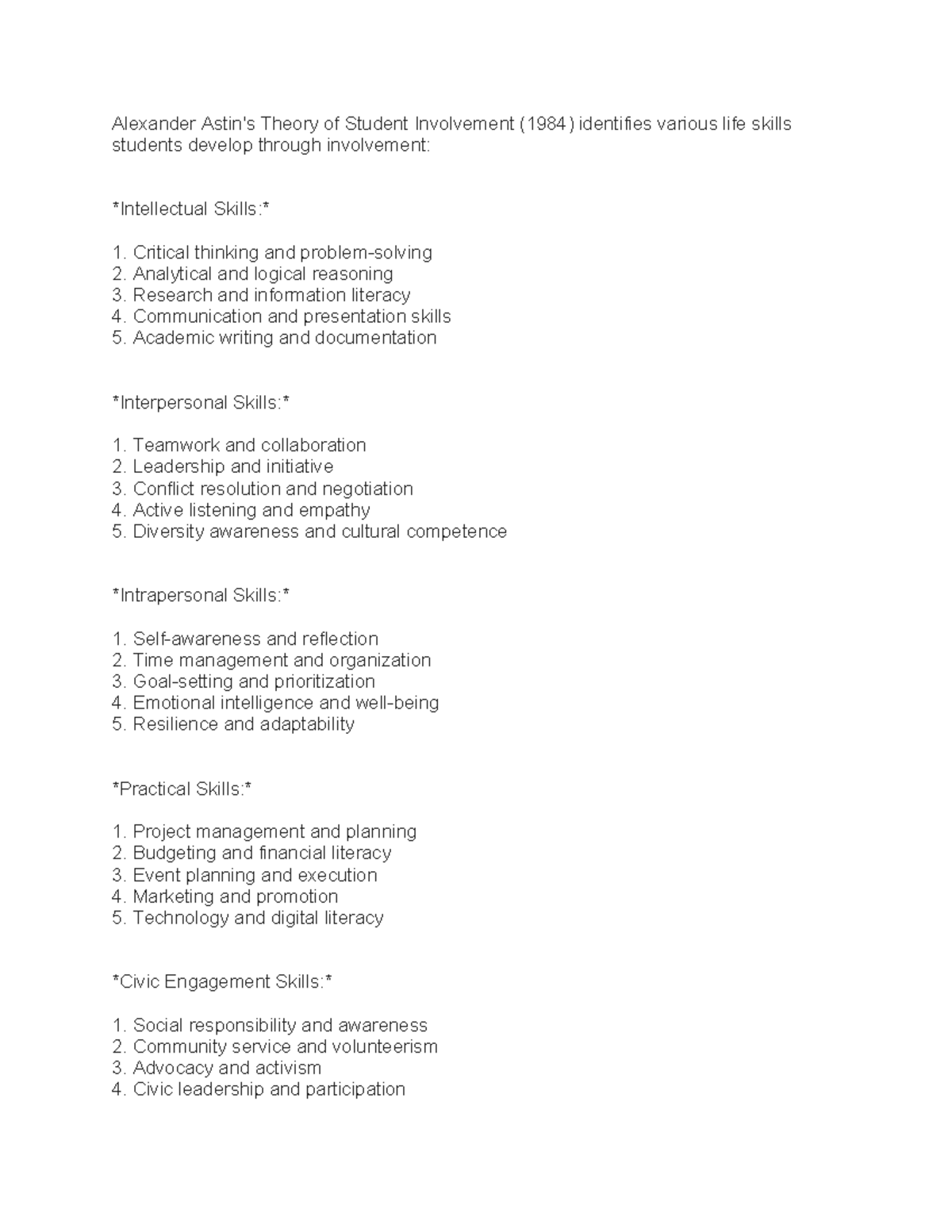
Outcomes are the results of the educational process—the "talents" that the institution seeks to develop. These can be categorized as:
- Cognitive Outcomes: Critical thinking skills, subject-matter mastery, and GPA.
- Affective Outcomes: Self-conceptions, values, attitudes, and satisfaction with the college experience.
- Behavioral Outcomes: Degree completion, career placement, and civic engagement.
The power of the I-E-O model lies in its ability to show how the Environment interacts with Inputs to produce Outcomes. It allows administrators in 2026 to ask: "Adjusting for the students we admit, which specific campus programs are actually helping them succeed?"
The Theory of Student Involvement
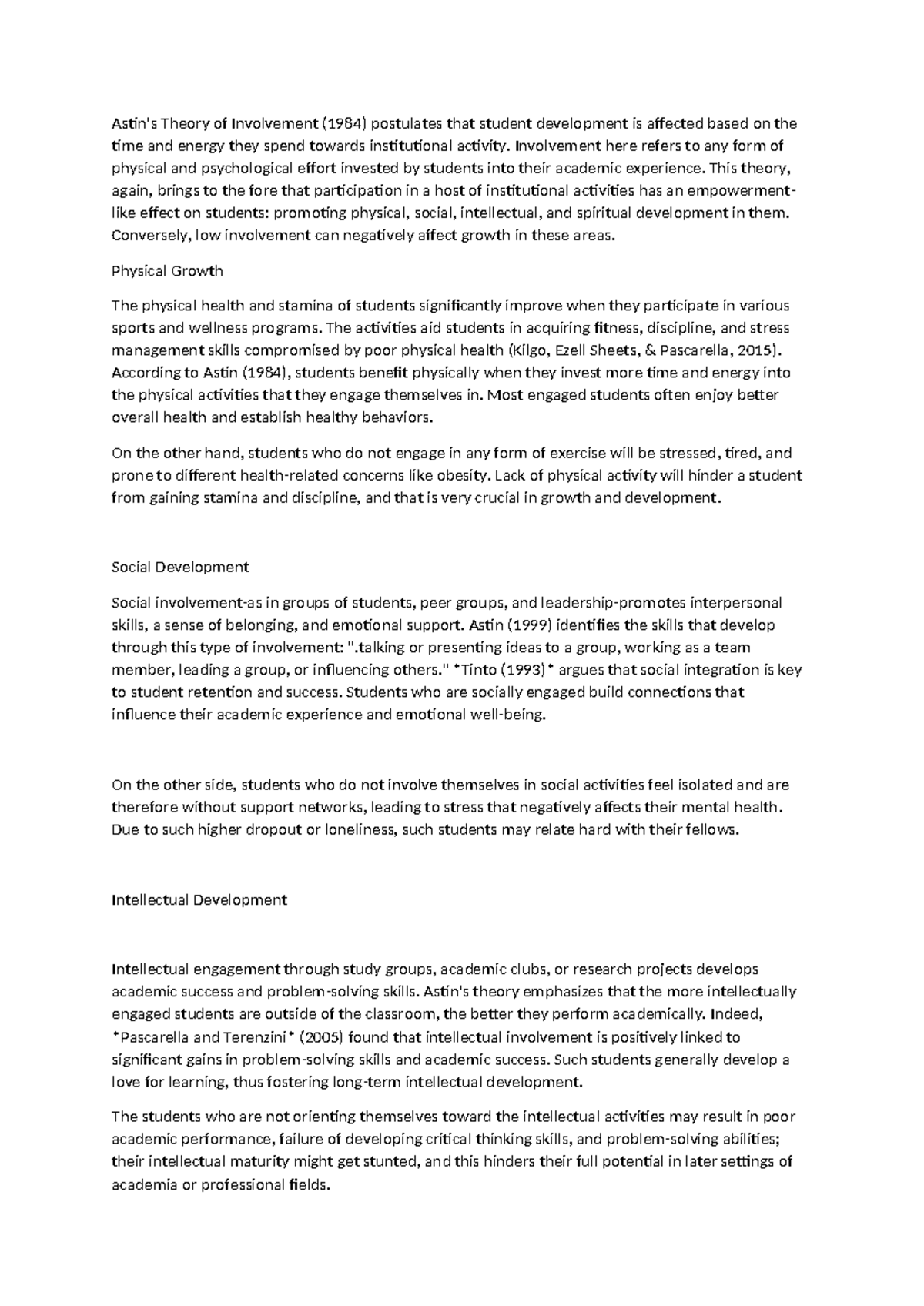
While the I-E-O model provides a structure for assessment, the Theory of Student Involvement explains the "how" of student development. Developed in the 1980s and refined through decades of longitudinal studies, this theory posits that students learn and grow more when they are actively involved in their education.
Astin defined involvement as the "amount of physical and psychological energy that the student devotes to the academic experience." Unlike other theories that focus on internal states or motivations, Astin’s theory is behavioral; it is about what the student actually does.
The Five Postulates of Involvement
Astin outlined five basic tenets that form the core of his theory:
- Involvement refers to the investment of physical and psychological energy in various objects. These objects can be highly general (the "student experience") or highly specific (preparing for a chemistry exam).
- Involvement occurs along a continuum. Different students manifest different levels of involvement in different objects at different times. No two students engage with the university in the exact same way.
- Involvement has both quantitative and qualitative features. The quantitative aspect is the time spent (e.g., "How many hours did you study?"); the qualitative aspect is the depth of that engagement (e.g., "Did you just read the text, or did you analyze it?").
- The amount of student learning and personal development is directly proportional to the quality and quantity of student involvement in that program.
- The effectiveness of any educational policy or practice is directly related to the capacity of that policy or practice to increase student involvement.
Key Forms of Involvement
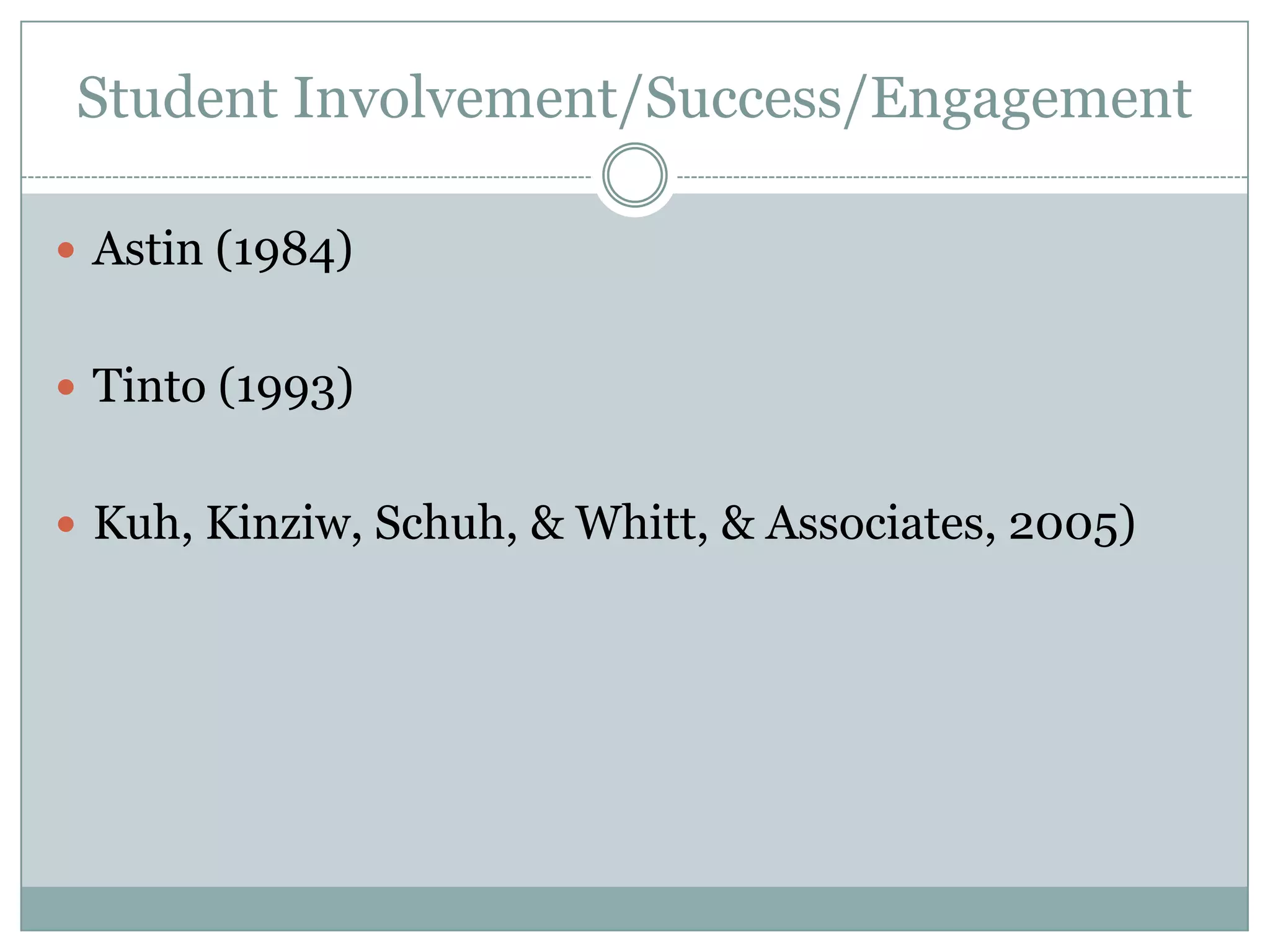
In his 1993 book, What Matters in College?, Astin identified three forms of involvement that have the most significant impact on student development:
- Academic Involvement: Engaging with faculty and coursework.
- Involvement with Faculty: Mentorship and out-of-class interactions.
- Involvement with Student Peer Groups: This is often cited as the most powerful source of influence on student growth.
The Longitudinal Legacy: CIRP and HERI
Astin’s theories were not just philosophical; they were backed by the most extensive data set in the history of higher education. In 1966, he helped establish the Cooperative Institutional Research Program (CIRP).
The CIRP Freshman Survey is the oldest and largest longitudinal study of higher education in the United States. By 2026, this data set includes millions of responses from students across thousands of institutions. This research is managed by the Higher Education Research Institute (HERI) at UCLA.
Through CIRP, Astin was able to track students from their first day of college through graduation and beyond. This allowed him to prove that "peer group effects" are often stronger than "faculty effects." It also allowed him to identify "high-impact practices"—such as study abroad, service learning, and undergraduate research—that consistently drive involvement and, consequently, development.
Comparison of Major Student Development Theories
To understand Astin’s place in the field, it is helpful to compare his work with other foundational theorists. While Astin focused on involvement and quantitative assessment, others focused on the stages of psychological growth or social integration.
| Theorist | Core Concept | Primary Focus | Application in 2026 |
|---|---|---|---|
| Alexander Astin | Involvement & I-E-O | Behavioral engagement and environmental impact. | Designing high-impact practices and assessment metrics. |
| Arthur Chickering | Seven Vectors | Identity development and emotional maturity. | Counseling and student affairs programming. |
| Vincent Tinto | Student Departure | Social and academic integration/retention. | Early warning systems and first-year seminars. |
| Nancy Schlossberg | Transition Theory | How students handle changes and "mattering." | Supporting non-traditional and transfer students. |
Practical Applications for Universities in 2026
In the current academic landscape of 2026, Astin’s theories are applied through "Student Success Suites" and integrated data analytics. Educational leaders use his principles to solve specific institutional problems.
Improving Retention Through Engagement
Universities no longer view retention as a financial metric but as a byproduct of involvement. If a student is not involved in at least one campus organization or does not have a meaningful relationship with a faculty member, they are flagged as "at-risk." Astin’s work provides the justification for investing in student organizations, intramural sports, and campus housing, as these are "environmental" factors that facilitate involvement.
Curriculum Design and "Active Learning"
Astin’s fifth postulate—that policy effectiveness is tied to its ability to increase involvement—has led to the widespread adoption of active learning. In 2026, the traditional "sage on the stage" lecture model is largely replaced by flipped classrooms and collaborative projects, as these require a higher investment of "psychological energy" from the student.
Reimagining "Merit" and Admissions
Using the I-E-O model, many institutions have moved toward holistic admissions. They recognize that "Inputs" (like high school prestige) are often a reflection of privilege. By focusing on "Talent Development," schools in 2026 look for students who show the greatest potential for growth when placed in the university's specific environment, rather than just those who have the highest entry-level scores.
Common Pitfalls in Applying Astin's Theories
While the Theory of Student Involvement is robust, it is often misinterpreted in two significant ways:
- Conflating "Busy-ness" with Involvement: Administrators sometimes assume that if a student is simply "on campus" or attending many events, they are "involved." Astin emphasized that involvement requires psychological energy. Superficial participation without cognitive or emotional investment does not lead to development.
- Ignoring the "Input" Side of the Equation: When assessing a new program, schools often look only at the "Outcome" (e.g., the GPA of students in the program). Without accounting for the "Inputs" (e.g., were the students in the program already high-achievers?), the assessment is invalid. This is known as "selection bias," which the I-E-O model was specifically designed to correct.
The Evolution: Spirituality and the Inner Life
Later in his career, alongside his wife Helen "Lenny" Astin, Alexander Astin expanded his research into the "inner life" of students. This work, often referred to as the study of spirituality in higher education, argued that student development must include the search for meaning and purpose.
In his 2011 book, Cultivating the Spirit, Astin utilized CIRP data to show that students' spiritual qualities (e.g., equanimity, spiritual quest, and compassionate self-interest) grow during the college years and that the college environment plays a critical role in this development. This expanded the "Outcomes" portion of the I-E-O model to include more than just job skills and GPA, advocating for a "whole-student" approach that remains a cornerstone of liberal arts education in 2026.
FAQ
What is the main difference between Astin's Involvement and Tinto's Integration?
While both theories focus on student success, Vincent Tinto’s theory of "Student Departure" focuses specifically on integration—how well a student fits into the social and academic systems of the school. Astin’s "Involvement" is broader and more behavioral; it focuses on the energy the student exerts. You can be integrated (feeling like you belong) but not necessarily involved (putting in the effort to grow).
Does the I-E-O model work for online students?
Yes, but the "Environment" (E) looks different. For online students in 2026, the environment includes the user interface of the Learning Management System (LMS), the frequency of digital interactions with peers, and the quality of asynchronous feedback from instructors. The challenge for online providers is to create "digital environments" that facilitate the same level of psychological energy as physical campuses.
Why is the CIRP Freshman Survey so important?
The CIRP survey is unique because of its scale and longevity. It provides a baseline (Inputs) for millions of students. By following up with these same students years later, researchers can see exactly how different environments (majors, types of colleges, extracurriculars) changed their attitudes, career paths, and health.
How can a student increase their own "Involvement"?
According to Astin, the most effective way is to find a "peer group" that shares academic or personal interests. Whether it is a research lab, a debate team, or a service fraternity, these groups provide the social support and motivation needed to invest the "physical and psychological energy" required for development.
Did Astin believe that prestige doesn't matter?
Astin didn't say prestige is irrelevant, but rather that it is often a "proxy" for inputs. He argued that a "prestige-heavy" school isn't automatically better for student development than a less-known school. What matters is the quality of interaction between the student and the environment.
Next Actions for Educators and Researchers
To effectively utilize Astin's framework in 2026, institutional leaders should:
- Audit Campus Environments: Use the I-E-O model to evaluate which programs (Environment) are providing the most "added value" to students, specifically controlling for incoming demographics (Inputs).
- Redesign First-Year Experiences: Focus on "Postulate 5"—ensuring that every policy for first-year students is designed to maximize their involvement early on.
- Engage with HERI Data: Utilize the Higher Education Research Institute’s resources to compare institutional data against national benchmarks to identify gaps in student engagement.
- Prioritize Peer Interaction: Given Astin’s finding that peer groups are the most powerful influence, universities should prioritize the creation of "learning communities" where students can interact both socially and academically.