Adam Air (officially PT. Adam SkyConnection Airlines) was a privately owned Indonesian low-cost carrier based in Jakarta that operated domestic and regional flights between 2003 and 2008. Despite achieving rapid commercial growth, the airline suffered multiple high-profile fatal accidents and severe safety violations, leading to the permanent revocation of its Air Operator Certificate in 2008.
Corporate Origins and Rapid Expansion (2002–2006)
Adam Air was established in 2002 by Indonesian businesswoman Sandra Ang and her family, with the airline named after her son, Adam Aditya Suherman, who served as the carrier’s Chief Executive Officer. Vice President Director Sandra Ang and commercial aviation veterans formed the management board with an ambitious strategy: to capitalize on the deregulation of Indonesia’s aviation market. The Indonesian government’s deregulation in the early 2000s allowed private start-up carriers to challenge state-owned flag carrier Garuda Indonesia and established private airlines like Lion Air.
The airline officially commenced commercial flight operations on December 19, 2003, with two leased Boeing 737-300 aircraft. From its primary hub at Soekarno-Hatta International Airport in Jakarta, Adam Air initiated aggressive price competition, offering low-cost fares coupled with bright, colorful cabin interiors, complimentary meals, and promotional campaigns that promised new seats and premium service at budget prices.
- Adam Air Founding (2002)
- First Flight Executed (Dec 2003)
- Rapid Fleet & Route Expansion (2004–2006)
- Multiple Severe Safety Incidents (2006–2007)
- AOC Suspended & Revoked (March–June 2008)
By 2006, Adam Air had rapidly expanded its network to cover over 20 domestic destinations across the Indonesian archipelago, including Surabaya, Medan, Denpasar, Makassar, and Yogyakarta. The airline also launched international regional routes connecting Jakarta and Medan to Singapore and Penang, Malaysia. Within three years of its inaugural flight, Adam Air captured a significant share of Indonesia's domestic passenger market, transporting millions of passengers annually.
However, this rapid growth came at the expense of operational control, adequate maintenance infrastructure, and technical oversight. The airline expanded its fleet faster than its internal quality control, technical support systems, and flight crew training programs could mature.
Fleet Profile and Maintenance Practices
Adam Air relied exclusively on leased narrow-body jetliners, specifically variant models of the Boeing 737 Classic family. As passenger demand increased, the carrier rapidly took delivery of secondhand aircraft sourced from global leasing entities.
Aircraft Fleet Composition
During its operational peak between 2005 and 2007, Adam Air operated a fleet consisting of the following aircraft types:
- Boeing 737-200: Older-generation twinjets used primarily for short-haul domestic routes and secondary provincial airports.
- Boeing 737-300: Mainstay medium-haul aircraft configured for high-density economy seating.
- Boeing 737-400: Larger capacity variants used on major trunk routes connecting Jakarta to high-volume provincial capitals.
- Boeing 737-500: Shorter-fuselage variants deployed on regional and medium-demand routes.
Maintenance Oversight and Operational Compromises
While the Boeing 737 Classic platform is historically reliable, the aircraft leased by Adam Air were older airframes requiring rigorous, continuous maintenance routines. Leaked internal reports and subsequent regulatory investigations conducted by Indonesia's National Transportation Safety Committee (NTSC / KNKT) revealed widespread non-compliance with standard aviation maintenance practices.
Former Adam Air engineers and flight crews submitted formal complaints to regulatory authorities citing severe operational deficiencies, including:
- Deferred Maintenance Defect Logs: Repeated deferral of critical mechanical and avionics repairs beyond allowable Minimum Equipment List (MEL) time limits.
- Cannibalization of Parts: Removing functional components from grounded aircraft to install them in active planes without proper logging or safety certification.
- Pressure on Maintenance Personnel: Reports of engineers being ordered to sign off on airworthiness documentation despite known unresolved instrument anomalies.
- Inadequate Spare Parts Inventory: Chronic shortages of specialized replacement parts, leading to temporary fixes for complex navigational and hydraulic systems.
These systemic maintenance compromises degraded overall fleet reliability, setting the stage for a series of catastrophic technical failures in flight.
Operational Timeline & Key Milestones
| Year | Milestone / Event | Operational Impact |
|---|---|---|
| 2002 | PT. Adam SkyConnection Airlines founded | Corporate establishment and licensing phase in Jakarta. |
| 2003 | Inaugural commercial flight launched | Operations begin with two leased Boeing 737-300 aircraft. |
| 2005 | International route expansion | Launched routes connecting Indonesia to Singapore and Malaysia. |
| Feb 2006 | Flight 782 navigation failure & off-course landing | Boeing 737-200 lands 470 km off-course in Sumba after instrument loss. |
| Jan 2007 | Flight 574 disaster in Makassar Strait | Boeing 737-400 crashes into ocean; all 102 passengers and crew killed. |
| Feb 2007 | Flight 172 hard landing in Surabaya | Boeing 737-300 suffers cracked and bent fuselage; 6 aircraft grounded. |
| Mar 2007 | Institutional investors acquire 50% stake | PT Bhakti Investama buys half the company to enforce corporate governance. |
| Jun 2007 | European Union places blanket ban on Indonesian airlines | Adam Air and all Indonesian carriers banned from EU airspace. |
| Mar 2008 | Flight 292 runway excursion in Batam | Boeing 737-400 skids off runway; investors withdraw funding. |
| Mar 2008 | Government grounds Adam Air fleet | Ministry of Transportation suspends Air Operator Certificate (AOC). |
| Jun 2008 | Permanent AOC Revocation | Adam Air legally dissolved and banned from future flight operations. |
Escalating Safety Incidents and Catastrophic Accidents
Adam Air's short operating history was marked by several severe safety incidents, culminating in one of the most significant aviation disasters in Indonesian history.
| Incident | Details |
|---|---|
| [Feb 2006] Flight 782 | Nav failure; landed 470 km off-course |
| [Jan 2007] Flight 574 | Fatal crash into Makassar Strait (102 dead) |
| [Feb 2007] Flight 172 | Hard landing; fuselage structural failure |
| [Mar 2008] Flight 292 | Runway excursion at Batam Airport |
February 11, 2006: Adam Air Flight 782
On February 11, 2006, a Boeing 737-200 (registration PK-KKE) carrying 145 people lost all inertial navigation and communication systems while en route from Jakarta to Makassar. The flight crew became severely disoriented, flying aimlessly for hours over open water without radio contact.
The pilots eventually made a visual emergency landing at Tambolaka Airport on the remote island of Sumba—over 470 kilometers off its planned flight path. Following the landing, the Indonesian Directorate General of Civil Aviation (DGCA) temporarily grounded the aircraft for investigation. The pilot and co-pilot were sanctioned, and inspectors identified recurring defects in the plane's Inertial Reference System (IRS) that had been repeatedly cleared by technicians without being resolved.
January 1, 2007: Adam Air Flight 574 Crash
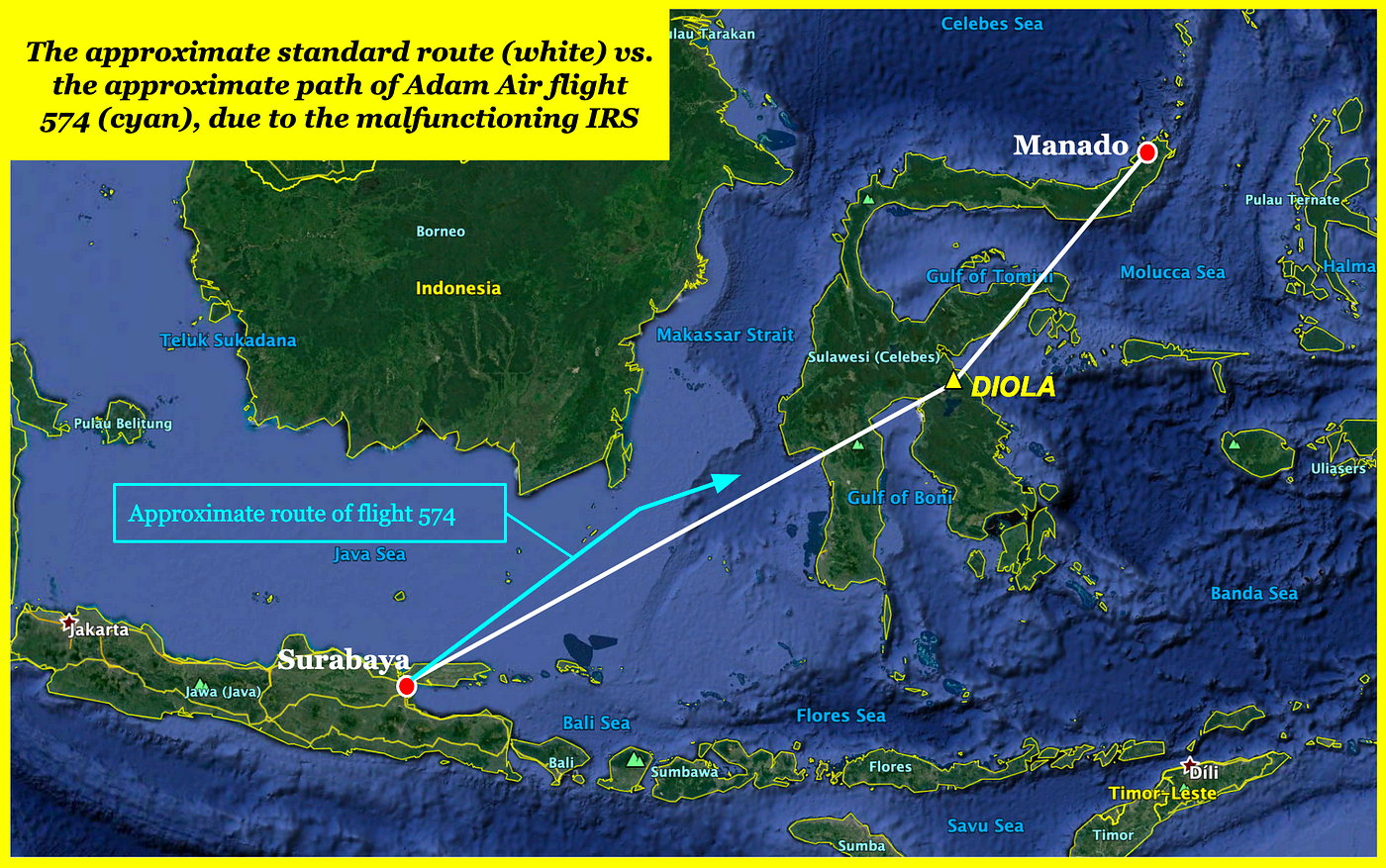
On New Year's Day 2007, Adam Air Flight 574, operated by a Boeing 737-400 (registration PK-KKW), departed Surabaya bound for Manado with 96 passengers and 6 crew members onboard. While cruising at 35,000 feet over the Makassar Strait, the flight crew encountered persistent malfunctions in the aircraft’s Inertial Reference System (IRS).
According to the official investigation by the National Transportation Safety Committee (KNKT), supported by the U.S. National Transportation Safety Board (NTSB):
- Navigational Troubleshooting: While attempting to troubleshoot the faulty IRS units, the flight crew inadvertently disconnected the autopilot system.
- Spatial Disorientation: Neither pilot monitored the aircraft's flight instruments or noticed that the plane was entering a slow right roll.
- Uncontrolled Descent: The aircraft rolled beyond 60 degrees of bank, pitched downward, and entered a high-speed spiral dive.
- Structural Breakdown: Due to spatial disorientation, the crew failed to level the wings before pulling back on the control column. The aircraft exceeded its structural design limits, breaking apart in mid-air before impacting the water at near-sonic speed.
All 102 people aboard perished. The black boxes (Flight Data Recorder and Cockpit Voice Recorder) were recovered months later from deep water off the coast of Majene, Sulawesi.
The investigation determined that the primary causes were pilot spatial disorientation during instrument failure troubleshooting, inadequate Crew Resource Management (CRM), lack of flight crew training on handling instrument failures, and a long history of uncorrected IRS maintenance defects recorded in the aircraft's logbook.
February 21, 2007: Adam Air Flight 172
Less than two months after the Flight 574 disaster, Adam Air Flight 172, a Boeing 737-300 (registration PK-KKV), suffered a severe hard landing at Juanda International Airport in Surabaya. The force of the impact caused the airframe to break its structural back, leaving the fuselage visibly cracked and bent downward behind the wings.
Although there were no fatalities among the 148 passengers, the incident highlighted structural integrity concerns within the operational fleet. In response, the Ministry of Transportation temporarily grounded six of Adam Air’s Boeing 737-300 aircraft to audit their structural integrity and maintenance histories.
March 10, 2008: Adam Air Flight 292
On March 10, 2008, a Boeing 737-400 (registration PK-KGU) operating Flight 292 from Jakarta to Batam skidded off the end of the runway upon landing at Hang Nadim International Airport in heavy rain. The aircraft sustained damage to its landing gear and wing structure. While no passengers were severely injured, the accident proved to be the final catalyst for the carrier's financial collapse and regulatory shutdown.
Major Safety Incidents Breakdown
| Incident | Date | Aircraft Type | Registration | Location | Fatalities | Primary Contributing Factors |
|---|---|---|---|---|---|---|
| Flight 782 | Feb 11, 2006 | Boeing 737-200 | PK-KKE | Tambolaka, Sumba | 0 | Total IRS avionics failure, crew disorientation, unresolved maintenance defects. |
| Flight 574 | Jan 1, 2007 | Boeing 737-400 | PK-KKW | Makassar Strait | 102 | IRS failure, loss of autopilot, crew disorientation, inadequate CRM, structural break-up. |
| Flight 172 | Feb 21, 2007 | Boeing 737-300 | PK-KKV | Surabaya | 0 | Severe hard landing, pilot technique, structural failure of fuselage. |
| Flight 292 | Mar 10, 2008 | Boeing 737-400 | PK-KGU | Batam | 0 | Runway excursion during bad weather, landing system management, pilot error. |
Corporate Collapse, Legal Actions, and Permanent Revocation
The series of accidents severely damaged passenger confidence, leading to a sharp drop in ticket sales and financial distress for Adam Air.
Investor Departure and Corporate Governance Failure
In March 2007, in an attempt to restore financial stability and operational credibility, Indonesian investment firm PT Bhakti Investama (along with Bright Stars Acquisition Ltd.) purchased a 50% controlling stake in Adam Air. The new investors attempted to institute professional management, hire independent safety consultants, and overhaul financial auditing practices.
However, internal conflict erupted between PT Bhakti Investama and the founding Ang family. The investors alleged that management refused to provide transparent access to accounting records, ignored safety recommendations, and concealed operational liabilities. On March 16, 2008—six days after the Flight 292 accident in Batam—PT Bhakti Investama officially announced the withdrawal of its investment, returning its shares to the founders and calling for the airline to be liquidated.
- Accumulated Deficits & Safety Violations
- Institutional Investors Pull Out (March 2008)
- Grounding Order Issued by Ministry (March 2008)
- Permanent Air Operator Certificate Revocation (June 2008)
- Asset Liquidation & Criminal Safety Inquiries
Government Intervention and AOC Revocation
Following the withdrawal of investor capital, Adam Air defaulted on payments for aircraft leases, fuel supply, airport services, and insurance premiums.
On March 18, 2008, the Indonesian Ministry of Transportation issued a safety order suspending Adam Air's Air Operator Certificate (AOC), effectively grounding the entire fleet. The government gave the airline 3 months to demonstrate compliance with basic national civil aviation safety regulations and resolve its financial defaults.
Adam Air failed to meet any of the safety or financial criteria set by the regulators. Consequently, on June 18, 2008, the Indonesian government permanently revoked Adam Air's AOC. The airline was formally dissolved, its leased aircraft were repossessed by international leasing firms, and its operational assets were liquidated to satisfy creditors.
Impact on Indonesian Aviation Safety Regulations
The catastrophic failure of Adam Air served as a major catalyst for structural reforms within the Indonesian civil aviation sector.
International Aviation Sanctions
The systemic failure of oversight exposed during the investigation of Adam Air led to severe international sanctions against the entire Indonesian aviation sector:
- European Union Air Safety List: In July 2007, the European Commission placed a blanket ban on all 51 Indonesian air carriers—including national carrier Garuda Indonesia—prohibiting them from operating flights into any EU member state due to inadequate regulatory oversight by the Indonesian DGCA.
- FAA Category 2 Downgrade: The United States Federal Aviation Administration (FAA) downgraded Indonesia’s International Aviation Safety Assessment (IASA) rating from Category 1 to Category 2, indicating that the country’s civil aviation authority lacked baseline technical expertise, trained inspectors, and safety auditing procedures.
| Year | Event |
|---|---|
| 2007 | EU bans all 51 Indonesian airlines; FAA downgrades safety rating |
| 2008 | Adam Air permanently shut down by Ministry of Transportation |
| 2009 | Enactment of Civil Aviation Act No. 1/2009 (Mandatory SMS standards) |
| 2016 | FAA restores Indonesia to Category 1 rating |
| 2018 | European Union removes all Indonesian carriers from EU Air Safety List |
Institutional Legislative Reform: Law No. 1 of 2009
To address systemic deficiencies, the Indonesian Parliament enacted Civil Aviation Act Law No. 1 of 2009, which completely revamped the nation’s aviation legal framework:
- Mandatory Safety Management Systems (SMS): Mandated that all commercial air operators implement certified Safety Management Systems, monitored via mandatory independent safety audits.
- Strict Fleet Age and Technical Limits: Imposed maximum age limits on imported commercial aircraft and stricter operational requirements for secondhand aircraft leases.
- Independent Authority for KNKT: Enhanced the investigative independence and funding for the National Transportation Safety Committee (KNKT) to ensure objective accident investigations.
- Enforcement Authority for DGCA: Strengthened the regulatory power of the Directorate General of Civil Aviation, allowing for swift grounding orders and financial audits of underperforming airlines.
Through these regulatory overhauls, Indonesian aviation gradually rebuilt its safety standards over the following decade. The FAA restored Indonesia to a Category 1 safety rating in August 2016, and the European Union removed the final blanket restrictions on Indonesian air carriers in June 2018.
Key Lessons for Commercial Aviation Oversight
The operational collapse of Adam Air remains a prominent aviation case study in crew resource management, organizational safety culture, and regulatory oversight.
1. Crew Resource Management (CRM) Integrity
Flight 574 highlighted how instrument anomalies can degrade safety when flight crews lack effective Crew Resource Management. Pilots must prioritize flight control and instrument monitoring over troubleshooting complex electronics in challenging weather conditions.
2. Maintenance Culture vs. Cost Pressures
Low-cost business models depend on high fleet utilization and low overhead. However, when financial pressures lead to deferred maintenance, falsified records, or unaddressed repeat defects, operational safety is severely compromised.
3. Regulatory Safety Enforcement
A rapid increase in passenger traffic must be matched by a corresponding expansion in regulatory oversight. Civil aviation authorities must maintain strong auditing capabilities to identify non-compliant operators before catastrophic incidents occur.
Frequently Asked Questions
What was Adam Air?
Adam Air was a low-cost passenger airline based in Jakarta, Indonesia. Operating between December 2003 and March 2008, it served an extensive domestic network alongside regional international routes using a fleet of Boeing 737 aircraft.
Why did Adam Air cease operations?
Adam Air ceased operations after its Air Operator Certificate (AOC) was revoked by the Indonesian Ministry of Transportation in June 2008. The revocation followed catastrophic fatal accidents, severe maintenance violations, institutional financial distress, and an internal dispute that led major investors to withdraw capital.
What caused the crash of Adam Air Flight 574?
Adam Air Flight 574 crashed into the Makassar Strait on January 1, 2007, due to a combination of instrument failure (Inertial Reference System), pilot spatial disorientation during troubleshooting, accidental disengagement of the autopilot, and inadequate Crew Resource Management. All 102 people aboard lost their lives.
Is Adam Air still operating under another name?
No. Adam Air was completely liquidated in 2008, and its operating license was permanently revoked. The airline did not rebrand or resume flight operations under another corporate entity.
How did Adam Air impact aviation safety laws in Indonesia?
The accidents involving Adam Air prompted international regulatory bans from the EU and FAA. This forced Indonesia to enact Aviation Law No. 1/2009, which modernized safety oversight, mandated Safety Management Systems (SMS) for all carriers, and strengthened independent accident investigations.
Practical Takeaways for Aviation Analysts and Industry Observers
For aviation managers, regulatory auditors, and safety analysts, Adam Air’s operational history offers clear lessons for evaluating airline safety:
- Monitor Repeat Defect Logs: Consistently check open Minimum Equipment List (MEL) entries for recurring failures in critical avionics and control systems.
- Audit Crew Training Standards: Ensure simulator training accounts for spatial disorientation, autopilot disengagement, and complex instrument failure protocols.
- Evaluate Organizational Financial Stability: Recognize that severe corporate financial strain often correlates with deferred maintenance and reduced safety margins.
For further regulatory guidelines and historical accident investigation reports, consult official documentation published by the National Transportation Safety Board (NTSB) or the Indonesian Ministry of Transportation.