When driving in Colorado, drivers must carry a specific baseline of financial protection mandated by the state. This baseline, commonly known as absolute minimum auto insurance, satisfies the legal requirements to operate a motor vehicle on public roads without providing extensive protection for your own vehicle or medical expenses. Purchasing this tier of coverage keeps drivers legally compliant while minimizing monthly premium expenses, though it exposes them to significant financial liabilities if they cause a serious accident.
Legal Framework of Colorado Auto Insurance Laws
Colorado operates under a "fault" system, also known as a tort system, for motor vehicle accidents. Unlike "no-fault" states where drivers turn to their own insurance companies for injury claims regardless of who caused the crash, Colorado requires the driver at fault for an accident to pay for the resulting damages. To ensure that motorists have a way to pay for these liabilities, the Colorado General Assembly and the Colorado Division of Insurance enforce strict mandatory auto insurance minimums.
Driving without active insurance in Colorado carries severe legal consequences. Law enforcement officers verify insurance status through electronic databases during traffic stops, and motorists caught driving uninsured face steep fines, driver's license suspension, mandatory community service, and the requirement to file an SR-22 certificate of financial responsibility for multiple years. Furthermore, uninsured drivers involved in accidents forfeit their right to recover non-economic damages, such as pain and suffering, even if the other driver was entirely at fault.
Specific Minimum Coverage Limits in Colorado
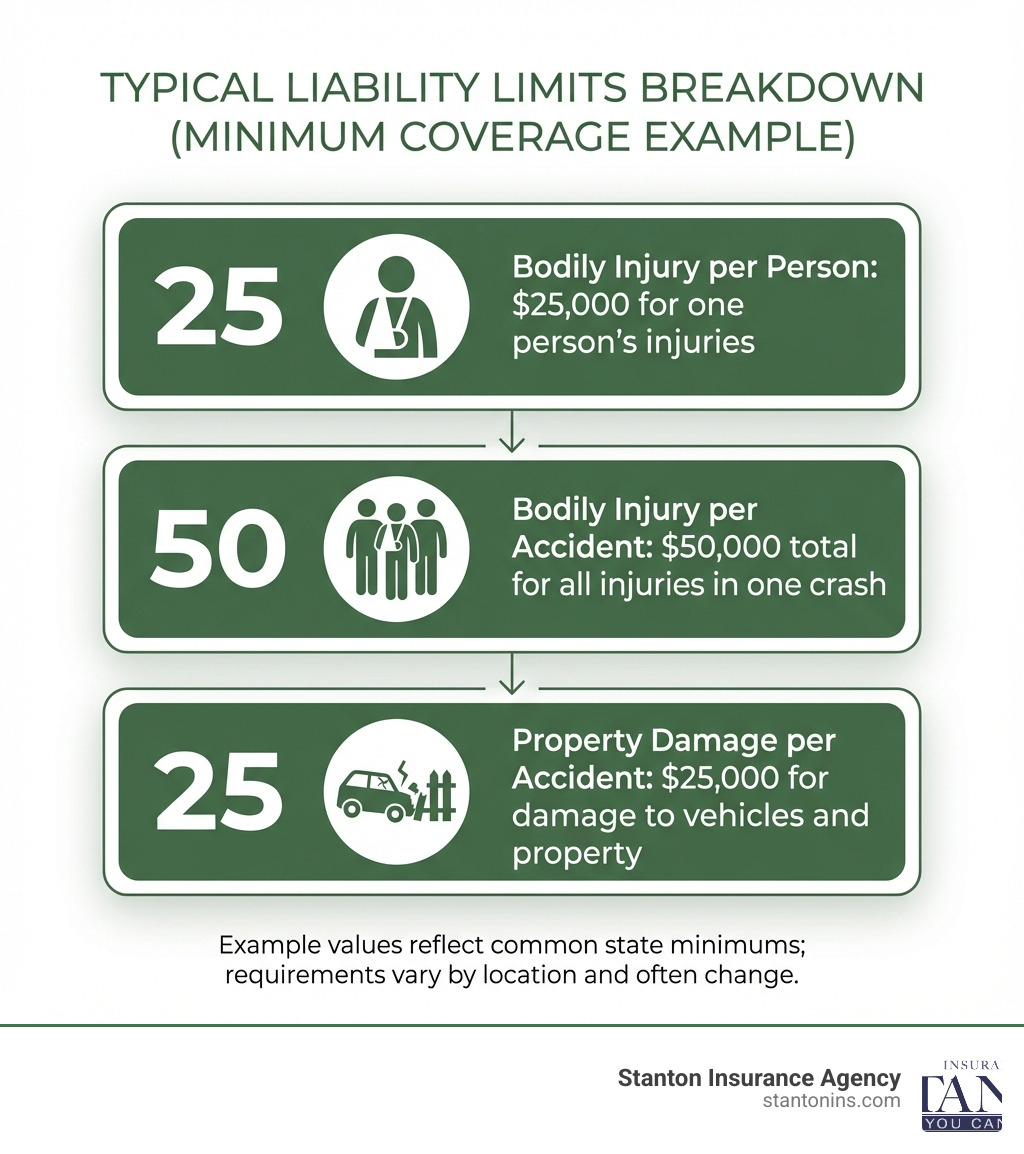
The absolute minimum auto insurance policy in Colorado must consist of three core components: bodily injury liability for one person, bodily injury liability for all persons injured in a single accident, and property damage liability. These limits are expressed numerically as a split-limit ratio.
The statutory minimum limits established by the state of Colorado are:
- $25,000 for bodily injury or death of one person in any single accident.
- $50,000 for total bodily injury or death of all persons in any single accident.
- $15,000 for property damage to another person's vehicle or physical property in any single accident.
These figures represent the absolute maximum amounts your insurance carrier will pay out per accident for injuries or property damage you cause to others. If the total cost of the accident exceeds these limits, you remain personally responsible for paying the remaining balance out of pocket.
Understanding Bodily Injury Liability
Bodily injury liability covers medical bills, rehabilitation costs, lost wages, and legal defense fees for drivers, passengers, or pedestrians whom you injure in an auto accident. The $25,000 cap applies to an individual victim, meaning if one person's medical expenses reach $35,000, your policy pays the first $25,000, and you must cover the remaining $10,000. The $50,000 aggregate cap limits total payouts for a multi-person collision.
Understanding Property Damage Liability
Property damage liability pays for repairs or replacement of physical items belonging to others that you damage with your vehicle. This most frequently includes other cars, but it also extends to utility poles, mailboxes, guardrails, fences, and buildings. The mandatory $15,000 limit can be depleted rapidly given modern vehicle repair costs and the proliferation of high-end automobiles on the road.
Optional Coverages Excluded from the Absolute Minimum
Opting for absolute minimum auto insurance means intentionally excluding several valuable types of coverage. Because minimum policies only protect third parties—meaning the people you hit—they leave your own vehicle and personal well-being unprotected.
- Collision Coverage: Pays to repair or replace your own vehicle if you hit another car, a tree, or a guardrail, regardless of fault.
- Comprehensive Coverage: Protects your car against non-collision incidents, including theft, vandalism, fire, hail, flooding, and hitting an animal.
- Medical Payments (MedPay): Covers medical and funeral expenses for you and your passengers after an accident, regardless of who is at fault. Colorado insurers are legally required to offer MedPay, but policyholders have the right to decline it in writing.
- Uninsured/Underinsured Motorist (UM/UIM): Protects you if you are hit by a driver who carries no insurance or whose policy limits are too low to cover your medical bills. Insurance companies must also offer UM/UIM coverage, which can likewise be rejected in writing.
Comparing Minimum Liability to Comprehensive Protection
To evaluate whether absolute minimum auto insurance suits your financial situation, reviewing a direct comparison against a standard full-coverage policy clarifies the trade-offs involved.
| Coverage Feature | Absolute Minimum Insurance | Full Coverage Policy |
|---|---|---|
| Legal Compliance | Meets Colorado minimum requirements | Exceeds Colorado minimum requirements |
| Third-Party Injury Payouts | Up to $25,000 / $50,000 | Higher limits available ($100k/$300k or more) |
| Third-Party Property Payouts | Up to $15,000 | Higher limits available ($50,000 to $100,000+) |
| Damage to Your Car | Not covered | Covered via Collision and Comprehensive |
| Your Medical Expenses | Not covered (unless MedPay added) | Covered via MedPay and Personal Injury Protection equivalents |
| Monthly Premium Cost | Lowest possible market rate | Significantly higher due to broader risk exposure |
| Personal Financial Risk | Extremely high after an at-fault crash | Substantially mitigated |
Financial Costs and Influencing Factors
While absolute minimum auto insurance represents the cheapest legal way to insure a vehicle in Colorado, the actual price varies significantly based on individual risk factors. Insurance underwriting algorithms evaluate multiple variables to determine your specific premium.
- Location: Urban areas such as Denver, Aurora, and Colorado Springs typically experience higher insurance rates due to heavy traffic density, higher rates of vehicle theft, and increased accident frequency compared to rural mountain counties.
- Driving Record: Speeding tickets, at-fault accidents, and driving under the influence (DUI) convictions cause substantial rate increases, often disqualifying drivers from the lowest-tier pricing even for minimum policies.
- Age and Experience: Teenage drivers and motorists under the age of 25 face the highest insurance costs because statistical data indicates a higher probability of collision involvement.
- Credit History: In accordance with state regulations, insurance companies factor credit-based insurance scores into pricing models, where lower credit scores correlate with higher premium charges.
- Vehicle Make and Model: Even though minimum liability does not pay to fix your car, the statistical profile of drivers who operate certain vehicle types influences liability claims data, affecting the base rate.
Risks and Financial Dangers of Carrying Minimum Limits
Choosing absolute minimum limits carries substantial financial exposure. Vehicle repair costs have risen significantly, and modern cars feature expensive computerized sensors, cameras, and aluminum body panels that drive up repair bills.
If you cause an accident that totals a vehicle worth $40,000, and your property damage liability limit is $15,000, you are personally liable for the remaining $25,000. Creditors can pursue your personal assets, including bank accounts, savings, and future wages, through civil lawsuits and court-ordered garnishments. Similarly, if you injure multiple people and medical bills exceed $50,000, injured parties can sue you directly for the deficit. For individuals with significant personal assets, homeownership, or steady employment, carrying minimum limits exposes those assets to severe legal vulnerability.
Frequently Asked Questions
Does absolute minimum auto insurance in Colorado cover my own car if I get into an accident?
No. Absolute minimum auto insurance only provides liability coverage for bodily injury and property damage caused to other people when you are at fault. It provides zero financial assistance for repairing or replacing your own vehicle. To protect your own car, you must purchase optional collision and comprehensive coverages.
Can I legally decline MedPay and Uninsured Motorist coverage in Colorado?
Yes. Colorado law requires insurance providers to include Medical Payments (MedPay) and Uninsured/Underinsured Motorist (UM/UIM) coverage on every policy quote, but consumers have the legal right to reject them. To decline these options, insurers typically require a signed written waiver or electronic acknowledgment confirming the rejection.
What happens if I am caught driving without insurance in Colorado?
Driving without proof of insurance in Colorado results in strict penalties enforced by the Department of Revenue. First-time offenders face fines starting at $500, mandatory suspension of driving privileges until proof of insurance is provided, and the requirement to file an SR-22 form for three years. Subsequent offenses carry higher fines, longer suspensions, and potential community service.
Are Colorado minimum limits sufficient for most drivers?
Statistically, Colorado's $25k/$50k/$15k limits are often considered inadequate for protecting personal assets in modern traffic conditions. Because average vehicle prices and medical costs easily exceed these thresholds in a moderate-to-severe accident, financial advisors and insurance professionals generally recommend higher limits, such as $100,000/$300,000/$50,000, if budget permits.
How do insurance companies verify my insurance status in Colorado?
Colorado utilizes an electronic verification system managed by the state in partnership with insurance carriers. This system regularly cross-references active vehicle registrations against active insurance policies. If your insurance lapses or cancels, your carrier reports the change to the state, prompting a notification requiring proof of new coverage to avoid license suspension.
Next Actions and Recommendations
Before purchasing an absolute minimum auto insurance policy in Colorado, evaluate your personal financial exposure rather than focusing solely on securing the lowest monthly payment. If you own a home, possess substantial savings, or drive a high-value vehicle, consult with a licensed insurance broker to compare quotes for higher liability limits and asset protection features. Request rate comparisons for $50,000/$100,000/$50,000 limits, as increasing your coverage often costs only a few extra dollars per month while shielding you from catastrophic personal debt after an unexpected accident.