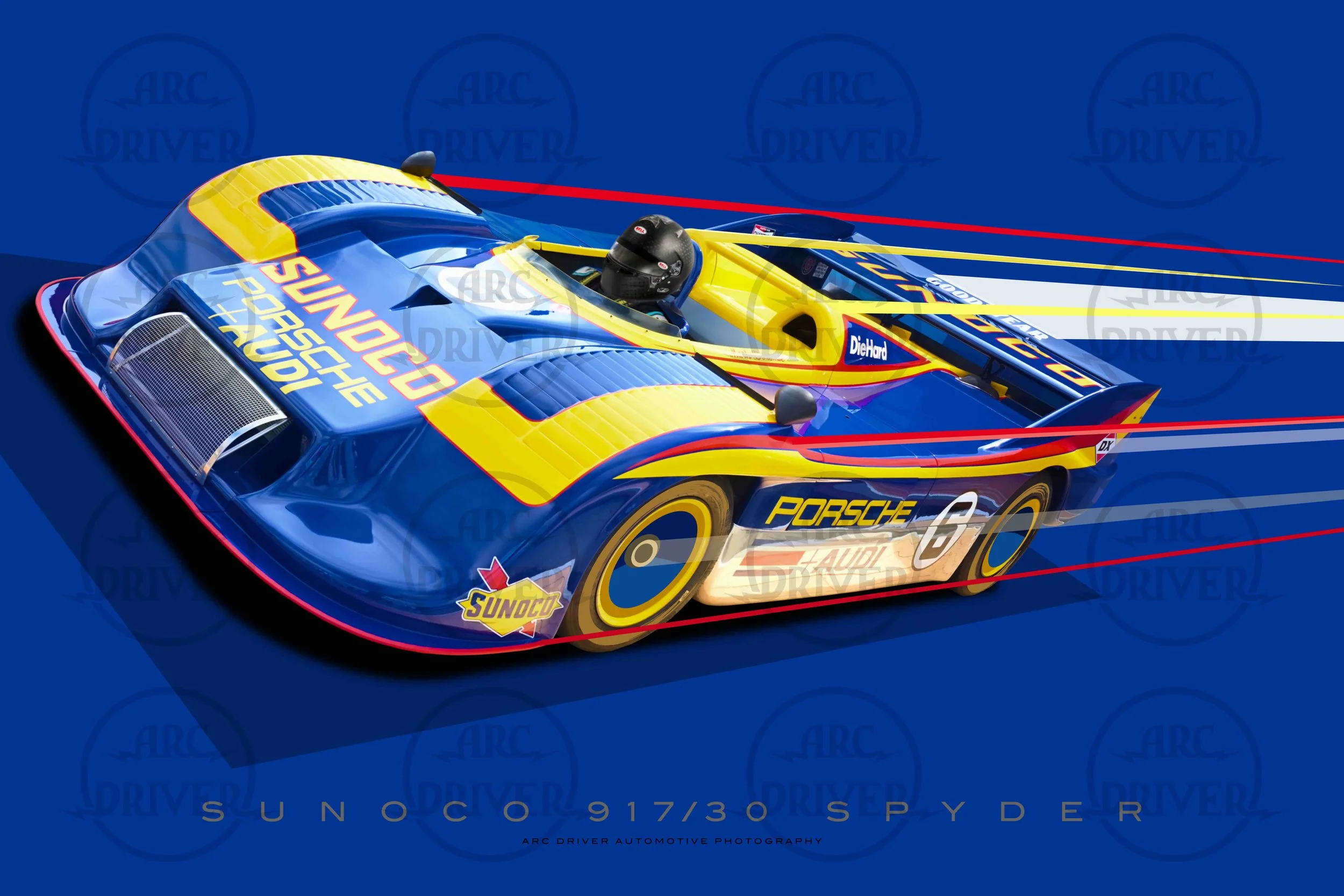
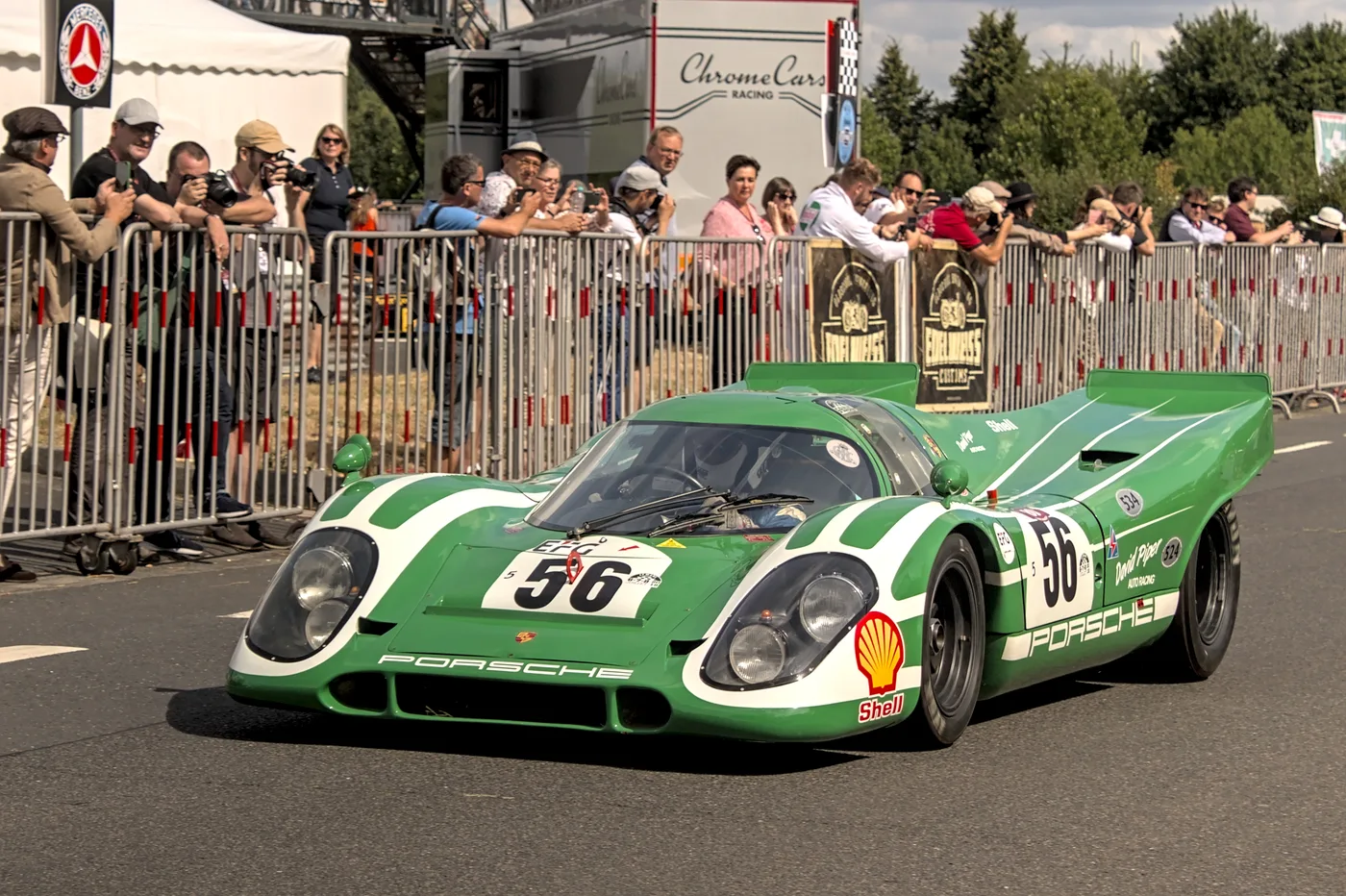
The Porsche 917/30 Spyder remains the most powerful road-racing car ever built, a twin-turbocharged behemoth that dominated the 1973 Can-Am season with such authority it effectively forced a change in racing regulations. Defined by its 1,100 to 1,580 horsepower output, 240-plus mph top speed, and an extreme rarity with only six chassis ever produced, it represents the absolute zenith of the internal combustion racing era.
The Heart of the Beast: Engineering Unprecedented Power
The core of the Porsche 917/30’s legend is its engine—the Type 912/52. While the original 917 utilized a naturally aspirated flat-12, the 917/30 evolution pushed the boundaries of forced induction to levels previously thought impossible for a reliable endurance machine. By 2026, even with the advent of high-output electric hypercars, the raw, mechanical violence of the 917/30's power delivery remains a benchmark for automotive historians and engineers.
The 5.4-Liter Flat-12 Architecture
The engine was an air-cooled, 5.4-liter 180-degree V12 (often referred to as a flat-12). Porsche engineers increased the bore to 90mm, resulting in a total displacement of 5,374cc. What set this engine apart was the integration of two Eberspächer turbochargers. In an era before sophisticated electronic engine management, managing the boost from these massive turbos was a feat of manual engineering.
Drivers had access to a "boost knob" in the cockpit, allowing them to vary the turbo pressure. For race endurance, the engine was typically tuned to produce approximately 1,100 horsepower at 1.3 bar of boost. However, for qualifying sessions where longevity was less critical, the boost could be turned up to 2.0 bar, resulting in a staggering 1,580 horsepower. To put this in perspective, the car weighed only 800 kilograms (approximately 1,760 lbs), giving it a power-to-weight ratio that exceeds almost every modern supercar in production today.
The Challenge of Turbo Lag and Delivery
One of the most significant technical hurdles was turbo lag. The 917/30 used a mechanical fuel injection system provided by Bosch, which had to be meticulously calibrated to ensure the engine didn't run lean under high boost. Because the turbochargers were so large, there was a noticeable delay between the driver hitting the throttle and the surge of power. This required a specific driving style—drivers like Mark Donohue had to anticipate corners, applying the throttle well before the apex so that the power would arrive exactly when the car was straightened out.
Physics Defied: Unmatched Speed and Acceleration
The 917/30 was not merely a "dragster" meant for straight lines; it was designed to conquer the diverse tracks of the Canadian-American Challenge Cup (Can-Am). However, its straight-line performance figures are what capture the imagination.
Performance Benchmarks
In 1973, the 917/30 recorded a 0-60 mph time of roughly 1.9 seconds, a figure that remains competitive with the most advanced all-wheel-drive electric vehicles of 2026. Its 0-100 mph time was approximately 3.9 seconds, and it could reach 200 mph in under 11 seconds.
The top speed was officially clocked at over 240 mph (386 km/h). In August 1975, Mark Donohue took a slightly modified 917/30 to the Talladega Superspeedway, where he set a closed-course world speed record with an average lap speed of 221.12 mph (355.85 km/h). This record stood for four years, illustrating the car’s aerodynamic stability and sustained power output.
Aerodynamics and the "Long-Tail" Spyder
To handle such immense speeds, Porsche developed a specialized body for the 917/30. Unlike the earlier 917/10, which had a shorter wheelbase and was prone to twitchiness, the 917/30 featured a longer wheelbase (extended by 184mm) to improve high-speed stability.
The bodywork was a masterclass in functional "wedge" design. The massive rear wing provided the necessary downforce to keep the rear wheels—shod with 17-inch wide Firestone tires—connected to the tarmac. The front nose was designed to be low and wide, minimizing lift. However, the sheer drag created by the downforce-heavy setup meant that the engine’s massive power was required just to "punch" through the air at speeds exceeding 200 mph.
The Rarity of the 917/30: A Finite Legacy
When discussing the 917/30, the term "rare" is an understatement. While many 917 variants were produced (including the K, LH, and 917/10 models), the 917/30 is the most exclusive. Only six chassis were ever officially designated as 917/30 units.
Chassis Breakdown
- 917/30-001: The prototype car. It featured an adjustable wheelbase and was used extensively for testing the new turbocharging configurations.
- 917/30-002: The primary race car used by Mark Donohue during the 1973 Can-Am season. This is the iconic "Sunoco" blue and yellow car that won six out of eight races.
- 917/30-003: A backup/spare car for the Penske team, also painted in the Sunoco livery.
- 917/30-004, 005, and 006: These chassis were built but not campaigned during the primary Can-Am season due to the sudden change in fuel consumption regulations which effectively banned the car for the 1974 season. These cars eventually made their way into private collections or museums.
As of 2026, the 917/30-002 remains one of the most valuable racing cars in existence. Its provenance as a championship winner, combined with the tragic legacy of Mark Donohue, elevates it beyond a mere machine into a piece of high-performance art. When these vehicles occasionally appear at prestigious events like the Goodwood Festival of Speed or the Monterey Motorsports Reunion, they are treated with the reverence usually reserved for national treasures.
Historical Context: The Can-Am Dominance and the Penske Partnership
To understand why the 917/30 is so significant, one must look at the competitive landscape of the early 1970s. The Can-Am series was essentially "Formula Liberty." There were very few restrictions on engine size, turbocharging, or aerodynamics.
The Donohue-Penske Synergy
The development of the 917/30 was a collaborative effort between Porsche in Stuttgart and Roger Penske’s racing team in the United States. Mark Donohue, often called "Captain Nice," was not just a driver but a brilliant engineer. He spent months in Germany working with Porsche’s engineers to refine the 917/30's handling.
Before the 917/30, McLaren had dominated Can-Am with their orange "M-series" cars. In 1972, the Porsche 917/10 began to chip away at that dominance. By 1973, however, the introduction of the 917/30 ended the competition entirely. Donohue and the 917/30 were so much faster than the rest of the field that they often lapped the entire pack.
The "Unfair Advantage"
The dominance was so absolute that spectators began to lose interest in the predictable outcomes. This led to the SCCA (Sports Car Club of America) introducing fuel consumption limits for the 1974 season. Since the 917/30 consumed fuel at a rate of roughly 2 miles per gallon under full race conditions, it could no longer compete. This regulation change effectively "killed" the 917/30 and accelerated the decline of the original Can-Am era.
Technical Specifications: 917/30 vs. Industry Peers
The following table compares the 917/30 to its predecessor and its primary rival of the era to illustrate the massive leap in technical capability it represented.
| Specification | Porsche 917/30 (1973) | Porsche 917/10 (1972) | McLaren M20 (1972) |
|---|---|---|---|
| Engine Type | 5.4L Twin-Turbo Flat-12 | 5.0L Twin-Turbo Flat-12 | 8.1L Chevrolet V8 (NA) |
| Horsepower (Race) | ~1,100 hp | ~900 hp | ~750 hp |
| Max Horsepower | 1,580 hp (Qualifying) | 1,100 hp | ~800 hp |
| Weight | 800 kg (1,763 lbs) | 767 kg (1,691 lbs) | 710 kg (1,565 lbs) |
| Top Speed | 240+ mph | 215 mph | 200 mph |
| Wheelbase | 2,500 mm | 2,316 mm | 2,413 mm |
| Transmission | 4-Speed Manual | 4-Speed Manual | 4-Speed Manual |
Challenges of Operating the 917/30
Operating a 917/30 in 2026 is a monumental task that requires a dedicated team of vintage racing specialists. The technical complexity of the 1970s turbocharging system means that every component is under extreme thermal and mechanical stress.
Cooling and Lubrication
Despite its massive power, the 917/30 is air-cooled. It relies on a giant horizontal fan sitting atop the engine, driven by the crankshaft. This fan sucks in air to cool the cylinders and the massive oil coolers. At idle, the car can overheat rapidly; it must be moving at speed to stay within safe operating temperatures. Furthermore, the oil system is a dry-sump design holding nearly 30 liters of specialized lubricant to ensure the turbo bearings remain functional under high heat.
Driver Demand
Driving the 917/30 is famously physically exhausting. It lacks power steering, power brakes, and any form of traction control or ABS. The clutch is incredibly heavy, and the four-speed gearbox requires precise, deliberate movements. Drivers must manage the massive torque—often exceeding 800 lb-ft—to avoid spinning the rear tires even in third or fourth gear.
Ownership and Preservation in 2026
For collectors, the 917/30 represents the "Holy Grail." Because of its rarity and its role as the ultimate expression of the 917 platform, market values are difficult to quantify. Most 917/30s are held in permanent collections, such as the Porsche Museum in Stuttgart or the Revs Institute.
If a 917/30 were to come to public auction in 2026, experts suggest it would command a price well into the eight-figure range, potentially exceeding $20 million to $30 million depending on the specific chassis history and condition. The cost of a "simple" engine rebuild for the Type 912/52 can exceed $500,000, as many parts must be custom-machined to original specifications since no new old stock (NOS) parts remain.
Frequently Asked Questions
Why is the Porsche 917/30 called the "Can-Am Killer"?
The 917/30 was so dominant during the 1973 season that it effectively ended competitive balance. It won six consecutive races with Mark Donohue at the wheel, often finishing laps ahead of the competition. This led the SCCA to implement fuel restrictions specifically designed to make the thirsty 917/30 ineligible, which many enthusiasts believe led to the eventual collapse of the Can-Am series.
How much horsepower does the 917/30 actually have?
In race trim, the 5.4L engine produced approximately 1,100 hp. However, by turning the "boost knob" to its maximum setting for qualifying, the engine was capable of producing up to 1,580 hp. It remains the most powerful circuit-racing car ever built by Porsche.
Is the Porsche 917/30 street legal?
No, the 917/30 is a dedicated racing machine with no headlights (in its standard configuration), no indicators, and ground clearance that would make driving on public roads impossible. However, one famous 917 (a 917K chassis) was modified by Count Rossi for street use in the 1970s. The 917/30, however, remains strictly a track car.
What happened to Mark Donohue's 917/30?
The primary race car (917/30-002) was retired after the 1973 season and the 1975 speed record run. It has been meticulously preserved and is frequently displayed by Porsche at major historical automotive events. It remains in its iconic Sunoco livery.
How does the 917/30 compare to modern F1 cars?
In terms of raw horsepower, the 917/30 (at qualifying boost) actually has more power than a modern 2026 Formula 1 car, which typically produces around 1,000 hp from its hybrid power unit. However, modern F1 cars are significantly lighter and have vastly superior aerodynamics and braking, making them much faster around a contemporary circuit.
Practical Recommendations for Enthusiasts
For those who wish to experience the power, speed, and rarity of the 917/30 without having a multi-million dollar budget, several avenues exist:
- Visit the Porsche Museum: The museum in Stuttgart frequently displays a 917/30. Seeing the scale of the car and its engine in person is the only way to truly appreciate the engineering.
- Attend the Rennsport Reunion: This event, held every few years at WeatherTech Raceway Laguna Seca, is the world's largest gathering of Porsche race cars. It is one of the few places where you might see—and hear—a 917/30 running on a track.
- Sim Racing: High-fidelity simulators like Assetto Corsa or iRacing have accurately modeled the 917/30. While it lacks the physical G-forces, it provides a startlingly accurate representation of the turbo lag and the difficulty of managing 1,100 horsepower through only two rear wheels.
The Porsche 917/30 is a reminder of an era where the only limit was the bravery of the driver and the imagination of the engineers. In 2026, it stands as a monument to the peak of the mechanical racing age.