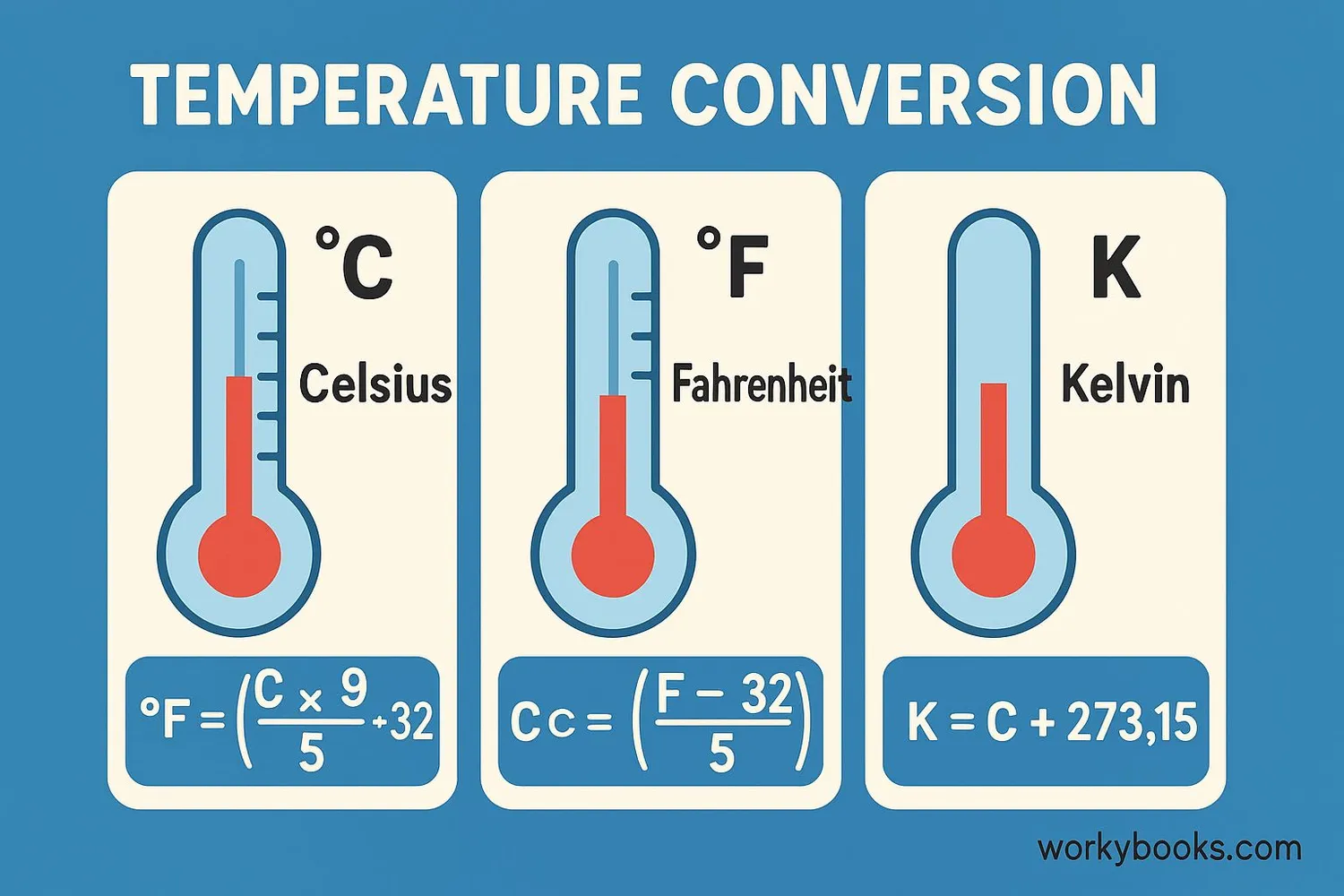
Converting 30 degrees Fahrenheit to Celsius yields approximately -1.11 degrees Celsius, sitting just below the freezing point of water at 32°F (0°C). This specific temperature represents a critical threshold in meteorology, home maintenance, and outdoor activities, marking the exact point where rain can transition into freezing precipitation, ice begins to form on exposed surfaces, and cold-weather protocols must be activated.
The Mathematical Foundation of Temperature Conversion
To transition accurately between Fahrenheit and Celsius scales, it is necessary to examine the mathematical formulas that bridge these two distinct thermodynamic systems. Developed in the early 18th century, the Fahrenheit scale sets the freezing point of water at 32 degrees and the boiling point at 212 degrees under standard atmospheric pressure, creating a 180-degree interval between these milestones. In contrast, the Celsius scale, formulated by Anders Celsius, establishes a more decimal-friendly range with 0 degrees representing the freezing point and 100 degrees marking the boiling point of water.
Because the starting points and the size of the degrees differ between the two scales, a direct conversion requires both a subtraction (or addition) and a fractional multiplication step. The standard formula to convert Fahrenheit ($F$) to Celsius ($C$) is:
$$C = (F - 32) \times \frac{5}{9}$$
When applying this formula to 30 degrees Fahrenheit, the step-by-step calculation unfolds as follows:
- Subtract 32 from the Fahrenheit value: $$30 - 32 = -2$$
- Multiply the result by 5: -2 \times 5 = -10
- Divide that product by 9: -10 \div 9 \approx -1.111...
Thus, 30°F is precisely $-1.11^\circ\text{C}$ (often rounded to $-1.1^\circ\text{C}$ for everyday applications).
Conversely, verifying this calculation by converting Celsius back to Fahrenheit utilizes the inverse formula:
$$F = (C \times \frac{9}{5}) + 32$$
Multiplying $-1.11$ by $\frac{9}{5}$ yields $-2$, and adding 32 returns the original value of 30°F. Understanding these underlying equations eliminates reliance on guesswork and ensures precision in scientific, industrial, and culinary contexts.
Meteorological Significance: The Freezing Threshold
In meteorology, crossing from just above freezing to 30 degrees Fahrenheit introduces distinct physical dynamics in the atmosphere and on the ground. Water does not automatically turn to solid ice the moment the thermometer drops to 32°F; supercooled liquid water droplets can remain liquid in the air even slightly below the freezing mark if nucleation sites are absent. However, once ambient temperatures settle at 30°F, freezing processes accelerate rapidly.
Phase Changes and Precipitation Types
At 30°F, precipitation frequently manifests as a wintry mix, wet snow, or freezing rain. When warm air layers aloft override a surface temperature of 30°F, falling snowflakes melt into rain, only to pass through a sub-freezing layer near the ground. Upon striking unheated surfaces—such as roadways, bridges, power lines, and aircraft wings—this supercooled liquid instantly freezes, creating hazardous sheets of clear ice known as black ice.
Frost and Plant Physiology
For agriculture and horticulture, 30°F represents a moderate to hard freeze depending on the duration of exposure. Tender annual vegetation experiences cellular rupture as intracellular water expands into ice crystals, leading to widespread cell death and blackened foliage. Hardy perennials, deciduous trees, and winter crops generally withstand 30°F without severe damage, having initiated hardening-off processes during autumn. Gardeners and orchard managers monitor these readings closely to deploy protective covers, frost cloths, or localized heating mechanisms before nightfall.
Practical Comparisons Around Freezing Point
Contextualizing 30 degrees Fahrenheit alongside surrounding temperatures helps clarify its relative warmth or severity within winter conditions. The table below outlines key temperature milestones near the freezing mark, comparing Fahrenheit and Celsius values alongside their practical physical effects.
| Fahrenheit (°F) | Celsius (°C) | Physical State and Environmental Impact |
|---|---|---|
| 35°F | +1.67°C | Cold rain; frost unlikely; safe for untreated outdoor plumbing. |
| 32°F | 0.00°C | Exact freezing point of pure water; ice begins to form on still water bodies. |
| 30°F | -1.11°C | Slight freeze; black ice potential on roads; frost forms on vegetation. |
| 25°F | -3.89°C | Moderate freeze; frozen ground; hard frost; ice accumulation on surfaces. |
| 20°F | -6.67°C | Deep freeze; risk of frozen residential pipes increases significantly. |
| 15°F | -9.44°C | Severe cold; high heating demand; heavy snow powder potential. |
Examining this spectrum demonstrates that 30°F is merely two degrees below the official freezing mark. While it does not represent extreme polar cold, it is cold enough to catch motorists and homeowners unprepared if surfaces remain damp when temperatures cross the threshold.
Infrastructure, Home Maintenance, and Safety Considerations
Managing properties and personal safety at 30°F requires specific precautions, particularly during the late autumn or early spring transition periods when ground temperatures have not yet plunged to seasonal lows.
Residential Plumbing and Pipe Vulnerability
While severe pipe bursts typically occur during prolonged cold snaps well below 20°F, vulnerable exterior lines, uninsulated crawlspaces, and garden hose bibs can be affected at 30°F if exposed to brisk winds or sustained sub-freezing hours. Homeowners should disconnect garden hoses, shut off interior valves to outdoor spigots, and ensure that crawlspace vents are secured against chilling drafts.
Automotive Safety and Traction
Road surfaces often retain residual heat from daytime sunlight, delaying ice formation. However, elevated structures such as highway overpasses, bridges, and shaded secondary roads lose heat rapidly. At 30°F, moisture on these vulnerable surfaces freezes long before standard roadways show signs of ice. Drivers should remain alert for black ice, maintain increased braking distances, and verify that tire pressure is adjusted for lower ambient temperatures, as tire pressure drops roughly 1 to 2 PSI for every 10°F decrease.
Outdoor Activity and Cold Exposure
For humans, 30°F is brisk but manageable with appropriate winter attire, including insulated coats, gloves, and hats. Frostbite and hypothermia are generally not immediate risks during short exposures at this temperature, provided clothing remains dry. However, individuals engaged in sedentary outdoor activities or those exposed to wind chill factors—which lower the effective temperature further—must guard against prolonged exposure, particularly on extremities.
Frequently Asked Questions
Is 30 degrees Fahrenheit colder than 0 degrees Celsius?
Yes, 30°F is colder than 0°C. Since 0°C equals 32°F, a temperature of 30°F sits two Fahrenheit degrees below the freezing point of water, whereas 0°C is the freezing point itself. Therefore, 30°F is equivalent to approximately -1.11°C.
How do I quickly estimate Fahrenheit to Celsius in my head?
To make a quick mental estimate without using the precise formula, subtract 30 from the Fahrenheit temperature and then divide that result by 2. For 30°F, subtracting 30 yields 0, and dividing by 2 gives 0°C (close to the actual -1.11°C). While this mental shortcut loses accuracy at higher or lower extremes, it provides a fast approximation near the freezing point.
Does snow fall when it is 30 degrees Fahrenheit?
Snow falls frequently at 30°F. In fact, many meteorologists consider temperatures between 25°F and 32°F ideal for producing light, powdery, or moderately packed snow because the air holds little moisture and prevents immediate melting during descent.
Will pipes freeze when the outdoor temperature is 30°F?
Pipes located entirely within heated interior walls will not freeze at 30°F. However, uninsulated pipes in exterior walls, attics, garages, or crawlspaces can freeze if the outdoor temperature remains at or below 30°F for an extended period, especially when combined with wind chill effects.
How does wind chill affect a temperature of 30 degrees Fahrenheit?
Wind chill does not lower the actual physical temperature of inanimate objects like water, metal, or vehicles below 30°F, but it accelerates heat loss from exposed human and animal skin. A 30°F air temperature paired with a 15 mph wind can make the environment feel significantly colder—closer to 20°F—increasing the rate at which body heat dissipates.
Conclusion and Next Actions
Converting 30 degrees Fahrenheit to Celsius establishes a precise baseline of -1.11°C, marking an essential environmental threshold just below the freezing point of water. Whether monitoring weather forecasts, preparing a garden for frost, or managing home infrastructure against ice hazards, recognizing the implications of this temperature ensures appropriate safety and preventative maintenance. For future weather tracking, keep a reliable conversion formula in mind or utilize digital tools to maintain accuracy across different regional measurement systems.