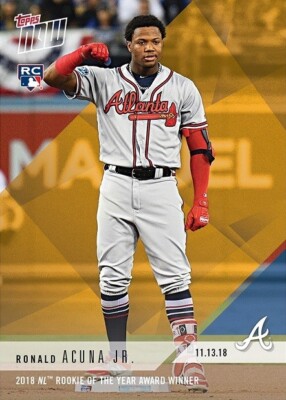
The 2018 National League Rookie of the Year was outfielder Ronald Acuña Jr. of the Atlanta Braves. His selection marked a defining moment in a highly competitive rookie class, as he outperformed fellow contenders including Juan Soto and Walker Buehler to secure the Baseball Writers' Association of America (BBWAA) honor. Acuña’s performance that year set the foundation for his status as a premier talent in Major League Baseball.
The Significance of the 2018 National League Rookie Class
The 2018 season is often cited by baseball historians and analysts as one of the deepest and most talented rookie classes in the history of the National League. While individual awards typically focus on one player, the race for the 2018 NL Rookie of the Year was a tight contest that highlighted the emergence of a new generation of superstars.
The competition was defined by a mix of high-ceiling prospects and players who were thrust into major league roles due to injury or roster vacancies. Ronald Acuña Jr., representing the Atlanta Braves, faced stiff competition from Washington Nationals outfielder Juan Soto, who debuted as a 19-year-old, and Los Angeles Dodgers pitcher Walker Buehler, who anchored a pitching staff that eventually reached the World Series.
This competition elevated the importance of the award. Unlike years where the winner is a clear standout, the 2018 race required voters to weigh different types of production—Acuña’s power-speed combination against Soto’s on-base prowess and Buehler’s dominance on the mound.
Ronald Acuña Jr.: A Historical Performance
Ronald Acuña Jr. entered the 2018 season as the consensus top prospect in baseball. His debut in April 2018 was highly anticipated, and he largely lived up to the immense expectations placed upon him by scouts and fans alike.
Throughout the 2018 campaign, Acuña displayed a unique set of tools. He finished the season with 26 home runs, 64 runs batted in, and 16 stolen bases, all while maintaining an impressive slash line of .293/.366/.552. Beyond the raw statistics, his impact was felt in his ability to change the complexion of a game from the leadoff spot. His flair for the dramatic, including hitting home runs in five consecutive games during the summer, helped propel the Atlanta Braves to an NL East division title, their first since 2013.
Key Statistics for the Top 2018 NL Rookie Contenders
When evaluating why Acuña secured the award, it is useful to look at the comparative statistical output of the top three finishers in the voting.
| Player | Position | Games Played | Home Runs | Stolen Bases | OPS |
|---|---|---|---|---|---|
| Ronald Acuña Jr. | OF | 111 | 26 | 16 | .917 |
| Juan Soto | OF | 116 | 22 | 5 | .923 |
| Walker Buehler | P | 24 | N/A | N/A | 2.62 ERA |
The table above illustrates the diverse skill sets of the top contenders. While Juan Soto posted a slightly higher On-Base Plus Slugging (OPS) percentage, voters ultimately favored Acuña’s overall contributions to a winning team and his dynamic power-speed profile.
The Voting Process and BBWAA Criteria
The National League Rookie of the Year award is voted on by members of the Baseball Writers' Association of America. Each voter submits a ballot containing their top three choices, with points assigned on a 5-3-1 basis.
In 2018, the voting was reflective of the narrow margins between the top candidates. Acuña received 27 of the 30 first-place votes, totaling 144 points. Juan Soto received two first-place votes, while Walker Buehler received one. This discrepancy does not necessarily imply a massive gap in talent between the three, but rather reflects the different stylistic preferences of the voting body at that time.
Some voters prioritized the impact of a starting pitcher like Buehler, whose 2.62 ERA and 1.9 WAR (according to Baseball-Reference) were instrumental in a pennant-winning run. Others focused on the offensive longevity and consistency shown by Soto, who arrived in May but produced at an elite level. However, the majority of the electorate converged on Acuña because of his role in the Braves' turnaround and his ability to excel in multiple facets of the game.
Challenges and Considerations for Rookies
Winning the Rookie of the Year is often described as the "first step" in a professional career, but it comes with unique pressures. For players like Acuña, the 2018 season served as a trial by fire.
Adjusting to Major League Pitching
One of the primary challenges for any rookie is the rapid adjustment required at the major league level. Pitchers in MLB possess superior control, better movement, and more strategic intent than those in the minor leagues. Acuña's ability to adjust his approach throughout the summer of 2018—particularly his ability to handle breaking balls—was a major reason for his sustained success.
The Mental Toll of the Long Season
A standard MLB season consists of 162 games, a significant increase from the typical minor league schedule. Rookies often hit a "wall" around the mid-point of the season, where physical exhaustion begins to impact performance. Acuña’s success in maintaining his offensive output through August and September was a critical factor in the Braves securing the division title, as he provided consistent production during the heat of the pennant race.
The Long-Term Impact of the 2018 Season
Looking back from 2026, the 2018 NL Rookie of the Year race is viewed as a "snapshot" of the future of the sport. The players involved in that year’s vote have all gone on to become the faces of their respective franchises.
Ronald Acuña Jr. solidified his role as a cornerstone of the Braves' organization, signing a long-term contract extension that kept him in Atlanta for the prime years of his career. Juan Soto continued his trajectory as one of the most disciplined hitters in baseball history, while Walker Buehler established himself as a frontline starter capable of anchoring a rotation in the postseason.
For the Atlanta Braves specifically, the 2018 season served as a proof-of-concept. The organization had undergone a significant rebuilding period, and the arrival of Acuña signaled that the rebuild was complete. His Rookie of the Year performance became the catalyst for a sustained period of competitive baseball for the franchise, influencing front-office decisions regarding future acquisitions and team culture.
Frequently Asked Questions
Did Ronald Acuña Jr. win the award unanimously?
No, the 2018 NL Rookie of the Year vote was not unanimous. Ronald Acuña Jr. received 27 of the 30 first-place votes. The remaining three first-place votes were split between Juan Soto and Walker Buehler.
Who were the primary competitors for the 2018 award?
The primary competitors were Juan Soto of the Washington Nationals and Walker Buehler of the Los Angeles Dodgers. Both players were considered strong candidates due to their impressive offensive and pitching metrics, respectively.
What statistics did Acuña prioritize during his rookie season?
While there is no single "priority" statistic, Acuña was highly valued for his power-speed combination. Recording 26 home runs and 16 stolen bases in just 111 games showed that he was a multi-dimensional threat who could score from any spot in the lineup.
How did the 2018 NL Rookie of the Year race affect future awards?
The competitiveness of the 2018 race set a high bar for subsequent rookie classes. It reinforced the notion that writers look at a combination of traditional statistics, advanced analytics, and "team impact"—specifically how a rookie’s arrival changes the competitive standing of their team.
Is the Rookie of the Year award limited to players under a certain age?
No. The primary eligibility for the Rookie of the Year award is based on service time rather than age. A player must not have exceeded 130 at-bats or 50 innings pitched in a previous major league season to be eligible for the award.
Recommendations for Further Research
For those looking to gain a deeper understanding of the 2018 baseball landscape, reviewing the full voting breakdowns from the BBWAA website provides insight into how individual writers prioritized different statistics at that time. Additionally, looking at the "Advanced Metrics" for the 2018 season—such as Statcast data—can show exactly how Acuña's exit velocities and sprint speeds compared to his peers, which explains much of the "eye test" success he displayed that year.
To track the ongoing careers of these players, historical archives from Baseball-Reference and the official Major League Baseball statistics portal offer the most accurate year-by-year comparisons. These resources will show that while the 2018 Rookie of the Year award was a singular honor, the success of the 2018 class has defined much of the league's competitive identity in the years since.