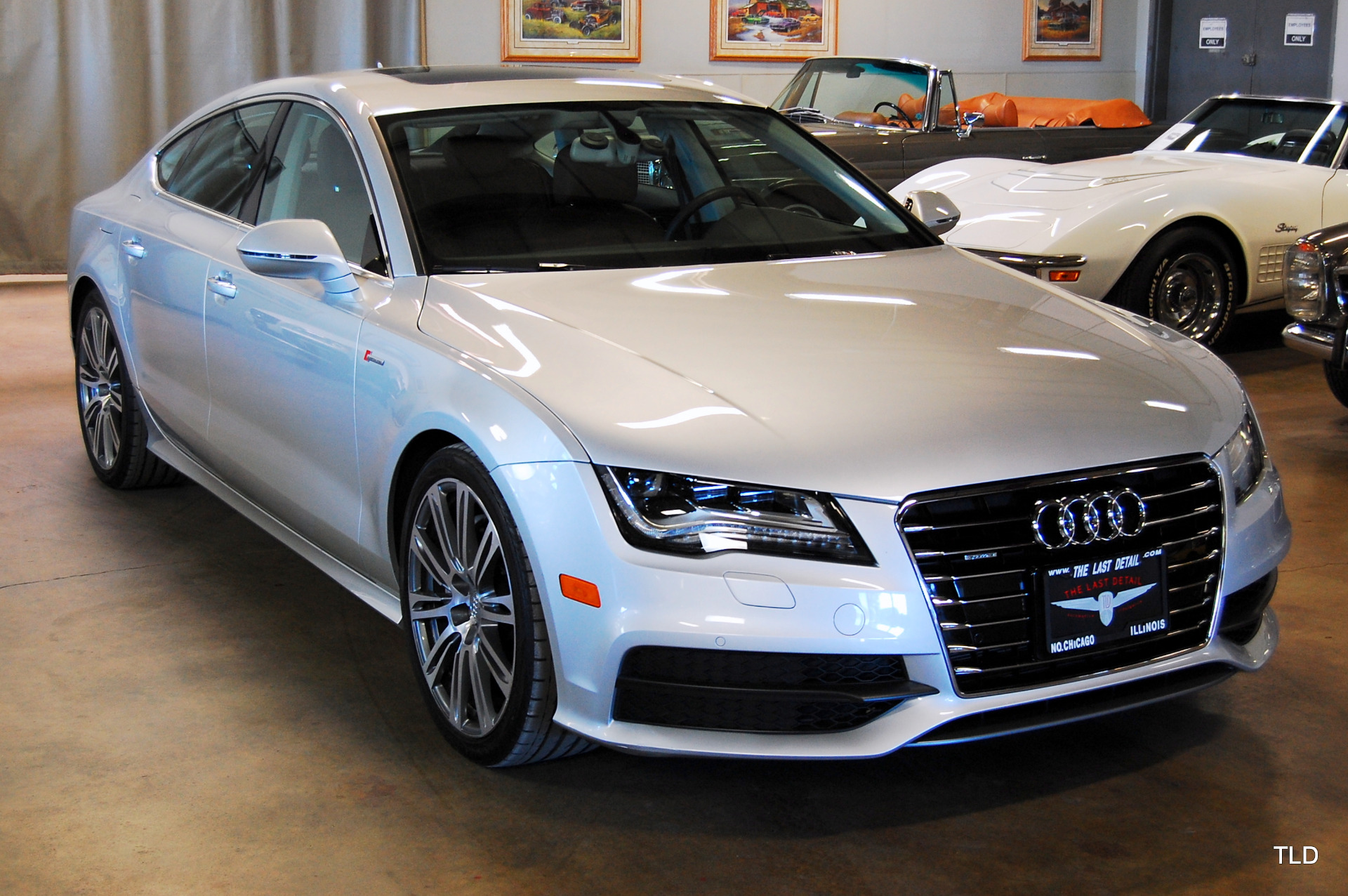
The 2012 Audi A7 Premium Quattro is a luxury four-door Sportback that redefined executive transportation by blending the sleek silhouette of a coupe with the practical utility of a hatchback. Featuring a 310-horsepower supercharged V6 and Audi’s signature Quattro all-wheel-drive system, it remains a benchmark for design and high-speed stability in the used luxury market.
The Genesis of the Sportback Design
When the 2012 Audi A7 first arrived on the North American market, it represented a bold departure from the traditional three-box sedan shape that had dominated the executive class for decades. While competitors like the Mercedes-Benz CLS had pioneered the "four-door coupe" concept, Audi took the idea a step further by incorporating a functional rear hatch. This "Sportback" design allowed the A7 to maintain a low, aggressive roofline while offering significantly more cargo flexibility than a standard trunk.
The exterior of the 2012 A7 is characterized by its long hood, short overhangs, and a sloping rear end that integrates a motorized spoiler. This spoiler automatically deploys at 80 mph and retracts at 50 mph, providing aerodynamic downforce at highway speeds—a feature that highlights the car’s Autobahn-bred heritage. Even as we view this vehicle from the perspective of 2026, the minimalist "Tornado line" running along the side of the car and the iconic LED daytime running lights ensure the A7 does not look dated compared to modern counterparts.
Engineering and Performance: The Supercharged Heart
Under the hood of every 2012 Audi A7 Quattro lies the 3.0-liter TFSI V6 engine. Despite the "T" in the name, which typically denotes turbocharging in modern automotive parlance, this specific engine utilizes a Roots-type twin-vortex supercharger nestled in the "V" of the engine block. This mechanical choice was pivotal for the A7’s driving dynamics.
Power Delivery and Transmission
The supercharged V6 produces 310 horsepower and 325 lb-ft of torque. Because the supercharger is belt-driven directly from the crankshaft, power delivery is instantaneous, with no "turbo lag." Peak torque is available from as low as 2,900 RPM, providing effortless acceleration during merging or overtaking.
Paired with this engine is the ZF-sourced 8-speed Tiptronic automatic transmission. In 2012, this was one of the most advanced torque-converter transmissions available, offering rapid shifts that rivaled dual-clutch systems while maintaining the smoothness required for a luxury cruiser. The wide spread of gear ratios allows the A7 to cruise at low engine speeds on the highway, improving fuel efficiency and cabin quietness.
The Quattro System
The "Quattro" designation indicates that this A7 is equipped with Audi’s permanent all-wheel-drive system. In the 2012 model, the system typically features a 40:60 front-to-rear power split under normal driving conditions. This rear-biased setup helps the car feel more agile and less prone to the understeer often associated with front-heavy AWD vehicles. If wheelslip is detected, the center differential can divert up to 70% of power to the front or 85% to the rear, ensuring traction in snow, rain, or spirited cornering.
Trim Level Breakdown: Defining the "Premium" Experience
In 2012, Audi offered the A7 in three distinct trim levels: Premium, Premium Plus, and Prestige. It is important to clarify that "Premium" served as the entry-level trim. However, in the context of an $60,000+ luxury vehicle, the Premium trim was anything but basic.
The 2012 Audi A7 Premium Quattro came standard with:
- 18-inch 7-spoke wheels.
- Xenon plus headlights with LED daytime running lights.
- Leather seating surfaces with heated, 12-way power front seats.
- Three-zone automatic climate control.
- Power sunroof and power tailgate.
- Audi Drive Select (adjustable steering, throttle, and shift mapping).
While the Premium Plus added larger wheels and navigation, and the Prestige added cooled seats and a Bose sound system, the Premium trim is often sought after in 2026 by second- or third-hand owners. The reason is simplicity; without the complex ventilated seat blowers or the more advanced adaptive headlights found in higher trims, there are fewer high-cost electronic components prone to failure as the vehicle ages.
Interior Craftsmanship and Cargo Versatility
The interior of the 2012 A7 is a masterclass in material selection. Audi’s designers utilized a wrap-around dashboard design that flows into the door panels, creating a cockpit-like feel. In the Premium trim, high-quality wood inlays and soft-touch plastics were standard, maintaining Audi's reputation for having the best interiors in the industry at that time.
The MMI Infotainment System
The 2012 model featured the Multi Media Interface (MMI) with a central 6.5-inch screen that electronically glides out of the dashboard upon startup. While the screen size and resolution are modest by 2026 standards, the physical scroll wheel and shortcut buttons on the center console remain highly intuitive, allowing drivers to keep their eyes on the road. It is important to note that the base Premium trim in 2012 did not always include factory navigation as standard, though many were optioned with it.
Practicality of the Sportback
The true "ace in the hole" for the A7 is its 24.5 cubic feet of cargo space behind the rear seats. Because it is a hatchback, the loading aperture is massive, allowing for the transport of items—such as bicycles or flat-pack furniture—that would never fit in a BMW 5 Series or Mercedes E-Class of the same era. The rear seats also fold flat to further expand this capacity, bridging the gap between a sedan and a small crossover.
| Feature | Specification |
|---|---|
| Engine | 3.0L V6 Supercharged (TFSI) |
| Horsepower | 310 hp @ 5,500 rpm |
| Torque | 325 lb-ft @ 2,900 rpm |
| Transmission | 8-Speed Tiptronic Automatic |
| Drive Type | Quattro All-Wheel Drive |
| 0-60 MPH | 5.4 Seconds |
| EPA Fuel Economy | 18 City / 28 Highway (Est.) |
| Cargo Volume | 24.5 Cubic Feet |
| Wheelbase | 114.7 Inches |
Reliability and Maintenance in 2026
As the 2012 Audi A7 enters its 14th year of service, prospective buyers and current owners must approach maintenance with a technical perspective. The 3.0T engine is widely regarded as one of Audi’s most reliable modern powerplants, but it is not without specific requirements.
Common Mechanical Considerations
- Carbon Buildup: As a direct-injection engine, the TFSI V6 is susceptible to carbon deposits on the intake valves. Over time, this can lead to reduced power and rough idling. A "carbon cleaning" (manually removing deposits) is typically recommended every 80,000 to 100,000 miles.
- Cooling System: The plastic components in the cooling system, including the water pump and thermostat, are known to fail around the 100,000-mile mark. In 2026, most surviving A7s will have likely had these replaced, but it is a critical inspection point.
- PCV Valve and Oil Consumption: The Positive Crankcase Ventilation (PCV) valve, located under the supercharger, can fail, leading to increased oil consumption. Replacing this is labor-intensive because the supercharger must be removed.
- Timing Chain Tensioners: While the chains themselves are designed to last the life of the engine, the plastic guides and hydraulic tensioners can wear. Owners should listen for a "rattle" during cold starts, which often signals the need for service.
Suspension and Chassis
The A7 uses a complex multi-link suspension setup that provides its signature balance of comfort and handling. By 2026, the rubber bushings in the control arms are likely nearing the end of their service life. Replacing these bushings can restore the "factory fresh" feel of the steering, which can otherwise become vague or prone to vibrations at highway speeds.
Safety and Technology Features
Despite being over a decade old, the 2012 A7 was ahead of its time regarding safety. The Premium trim included Audi Pre Sense Basic, which detects emergency maneuvers and prepares the vehicle for a potential impact by tensioning seatbelts and closing the sunroof and windows.
Standard safety equipment also included:
- Electronic Stability Control (ESC) with a "Sport" mode.
- Anti-lock Braking System (ABS) with Electronic Brake-pressure Distribution (EBD).
- Six standard airbags (including knee airbags), with rear-side airbags often available as an option.
- Tire Pressure Monitoring System (TPMS).
For those looking at high-mileage examples in 2026, it is vital to ensure that the electronic parking brake and the motorized rear spoiler are fully functional, as these can be expensive to repair and are integrated into the car's central safety computer.
Comparison: A7 vs. the Competition
In 2012, the A7 occupied a unique niche. It was more expensive than the Audi A6 (with which it shared a chassis) but offered significantly more style and utility.
- Versus Mercedes-Benz CLS550: The CLS featured a V8 engine and a more traditional luxury feel, but its tiny trunk and lack of a folding rear seat made it far less practical than the A7.
- Versus BMW 5 Series Gran Turismo: The BMW 5 GT offered more interior room but was widely criticized for its polarizing, bulky styling. The A7 was generally considered the more attractive and balanced vehicle.
- Versus Porsche Panamera: While the Panamera offered superior handling, its entry price was significantly higher, and the 2012 base models lacked the punch of the Audi’s supercharged V6.
The 2012 Audi A7 Premium Quattro succeeded because it didn't force the buyer to choose between a sports car, a luxury sedan, or a utility vehicle. It performed all three roles competently.
FAQ: Frequently Asked Questions
Is the 2012 Audi A7 a reliable used car in 2026?
The 2012 A7 is considered reliable for a German luxury car, provided it has a documented service history. The 3.0T engine and ZF 8-speed transmission are a robust combination. However, owners should budget for higher-than-average maintenance costs compared to non-luxury brands, particularly for items like brakes, tires, and specialized engine seals.
What is the difference between the Premium and Premium Plus trims?
The Premium trim was the base model, featuring 18-inch wheels and a basic MMI system. The Premium Plus added 19-inch wheels, Audi MMI Navigation plus with a larger screen, a color driver information display, and front/rear parking sensors. In 2026, the price gap between these trims on the used market is often negligible.
Does the 2012 Audi A7 have Bluetooth for music streaming?
While most 2012 A7 models include Bluetooth for phone calls, Bluetooth A2DP (music streaming) was not standard on all early base MMI systems. Many owners in 2026 use aftermarket "Tune2Air" adapters or updated MMI modules to add modern streaming and Apple CarPlay/Android Auto functionality.
How does the 2012 A7 handle in the snow?
Thanks to the Quattro all-wheel-drive system and a heavy curb weight (approximately 4,200 lbs), the 2012 A7 is excellent in winter conditions. When equipped with high-quality winter tires, it is one of the most stable luxury vehicles for cold-climate driving, offering better traction than many crossovers.
What should I look for when buying a high-mileage A7?
Check for oil leaks around the valve covers and timing chain covers. Verify that the rear spoiler deploys and retracts smoothly. Ask for records of a transmission fluid flush and a carbon cleaning. A Pre-Purchase Inspection (PPI) by a technician familiar with Audi’s 3.0T platform is highly recommended.
Final Recommendation: A Timeless Value
In 2026, the 2012 Audi A7 Premium Quattro represents an exceptional value for enthusiasts who prioritize design and mechanical substance over the latest digital screens. Its supercharged V6 remains a highlight of Audi’s engineering history, offering a blend of responsiveness and tunability that modern small-displacement turbocharged engines struggle to match.
If you are considering this vehicle, prioritize finding an example with a clean history and evidence of cooling system updates. While it is an older luxury car that requires diligent upkeep, the reward is a driving experience that still feels contemporary, refined, and remarkably versatile.