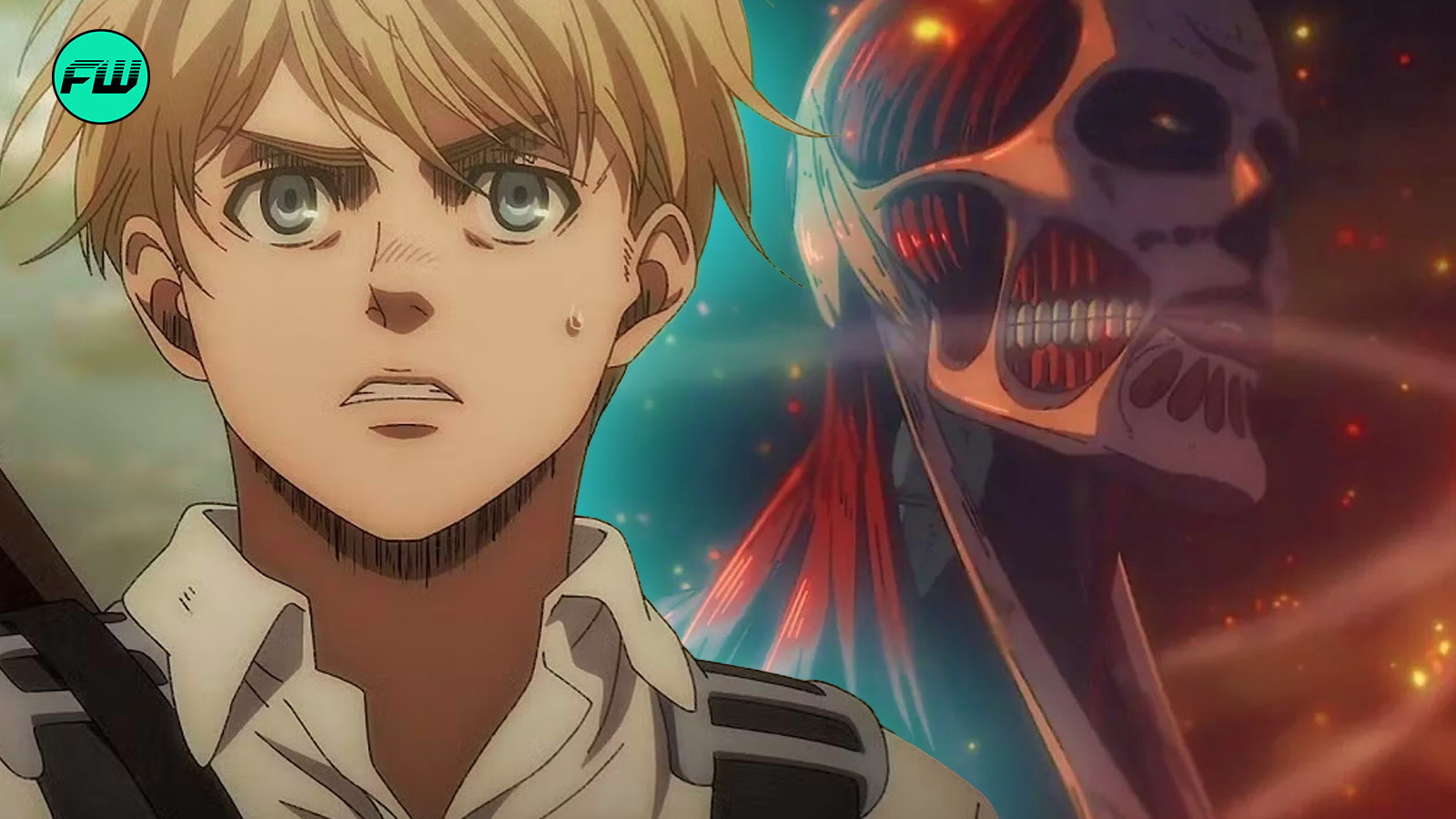
Armin Arlert’s destruction of the Marleyan naval fleet during the Raid on Liberio is a pivotal moment in Attack on Titan, marking his first combat use of the Colossal Titan. By triggering a massive explosive transformation in the heart of Liberio’s harbor, Armin neutralized Marley’s primary maritime reinforcements, effectively isolating the battlefield and ensuring the Survey Corps' temporary tactical superiority.
The Strategic Context of the Raid on Liberio
The event where Armin Arlert steps onto the wreckage of the Marleyan ships occurs during the "Raid on Liberio," a pre-emptive strike orchestrated by Eren Yeager and supported by the Survey Corps. By the year 854, the geopolitical landscape of the world had shifted. Marley, once the undisputed global superpower, found its dominance challenged by the Mid-East Allied Forces. Following their victory in that four-year conflict, Marleyan leadership recognized that the era of Titan dominance was ending due to advancements in anti-Titan artillery.
To regain their standing, Marley sought to reclaim the Founding Titan from Paradis Island. However, Eren Yeager struck first. The Raid on Liberio was designed to accomplish three primary goals: extract Eren Yeager, seize the War Hammer Titan, and cripple Marley’s military infrastructure to prevent an immediate counter-invasion of Paradis. Armin’s specific role was the most devastating: he was the "tactical nuke" tasked with eliminating the Marleyan Navy before it could deploy to the harbor to shell the Survey Corps' positions.
Armin Arlert’s Inheritance of the Colossal Titan
To understand the weight of Armin stepping onto those ships, one must recall the "Midnight Sun" incident. Armin inherited the Colossal Titan after the grueling Battle of Shiganshina, where he was chosen over Commander Erwin Smith to receive the Titan injection. This decision haunted Armin for years. Unlike his predecessor, Bertholdt Hoover, who was a trained Marleyan Warrior, Armin was a strategist and a pacifist by nature.
The Colossal Titan is unique among the Nine Titans for its sheer scale (60 meters) and its ability to control the energy released during transformation. While most Titans transform with a flash of light and a minor pressure wave, the Colossal Titan can trigger an explosion equivalent to a tactical nuclear strike. Armin’s mastery of this ability was put to its first major test in the Liberio harbor.
The Tactical Execution: Destroying the Marleyan Navy
As the battle raged in the internment zone between Eren’s Attack Titan and the War Hammer Titan, Armin approached the Marleyan naval base in a small, inconspicuous fishing boat. This stealthy approach was critical; had Marleyan sentries spotted a Titan shifter early, they might have dispersed the fleet or engaged him with long-range cannons before he could get into position.
The Transformation Blast
Armin’s transformation was not merely a physical change but a calculated deployment of kinetic energy. By intensifying the heat and pressure of the transformation, Armin generated a massive fireball that instantly vaporized the water in the harbor and shattered the hulls of the Marleyan warships.
The ships in the harbor were the pride of the Marleyan Navy—dreadnoughts and cruisers that represented the pinnacle of their conventional military might. In a single moment, the explosion reduced these vessels to twisted metal. The shockwave leveled the surrounding port infrastructure, including warehouses and coastal defenses.
Walking Through the Ruins
After the initial blast, the dust settled to reveal the 60-meter form of Armin’s Colossal Titan standing in the shallows of the port. This is the iconic moment where Armin "steps on" what remains of the Marleyan ships. The visual of the Colossal Titan wading through the burning wreckage is a stark contrast to Armin’s character. He looked down upon the devastation with a gaze of profound sadness, reflecting his inner turmoil.
The physical act of stepping on the ships served two purposes. First, it ensured the complete destruction of any vessel that might have survived the initial blast radius. Second, it served as a psychological deterrent. The sight of the "God of Destruction" standing over their ruined navy signaled to any surviving Marleyan forces that the harbor was lost.
Analyzing the Power of the Colossal Titan’s Transformation
The energy output of Armin's transformation in Liberio was significantly higher than many of Bertholdt’s previous transformations. This suggests that the "Blast" is a variable skill that the shifter can tune based on the situation.
| Feature | Description | Tactical Impact |
|---|---|---|
| Explosive Yield | High-pressure thermal release | Instant destruction of steel-hulled warships and reinforced concrete. |
| Steam Emission | Superheated water vapor | Created a localized vacuum and heat shield, preventing immediate boarding. |
| Height Advantage | 60 Meters (approx. 197 feet) | Provided a clear line of sight over the city to signal the extraction zeppelin. |
| Mobility Cost | Extremely low movement speed | Armin remained stationary or moved slowly to maintain the area-of-denial effect. |
The destruction of the ships was not just about the vessels themselves. By destroying the port, Armin removed Marley’s ability to mobilize sea-based reinforcements. In 854, rail and sea were the only ways to move large armies quickly. With the sea route severed, Marley was forced to rely on slower land-based logistics, buying Paradis months of time to prepare for the inevitable Global Allied Fleet invasion.
The Psychological and Moral Toll on Armin Arlert
Armin’s character arc is defined by his belief that "to surpass monsters, you must be willing to discard your humanity." In Liberio, he lived this philosophy to its most horrific conclusion. As he stood among the burning ships, he noted the presence of civilians and non-combatants who were caught in the blast.
Armin’s monologue during this scene highlights his self-loathing. He sees himself as a monster, no different from the Warriors who broke the walls of Shiganshina. The "steps" he took on the Marleyan ships were heavy with the weight of thousands of lives. This event fundamentally changed his relationship with Eren; while Eren was focused on the "enemy" across the sea, Armin was focused on the shared suffering that their actions caused.
Comparative Analysis: Armin vs. Bertholdt’s Colossal Titan
Armin’s Colossal Titan differs visually and functionally from Bertholdt’s. These differences are not just aesthetic but reflect the different nature of the two shifters.
- The Appearance: Armin’s Colossal Titan has a more "exposed" look, particularly around the throat and ribs. It lacks the bulky musculature of Bertholdt’s version, appearing somewhat more emaciated. This could be interpreted as a reflection of Armin’s own physical build or his focus on the Titan's utility rather than raw physical combat.
- Usage of the Blast: Bertholdt often used the transformation as a means of entry (e.g., the Fall of Shiganshina) or a defensive knockback. Armin used it as a primary weapon of mass destruction. The precision with which Armin detonated in the harbor, maximizing damage to the fleet while minimizing the "over-spill" into the residential areas of the internment zone (though many still died), showed his superior tactical mind.
- The Role in Combat: Bertholdt was often used as a front-line bruiser or a wall-breaker. Armin’s Colossal Titan was treated by the Survey Corps as a strategic asset—a deterrent that was kept in reserve until the absolute moment of necessity.
Long-term Consequences of the Port Destruction
The destruction of the Marleyan ships in Liberio had ripple effects that lasted until the Rumbling. By the time we reach 2026 in our current chronological perspective of the franchise’s history, historians within the Attack on Titan lore cite this event as the catalyst for the formation of the Global Allied Fleet.
Marley’s humiliation at the port proved to the world that no nation was safe from the "Devils of Paradis." This fear was what Willy Tybur intended to stoke, and Armin’s actions, while tactically necessary for the survival of his friends, played directly into the narrative that Paradis was a global threat.
Furthermore, the loss of the fleet meant that when the Marleyan military eventually launched their surprise counter-attack on Shiganshina, they had to do so via mid-air deployment using Zeke Yeager’s outdated airship technology. This made their invasion much riskier and more desperate than if they had been able to provide naval support.
FAQs About Armin’s Colossal Titan and the Marleyan Ships
Why did Armin have to destroy the ships instead of just the soldiers?
The ships represented Marley’s long-range projection of power. If the ships remained intact, Marley could have surrounded Liberio and trapped the Survey Corps. Additionally, the ships carried heavy cannons capable of killing a Titan from a distance. By destroying the vessels, Armin neutralized the most significant threat to the Survey Corps' extraction zeppelin.
Did Armin enjoy the destruction he caused?
Absolutely not. Armin is depicted as being in deep emotional distress during and after the raid. His conversation with the "spirit" of Bertholdt and his later reflections show that he felt forced into the role of a mass murderer to protect his people, a burden that caused him immense guilt.
How many ships did Armin destroy?
While an exact count isn't provided in the source material, visual evidence from the anime and manga suggests the entire Marleyan Mediterranean Fleet was docked in the harbor. This would include several dozen warships, ranging from small patrol boats to massive ironclad dreadnoughts.
Could the Marleyan Navy have stopped Armin?
Under normal circumstances, a fleet equipped with anti-Titan cannons could potentially take down a Colossal Titan if they were at a distance. However, Armin used the element of surprise. By transforming inside the harbor, he bypassed their defenses entirely. The ships were not prepared for a 60-meter Titan appearing in their midst.
Does the Colossal Titan always explode when it transforms?
The shifter has control over the explosion. We see Bertholdt transform multiple times throughout the series with varying degrees of force—sometimes just a puff of steam, other times a massive blast. Armin specifically chose the maximum explosive output for the harbor to ensure no ships survived.
What happened to the port after the battle?
The port of Liberio was left in ruins. The environmental and economic impact on the city was devastating. The wreckage of the ships created a graveyard of steel that made the harbor unusable for months, further hampering Marley's military response.
Practical Recommendation for Further Study
For those interested in the tactical and historical nuances of this event, it is highly recommended to compare Chapter 103 of the manga with Season 4, Episode 7 of the anime. The anime (produced by MAPPA) provides a visceral sense of scale and sound that emphasizes the sheer power of the transformation, while the manga offers more internal monologue from Armin regarding the necessity and horror of his actions.
Understanding the "Armin steps on ships" moment is crucial for any fan or scholar of the series, as it serves as the definitive turning point for Armin Arlert. He moved from being the strategist who came up with the plans to the soldier who executed the most violent of them. This transformation—both physical and psychological—is central to the final themes of Attack on Titan.