Understanding the distinction between term and permanent coverage is fundamental to financial planning, yet one specific similarity often trips up policyholders: both types of insurance provide a tax-free death benefit to beneficiaries. While they differ in duration, cash value, and cost, they share the primary purpose of financial protection upon the insured's passing.
Navigating the landscape of life insurance in 2026 requires more than a surface-level understanding of policy names. For students of finance or consumers looking to protect their families, the question "all of these are valid differences between term life insurance and whole life insurance except" usually points toward a core functional similarity that both products share. By identifying what these products have in common, we can better appreciate the specialized roles each plays in a modern financial portfolio.
The Core Similarity: What the "Except" Usually Represents
In the context of insurance exams or financial literacy assessments, the "except" in this comparison almost always refers to the death benefit. Whether you purchase a 20-year term policy or a participating whole life policy, the fundamental promise of the contract remains the same: the insurer will pay a specified sum of money to the named beneficiaries upon the death of the insured, provided the policy is in force.
Other common similarities that are often used as the "except" answer include:
- Insurable Interest: Both require that the policyowner has a legitimate financial interest in the life of the insured at the time of application.
- Tax-Free Proceeds: Under current 2026 federal tax guidelines, death benefits from both term and whole life insurance are generally received by beneficiaries free of income tax.
- State Regulation: Both products are strictly regulated by state insurance departments to ensure solvency and fair treatment of consumers.
- Mortality Tables: Both use actuarial data (mortality tables) to determine the statistical likelihood of death at various ages, which forms the basis of the premium calculation.
Defining the Two Pillars of Life Insurance
To understand why the differences are so stark, we must first define the mechanics of each product as they stand in 2026.
Term Life Insurance: Pure Protection
Term life insurance is often described as "renting" coverage. It is designed to provide high levels of protection for a specific window of time—usually 10, 20, or 30 years. It does not build equity, and it has no value once the term expires unless the policy is renewed or converted. In 2026, many term policies also include "living benefits" riders, allowing the insured to access a portion of the death benefit if they are diagnosed with a terminal or chronic illness.
Whole Life Insurance: Permanent Equity
Whole life insurance is a form of permanent coverage designed to last for the insured's entire life, often maturing at age 100 or 121. Unlike term insurance, whole life includes a cash value component. A portion of every premium payment is funneled into a tax-deferred savings account within the policy. Over time, this cash value grows and can be accessed by the policyowner via loans or withdrawals.
Major Differences Explained
When analyzing the differences between these two products, we focus on four primary pillars: duration, cost, cash value, and flexibility.
1. Duration and Expiration
The most obvious difference is the "expiration date." Term insurance is temporary. If the insured outlives the 20-year term, the coverage simply ceases. While many policies offer a "guaranteed renewability" feature, the premiums at the end of the term typically skyrocket because they are recalculated based on the insured's attained age.
Whole life insurance is intended to stay in place until the day the insured passes away. As long as the premiums are paid, the insurance company cannot cancel the policy. This makes whole life a preferred tool for estate planning, funeral expenses, and legacy building, whereas term is preferred for covering temporary debts like mortgages or children’s education.
2. Premium Structure and Initial Cost
In 2026, the price gap between term and whole life remains significant. Term insurance is exponentially cheaper for younger individuals because the insurance company is only betting that the insured will die within a small window of time.
Whole life premiums are much higher—often 5 to 10 times the cost of an equivalent term policy—because the insurer knows with 100% certainty that they will eventually pay a death claim, provided the policyholder keeps the policy active. Furthermore, part of that premium is going toward building the cash value reserve.
3. Cash Value and Living Benefits
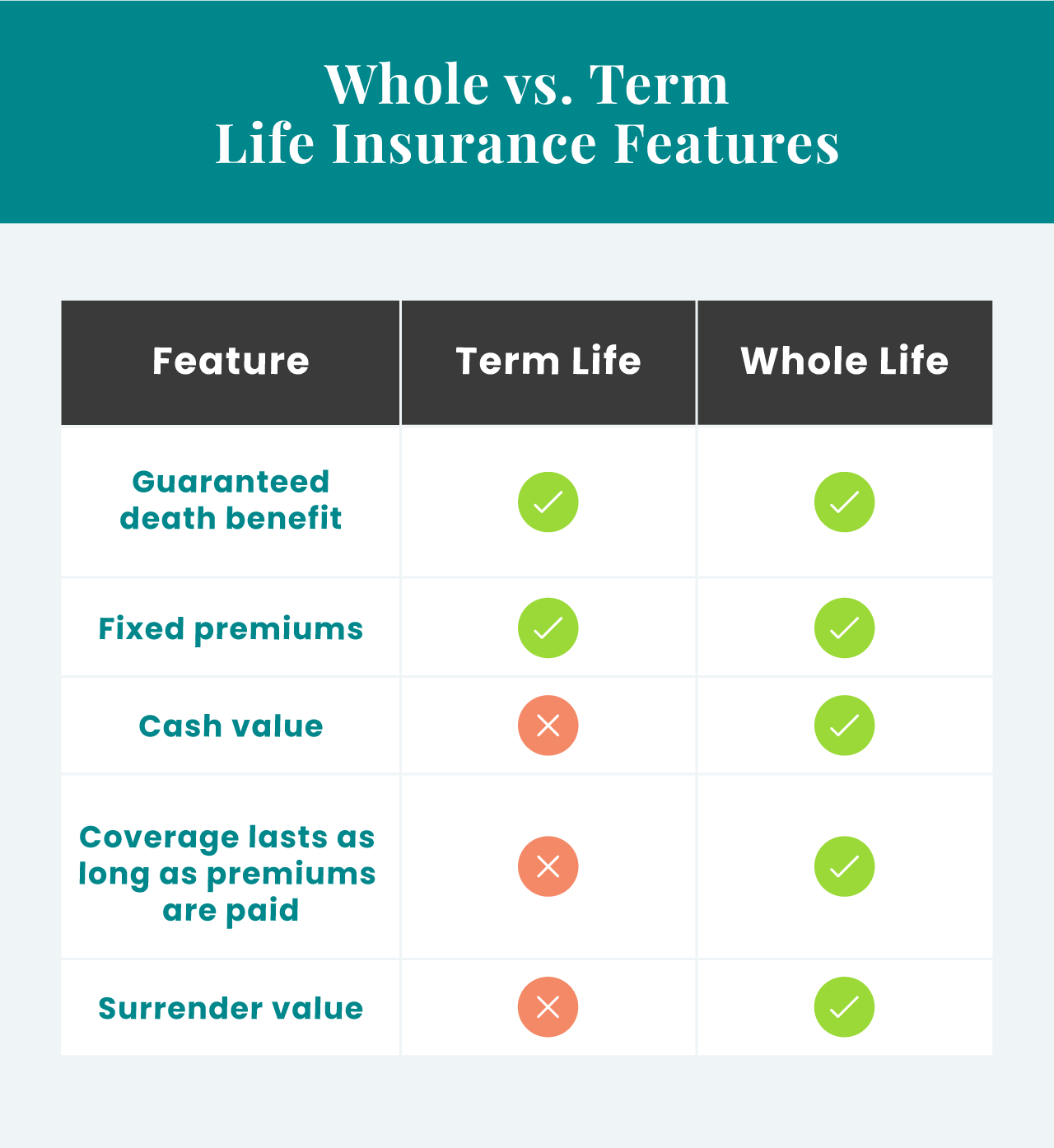
This is the "investment" side of the equation. Whole life insurance builds a "surrender value." If a policyholder decides they no longer need the coverage after 20 years, they can cancel the policy and walk away with the accumulated cash. Term insurance offers no such return; if you cancel a term policy, you receive nothing.
The cash value in a whole life policy can also be used as collateral. Policyholders can take out loans against their death benefit using the cash value as security. In 2026, these loans remain a popular way for individuals to self-finance large purchases or supplement retirement income, though unpaid loans will reduce the final death benefit paid to heirs.
4. Dividends and Participation
Many whole life policies are "participating," meaning they are issued by mutual insurance companies that pay dividends to policyholders. These dividends can be used to purchase "paid-up additions" (increasing the death benefit), reduce the out-of-pocket premium, or be taken as cash. Term insurance policies are almost never participating and do not pay dividends.
Detailed Comparison Table: Term vs. Whole Life (2026 Standards)
| Feature | Term Life Insurance | Whole Life Insurance |
|---|---|---|
| Coverage Period | Temporary (10–30 years) | Permanent (Life of the insured) |
| Initial Cost | Low; very affordable | High; significant commitment |
| Cash Value | None | Yes; builds over time |
| Premium Stability | Level for the term, then rises | Level for the life of the policy |
| Death Benefit | Fixed (usually) | Fixed (or increasing with dividends) |
| Policy Loans | Not available | Available after equity builds |
| Dividends | No | Often yes (Participating policies) |
| Complexity | Simple and straightforward | Complex; involves cash growth and taxes |
Why the "Except" Matters in Financial Planning
The reason the question "all of these are valid differences... except" is so prevalent in financial circles is that it forces the individual to recognize the utility of life insurance. If you focus only on the differences, you might forget that the primary goal of both is the protection of human life value.
In 2026, a common mistake is viewing whole life insurance strictly as an investment or term insurance strictly as a "waste of money." Neither is true.
- The Term Philosophy: "Buy term and invest the difference." This strategy suggests that by paying the lower term premium and investing the savings into the stock market or a 401(k), the consumer will end up with more wealth than if they had bought a whole life policy.
- The Whole Life Philosophy: "The volatility buffer." Proponents of whole life argue that the guaranteed growth of cash value provides a safe haven during market downturns, allowing the policyholder to spend their cash value while waiting for their other investments to recover.
Both philosophies rely on the fact that the death benefit—the similarity—is there to catch the family if the primary earner passes away unexpectedly.
Common Distractors in the "Differences" Comparison
When looking at a multiple-choice scenario regarding these differences, be wary of "distractor" answers that sound like differences but are actually nuances or similarities.
- Underwriting Requirements: Someone might claim that only whole life requires a medical exam. This is false. Both products generally require medical underwriting, though "no-exam" or "accelerated underwriting" has become standard for both categories in 2026 for those with clean health records.
- The Ability to Name Beneficiaries: You can name primary and contingent beneficiaries on both types of policies. There is no difference in how the money is distributed to your loved ones.
- The Grace Period: Both policy types are required by law to offer a grace period (usually 30 or 31 days) if a premium payment is missed before the policy lapses.
The Role of Convertibility
One of the most important bridge features between these two products is the conversion rider. Most term policies in 2026 include a provision that allows the policyholder to switch their term coverage to a permanent whole life policy without undergoing a new medical exam.
This is a vital "difference" that eventually becomes a "similarity." A policyholder might start with term insurance because it is all they can afford while raising young children. As their income grows and they look toward estate planning in their 50s, they can convert that term policy into a whole life policy, ensuring they have coverage that will never expire.
Frequently Asked Questions
Which type of insurance is better for young families in 2026?
For most young families, term life insurance is the preferred choice. The primary goal at that stage of life is to replace a high level of income during the years when debt (mortgages) is high and assets (savings) are low. Term insurance allows a family to secure a $1 million or $2 million death benefit for a relatively small monthly premium, which might be cost-prohibitive with a whole life policy.
Can I have both term and whole life insurance at the same time?
Yes, this is often referred to as "layering" or a "laddering" strategy. Many people choose to have a base of whole life insurance for final expenses and a permanent legacy, while adding a 20-year term rider to cover the years when they have a mortgage or children in the house. This provides maximum protection during the "high-risk" years while maintaining a permanent safety net.
Is the cash value in a whole life policy taxable?
The growth of the cash value is tax-deferred. As long as the money remains inside the policy, you do not pay taxes on the gains. If you withdraw money, it is taxed on a "first-in, first-out" (FIFO) basis, meaning you withdraw your original premiums (your "basis") first, which are tax-free. Only when you withdraw more than you have paid in premiums do you owe income tax on the excess.
What happens if I stop paying premiums on a whole life policy?
Whole life policies have "non-forfeiture options." If you stop paying, you don't necessarily lose everything. You can usually choose to take the cash surrender value, use the cash value to buy a "reduced paid-up" policy (a smaller death benefit with no more premiums due), or use the cash value to purchase "extended term" insurance for a set number of years.
Do term policies pay dividends in 2026?
Standard term life policies do not pay dividends. Dividends are a return of excess premium to the policyholders of a mutual insurance company, and since term insurance is priced very tightly to the cost of mortality, there is rarely an "excess" to return. Dividends are almost exclusively a feature of permanent (whole life or universal life) policies.
Final Recommendation: Selecting the Right Path
When faced with the question of whether a difference is valid or not, always return to the fundamental purpose of the contract. If the statement describes a feature related to savings, duration, or cost flexibility, it is likely a valid difference. If the statement describes the protection of the beneficiary, the tax status of the death benefit, or the requirement of insurable interest, it is a similarity—the "except" you are looking for.
As of 2026, the best path forward for most consumers is to prioritize total coverage amount over policy type. It is better to have a $1,000,000 term policy that fully protects your family than a $100,000 whole life policy that leaves them underinsured. Once the "human life value" is fully protected with term insurance, you can then explore whole life insurance as a tool for tax-advantaged accumulation and permanent estate planning.