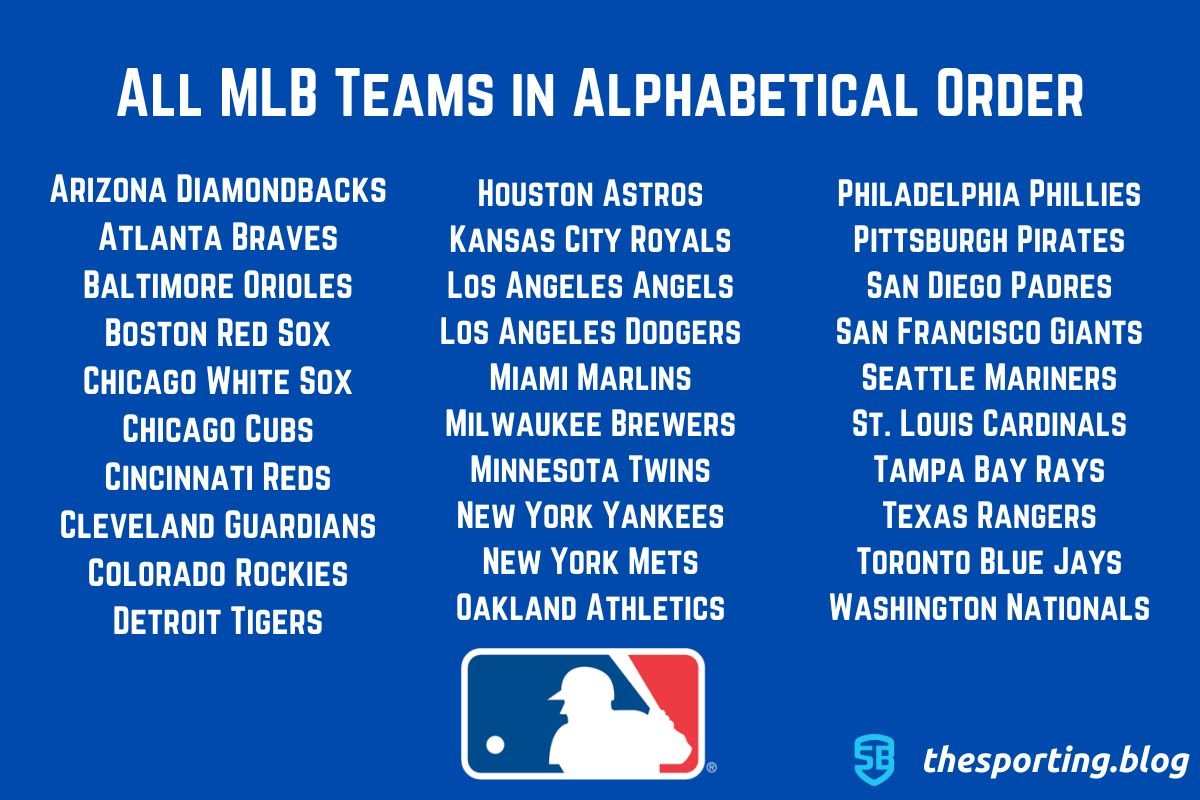
Major League Baseball (MLB) currently consists of 30 franchises divided equally into two primary leagues: the American League (AL) and the National League (NL). Each league is further organized into three divisions—East, Central, and West—with five teams in each, creating a balanced and highly competitive professional sports structure across North America.
To understand the landscape of professional baseball in 2026, one must look at the specific organizational hierarchy that governs the sport. The 30-team format has been the standard since 1998, though the locations and competitive dynamics of these teams continue to evolve. Whether you are a lifelong fan or a researcher looking for technical specifications of the league’s geography, this guide provides a deep dive into every franchise, their home venues, and their place within the modern game.
The Structure of Major League Baseball
The 30 teams are split into two leagues that operated as separate legal entities for nearly a century before merging into a single organization led by the Commissioner of Baseball in 2000. Despite this merger, the distinction between the American League and the National League remains culturally and competitively significant.
Historically, the leagues were distinguished by the Designated Hitter (DH) rule, which the American League adopted in 1973. However, since the 2022 Collective Bargaining Agreement, the universal DH has been implemented across both leagues, standardizing the on-field rules. Today, the primary differences between the AL and NL are found in their historical lineages and their specific divisional rivalries.
The American League (AL)
The American League, often called the "Junior Circuit" because it was established in 1901 (several decades after the National League), contains some of the most iconic brands in global sports.
AL East: The Powerhouse Division
The AL East is frequently cited as the most competitive division in baseball, characterized by high payrolls and historic rivalries.
- Baltimore Orioles: Playing at the trend-setting Oriole Park at Camden Yards, the Orioles have seen a massive resurgence in the mid-2020s thanks to a robust farm system.
- Boston Red Sox: Based at the historic Fenway Park, the Red Sox remain a cornerstone of New England sports culture.
- New York Yankees: The most successful franchise in MLB history, the Yankees operate out of the Bronx and represent the league's most recognizable global brand.
- Tampa Bay Rays: Known for their analytical prowess, the Rays continue to compete at a high level despite playing in the smaller market of the Tampa Bay area.
- Toronto Blue Jays: As the only MLB team located outside the United States, the Blue Jays represent an entire nation from their home at the newly renovated Rogers Centre.
AL Central: The Heartland of Baseball
The AL Central features teams primarily located in the Midwest, known for a gritty style of play and loyal fanbases.
- Chicago White Sox: Located on the South Side of Chicago, the White Sox have a storied history dating back to the league's founding.
- Cleveland Guardians: Following their rebrand in 2022, the Guardians have focused on elite pitching development at Progressive Field.
- Detroit Tigers: A "Charter Member" of the American League, the Tigers are a central pillar of the Detroit sports landscape at Comerica Park.
- Kansas City Royals: The Royals represent one of the smaller markets in the league but maintain a dedicated following at the scenic Kauffman Stadium.
- Minnesota Twins: Based in Minneapolis at Target Field, the Twins have been the most consistent presence in the Central division over the last two decades.
AL West: The Frontier and Expansion
The AL West covers a vast geographic area, from the Gulf Coast to the Pacific Northwest.
- Houston Astros: Since moving from the NL to the AL in 2013, the Astros have become a dominant force, characterized by a high-octane offense at Minute Maid Park.
- Los Angeles Angels: Located in Anaheim, the Angels remain a significant draw in the Southern California market.
- Athletics: As of 2026, the Athletics are in a transitional period, playing their home games at Sutter Health Park in Sacramento while awaiting the completion of their permanent stadium in Las Vegas.
- Seattle Mariners: The Mariners represent the Pacific Northwest at T-Mobile Park, known for its unique retractable roof design.
- Texas Rangers: The 2023 World Series champions play at Globe Life Field in Arlington, a state-of-the-art facility featuring climate control for the Texas heat.
The National League (NL)
The National League, or the "Senior Circuit," was founded in 1876. It prides itself on tradition while embracing the technological and rule changes of the 2020s.
NL East: Historic Rivalries
The NL East spans the Atlantic coast, featuring some of the oldest franchises in the game.
- Atlanta Braves: The Braves have established a modern dynasty in the East, fueled by a deep roster and the vibrant atmosphere of Truist Park.
- Miami Marlins: Operating out of loanDepot park, the Marlins focus on international talent and a fast-paced style of play.
- New York Mets: Based at Citi Field in Queens, the Mets are often at the center of the league’s most high-profile free-agent signings.
- Philadelphia Phillies: One of the most passionate fanbases in sports supports the Phillies at Citizens Bank Park.
- Washington Nationals: Since moving from Montreal in 2005, the Nationals have become a staple of the D.C. sports scene at Nationals Park.
NL Central: Traditionalist Strongholds
The NL Central is home to some of the most iconic "Old School" ballparks and intense regional feuds.
- Chicago Cubs: Playing at the legendary Wrigley Field, the Cubs remain one of the most popular teams in professional sports.
- Cincinnati Reds: Often recognized as the first professional baseball team, the Reds play at Great American Ball Park along the Ohio River.
- Milwaukee Brewers: Known for their unique culture and "tailgating" tradition, the Brewers play under the roof at American Family Field.
- Pittsburgh Pirates: PNC Park, the home of the Pirates, is widely considered one of the most beautiful stadiums in the world due to its skyline views.
- St. Louis Cardinals: With one of the highest winning percentages in league history, the Cardinals are the heartbeat of St. Louis at Busch Stadium.
NL West: The Coastal Giants
The NL West features teams in high-growth markets and some of the most expensive rosters in the game.
- Arizona Diamondbacks: An expansion success story, the Diamondbacks play at Chase Field in downtown Phoenix.
- Colorado Rockies: Coors Field in Denver provides a unique playing environment due to the high altitude, which affects ball flight.
- Los Angeles Dodgers: A perennial contender, the Dodgers at Dodger Stadium represent the pinnacle of modern player development and financial investment.
- San Diego Padres: The Padres have transformed Petco Park into one of the league's premier destinations through aggressive roster building.
- San Francisco Giants: Located at Oracle Park, the Giants have a rich history dating back to their days in New York, maintaining a fierce rivalry with the Dodgers.
Comprehensive List of All 30 MLB Teams
The following table provides a quick-reference guide to all 30 franchises as they stand in 2026, including their home stadium and the year they were established (including their time in previous cities).
| Team Name | League | Division | Home Ballpark | Established |
|---|---|---|---|---|
| Arizona Diamondbacks | NL | West | Chase Field | 1998 |
| Atlanta Braves | NL | East | Truist Park | 1871 |
| Baltimore Orioles | AL | East | Oriole Park at Camden Yards | 1901 |
| Boston Red Sox | AL | East | Fenway Park | 1901 |
| Chicago Cubs | NL | Central | Wrigley Field | 1876 |
| Chicago White Sox | AL | Central | Guaranteed Rate Field | 1901 |
| Cincinnati Reds | NL | Central | Great American Ball Park | 1881 |
| Cleveland Guardians | AL | Central | Progressive Field | 1901 |
| Colorado Rockies | NL | West | Coors Field | 1993 |
| Detroit Tigers | AL | Central | Comerica Park | 1901 |
| Houston Astros | AL | West | Minute Maid Park | 1962 |
| Kansas City Royals | AL | Central | Kauffman Stadium | 1969 |
| Los Angeles Angels | AL | West | Angel Stadium | 1961 |
| Los Angeles Dodgers | NL | West | Dodger Stadium | 1883 |
| Miami Marlins | NL | East | loanDepot park | 1993 |
| Milwaukee Brewers | NL | Central | American Family Field | 1969 |
| Minnesota Twins | AL | Central | Target Field | 1901 |
| New York Mets | NL | East | Citi Field | 1962 |
| New York Yankees | AL | East | Yankee Stadium | 1901 |
| Athletics | AL | West | Sutter Health Park (Temp) | 1901 |
| Philadelphia Phillies | NL | East | Citizens Bank Park | 1883 |
| Pittsburgh Pirates | NL | Central | PNC Park | 1881 |
| San Diego Padres | NL | West | Petco Park | 1969 |
| San Francisco Giants | NL | West | Oracle Park | 1883 |
| Seattle Mariners | AL | West | T-Mobile Park | 1977 |
| St. Louis Cardinals | NL | Central | Busch Stadium | 1882 |
| Tampa Bay Rays | AL | East | Tropicana Field | 1998 |
| Texas Rangers | AL | West | Globe Life Field | 1961 |
| Toronto Blue Jays | AL | East | Rogers Centre | 1977 |
| Washington Nationals | NL | East | Nationals Park | 1969 |
The Evolution of the 30-Team Format
The current 30-team alignment is the result of several waves of expansion and relocation. In the early 20th century, MLB consisted of only 16 teams, primarily located in the Northeast and Midwest.
The Western Expansion
The first major shift occurred in 1958 when the Brooklyn Dodgers and New York Giants moved to California. This opened the door for MLB to become a truly national league. Subsequent expansions in 1961, 1962, 1969, and 1977 added teams in markets like Houston, Montreal (now Washington), Seattle, and Toronto.
The Modern Era
The most recent expansion occurred in 1998 with the addition of the Arizona Diamondbacks and the Tampa Bay Devil Rays (now the Rays). This brought the total to 30 teams. For several years, the leagues were uneven, with the NL having 16 teams and the AL having 14. This was corrected in 2013 when the Houston Astros moved from the NL Central to the AL West, resulting in the current six-division, five-team-per-division format.
Balanced Scheduling in 2026
By 2026, the "balanced schedule" has become a fundamental part of the MLB experience. Previously, teams played the majority of their games against divisional opponents. Under the new rules, every team plays at least one series against every other team in the league annually. This means fans of an AL team like the Yankees are guaranteed to see NL stars like those from the Dodgers or Braves at least once every year, regardless of the venue.
Critical Considerations for Fans and Researchers
When analyzing the 30 MLB teams, several technical factors influence how the league operates:
- Revenue Sharing: MLB employs a complex revenue-sharing system designed to help teams in smaller markets (like Milwaukee or Cincinnati) compete with large-market behemoths (like New York or Los Angeles).
- The Luxury Tax: Officially known as the Competitive Balance Tax (CBT), this mechanism penalizes teams that exceed a certain payroll threshold, encouraging parity across the 30 franchises.
- The Farm System: Each of the 30 MLB teams has a hierarchy of Minor League affiliates (AAA, AA, High-A, and Single-A). Understanding a team's strength often requires looking at their "pipeline" of young talent.
- Territorial Rights: These are legal agreements that define which team has the right to broadcast games in specific geographic regions. This is a common point of contention in areas like Northern California (Giants vs. Athletics) or the Mid-Atlantic (Orioles vs. Nationals).
FAQs About the 30 MLB Teams
Which MLB team is the oldest? The Cincinnati Reds are widely considered the oldest professional baseball team, tracing their roots back to the 1869 Cincinnati Red Stockings. However, the Atlanta Braves franchise (originally in Boston) also claims a continuous history dating back to 1871.
Are there plans to expand beyond 30 teams? As of 2026, Commissioner Rob Manfred and MLB ownership have expressed significant interest in expanding to 32 teams. Potential candidate cities often mentioned include Nashville, Salt Lake City, Portland, and Charlotte. However, a formal timeline for expansion usually depends on resolving stadium issues for existing teams like the Rays and Athletics.
Which city has two MLB teams? Three metropolitan areas currently host two MLB teams: New York City (Yankees and Mets), Chicago (Cubs and White Sox), and the Los Angeles area (Dodgers and Angels). While the San Francisco Bay Area previously hosted two, the Athletics' move to Sacramento has altered that dynamic.
How many teams make the playoffs in 2026? The current postseason format includes 12 teams—six from the American League and six from the National League. This includes the three division winners from each league and three "Wild Card" teams per league based on the best remaining records.
What is the newest stadium among the 30 teams? While several teams have undergone massive renovations (like the Blue Jays), the most recently constructed permanent stadium is Globe Life Field in Arlington, Texas, which opened in 2020. The Athletics' planned stadium in Las Vegas is expected to take the title once completed later this decade.
Next Actions for Fans
If you are looking to engage more deeply with the 30 MLB teams, the following steps are recommended:
- Official League Tracking: Visit the official MLB website for real-time standings and roster moves.
- Statistical Analysis: Use resources like Baseball-Reference to compare historical performance across all 30 franchises.
- Attend a Game: Use the official MLB Ballpark app to find tickets and stadium maps for any of the venues listed above.
- Museum Exploration: Visit the National Baseball Hall of Fame in Cooperstown, NY, to see the history of all 30 teams and the legends who played for them.