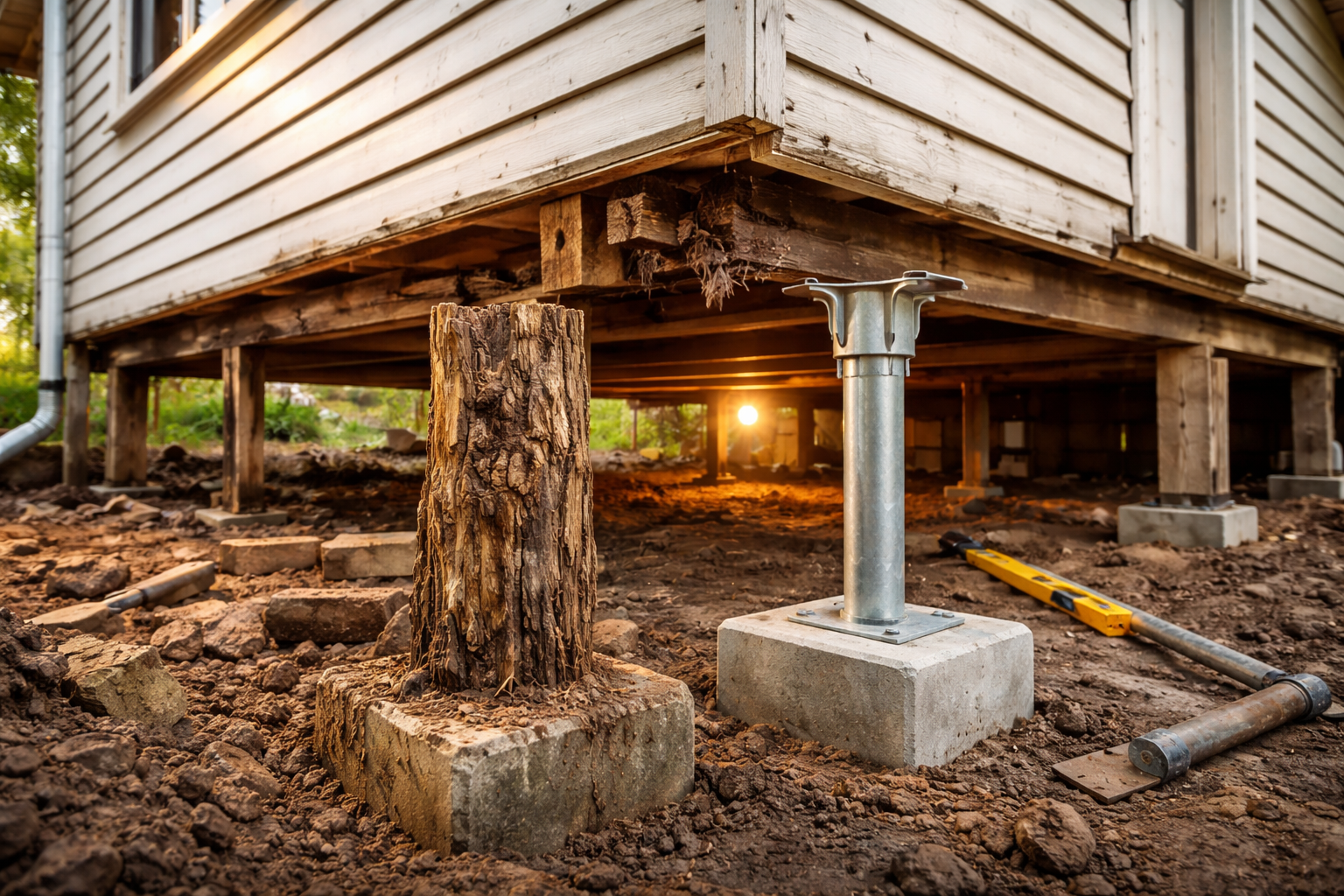
Property owners searching for affordable foundation repair in Cornelius, NC, often face a stressful dilemma: balancing the high stakes of structural damage with the practical realities of home repair budgets. Navigating foundation stabilization requires understanding local red clay soils, recognizing early warning signs of failure, evaluating different repair methods like steel piers or carbon fiber straps, and working with licensed contractors who offer transparent pricing and financing options.
Understanding Foundation Challenges in Cornelius, NC
Cornelius sits along the shores of Lake Norman in Mecklenburg County, a region characterized by specific geological formations that directly impact residential and commercial structures. The local soil composition heavily influences how foundations behave over time, making structural maintenance a common concern for property owners in the area.
The Role of Piedmont Red Clay and Soil Expansion
The predominant soil type throughout the Cornelius area is part of the Southern Piedmont physiographic province, commonly known as red clay. While this soil provides a sturdy base when stable, it possesses high clay content that exhibits significant volumetric changes in response to moisture fluctuations.
During prolonged dry spells, clay soils shrink, causing the earth beneath a foundation to settle or drop. Conversely, during heavy rainfall events—common during tropical storm remnants moving up from the coast—the clay absorbs water and swells significantly. This expansion exerts immense lateral pressure on basement walls and crawl space foundations, while alternating cycles of shrinking and swelling create uneven support beneath concrete slabs and footings.
Common Signs of Foundation Distress
Recognizing structural problems early can prevent minor settlement from escalating into a catastrophic and expensive failure. Property owners should routinely inspect their interiors and exteriors for specific red flags:
- Sticking Doors and Windows: When foundation footings shift or settle unevenly, door frames and window openings become warped, causing doors to jam or windows to stick shut.
- Drywall and Plaster Cracks: Diagonal cracks stretching from the corners of doors and windows usually indicate differential settlement of the underlying structure.
- Exterior Brick Cracks: Stepped cracking following the mortar joints of brick veneer exterior walls points directly to movement in the foundation wall.
- Gaps Around Cabinets and Countertops: Interior walls pulling away from kitchen cabinets or countertops suggest that the floor framing or foundation is sagging.
- Bowing or Leaning Basement Walls: Walls curving inward under the pressure of saturated exterior soils indicate serious lateral load issues that require immediate structural intervention.
Evaluating Foundation Repair Methods and Their Cost Profiles
When addressing foundation issues, repair strategies vary based on the specific type of failure, whether the structure sits on a crawl space, basement, or slab, and the severity of the displacement. Understanding the mechanics of each repair method helps property owners assess contractor proposals and gauge true affordability.
Piering Systems for Structural Settlement
When a foundation sinks due to weak soils or inadequate load-bearing strata, weight must be transferred down to stable bedrock or load-bearing soil layers.
- Steel Push Piers: These heavy-duty steel tubes are driven hydraulically into the ground through brackets attached to the foundation footing until they reach load-bearing strata. The structure’s weight is then transferred onto the piers, and hydraulic jacks can often lift the structure back toward its original elevation. Steel piers represent a premium, permanent solution suited for heavy homes.
- Helical Piers: Resembling large steel screws, helical piers are rotated deep into the ground mechanically rather than driven by weight. They are ideal for lighter structures, porches, and situations where torque monitoring can verify load capacity during installation.
Wall Stabilization for Bowing Basement Walls
When lateral soil pressure pushes basement or crawl space walls inward, piers alone will not suffice. The wall must be stabilized or straightened.
- Carbon Fiber Straps: High-tensile carbon fiber strips are epoxy-bonded to the interior face of the cracked or bowing wall and anchored to the sill plate and foundation floor. This method is low-profile, non-invasive, and prevents further inward movement without taking up usable basement space.
- Steel Wall Plate Anchors: This method involves driving steel anchors into the stable soil outside the foundation wall and connecting them via steel rods to plates mounted on the inside of the basement wall. The system can be tightened over time to pull leaning walls back toward a vertical position.
Concrete Slab Repair and Mudjacking
Slab-on-grade foundations often experience settlement due to poorly compacted fill dirt beneath the concrete.
- Polyurethane Foam Injection (Polyjacking): Expanding polyurethane foam is injected through small holes drilled into the sunken concrete slab. The foam fills voids and expands, lifting the slab back into place. It is lightweight, cures rapidly, and resists future erosion.
- Traditional Mudjacking: A slurry mixture of mud, cement, and other materials is pumped beneath the slab to raise it. While historically common, it is heavier than foam and can sometimes reintroduce weight issues to weak sub-grades.
| Repair Method | Primary Application | Cost Range (Estimated) | Durability & Effectiveness |
|---|---|---|---|
| Steel Push Piers | Settling foundations, sinking corners | $1,500 – $3,000 per pier | Permanent; transfers load to bedrock |
| Helical Piers | Porches, chimneys, lighter structures | $1,200 – $2,500 per pier | High; excellent load predictability |
| Carbon Fiber Straps | Bowing or cracked basement walls | $400 – $800 per strap | Stops lateral movement; very low profile |
| Wall Plate Anchors | Severely leaning exterior walls | $500 – $1,000 per anchor | Allows gradual wall straightening |
| Polyurethane Foam | Sunken concrete slabs, driveways, patios | $1,000 – $3,500 total project | Fast curing, lightweight void fill |
What "Affordable Foundation Repair" Actually Means
In the context of structural engineering and home construction, affordability is rarely about finding the absolute lowest initial bid. True affordability encompasses long-term value, warranties, engineering precision, and preventing recurring damage that multiplies repair costs over time.
The Dangers of Low-Ball Bids
Homeowners working within a strict budget may be tempted to select the contractor offering the lowest estimate. However, foundation repair is a specialized trade where cutting corners carries severe financial risks. Low-cost bids often involve:
- Inadequate Engineering: Installing fewer piers than required or using substandard, ungalvanized steel that corrodes in acidic North Carolina clay.
- Surface Treatments Only: Filling cracks with cosmetic epoxy without addressing the underlying soil movement, causing the crack to reopen within months.
- Lack of Proper Licensing and Insurance: Operating without structural engineering oversight or general liability insurance, leaving the property owner liable for workplace accidents or failed repairs.
Maximizing Value and Managing Project Costs
Achieving affordable foundation repair involves strategic planning, prioritizing critical structural zones, and utilizing available financial tools:
- Get Multiple Professional Evaluations: Consult at least three reputable, licensed structural repair contractors or independent structural engineers. An independent engineer who does not sell repair services can provide an unbiased scope of work, ensuring you only pay for necessary repairs.
- Prioritize Structural Integrity Over Cosmetics: Address stabilizing settling walls and stopping active water intrusion before spending budget on cosmetic tuckpointing or finished drywall repair.
- Explore Contractor Financing: Many established foundation repair companies offer promotional financing plans, such as low-interest or zero-interest deferred payment options, which allow homeowners to spread major repair costs over several years without liquidating savings.
- Verify Transferable Warranties: Look for companies that back their work with robust, transferable warranties. A warranty that transfers to future buyers protects your investment and adds resale value if you sell the property.
Choosing a Qualified Foundation Contractor in the Cornelius Area
Hiring the right specialist is the single most important step in ensuring a successful and cost-effective repair. Because foundation work alters the structural skeleton of a house, vetting requires careful due diligence.
Licensing, Insurance, and Engineering Standards
In North Carolina, general contractors must hold appropriate license classifications for structural work, and specialized structural repairs frequently benefit from engineering stamps or certified installation credentials.
- Verify General Liability and Workers' Compensation: Always request certificate of insurance directly from the carrier to protect yourself against property damage or contractor injuries during excavation and lifting operations.
- Check Local Experience: Contractors familiar with Mecklenburg County and Lake Norman geography understand local building codes, soil profiles, and water table considerations better than out-of-state storm-chasing companies.
- Review Independent Accreditations: Check ratings with organizations such as the Better Business Bureau (BBB) and look for verified customer reviews on independent platforms.
Frequently Asked Questions About Foundation Repair
How much does foundation repair typically cost in Cornelius, NC?
Total project costs vary widely based on the extent of the damage. Minor repairs, such as carbon fiber strap installations for localized wall cracks, may cost between $2,000 and $4,000. Major structural stabilization involving multiple steel push piers or extensive wall anchors often ranges from $7,000 to $15,000+, depending on home size and soil depth.
Will my homeowners insurance cover foundation repair?
Generally, standard homeowners insurance policies do not cover foundation repairs caused by normal soil settling, earth movement, or clay expansion. Insurance typically only covers foundation damage if it results directly from a covered peril, such as sudden plumbing leaks or specific natural disasters. Review your specific policy or consult your insurance agent for clarification.
Can I DIY foundation repair to save money?
Foundation repair is not a suitable DIY project. It requires heavy hydraulic equipment, precise load calculations, structural engineering knowledge, and specialized materials. Improper lifting or pier placement can cause catastrophic structural failure, collapsing floors, and dramatically higher repair bills. Always rely on trained professionals.
How long does a typical foundation repair project take?
Most residential foundation repair projects are completed within one to five days, depending on complexity. Exterior pier installation or carbon fiber strap application often takes just one or two days, while complex stabilization or extensive slab lifting may take several days of active work, excluding initial engineering evaluations and permit approvals.
Are foundation repair warranties transferable?
Many reputable foundation repair companies offer lifetime, transferable warranties on steel piers and structural stabilization systems. If you sell your home, the warranty transfers to the new owner, serving as a strong selling point that reassures buyers about the structural soundness of the property. Always confirm warranty terms in writing before signing a contract.
Next Actions for Property Owners
If you suspect foundation issues in your Cornelius home, begin by documenting all visible cracks, sticking doors, and uneven floors with photographs and measurements. Schedule evaluations with licensed local professionals who provide transparent, itemized estimates rather than high-pressure sales pitches. By addressing structural concerns methodically with engineered solutions, you protect both your family's safety and your long-term real estate investment.