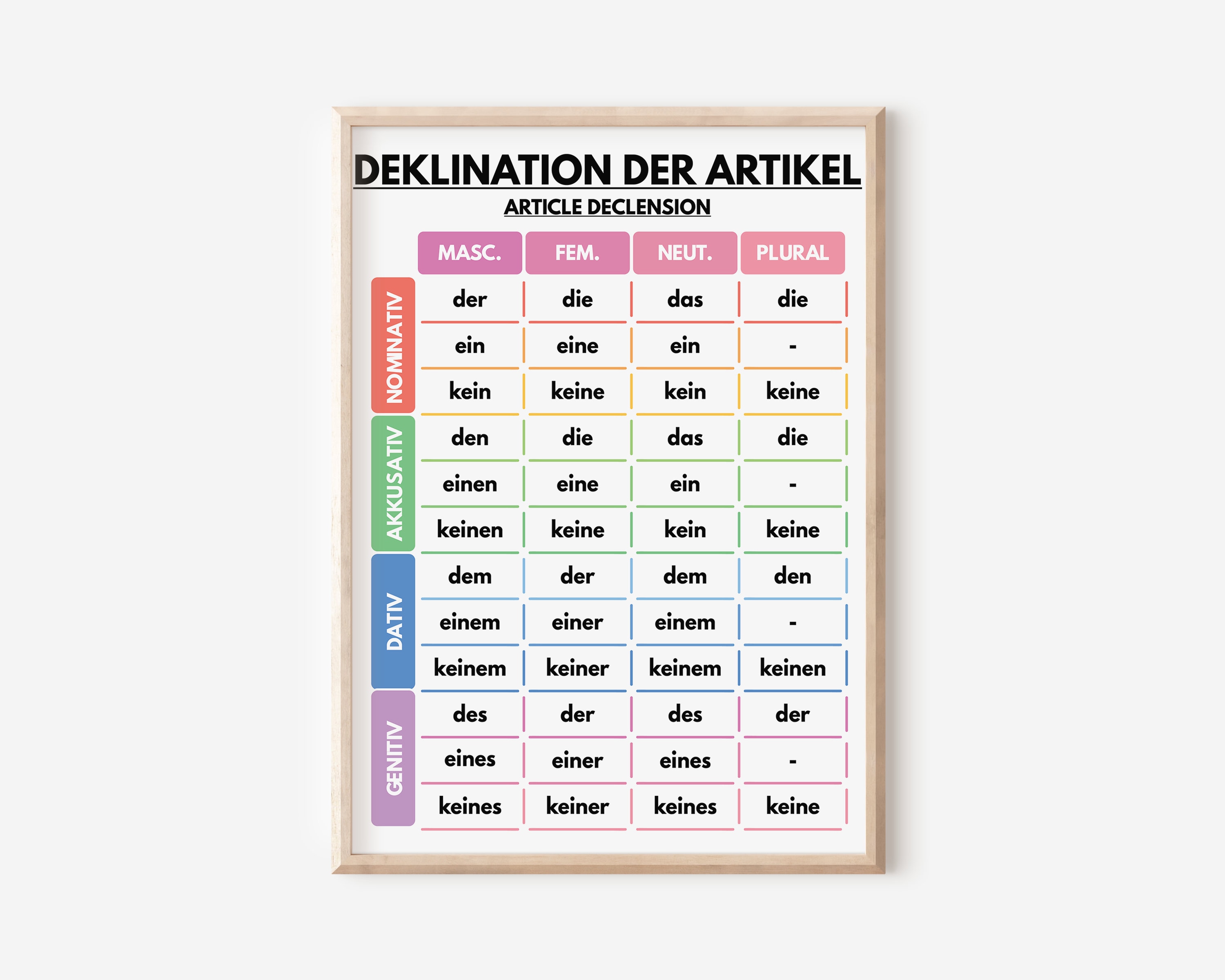
Adjective declension in German is the process of modifying an adjective's ending to match the gender, case, and number of the noun it describes, while also accounting for the type of article preceding it. To determine the correct ending, you must identify if the article is definite, indefinite, or absent, and then apply the corresponding weak, mixed, or strong declension rules.
The German language is famous for its grammatical precision, and perhaps no part of its syntax is as feared by learners as the Adjektivdeklination (adjective declension). While English adjectives remain static regardless of the noun's role—"the green book" and "with a green book"—German adjectives are dynamic. They function as signals that help the listener identify the grammatical case and the gender of the noun.
By 2026, the methodology for teaching these endings has shifted away from rote memorization of massive tables toward a logic-based "functional" approach. Understanding the "why" behind the ending makes the "what" much easier to manage. This guide breaks down the three types of declension, the variables that dictate them, and the strategies for applying them fluently in speech and writing.
The Three Variables of German Adjective Declension
Before you can choose an ending, you must evaluate three specific pieces of information about the noun phrase you are constructing. In German grammar, adjectives are sensitive to the linguistic environment surrounding them.
1. The Type of Article (Determiner)
The most important factor is what comes before the adjective. The article or determiner acts as the primary "signal" for gender and case.
- Definite Articles: Der, die, das (the). These provide a "strong" signal.
- Indefinite Articles: Ein, eine (a/an), possessives like mein (my), or the negation kein (no/none). These provide a "partial" signal.
- Zero Article: No word precedes the adjective. The adjective must provide the "full" signal itself.
2. Grammatical Case
The case identifies the noun's function in the sentence.
- Nominative: The subject (the person or thing doing the action).
- Accusative: The direct object (the thing being acted upon).
- Dative: The indirect object (usually the recipient or involving specific prepositions).
- Genitive: Indicates possession or relationship.
3. Gender and Number
Every German noun has a gender—Masculine (maskulin), Feminine (feminin), or Neuter (neutrum)—and a number (Singular or Plural). Because plural nouns don't have gender distinctions in the same way, "Plural" effectively acts as a fourth gender category for the purposes of declension.
Weak Declension: Following Definite Articles
Weak declension occurs when the adjective follows a "der-word." These include the definite articles (der, die, das) and determiners that behave like them, such as dieser (this), jener (that), jeder (every), mancher (some), and welcher (which).
The logic here is simple: the definite article already clearly tells the listener the gender and case. Therefore, the adjective doesn't need to do any heavy lifting. It takes a "weak" ending. In this system, there are only two possible endings: -e and -en.
The "Five -e" Rule
In the weak declension table, there are only five instances where the adjective ends in -e. These are the Nominative singular (Masculine, Feminine, Neuter) and the Accusative singular (Feminine, Neuter). Every other instance—all Dative, all Genitive, all Plural, and the Masculine Accusative—takes an -en.
- Der alt*e Mann* (Nominative Masculine: The old man)
- Mit dem alt*en Mann* (Dative Masculine: With the old man)
- Die neu*en Autos* (Nominative Plural: The new cars)
Mixed Declension: Following Indefinite Articles
Mixed declension is used after "ein-words." These include the indefinite article (ein, eine), the negative article (kein), and all possessive determiners (mein, dein, sein, ihr, unser, euer, ihr).
These words are called "mixed" because sometimes they signal the gender/case clearly (like eine for feminine), but sometimes they are ambiguous (like ein, which could be masculine nominative or neuter nominative/accusative). When the article fails to show the gender clearly, the adjective must step in and provide the "strong" marker. When the article does show the case clearly (as in the Dative or Genitive), the adjective defaults to the weak -en ending.
- Ein alt*er Mann* (Nominative Masculine: An old man. Ein doesn't show gender, so the adjective takes -er from der).
- Ein neu*es Auto* (Nominative Neuter: A new car. Ein doesn't show gender, so the adjective takes -es from das).
- Meine alt*en Freunde* (Nominative Plural: My old friends. The plural always ends in -en in mixed declension).
Strong Declension: The Zero Article Scenario
Strong declension is used when there is no article at all before the adjective. This frequently happens with plural nouns, mass nouns (like water, milk, or bread), or abstract concepts.
Because there is no article to signal the case or gender, the adjective must do all the work. It "steals" the endings from the definite articles (der, die, das). If you know your definite articles, you essentially know strong declension endings, with one minor exception in the Genitive masculine and neuter.
- Kalt*es Wasser* (Nominative Neuter: Cold water. Takes -es from das).
- Guter Wein (Nominative Masculine: Good wine. Takes -er from der).
- Frische Eier (Nominative Plural: Fresh eggs. Takes -e from die).
The Genitive Exception: In the Genitive Masculine and Neuter, the strong ending is -en instead of -es. This is because the noun itself usually ends in -s or -es in these cases (e.g., eines guten Weines), so the adjective doesn't need to repeat the "s" sound.
Summary Table of Adjective Endings (2026 Standards)
The following table summarizes the endings for all three declension types across the four cases and four categories (M, F, N, P).
| Case | Gender | Weak (after der) | Mixed (after ein) | Strong (no article) |
|---|---|---|---|---|
| Nominative | Masculine | -e | -er | -er |
| Feminine | -e | -e | -e | |
| Neuter | -e | -es | -es | |
| Plural | -en | -en | -e | |
| Accusative | Masculine | -en | -en | -en |
| Feminine | -e | -e | -e | |
| Neuter | -e | -es | -es | |
| Plural | -en | -en | -e | |
| Dative | Masculine | -en | -en | -em |
| Feminine | -en | -en | -er | |
| Neuter | -en | -en | -em | |
| Plural | -en | -en | -en | |
| Genitive | Masculine | -en | -en | -en |
| Feminine | -en | -en | -er | |
| Neuter | -en | -en | -en | |
| Plural | -en | -en | -er |
Special Cases and Irregularities
While the tables cover 95% of usage, German contains specific nuances for certain adjectives that can trip up even intermediate speakers.
Adjectives Ending in -el, -en, and -er
When adjectives end in these unstressed syllables, the -e- is often dropped before adding a declension ending to maintain the flow of the language.
- Dunkel (dark): Ein dunkl*er Raum* (not dunkeler).
- Teuer (expensive): Ein teur*es Auto* (not teueres).
- Trocken (dry): Ein trockn*er Wein* (not trockener).
The Adjective "Hoch"
The adjective hoch (high/tall) is unique. When it is declined, the ch changes to h.
- Der Berg ist hoch. (The mountain is high - no declension because it is a predicate adjective).
- Ein hoher Berg. (A high mountain - declined).
City Adjectives
Adjectives derived from the names of cities (e.g., Berliner, Hamburger, Wiener) are indeclinable. They always end in -er and do not change regardless of the case or gender of the noun.
- Das Berlin*er Bier.*
- Mit den Berlin*er Bürgern.*
Colors from Foreign Languages
Some newer color words, often borrowed from French or English, do not take endings. Examples include rosa (pink), lila (purple), and beige.
- Ein rosa Hemd (A pink shirt).
- Die lila Bluse (The purple blouse). Note: In modern 2026 colloquial German, some speakers add "-farben" (e.g., rosafarbenes) to make them declinable, but the root forms remain unchanged.
Predicate vs. Attributive Adjectives
It is crucial to distinguish between where an adjective sits in a sentence. Declension only applies to attributive adjectives—those that come directly before a noun.
If the adjective comes after a verb like sein (to be) or werden (to become), it is a predicate adjective. Predicate adjectives never take endings.
- Attributive: Der gut*e Wein.* (The good wine).
- Predicate: Der Wein ist gut. (The wine is good).
This distinction is a common point of relief for learners; if you can structure your sentence to put the adjective at the end, you can often avoid the declension complexity entirely. However, for natural and sophisticated German, mastering the attributive endings is essential.
Step-by-Step Strategy for Correct Declension
To apply these rules in real-time, follow this mental checklist:
- Locate the Noun: What is the adjective describing?
- Determine Gender and Number: Is the noun Masculine, Feminine, Neuter, or Plural?
- Identify the Case: Is the noun a subject (Nom), a direct object (Acc), an indirect object (Dat), or possessive (Gen)?
- Check the Article:
- Is it a Definite Article (der/die/das)? Use Weak.
- Is it an Indefinite/Possessive (ein/mein/kein)? Use Mixed.
- Is there no article? Use Strong.
- Apply the Ending: Use the corresponding box in the declension table.
Common Mistakes to Avoid
- Over-using -en: While -en is the most common ending (especially in Dative and Plural), beginners often use it as a "safety" ending for everything. Remember the "Five -e" rule for definite articles.
- Ignoring the Dative Plural Noun: Remember that in the Dative plural, not only does the adjective get an -en, but the noun itself usually gets an -n (e.g., mit den alten Männern).
- Confusion with "Ein": Learners often forget that ein is used for both Masculine and Neuter in the Nominative. However, the adjective endings differ (ein guter Mann vs. ein gutes Kind).
- Mixing up Strong and Weak: Never use a strong ending if a definite article is present. Der guter Mann is incorrect; it must be der gute Mann.
Practical Examples in Context
To see how these rules function in practice, consider the following sentences:
- Nominative (Weak): Die jung*e Frau liest ein Buch.* (The young woman reads a book).
- Accusative (Mixed): Ich habe einen alt*en Wagen gekauft.* (I bought an old car).
- Dative (Strong): Wir trinken kühlem Wasser. (We drink [from] cool water).
- Genitive (Weak): Die Farbe des neu*en Hauses ist weiß.* (The color of the new house is white).
FAQ: German Adjective Declension
Why does German use adjective declension?
German uses declension to provide redundancy and clarity. Because German word order can be more flexible than English, the endings on adjectives and articles help indicate which noun is the subject and which is the object, preventing ambiguity in complex sentences.
What is the easiest way to learn these endings?
The most effective method is focusing on the "markers." If the article shows the case (e.g., dem, den, der), the adjective usually ends in -en. If the article is absent or ambiguous (e.g., ein, das, die), the adjective usually provides the specific gender marker (-er, -es, -e).
Do plural adjectives always end in -en?
Not always, but in most common scenarios, yes. In Weak and Mixed declension (after die, keine, meine), the plural adjective always ends in -en. It only ends in -e in Strong declension (when there is no article at all).
Does adjective declension change in 2026?
The grammatical rules of German are governed by the Council for German Orthography and remain stable. While slang and vocabulary evolve, the core system of Case, Gender, and Declension described here remains the standard for academic, professional, and daily communication in 2026.
Are there adjectives that never decline?
Yes. Adjectives derived from cities (Münchner), certain colors (lila, rosa), and adjectives used as adverbs or predicate adjectives (after the verb sein) do not take declension endings.
Final Recommendation for Learners
Mastering German adjective declension requires a transition from analytical thinking to muscle memory. Start by mastering the Weak Declension (the "Five -e" rule), as it is the most common in structured writing. Once comfortable, move to Mixed Declension, focusing on how the adjective "fills the gap" left by the indefinite article. Finally, practice Strong Declension with mass nouns like food and drink. Consistent reading and listening are the best ways to internalize these patterns until they become second nature.