The Abraham bloodline represents one of the most culturally, historically, and religiously significant lineages in human history, tracing the ancestral roots of the patriarch Abraham across ancient Near Eastern texts, sacred traditions, and modern genealogical studies.
Introduction to the Abraham Bloodline and Its Significance
The ancestral heritage associated with Abraham serves as a cornerstone for several major world religions, including Judaism, Christianity, and Islam, which are collectively referred to as the Abrahamic faiths. In these traditions, Abraham is revered as a patriarch, a prophet, and a model of unwavering faith.
Disambiguating the concept of the Abraham bloodline requires looking at it through multiple lenses: textually through ancient scriptures, historically within the context of the Bronze Age Near East, and culturally through the millions of people worldwide who claim a spiritual or biological connection to his lineage. While modern genetic science explores population genetics in the Middle East, the traditional understanding of the bloodline remains rooted in ancient texts, primarily the Hebrew Bible (or Old Testament), which meticulously records generations from creation down to the patriarchs and their immediate descendants.
Understanding this subject requires examining the foundational texts, tracing the geographical and genealogical paths described in historical records, and analyzing how various traditions interpret the scope of Abraham's descendants today.
Scriptural Roots and Genealogical Structure
In biblical and traditional literature, the lineage of Abraham is traced from the earliest generations of humanity, creating a bridge between primeval history and the establishment of specific nations.
From Adam to Abraham
According to the genealogical tables found in the Book of Genesis, Abraham—originally known as Abram—descends from Noah’s son, Shem, making him part of the Semitic peoples. The narrative traces a direct patrilineal descent from Shem through several generations down to Terah, Abraham's father. Terah lived in the ancient Mesopotamian city of Ur before moving his family northward to Haran.
Shem -> Arpachshad -> Shelah -> Eber -> Peleg -> Reu -> Serug -> Nahor -> Terah -> Abraham
This linear progression establishes the ancestral framework within biblical theology, positioning Abraham as the focal point through whom subsequent covenants and national identities are formed.
The Descendants of Abraham
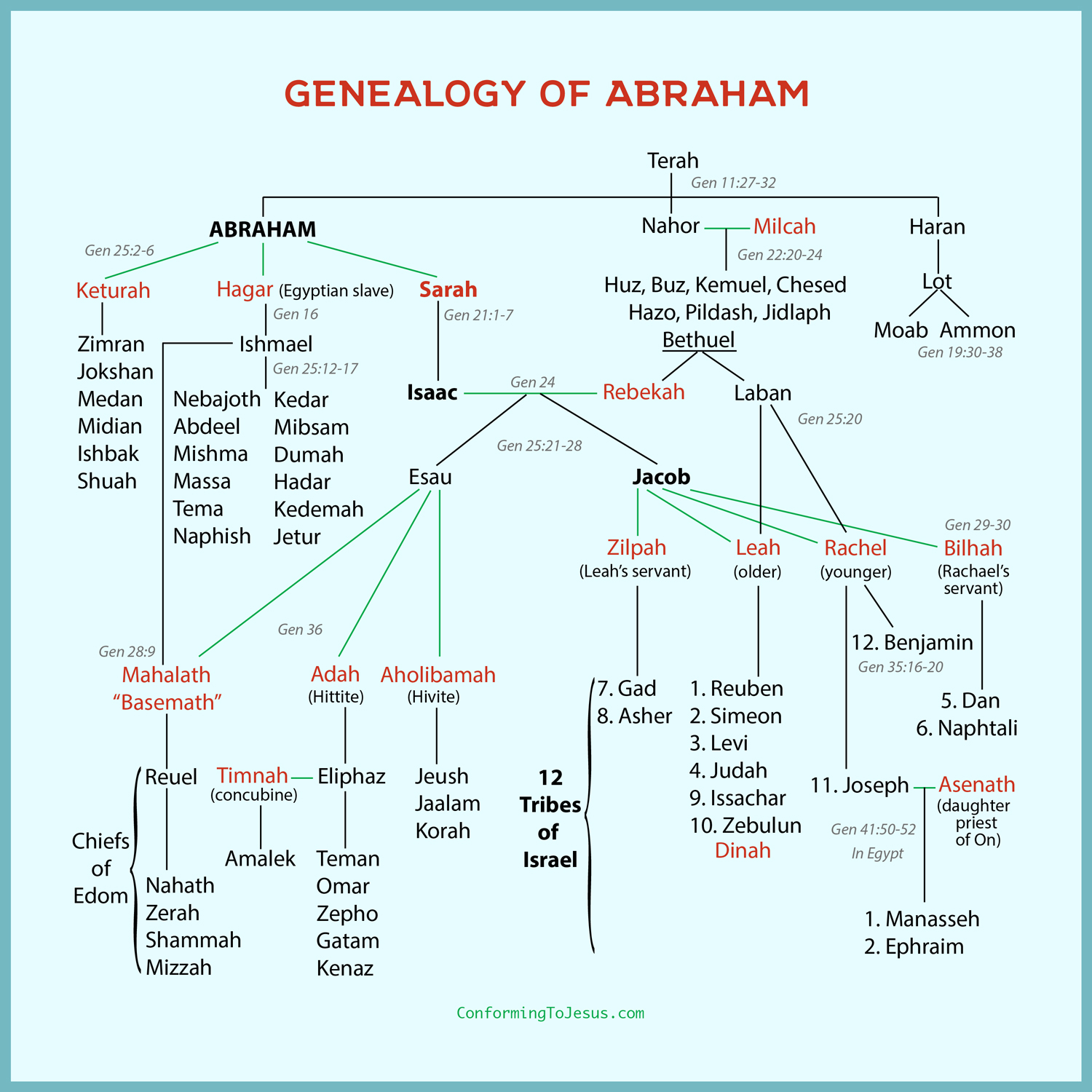
Abraham's bloodline diverges into multiple prominent branches through his different wives and concubines, each playing a distinct role in Near Eastern history according to scriptural accounts:
- Through Sarah (Isaac): The primary lineage continues through Isaac, Abraham's son with Sarah. Isaac's son, Jacob (later named Israel), becomes the father of the twelve tribes of Israel, forming the foundational bloodline of the Jewish people.
- Through Hagar (Ishmael): Ishmael, Abraham's son with Hagar, is recognized in Islamic tradition as a patriarch of Arab peoples. Islamic genealogy traditionally traces several northern and western Arabian tribes back to Ishmael.
- Through Keturah (Zimran, Jokshan, Medan, Midian, Ishbak, and Shuah): After Sarah's passing, Abraham took Keturah as a wife, fathering several sons whose descendants settled primarily in the eastern and southern deserts, including the Midianites, who frequently interact with the Israelites in later biblical narratives.
Historical and Archaeological Context of the Patriarchal Age
Evaluating the Abraham bloodline requires placing the biblical narratives within the broader historical backdrop of the Middle Bronze Age (c. 2000–1550 BCE).
Ur of the Chaldees and Haran
The narratives place Abraham's origins in "Ur of the Chaldees," a major Sumerian city-state in southern Mesopotamia characterized by sophisticated urban planning, ziggurats, and cuneiform writing. Archaeological excavations at Ur have revealed a thriving urban center dedicated to the moon god Nanna during the early second millennium BCE.
The subsequent migration to Haran, located in upper Mesopotamia (modern-day southeastern Turkey), aligns with known Amorite and pastoral migration patterns of the period. Nomadic and semi-nomadic pastoralists frequently moved along the Fertile Crescent in response to political shifts, trade routes, and environmental conditions.
Legal and Social Customs of the Ancient Near East
Many details within the Abrahamic narratives reflect the legal and social customs documented in ancient Near Eastern legal codes, such as the Code of Hammurabi and the Nuzi tablets. Practices such as adopting a chief servant as an heir in the absence of a biological child, utilizing a handmaid to secure offspring, and the legal binding of land purchases (such as the purchase of the Cave of Machpelah) mirror real legal frameworks from the second millennium BCE. While these parallels do not independently verify every specific event in the narrative, they demonstrate that the cultural milieu reflected in the accounts is consistent with the purported era.
Comparative Religious Perspectives on the Lineage
The significance of the Abraham bloodline varies across the traditions that claim inheritance from him.
Jewish Tradition
In Judaism, the Abraham bloodline is inextricably linked to the concept of the Covenant (Brit). God's promise to make Abraham the father of a great nation is fulfilled through Isaac and Jacob. Membership in this lineage carries both biological and spiritual dimensions, emphasizing ancestral continuity, covenantal obligations, and adherence to divine commandments (mitzvot).
Christian Tradition
Christianity views the Abraham bloodline through both historical fulfillment and a broader theological framework. While the New Testament acknowledges the physical descent of Jesus from Abraham through the genealogies recorded in the Gospels of Matthew and Luke, Christian theology emphasizes that the ultimate fulfillment of the Abrahamic promise extends beyond biological lineage. Passages in the Pauline epistles argue that those who share Abraham's faith are considered spiritual "children of Abraham," uniting diverse peoples under a shared covenant.
Islamic Tradition
In Islam, Abraham (Ibrahim) is celebrated as Khalil Allah (the Friend of God) and a supreme example of pure monotheism (Hanif). The Islamic tradition traces the prophetic line through both Ishmael (leading down to the Prophet Muhammad) and Isaac (leading down to the Israelite prophets, including Jesus). The bloodline is viewed with great respect, but Islamic theology strongly emphasizes that true closeness to God is determined by righteousness and submission to the divine will rather than racial or biological exclusivity.
| Tradition | Primary Lineage Focus | Key Theological Interpretation |
|---|---|---|
| Judaism | Isaac and Jacob (Twelve Tribes of Israel) | Physical and spiritual covenantal descent; chosen people concept. |
| Christianity | Jesus of Nazareth (Physical & Spiritual) | Fulfillment of prophecy; spiritual inheritance through faith for all nations. |
| Islam | Ishmael and Isaac (Prophetic Lineage) | Pure monotheism (Hanif); universal prophetic heritage centered on submission to God. |
Modern Population Genetics and Ancestral Studies
In the modern era, the intersection of science and ancient history has led to numerous genetic studies attempting to trace population markers associated with Middle Eastern lineages, including those claiming descent from ancient Semitic patriarchs.
Genetic Studies of Semitic Populations
Geneticists analyzing Y-chromosomal DNA (Y-DNA) and mitochondrial DNA across various Middle Eastern populations—including Jewish, Arab, Druze, and Kurdish groups—have identified shared genetic affinities that point toward common ancestral pools in the Levant and Mesopotamia.
Haplogroup J (and its subclades, such as J1 and J2) is frequently found in high concentrations among Semitic-speaking populations. While genetic markers can trace ancient migrations, population splits, and geographical origins on a macro scale, genetic science cannot isolate or verify a single individual's specific lineage to a figure like Abraham due to the millennia of intermarriage, migration, and genetic dilution that have occurred since the Bronze Age.
Frequently Asked Questions
Who was the founder of the Abraham bloodline?
Abraham (originally Abram) is considered the foundational patriarch of this lineage. According to scriptural texts, he was the son of Terah and traced his ancestry back to Shem, the son of Noah.
What are the main branches of Abraham's descendants?
The primary branches include the Israelites through his son Isaac (born to Sarah), the Arab peoples through his son Ishmael (born to Hagar), and several North Arabian and East-Jordanian tribes through the sons born to his later wife, Keturah.
Do modern genetic tests trace back to Abraham?
No commercial genetic test can trace ancestry back to biblical figures like Abraham. While DNA tests can identify broader regional origins and haplogroups shared by ancient populations in the Middle East, they cannot verify a specific familial connection to ancient patriarchs.
Why is the Abraham bloodline important to multiple religions?
Judaism, Christianity, and Islam all trace foundational spiritual or physical roots to Abraham. He is revered across these traditions for his radical monotheism, obedience, and the covenants established between God and his descendants.
How do historians view the existence of Abraham?
Historians generally categorize the patriarchal narratives as part of ancestral traditions that reflect the social norms and migration patterns of the Middle Bronze Age, though direct archaeological proof confirming the existence of Abraham as an individual remains outside the scope of current physical evidence.
Conclusion and Next Actions
Examining the Abraham bloodline involves navigating a complex intersection of ancient sacred literature, Near Eastern archaeology, comparative religion, and modern population genetics. For those researching the subject academically or religiously, the most productive next actions include consulting critical commentaries on ancient Near Eastern texts, reviewing peer-reviewed studies on Levantine population genetics, and examining primary scriptural sources across the Jewish, Christian, and Islamic traditions to understand how each interprets this enduring ancestral heritage.